The Bank That Hired a Geomancer

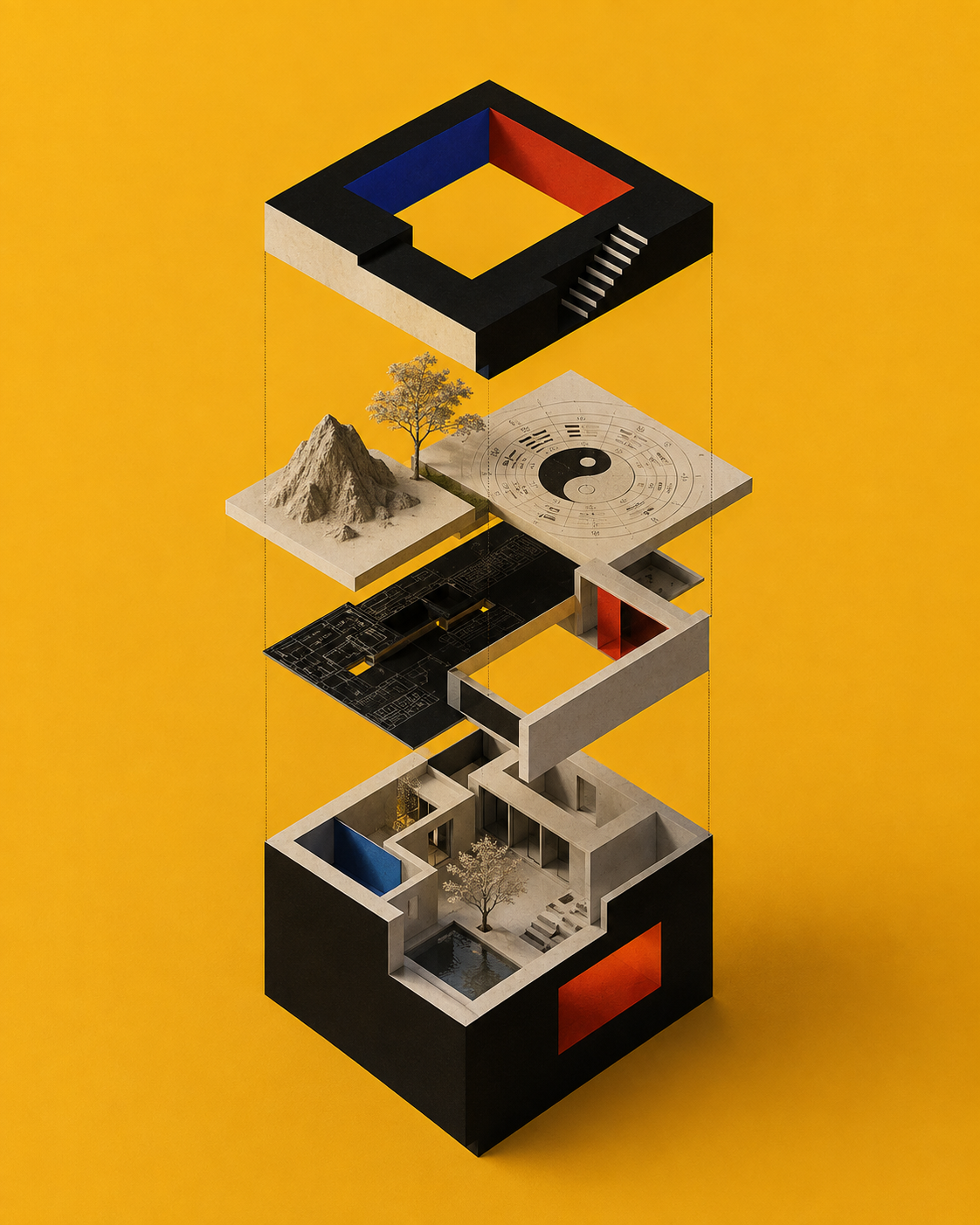
Feng shui combines practical environmental design with metaphysical superstition. While the Compass School relies on unproven astrological calculations, the Form School aligns with environmental psychology and bioclimatic design. Scientific research indicates that well-planned spatial layouts measurably reduce stress and support human physiological calm.
From a perspective grounded in Islamic principles, spatial arrangements do not control wealth or destiny. However, integrating valid design principles regarding order, light, and natural views fosters human well-being. Architects can utilize the practical spatial wisdom of the tradition while discarding its supernatural cosmological claims.
On the roof of one of the most sophisticated banking headquarters ever built, designed by one of the most rational architects of the modern age, sit two objects shaped like cannons. They are not weapons. They are maintenance cranes, but they were positioned, deliberately, to point at the sharp edged tower of a rival bank next door, because the rival’s angular form was believed to fire killing energy across the street. The building beneath them, the HSBC headquarters in Hong Kong by Norman Foster, is a monument to steel, prefabrication, and engineering logic, and its design integrated the advice of a feng shui master at nearly every turn, its atrium hollowed to let wind and energy flow, its escalators angled because spirits were said to travel only in straight lines, its plaza left open to the harbor because water is wealth. This is the puzzle worth sitting with before dismissing anything. Some of the coldest, most numerate institutions on earth, banks that price risk for a living, pay geomancers to arrange their buildings, and they do it in Hong Kong, in Singapore, in Kuala Lumpur, across the most economically dynamic region of the planet. A practice that a Western rationalist files under grandmother’s talk governs the skyline of global finance. Why?
I approach this question as a Muslim who reads and tries to understand rather than mock, and who holds two convictions that will shape everything that follows. The first is that no arrangement of furniture or orientation of a door has ever made a person wealthy. Wealth comes through effort and striving, and ultimately through the will and provision of God, and any claim that a compass reading can summon fortune is, from where I stand, a false belief, however ancient and however elegantly dressed. The second conviction is the one that keeps me from waving the whole tradition away, because when you order the world around you with care, you do in fact live better, think more clearly, and rest more deeply, and that improvement is real, measurable, and worth understanding. The task, then, is not to accept feng shui or reject it whole. It is to separate the part of it that is quietly good environmental design from the part that is cosmology and superstition, and to ask what an honest architecture of the spirit would keep and what it would leave behind.
Two Schools, Two Fates Under Scrutiny
Feng shui, literally wind and water, is not one thing, and the confusion between its parts is the source of most of the argument about it. Scholars divide it into two schools, and they do not survive scrutiny equally. The Form School reads physical landforms, mountains, watercourses, the shape of the land, and prescribes the famous armchair configuration, a site backed by higher ground to the north, opening to water in the south, sheltered by hills to the left and right. The Compass School relies on the luopan compass, the trigrams, birth years, and astrological calculation to assign auspicious directions to individuals. When researchers test these two against modern evidence, they diverge sharply. The Form School turns out to encode genuine environmental intelligence. The Compass School dissolves, under measurement, into cultural symbolism with no physical mechanism behind it. This single distinction does most of the work of an honest reading, and it is why lumping the whole practice together, as both its devotees and its scorners tend to do, produces only confusion.
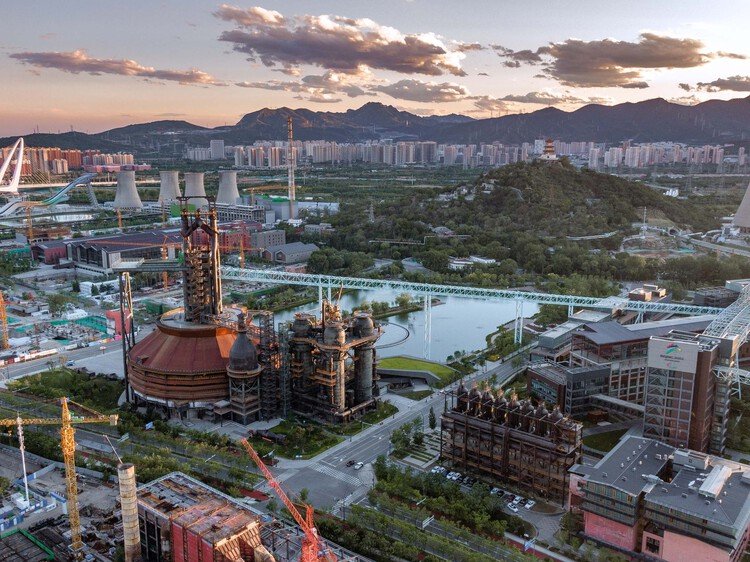
Consider what the Form School actually recommends and why it works. A site backed by high ground to the north and opening south is, in the northern hemisphere, a description of passive solar design written in mythological language. It maximizes winter sun, shelters against cold northern wind, secures drainage, and places water where a settlement needs it. Most of the great traditional Chinese cities conform to this model, and when Beijing’s natural landscape lacked the protective hill behind the Forbidden City, the Ming builders simply constructed one, the artificial Jingshan, to complete the diagram. The most telling evidence is a survey in which architects trained in Sydney and architects trained in Hong Kong were shown site configurations with no feng shui terminology attached, and overwhelmingly, nearly ninety percent of the Western trained and nearly all of the Eastern trained, preferred the classic armchair arrangement. That is not a cultural preference transmitted by tradition. That is a human preference, surfacing in people who had never studied the doctrine, which suggests the Form School captured something true about how our species reads a landscape for safety and comfort long before it dressed that truth in dragons and tigers. The architecture of the armchair site is not magic. It is bioclimatic common sense that happened to be discovered early and remembered in myth.
When the Doctrine Meets the Instrument
The interior principles tell the same story, that beneath a metaphysical vocabulary sits a layer of measurable environmental and psychological sense, wrapped around a core of pure symbolism. The most rigorous study to date placed subjects in virtual rooms designed with and without feng shui compliance and measured both their physiology, through heart rate variability, and their mood. The feng shui compliant rooms produced measurably better autonomic regulation and significantly lower mood disturbance. The people were calmer, and their bodies showed it. But look at which specific rules generated the effect, because this is where the honest separation happens. The highest ranked principle was avoiding sharp corners pointed at where a person sleeps, and environmental psychology has a straightforward explanation, that the human brain’s threat detection responds rapidly and unconsciously to pointed forms, so a blade of furniture aimed at the bed keeps the nervous system faintly alert all night. The principle that the head of the bed rest against a solid wall, with the door visible but not directly aligned, is a near perfect statement of prospect and refuge theory, the deep preference for a protected back and a clear view of the entrance, a preference inherited from every ancestor who needed to see a threat coming while sleeping against something solid.
These are not superstitions. They are observations about the human animal that feng shui recorded accurately and then explained incorrectly, attributing to the flow of qi what actually belongs to the amygdala, the circadian system, and the physics of airflow. The prohibition on aligning doors and windows in a straight line, framed as preventing energy from leaking through, is in building terms the avoidance of an uncomfortable draft and the protection of visual privacy. The preference for calm meandering water over fast straight channels, framed as gathering fortune, is in ecological terms sound stormwater and erosion management, and in psychological terms the well documented restorative power of calm water, which research on biophilic design has repeatedly confirmed reduces stress more than almost any other natural view. The recommendation of natural materials, daylight, and views of nature is simply biophilia, our evolved affinity for the living world, which the construction of healthy buildings now pursues deliberately under a modern name. Strip away the cosmology, and a large part of feng shui is revealed as a pre scientific field guide to environmental comfort, remarkably accurate in its observations and entirely mistaken in its explanations.
And then there is the part that does not survive, and honesty requires naming it as clearly as the part that does. Qi, as a universal life force that a compass can measure and a mirror can deflect and that carries wealth into a household, has never been detected by any instrument, and the claim that a direction assigned by your birth year determines your fortune has no basis beyond cosmological tradition. The number four being unlucky because it sounds like the word for death is linguistic superstition. The belief that a mirror facing the bed disturbs the soul is symbolism, though it happens to overlap with a real and minor effect, that catching your own movement in a dark room can startle you awake. The projects in Hong Kong that added rooftop pools to extinguish the fire energy of a candle shaped tower, or aimed crane cannons at a rival’s edges, were not managing any physical force. They were performing a culture, and the misfortunes later blamed on bad feng shui, a governor’s death, a market downturn, were the ordinary accidents of life read backward through belief. From my standpoint this is precisely where the practice crosses from wisdom into something a Muslim cannot follow, because it assigns to objects and directions a power over destiny that belongs to God alone, and no amount of measured calm in a well arranged room changes that judgment about the metaphysical claim.
What the Muslim Builder Keeps
So where does this leave the believer who is also a serious student of building? It leaves me, I think, with a clarifying inheritance, and with the outline of a different idea that I would call an architecture of the spirit, built on purity and cleanliness rather than on luck and cosmic force. Islam already contains, at the center of its practice, a profound architecture of the environment, though we rarely name it that way. The command that the place of prayer be clean, the ablution that precedes worship, the emphasis on light and space and orientation, the orientation of every mosque and every prayer toward a single point, these are spatial disciplines concerned with purity, order, and the alignment of the body with something higher. The believer does not need qi to understand that a clean, ordered, light filled, well ventilated space lifts the soul and calms the heart, because the tradition already teaches that cleanliness is part of faith, and anyone who has felt the difference between praying in a disordered room and a pure one knows the effect in the body before the mind explains it.
This is the architecture of the spirit that I would set beside feng shui, taking the measurable wisdom and refusing the metaphysics. It keeps everything feng shui observed correctly, the calming effect of order, the comfort of a protected back and an open view, the restoration of daylight and water and natural material, the quiet stress of clutter and sharp edges and bad air, because these are true observations about the human being God created, available to anyone regardless of creed. And it discards everything feng shui explained falsely, the flow of fortune, the luck of directions, the power of arrangement over destiny, because provision comes from striving and from God, never from a compass. A well ordered home does not make you rich. But it makes you calmer, clearer, and more able to do the work through which, by God’s will, provision actually arrives, and that is a real and sufficient reason to arrange your space with care, needing no cosmology to justify it.
There is a reason the cities of Asia kept this practice alive while the West mostly discarded such traditions, and it is not that Asians are more credulous. It is that feng shui, whatever its errors, preserved a habit the modern world abandoned, the habit of treating the arrangement of space as something that matters to human wellbeing rather than as a neutral container for activity. The news treats the banker’s geomancer as an exotic curiosity, and the design competition rewards the striking form over the calming one, but the deeper current, that space acts on the body and the spirit, is one the evidence now fully supports and one that any tradition concerned with the inner life already knew. The honest architect, and certainly the honest sustainability argument, can learn from feng shui exactly what a Muslim can learn from it, which is that the observations were often right and the explanations were often wrong, and that separating the two is not disrespect but the beginning of real understanding. Serious architectural research has already done much of that separation, and the picture it draws is consistent, that the Form School anticipated bioclimatic design and prospect refuge preference while the Compass School remains cultural belief.
So the conclusion is not that feng shui is science, and not that it is mere superstition, but something more useful than either verdict. It is a three thousand year old record of accurate observations about how space affects the human being, bound together with a cosmology that claims those effects come from a force that does not exist. For the Muslim builder, the path is clear and it is neither adoption nor mockery. Take the wisdom, that order and light and cleanliness and a protected calm genuinely nourish the person, and leave the idol, the belief that any arrangement of the world can command the fortune that belongs to God alone. Build spaces of purity rather than spaces of luck. The bank hired a geomancer to summon wealth it would have earned or lost regardless, but the quiet calm of its ordered atrium was real, and the lesson is that we were always free to keep the calm and let go of the superstition, to build for the spirit without ever bowing to the compass.
✦ ArchUp Editorial Insight
The HSBC rooftop cranes are the most structurally honest detail in this article, not because they reveal the irrationality of a global bank but because they reveal the precise mechanism by which spatial belief systems acquire institutional legitimacy: the same risk pricing apparatus that governs billion-dollar lending decisions operates, at the moment of building commissioning, within a cultural framework that assigns real causal weight to the orientation of a crane, and the bank’s willingness to pay for that orientation is not a departure from its financial logic but an extension of it — a hedge against reputational and social risk in a market where client confidence is partly constructed through the performance of shared spatial values. The article’s most analytically significant contribution is its separation of the Form School from the Compass School, because that separation dissolves the category error that governs most Western dismissal of feng shui: the Form School’s armchair site — backed hill, open south, sheltered flanks, water in view — is not a superstition that happens to produce good environmental outcomes; it is an accurate empirical observation about human landscape preference that was discovered early, encoded in cosmological language to ensure transmission across generations without an institutional science to carry it, and then gradually misread as metaphysics once the observational intelligence and the explanatory framework were no longer distinguished from each other. What connects this to what The Geography of Stigma identified — that perceived causal power in space is a real economic variable even when actual causal power is zero — is the underlying finding that the human relationship to spatial meaning operates independently of physical mechanism, and that a profession which understands only the mechanism while dismissing the meaning will consistently fail to account for the full range of forces that determine whether a building is inhabited with ease, with anxiety, or not at all.
Ibrahim Fawakherji — ArchUp
Sources
- Jin Z, Juan YK. Is Fengshui a science or superstition? A new approach combining the physiological and psychological measurement of indoor environments. Building and Environment, 2021, 201, 107992.
- Mak MY, Ng ST. The art and science of Feng Shui: a study on architects’ perception. Building and Environment, 2005, 40(3), 427 to 434.
- Yoon HK. Chinese geomancy and traditional urban design. Journal of Urban Design, 2017, 22(6), 743 to 757.
- Berta M, Bell S. Harmonious spaces: the influence of Feng Shui on urban form and design. Journal of Urban Design, 2017, 22(6), 709 to 725.
- The comparative study of ancient Chinese architecture and design psychology of Feng Shui. Applied Mechanics and Materials, 2012, 174 to 177, 1888 to 1891.
- Fusion study on architecture Feng Shui theory and ecological architecture of Edong ancestral hall. Advanced Materials Research, 2013, 671 to 674, 2198 to 2202.
- Modern environmental design of Feng Shui culture ecological analysis. Applied Mechanics and Materials, 2013, 361 to 363, 519 to 523.
- The influence and application of Feng Shui in the design of interior doors and windows. Applied Mechanics and Materials, 2013, 357 to 360, 209 to 212.
- Gillis K, Gatersleben B. A review of psychological literature on the health and wellbeing benefits of biophilic design. Buildings, 2015, 5(3), 948 to 963.
- Joye Y. Architectural lessons from environmental psychology: the case of biophilic architecture. Review of General Psychology, 2007, 11(4), 305 to 328.
- Dosen AS, Ostwald MJ. Evidence for prospect refuge theory: a meta analysis of the findings of environmental preference research. City, Territory and Architecture, 2016, 3, 4.
- Stamps AE. Interior prospect and refuge. Perceptual and Motor Skills, 2006, 103(3), 643 to 653.