Fuselage-Inspired Luxury Retail Lands at London’s Heathrow Terminal 2

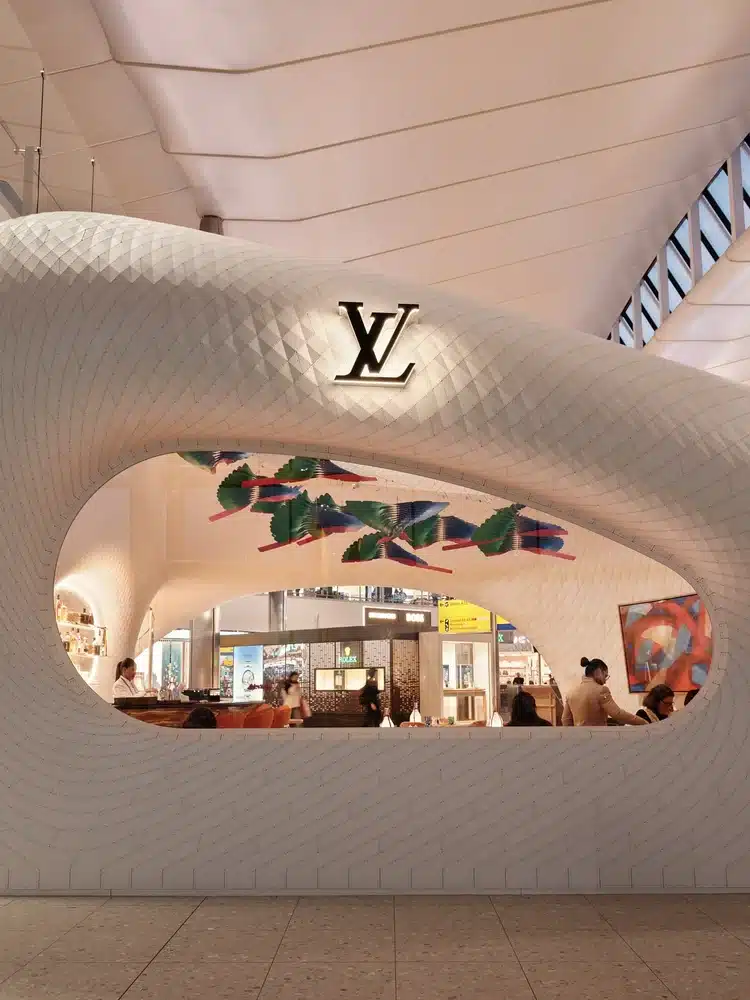
A striking retail installation has transformed the passenger experience at London’s Heathrow Terminal 2. The structure merges boutique shopping with fine dining through a continuous aerodynamic envelope that challenges conventional architectural design.
Aviation Aesthetics Meet Retail Innovation
The project introduces a fuselage-inspired structure that appears to have momentarily landed within the bustling terminal environment. This design philosophy creates a seamless loop integrating retail and hospitality spaces into a single cohesive form.
The facade emerges from the terminal floor as a vertical plane. Subsequently, it unfolds in waves of light and curvature. Therefore, passengers encounter an envelope of living crests that dissolve boundaries between commercial threshold and circulation space.
Structural Skin Replaces Traditional Framework
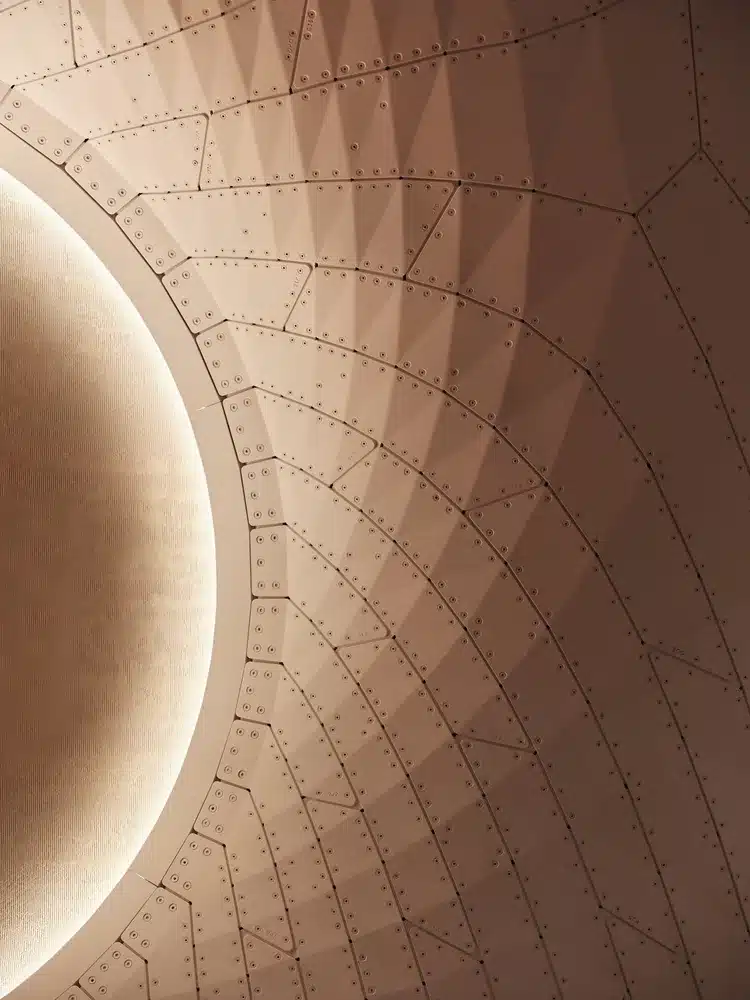
The installation comprises thousands of individually curved aluminum panels. Moreover, these components reference aviation construction techniques through visible rivet assembly. The exterior surface shimmers with precision-perforated patterns reminiscent of textile weaves.
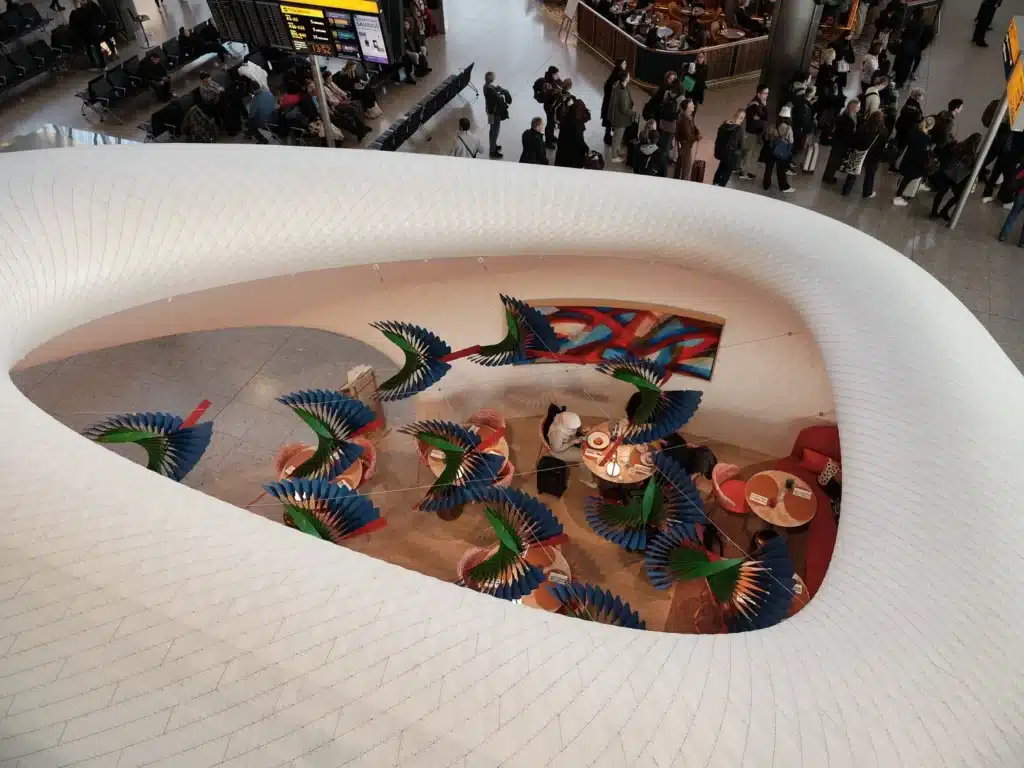
However, the most radical aspect involves eliminating conventional beams and columns entirely. Instead, the ultra-thin aluminum skin functions as a self-supporting structural system. Additionally, the envelope anchors at its crown through a circular oculus serving as a compression ring.
The structure demonstrates three defining characteristics. First, non-linear geometry suggests aerodynamic movement and fluidity. Second, doors and windows integrate so seamlessly their outlines dissolve into the larger surface. Third, the interior provides spatial pause contrasting with the terminal’s high-velocity passenger flow.
Digital Fabrication Enables Complex Curvature
Achieving dimensional accuracy required advanced digital tools. Consequently, the team employed photorealistic digital twins to verify physical dimensions before site work commenced. Meanwhile, 3D modeling identified structural issues prior to execution.
The envelope incorporates a calibrated layered system. Therefore, space between inner and outer skins functions as a large air plenum. This breathability serves both spatial and technical performance requirements within the challenging airport environment.
Interior Refinement Balances Technical Expression
Inside, warm tones and rust-colored banquettes contrast with the technical exterior. Furthermore, the filigree ceiling incorporates geometric floral monogram patterns referencing brand heritage. This interior design strategy creates refuge within the terminal’s infrastructure.
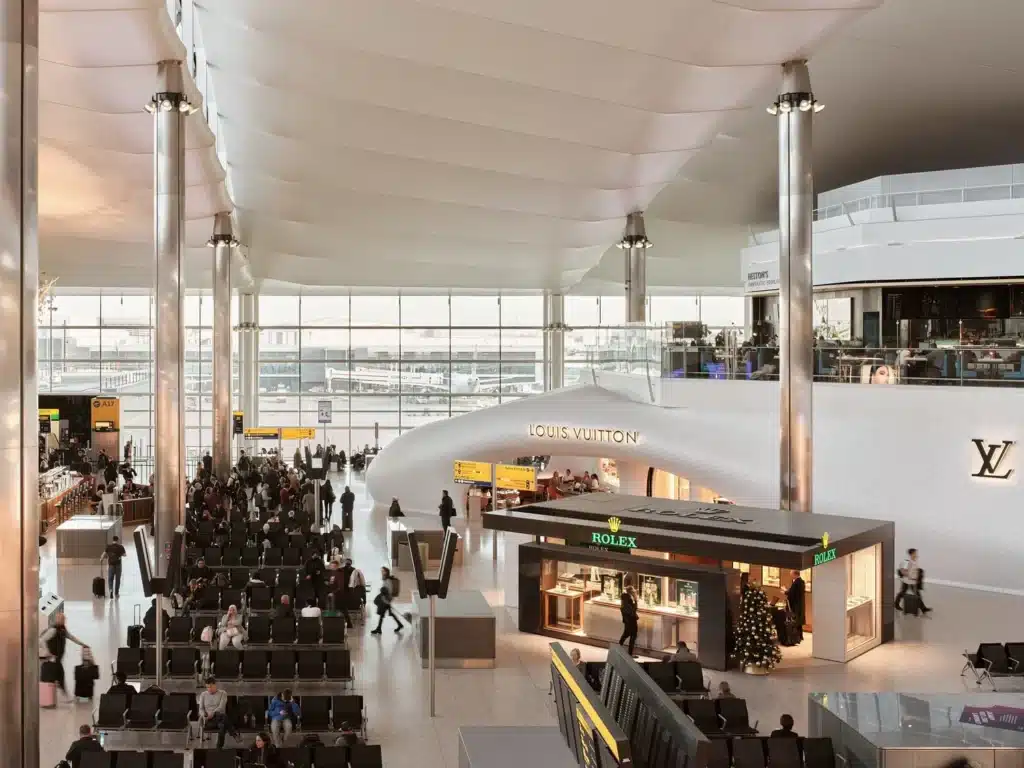
The project represents synthesis between structural ingenuity and brand identity. Moreover, it redefines luxury retail architecture within modern aviation infrastructure.
Does fuselage-inspired architecture signal a broader shift in airport commercial design? Share your perspective on how aviation aesthetics might influence future retail structures.
A Quick Architectural Snapshot
Located at Heathrow Terminal 2 in London, this self-supporting structure eliminates traditional columns through digitally fabricated aluminum skin technology. Thousands of curved panels with visible rivets create an aerodynamic envelope. The circular crown oculus provides structural stabilization. Interior spaces feature geometric ceiling patterns and warm material palettes contrasting technical exterior expression.
✦ ArchUp Editorial Insight
Airport retail architecture follows a predictable sequence. Duty-free revenue models demand maximum passenger dwell time. Terminal operators monetize every square meter of post-security space. Luxury brands compete for spatial dominance within captive consumer corridors. Consequently, architectural expression becomes a differentiation tool in an environment where location is non-negotiable and audience is guaranteed.
The decision to deploy structurally self-supporting skin systems reflects a deeper constraint. Airport terminals restrict column placement and floor loading. Traditional construction timelines conflict with operational continuity requirements. Digital fabrication emerges not from aesthetic ambition but from logistical necessity within active infrastructure.
The pattern repeats globally. Luxury installations in transit zones prioritize visual complexity to justify price premiums in spaces where consumer choice is artificially limited. The architectural outcome, a fuselage metaphor inside an actual aviation facility, is the logical product of brand positioning pressure, terminal leasing economics, and fabrication technologies optimized for constrained construction windows.