David Hockney and the Representation of Architectural Space

British artist David Hockney utilized the rigorous geometries of mid-century modern architecture to define the spatial logic of his most famous works. After moving to California in the 1960s, Hockney adopted the formal language of modernist pavilions, characterized by horizontal planes, extensive glazing, and the integration of interior and exterior environments. His paintings function as architectural documents that capture the stillness of built forms against the fluidity of light and water.
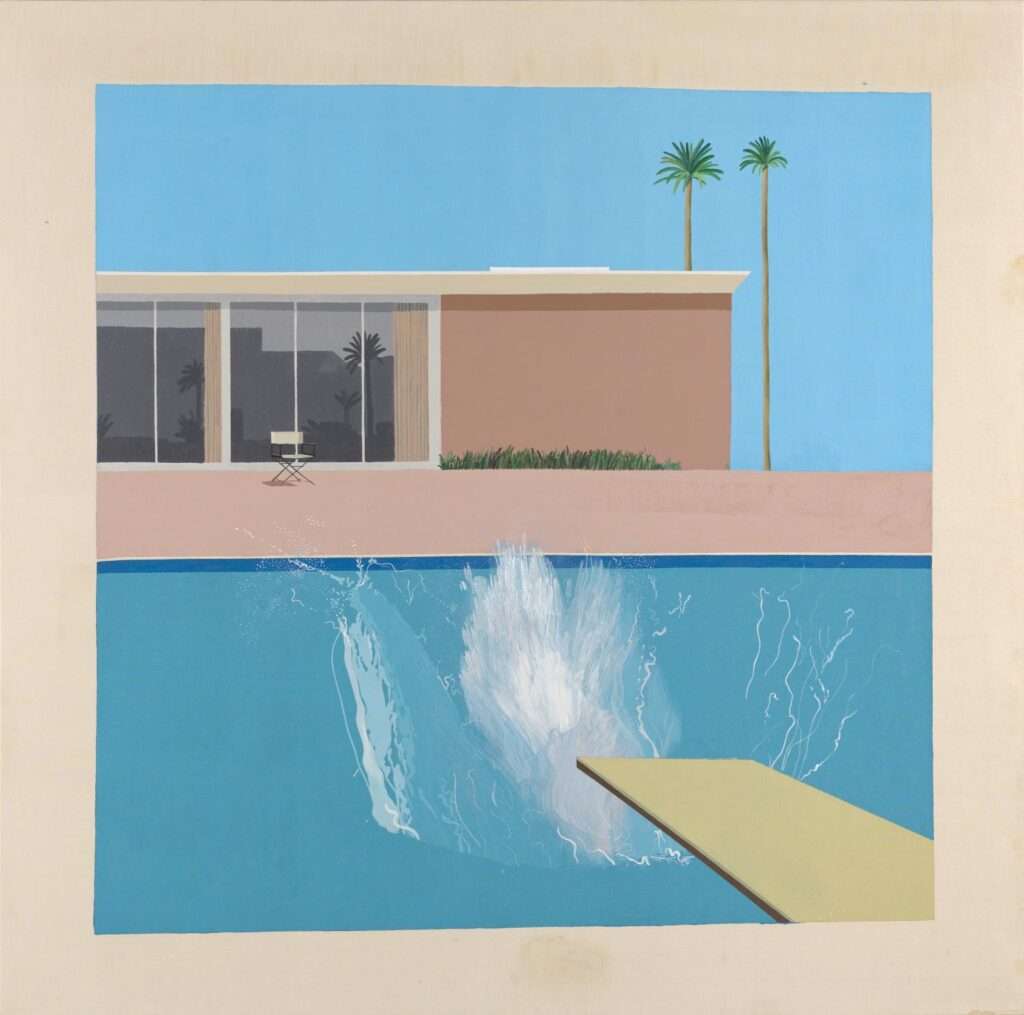
The 1967 painting A Bigger Splash highlights the precision of Euclidean geometry within a residential setting. The composition features a flat-roofed pavilion and sliding glass doors that establish a rigid grid of vertical and horizontal lines. This architectural stillness contrasts sharply with the chaotic movement of the water. The built environment serves as a silent, permanent witness to a transient human event, emphasizing the static nature of modernist design.
In Beverly Hills Housewife (1966), Hockney explored the concept of transparency through a full-height glass facade. This architectural boundary functions less as a barrier and more as a visual extension of the living space. By positioning the subject on a tiled terrace framed by slender metal columns, the artist blurred the distinction between the enclosed room and the outdoor patio. The resulting spatial condition creates the illusion of an open-air living room, reflecting the core tenets of Californian modernism.
Light and openings as spatial organizers
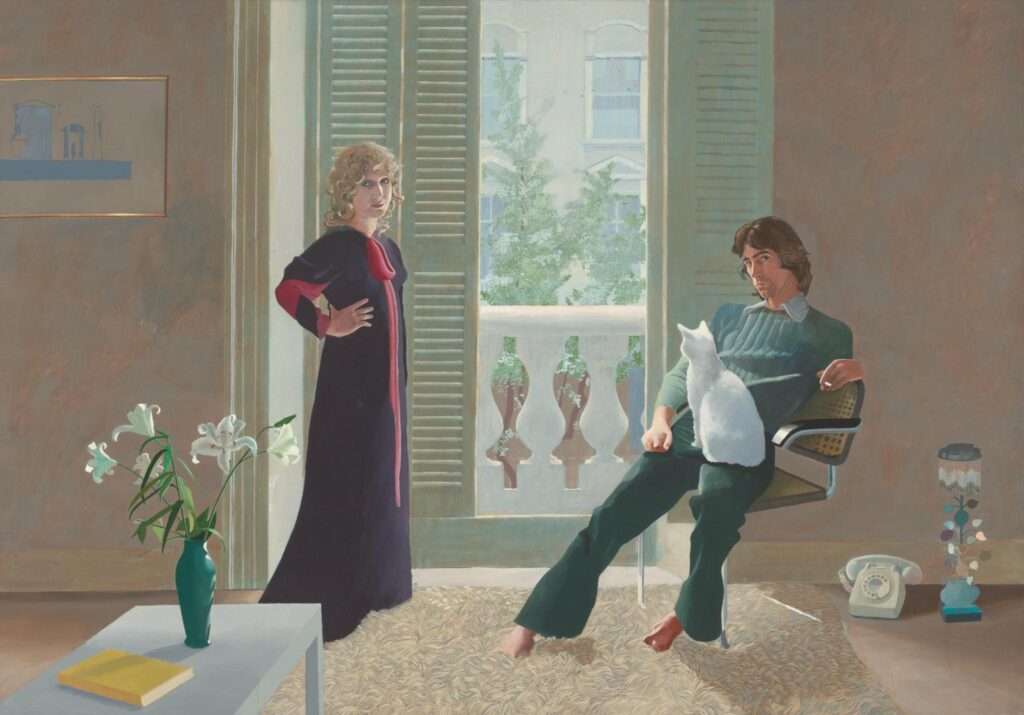
The interior logic of Mr and Mrs Clark and Percy (1970–1971) relies on the technique of contre-jour lighting. Here, the architectural opening—represented by open French doors with metal louvers—acts as the primary light source and spatial organizer. This aperture divides the room into distinct zones of illumination and shadow. Hockney used the minimalist interior and vacant wall surfaces to illustrate psychological distance, where the physical void between the figures mirrors their emotional state.
In Portrait of an Artist (Pool with Two Figures), the swimming pool functions as a transparent architectural volume. The sharp, curving edge of the pool creates a deep perspective that directs the viewer toward the distant mountain range. This technical strategy links the precise geometry of the built pool with the irregular forms of the natural landscape. The pool becomes a structured intervention that mediates between human engineering and the organic environment.
Reverse perspective and the deconstruction of interiors
Hockney challenged traditional architectural representation in Large Interior, Los Angeles (1988) by employing reverse perspective. Rather than following the single-point perspective established during the Renaissance, the lines in this painting expand toward the viewer. This technique deconstructs the interior volume, creating a dynamic sense of movement within the room. This shift in perspective transforms the viewer from a passive observer into an active participant within the spatial field.
The architectural elements in these works—pools, windows, and structural columns—transcend their functional roles to become psychological and environmental frames. Hockney demonstrated that space consists of more than physical dimensions; it integrates color, light, and human interaction. His focus on natural light and the relationship between individuals and material surfaces continues to offer insights into the design of vibrant, light-filled environments.
Project Team: David Hockney (Artist). Location: California and London.
Project Notes: This analysis covers key works from 1966 to 1988 focusing on mid-century modern architectural influences and spatial deconstruction.
✦ ArchUp Editorial Insight
Hockney treats mid-century modernism not as mere scenery, but as a rigorous spatial instrument to investigate the boundary between human experience and the built environment. By deconstructing architecture into planar grids and volumetric voids, he captures the precise tension between the static permanence of residential pavilions and the transient nature of light and shadow, effectively documenting the psychological weight of modernist transparency and geometry.
However, this reading risks romanticizing a specific, exclusionary suburban aesthetic as a universal spatial truth. While Hockney’s reverse perspective attempts to democratize the viewer’s position, his subjects remain encased in the high-maintenance artifice of the Californian landscape. This artistic design overlooks the carbon-heavy reality of the private pool and glazed enclosure, sanitizing the ecological costs of the mid-century sprawl into a series of frictionless, aestheticized planes.