How AI and BIM 2.0 Are Shaping the Future of Architecture: A Journey from Digital Drafting to Intelligent Partnership

The Beginning: The Digital Turning Point in an Architect’s Life
The first moment an architect engages with software has always been a pivotal point in their career. It is not merely a technical step of learning a new tool, but a launch into a vast digital world where abstract ideas and initial sketches transform into living, scalable digital entities. This journey, which begins in lecture halls, continues throughout a professional lifetime, laden with endless possibilities. Today, we stand on the brink of another radical transformation, perhaps the most significant yet, where advanced Artificial Intelligence (AI) technologies converge with the evolution of Building Information Modeling (BIM) 2.0 to fundamentally reshape the architectural design experience. The question is no longer if these technologies will change the architectural landscape, but how they will do so, and what profound implications they will have on the role of the architect themselves.
The Rise of the Integrated Ecosystem: The End of the Isolated Software Era
No More Room for Standalone Tools
In an age of increasing design complexity, a single software can no longer meet all project requirements or contain every detail of the workflow. Integrated software “ecosystems” have become the strategic solution and an urgent necessity. Today, architects navigate between AI-specific platforms, tackle interoperability challenges between programs, and rely on cloud-based collaboration platforms.
Graphisoft: An Integrated Vision for a Unified Design Experience
At the IGNITE conference in Budapest, Graphisoft’s vision came into clear focus, emphasizing the importance of integrated tools that foster creativity and collaboration. This goal is embodied in the release of Archicad 29, which represents the cornerstone of the company’s “Design Intelligence” strategy. This strategy aims not only to streamline processes but to empower architects and their teams to focus on the core of the work: exploring ideas and developing complex architectural solutions. As Márton Kiss, Chief Product Officer, stated, “Archicad 29 is the cornerstone of our Design Intelligence strategy, and the backbone of the next generation of AI-powered workflow and superior user experience.”
Multidisciplinary Collaboration: MEP Designer and DDScad as a Model
This new generation of software includes tools that facilitate collaboration like never before. The MEP Designer tool allows for seamless coordination with mechanical, electrical, and plumbing (MEP) engineers, ensuring a more stable workflow and preventing clashes. In parallel, DDScad 21 integrates within this ecosystem, enabling architects and MEP professionals to handle their designs with high precision and align every component with industry standards, from planning electrical systems to configuring fire safety networks.
The AI Revolution: From Tool to Intelligent Design Assistant
Liberating Creativity: AI’s Role as a Partner, Not a Replacement
Discussions within the architectural community have moved beyond the primitive question of whether AI will replace architects. The focus is now entirely on “empowerment.” János Detre, Product Management Director, emphasizes this: “We aim to enhance the capabilities of architects.” The role of AI is that of an intelligent assistant that improves workflow and frees the architect from routine burdens, allowing them to dedicate their mental energy to creativity and solving complex problems.
How Does the Architect Interact with the Intelligent Assistant?
This interaction happens through intuitive interfaces like smart prompts, model-based queries, and expert guidance, all without the need to switch tools or disrupt the workflow. The “AI Assistant” integrates directly with the AI Visualizer 2.0, allowing the architect to generate realistic, model-based visualizations from simple text instructions, adjust styles, compare before-and-after states, and even edit specific areas with high precision.

BIM 2.0 and Foresight: The Future of Early-Stage Design and Data
Project Aurora: The Next-Generation Platform for Cloud-Based Design
In response to the evolution of BIM 2.0, “Project Aurora” emerges as a native cloud platform designed to support the design process from the very moment an idea is born. This platform represents a qualitative leap in design philosophy, where the digital model no longer starts from scratch, but from the context itself. It integrates intuitive modeling tools with AI-assisted thinking, site context, and construction and environmental data directly into the fabric of the design.
Data in the Design Phase: From Luxury to Necessity
János Detre stresses this point: “Analytics and data should be used in the early stages of design; their use is almost natural and a given.” Predictive performance and sustainability analytics embedded in such platforms enhance decision-making, proactively guiding projects toward increased efficiency and a reduced environmental footprint. These are tools that shape not only structures but also the very “way of thinking” in architecture.
Practical Proof: Case Studies from the Field
Learning from Projects: How Collaboration and Creativity Reimagine Design
A key takeaway from the IGNITE conference was the focus on practical application. Renowned architecture firms like Delugan Meissl Associated Architects, LINK Arkitektur, and 3LHD presented case studies demonstrating how interoperability between Graphisoft’s tools served as the bridge connecting ambitious architectural ideas with their real-world execution.
The Expo Cultural Park Greenhouse in Shanghai: From Warehouse to Net-Zero Energy Building
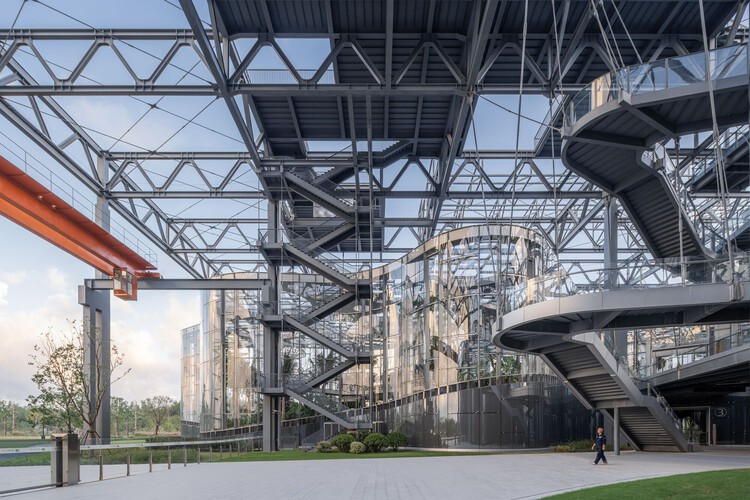
This massive project (47,000 square meters) is a living example of how advanced BIM strategies can enhance collaboration and reduce digital complexity. By reimagining a former industrial warehouse, the design transforms the space into a dynamic public environment, integrating organic glass forms with a complex steel structure. Crucially, the greenhouse operates as a net-zero energy building, an achievement accomplished through the use of customized glass to reduce heat loss and minimize reliance on artificial lighting.
MJE House in Brazil: Translating a 2D Vision into a 3D Reality
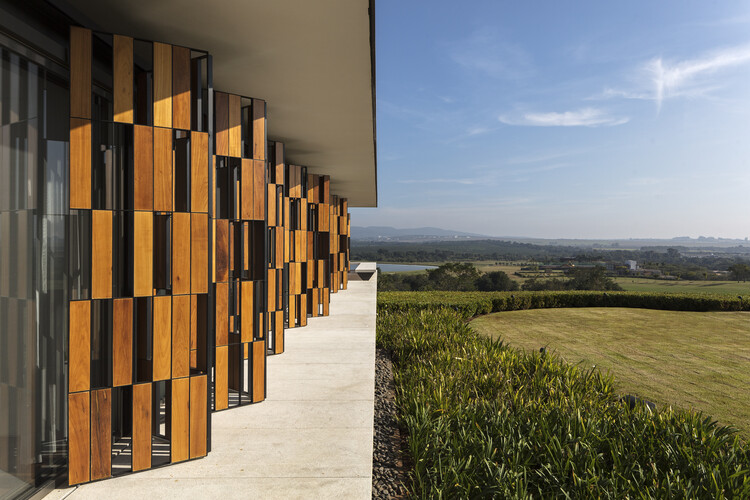
On a completely different scale, this luxurious residential project demonstrates how software can be a tool for translating a precise two-dimensional architectural language into a rich and sensitive three-dimensional model. The tools enabled the team to explore volumes naturally while maintaining the precision required for sunlight and visibility studies, allowing the project to connect visually with the adjacent lake while preserving the original design purity.
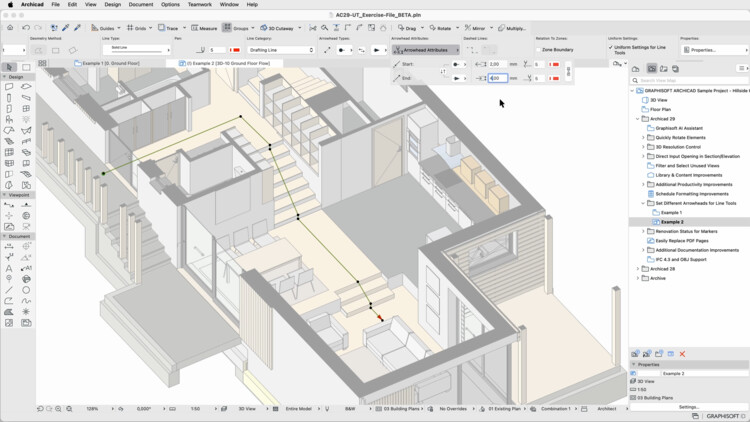
Archicad 29 is the cornerstone of our design intelligence strategy, the backbone of next-generation AI-powered workflows and superior user experiences. – Marton Kiss, Chief Product Officer, Graphisoft
Conclusion: The Future of Architecture in the Age of Digital Integration
Not Just Faster Tools, But a New Methodology for Thinking
As Daniel Csillag, CEO of Graphisoft, summarized: “This year’s conference is not just about technology, it is about collaboration, creativity, and reimagining what is possible in design.” The conclusion is that the future of architecture is no longer about simply learning a faster new software tool. The future is about understanding an integrated working philosophy where technology becomes an invisible partner in the creative process.
The convergence of BIM 2.0 and AI offers not just faster tools, but a new methodology for thinking. It expands the boundaries of creativity, makes collaboration between different disciplines natural and seamless, and integrates environmental and sustainability considerations into the design sensibility from the very first moment, not merely as an afterthought. The future we envision is one of smarter, more sustainable, and, at its core, more human-centered design.
✦Archup Editorial insight
The article examines the qualitative shift in architectural practice through the integration of AI and BIM 2.0, promising a restructuring of the design workflow. This trend raises questions about the centrality of the digital model in the creative process, as over-reliance on predictive AI solutions and predefined data could standardize design outputs and diminish the space for improvisation and personal architectural intuition. Furthermore, integrating these complex technologies within a unified software ecosystem creates a potential issue of vendor lock-in for the user, which may limit flexibility of choice and impact data privacy. However, the organic integration of environmental analysis tools in the earliest design stages provides an objective framework for measuring a project’s sustainability performance from its inception
Brought to you by the ArchUp Editorial Team
Inspiration starts here. Dive deeper into Architecture, Interior Design, Research, Cities, Design, and cutting-edge Projectson ArchUp.