How Medical Gold Nanoparticles Could Redefine Smart Facades

Historically, the use of gold in architecture has been associated with visual luxury, religious symbolism, and authority through gilded domes and ornaments. However, as nanomedicine advances the use of gold nanoparticles (AuNPs) for targeted tumor therapy and bioimaging, an extraordinary opportunity arises to project these unique physical and chemical properties onto building materials science.
By upcycling “gold waste”—such as filings from goldsmith workshops, residual factory dust, and extractions from dilapidated classical finishes—gold can be transformed from an expensive decorative element into smart nano-coatings that enhance energy efficiency, control solar radiation, and provide sustainable radiation shields for healthcare and technological facilities.
Architectural Chemistry: From the Medical Micro-Scale to the Building Envelope
Advanced medical research demonstrates that gold nanoparticles possess unique properties in their exceptional response to light, heat, and radiation. In medicine, these properties are utilized to target cancer cells with unparalleled precision. However, when these principles are transferred to the architectural macro-scale, and by recycling industrial gold dust and its byproducts, we face a new generation of “Adaptive Building Materials” that interact with the surrounding environment with unprecedented efficiency.
1. The Photothermal Effect: Passive Heating Facades
The Medical Foundation: Photothermal therapy (PTT) relies on the ability of gold nanoparticles to absorb near-infrared (NIR) light and convert it rapidly (within picoseconds) into localized heat to destroy tumors [3,5].
The Architectural Projection: Upcycled and nano-processed gold powder can be integrated into the exterior facade coatings of buildings in cold climates. These facades act as microscopic thermal collectors; they absorb NIR radiation from sunlight and convert it into thermal energy that slowly radiates into the architectural space. This conversion creates a highly efficient “Passive Heating” system that radically reduces reliance on mechanical heating systems (HVAC) and overall energy consumption.
2. Localized Surface Plasmon Resonance (LSPR): Smart Glass and Spectral Selectivity
The Medical Foundation: Light induces electron oscillation on the surface of gold nanoparticles (LSPR), causing them to scatter light immensely—a property utilized in dark-field microscopy. Crucially, the resonance wavelength shifts based on the particle’s size and shape [5,6].
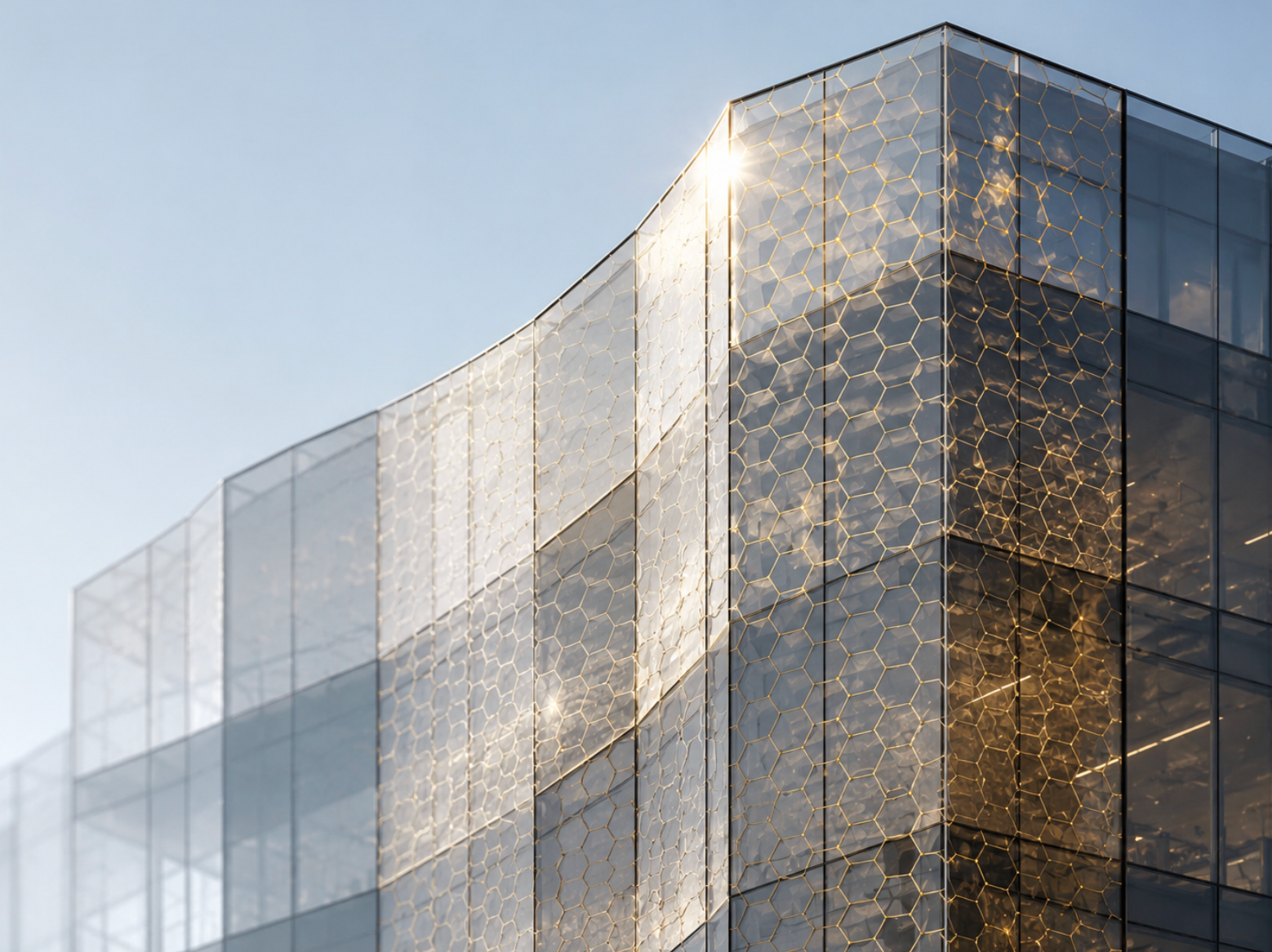
The Architectural Projection: Instead of relying on double-glazing or traditional low-emissivity (Low-E) silver coatings, gold nanoparticles can be injected into the interlayers of architectural glass. Thanks to plasmonic resonance control, windows can be engineered to be “spectrally selective.” They allow full natural visible light to pass through (maximizing daylighting) while scattering and reflecting heat waves (infrared) and ultraviolet rays. This creates completely transparent glass facades that prevent solar heat gain from entering the interior space.
3. Radiotherapy Enhancement: Lead Alternatives in Healthcare Architecture
The Medical Foundation: Gold has a high atomic number (Z=79) and high electron density, making it highly absorptive of X-rays, which enhances targeted radiotherapy in oncology [2,4].
The Architectural Projection: Hospital architecture currently relies heavily on lead plates—a toxic, heavy, and unsustainable material—to line the walls of X-ray and radiology rooms. Factory-extracted gold dust and filings can be mixed into concrete matrices or gypsum boards to create eco-friendly “Radiation Shielding.” Furthermore, these gold-infused panels can be utilized in Data Centers to block electromagnetic interference and protect sensitive servers.
4. Photodynamic Therapy (PDT): Self-Cleaning and Air-Purifying Surfaces
The Medical Foundation: Gold enhances the production of reactive oxygen species (ROS) when exposed to light, contributing to the chemical destruction of malignant cells [1,8].
The Architectural Projection: When gold nanoparticles are combined with materials like titanium dioxide (TiO2) in building coatings, the facade transforms into a giant photocatalyst. These surfaces react with sunlight and urban smog to break down organic pollutants and vehicle emissions (nitrogen oxides). The facade effectively becomes an urban “lung” that purifies the surrounding air while simultaneously self-cleaning dirt from its own surface.
The Economics of Dust: From Ornamental Waste to Performance Assets
The primary barrier to utilizing gold architecturally is cost. But here lies the innovative solution: Circular Extraction. This proposal relies on exploiting industrial waste considered to have no structural value, such as scattered filings in goldsmith workshops, polishing powder, accumulated dust in jewelry factories, and even extractions from e-waste and dilapidated classical finishes.
Milling this industrial “waste” and chemically processing it into nanoparticles (no larger than 50 nanometers) consumes minute amounts of raw material to cover vast architectural surfaces. This transforms the concept from a theoretical fantasy into a pioneering, practical model in the Circular Economy.
✦ ArchUp Editorial Insight
The transition of gold from the surface of ornamentation to the depth of performance represents a profound philosophical shift in our understanding of “precious materials” in architecture. For centuries, architects used gold to produce an exclusive visual effect; a shiny veneer indicating wealth, divinity, or authority, yet performing absolutely no climatic or structural function. What this transdisciplinary projection proposes—from nanomedicine to building physics—is a radical redefinition of material value. By stripping gold of its visible macro-scale and transforming its waste and filings into nanoparticles, gold loses its classic visual luster but gains immense performative value. A facade no longer needs to “look” gold to be precious; it becomes precious because, thanks to the gold dust hidden within its molecular structure, it insulates heat, blocks harmful radiation, and purifies city air. This is the true meaning of deep sustainability: when the discarded waste of luxury transforms into the technology of absolute necessity.
References (Architectural projections based on the following medical research):
- Huang, X.; El-Sayed, M. A. Gold nanoparticles: Optical properties and implementations in cancer diagnosis and photothermal therapy. Journal of Advanced Research 2010, 1(1), 13–28. (Referenced for Photothermal absorption and Plasmonic Resonance).
- Fernandes, D. A. Multifunctional gold nanoparticles for cancer theranostics. 3 Biotech 2024, 14(11). (Referenced for Radiation Shielding and X-ray absorption).
- Yao, C.; et al. Gold nanoparticle mediated phototherapy for cancer. Journal of Nanomaterials 2016. (Referenced for Photodynamic therapy and Reactive Oxygen generation).
- Kim, D.; Jon, S. Gold nanoparticles in image-guided cancer therapy. Inorganica Chimica Acta 2012, 393, 154–164.