Architecture in the Prophetic Tradition: When Space Entered the Text

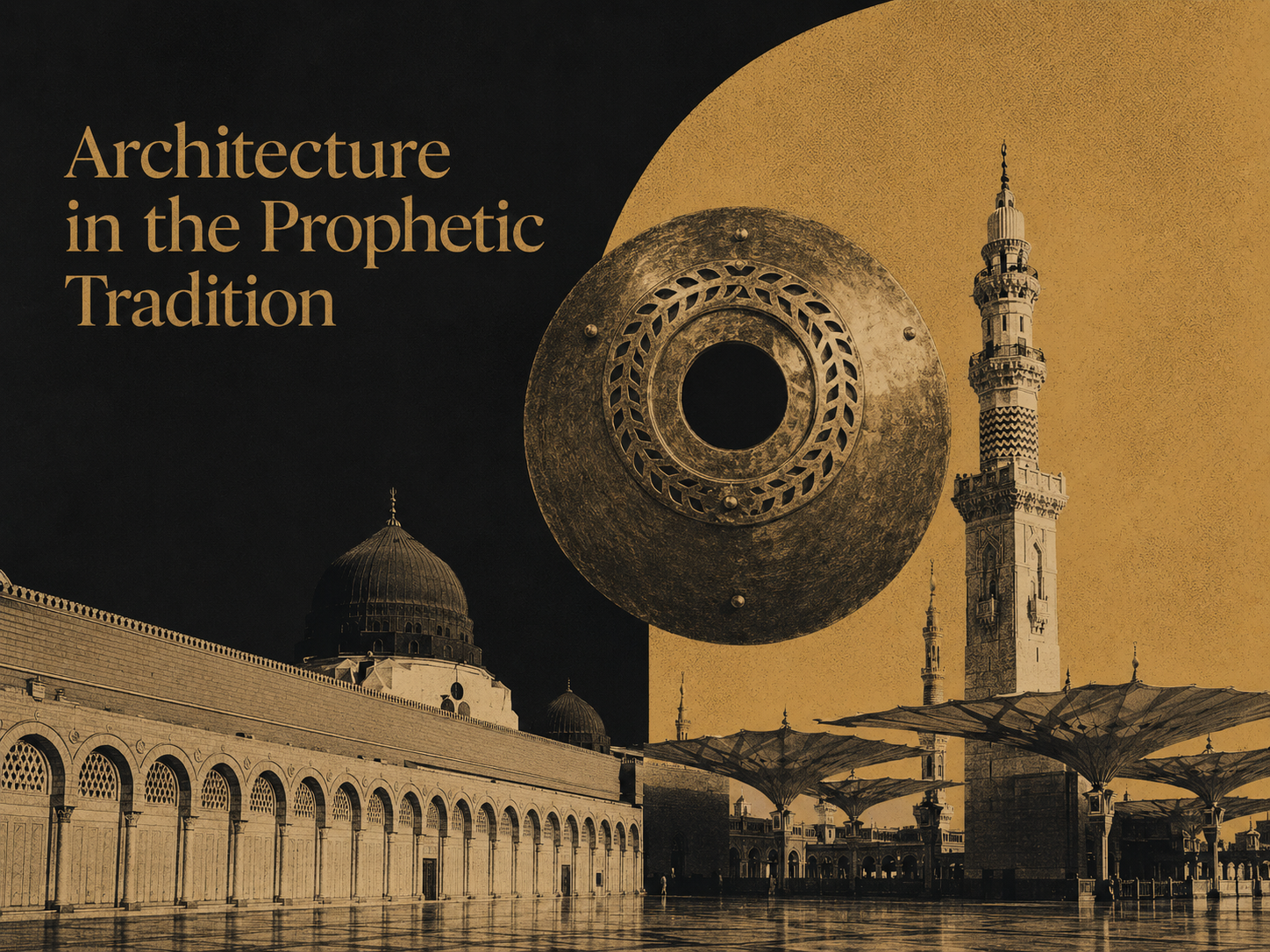
When the conversation turns to Islamic architecture, the mind moves immediately toward the visible: domes and minarets, geometric ornament, the calligraphic inscription carved into stone. These are the images that travel, the ones that appear in surveys and textbooks and the photography of tourists standing in courtyard light. They are real achievements, and they deserve the attention they receive.
But they are not the beginning.
The beginning happened before any of those forms existed. Before the pointed arch was refined and the muqarnas was developed and the courtyard house became a regional typology stretching from Andalusia to Central Asia. The beginning happened when space entered the text. When the house appeared in the hadith. When the relationship between a human being and a room became part of the daily behavioral guidance of a society.
In most ancient civilizations, architecture was built first and philosophy arrived later to explain it. What happened in the early Islamic tradition was structurally different. The texts did not offer floor plans or building codes. They offered a set of behavioral principles that subsequently produced, across several centuries and an enormous geographic range, a coherent architectural culture. The principles came first. The forms followed.
The most instructive of these principles is also the simplest. The Prophet, peace be upon him, said: “Permission to enter was prescribed because of the gaze.”
On the surface this is a statement about manners. In its architectural implications it is something considerably more serious. If the permission to enter was legislated in order to protect the privacy of those inside, then the building itself carries the same obligation. The architecture must do what the ethical norm requires.
This is the logic that produced the bent entrance, one of the most consistent spatial devices in the traditional Islamic house. The visitor did not pass directly from the street into the domestic interior. A turn, a pause, an intermediate threshold interrupted the line of sight before it could reach the private spaces of the household. This was not a decorative decision. It was the translation of a social and ethical idea into built form. The space was being asked to do moral work.
The room, in this reading, was not a container for human activity. It was an instrument for protecting human dignity.
A second hadith establishes an equally consequential principle. When the companions said they had no alternative but to sit in the streets, the Prophet’s response was not to prohibit the practice but to define its obligations. He said the street had rights: lowering the gaze, removing harm, returning greetings, enjoining good, and forbidding wrong.
This is a fundamentally different conception of urban space from the one that has governed most modern city-making. The street, in this framework, is not a residual void between buildings. It is not infrastructure for the movement of vehicles. It is a social institution with its own ethical demands, inhabited by people who carry responsibilities toward one another simply by being present in it.
Centuries before the vocabulary of urban design produced terms like pedestrian priority and public realm and the right to the city, the street was being treated as a domain of mutual obligation. The traditional Islamic souk and the historic medina carry a particular human quality that is difficult to articulate in purely formal terms. Part of what produces that quality is this underlying assumption: that the people moving through the space have duties toward one another, and that the space itself was shaped by that assumption.
If there is one interior in the Islamic tradition that concentrates the question of how much meaning a room can hold, it is the chamber of Aisha, may God be pleased with her.
By any contemporary measure it was modest. It was not a hall of state. It was not a monument. It was a small domestic space attached to the mosque in Medina. And yet this room became one of the most charged sites in Islamic memory, not because of its dimensions or its materials or its formal qualities, but because of what occurred within it. The Prophet lived his final days there. He died there. He was buried there. Then Abu Bakr requested permission to be buried beside him. Then Umar made the same request.
The architectural question this raises is precise: how does a space of such physical modesty accumulate such historical weight?
The answer reveals something that architectural education tends to underemphasize. The value of a place does not derive primarily from its scale, its cost, or its decoration. It derives from the story it contains, from the people who inhabited it, from the meaning that accumulated within its walls across time. The chamber was small. The memory it carries is among the largest in fourteen centuries of Islamic civilization.
Size and significance are different categories. The profession regularly confuses them.
There is a passage in Islamic tradition involving Ibrahim and his son Ismail, peace be upon them both, in which Ibrahim visits and finds Ismail absent. He leaves a message with Ismail’s wife: tell him to change the threshold of his door.
The phrase was understood as a reference to his domestic situation. But the expression chosen was architectural. The threshold.
This was not an accidental selection of vocabulary. The threshold is among the most symbolically loaded elements in the history of built form across cultures. It is the boundary between inside and outside, between the private and the public, between the protected interior and the exposed world. Cultures that have thought carefully about dwelling have consistently treated the threshold as something more than a structural detail. It is a declaration: here is where one condition ends and another begins.
The fact that a message of such personal gravity was encoded in this architectural term suggests how deeply spatial thinking was embedded in the language and thought of the tradition.
The mosque in Medina, as it functioned in the early Islamic community, was not a building with a single purpose.
It was a school, a council chamber, a court, an administrative center, a place for receiving delegations, a space for social exchange, a site of learning. All of this within a single structure, organized around a courtyard open to the sky.
This multivalence was not accidental. It reflected a conception of the religious center as inseparable from the civic center, of the spiritual life of a community as continuous with its political and social life. The mosque was the first multi-institutional civic building in the early Islamic city, and its model influenced urban planning across the Islamic world for centuries. Cities organized themselves around this kind of center. The architectural hierarchy of the medina, with the mosque at its core and the residential fabric extending outward, was not an aesthetic preference. It was the physical expression of a set of values about what mattered most in the life of a community.
The Arabic word for house and the Arabic word for stillness share the same root. The word “sakan,” dwelling, carries within it the meaning of tranquility, of the cessation of agitation, of the settling of the restless self into a place of rest. The language was already treating the house as a form of remedy before it was treating it as a form of property.
This etymological fact points toward something the tradition understood that contemporary real estate culture largely does not: that a house is not primarily an asset. It is a relationship between a human being and a place. It is the specific location where a life becomes legible to itself.
The moving into a new house was a social event in early Islamic culture, acknowledged by the community, marked by blessings and well-wishes. The transition was understood as the beginning of a new chapter of a life, not the execution of a financial transaction. The building was important because the life inside it was important.
What the Prophetic tradition did not provide was a specific architectural style.
It did not specify how facades should be composed, what form windows should take, what rooflines were appropriate. The tradition was not interested in producing a visual vocabulary. What it produced instead was something architecturally more consequential: a complete ethical framework for the relationship between human beings and the spaces they inhabit.
From the principle of seeking permission came privacy, and from privacy came the spatial devices that protect it.
From the rights of the street came the obligations of public space, and from those obligations came a particular quality of urban life.
From the value of neighborliness came the relational logic of how buildings sit beside one another.
From the multivalent mosque came the organizing principle of the Islamic city.
From one small room in Medina came a memory that has outlasted every imperial capital of the era.
The Islamic architectural tradition did not begin with stone. It began with behavior. With a set of ideas about how human beings should treat one another, and how the spaces they build should support rather than undermine that treatment.
This is perhaps why so much of it has survived. What is built on values lasts longer than what is built on style alone. Styles change with taste and technology and the movements of capital. Values, when they are genuinely held, have a different relationship with time.
The forms we associate with Islamic architecture, the dome, the minaret, the courtyard, the geometric ornament, are the visible layer. They are what the cameras capture and the surveys catalog.
But the layer beneath them, the one that determined how the spaces would be used and what obligations they would carry and whose dignity they would protect, that layer was written before the first stone was cut.
It was written in the text.
✦ ArchUp Editorial Insight
The article explores design through the Prophetic tradition, framing architecture not as a monument to ego, but as an ethical, humble instrument serving community and spiritual alignment. It extracts principles of structural modesty, resource optimization, and social equity, arguing that contemporary design should abandon ostentatious display to reclaim human-scale, purpose-driven environments rooted in historical and spiritual mindfulness.
However, elevating early traditions into a rigid architectural dogma risks paralyzing contemporary urban evolution. What was an ethical response to localized, resource-scarce environments cannot easily scale to meet the staggering demands of modern cities. Conflating historical simplicity with a universal spatial mandate overlooks the necessity for complex, high-density infrastructure, potentially weaponizing nostalgia against the technological innovation required to sustain modern civilizations.