The New Arts Annex: Mass and Complex Urban Context

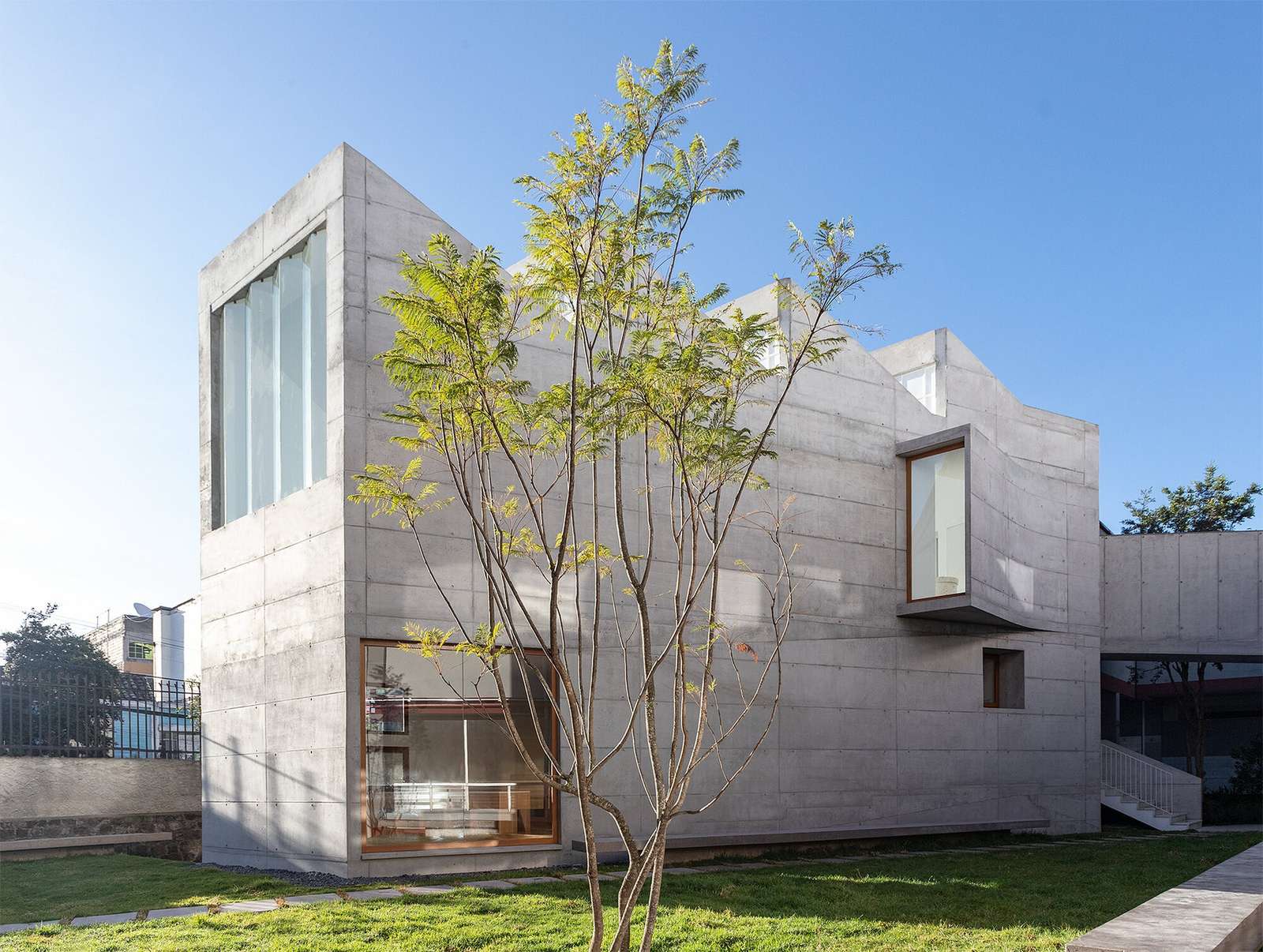
Mass Composition and Complex Contextual Dialogue
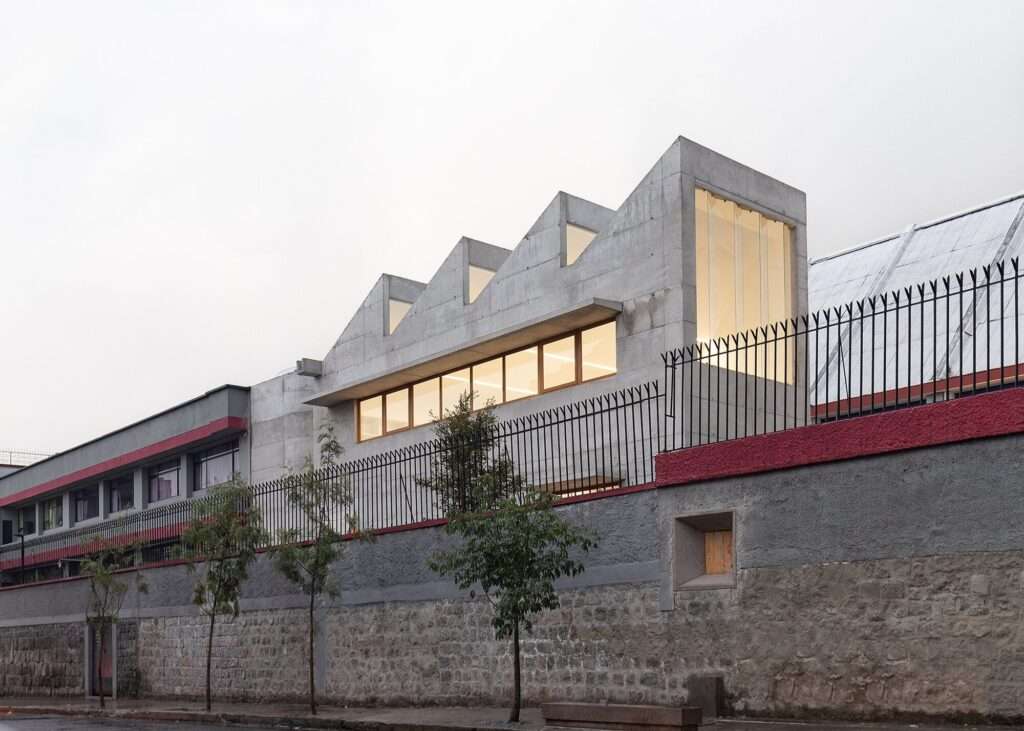
The architectural value of the new Arts Halls annex emerges in its ability to formulate a precise structural response to an intensely complex and congested urban environment. The building’s geographic positioning, between a sports hall, a massive retaining wall, a cluster of classrooms, and an existing church, posed a spatial challenge that required careful separation and balanced solutions between structural adaptation and functional autonomy. The design abandons formal excess, allowing the exterior expression to become an honest and direct manifestation of the internal spaces and the structural logic governing them, thereby reinforcing visual harmony with its surroundings without creating an architectural rupture with neighboring buildings.
Spatial Experience and Human Scenography
The user’s movement within the annex becomes a living scenographic experience that begins at the moment of transition from conventional educational spaces into specialized art studios. The design directs internal circulation paths to seamlessly connect the graphic design studio, painting studio, office, and storage areas. Meanwhile, the movement of natural light and shadows cast through openings plays a fundamental role in shaping the user’s psychological and material perception, as the building’s geometric angles interact with the sun’s path to produce dynamic lighting conditions suited to artistic activities. This dynamic interaction extends outward, where a dedicated green space for relaxation and learning is integrated, functioning as an environmental buffer that connects the human experience with the surrounding natural context.
Structural Deconstruction and Functional Liberation
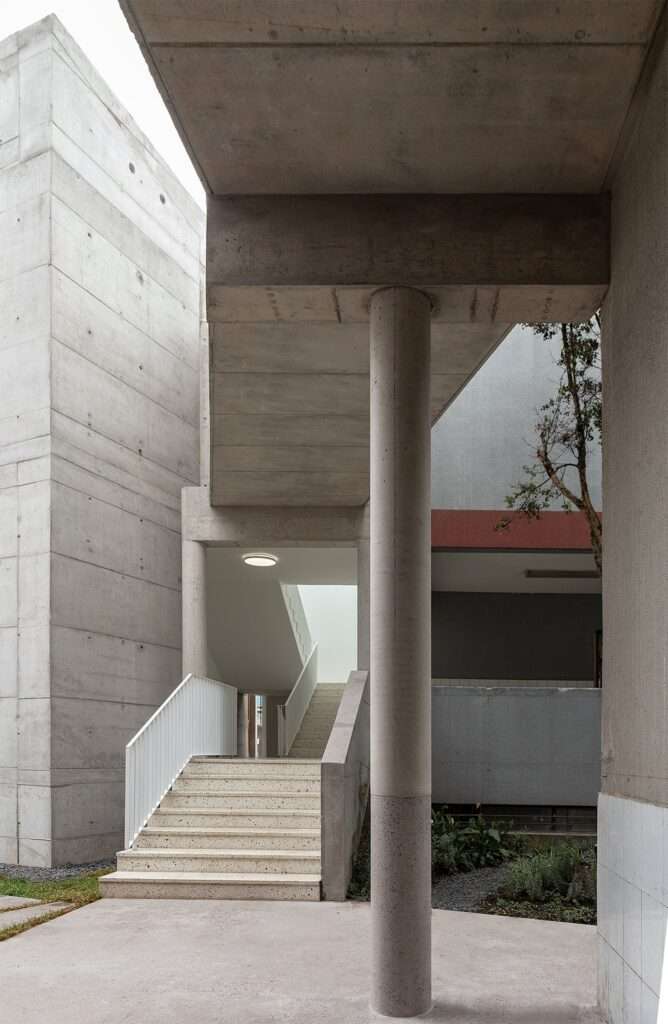
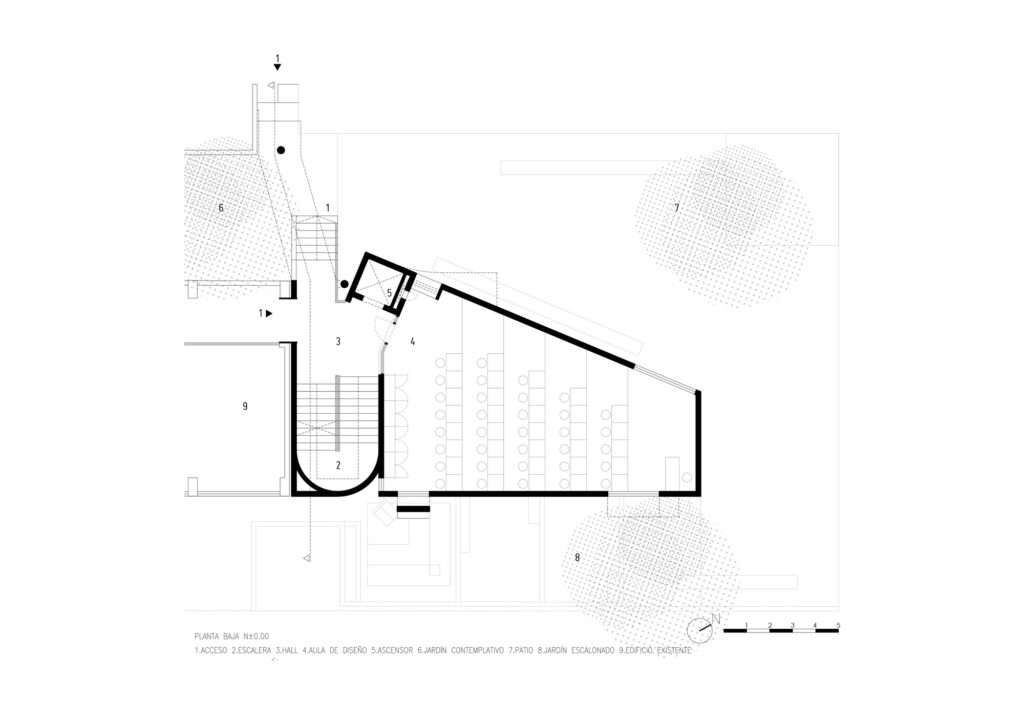
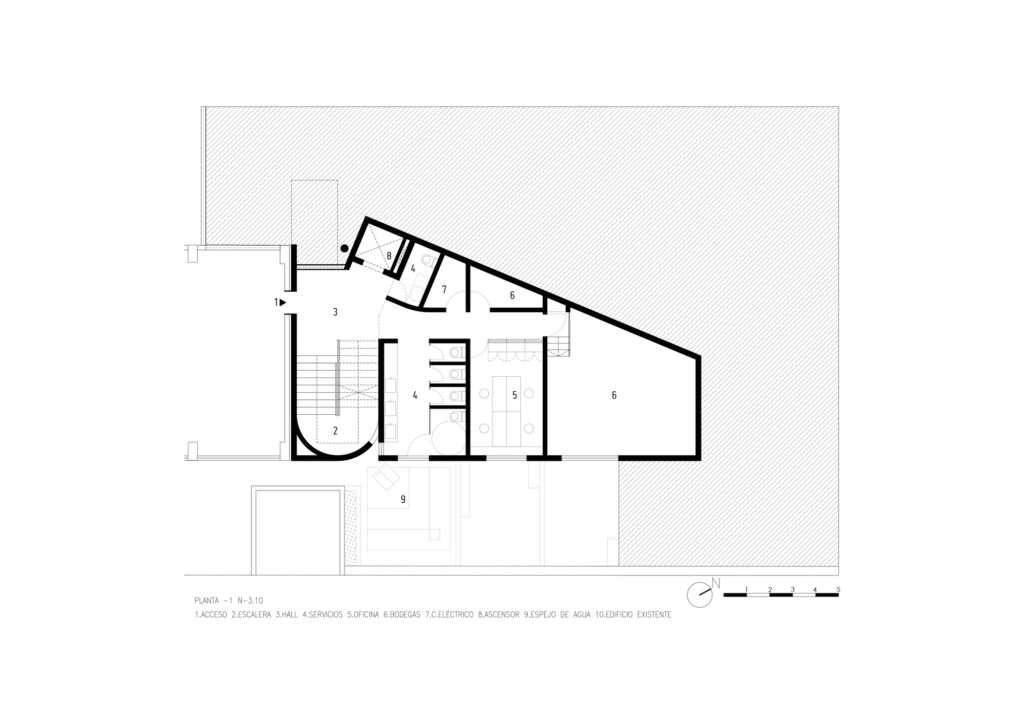
Spatial balance in the project is achieved by relocating the vertical and horizontal circulation core, comprising the staircase, bridge, and elevator, adjacent to the existing classroom block. This strategic decision allowed the main building volume to be fully liberated and dedicated entirely to teaching studios. Meanwhile, two inclined post-tensioned concrete slabs operate as an advanced structural solution addressing spatial and visual openness within the classrooms, while simultaneously resolving the challenges of the trapezoidal plan. This exposed concrete system not only resolves engineering complexities but also reduces long-term maintenance costs as a direct and sustainable intervention.
Spatial Dynamics and Sensory Experience
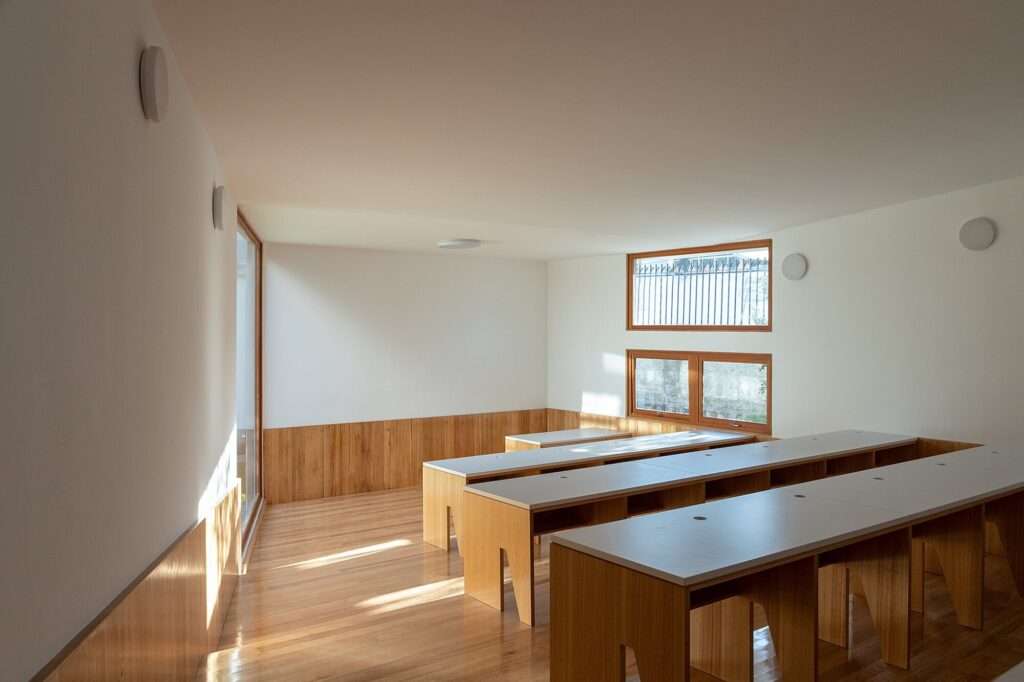
The human experience within the space gains both visual and kinetic depth through the introduction of a diagonal axis in the plan, a design decision driven by the need to maximize green areas, enhance natural light flow, and improve sightlines toward the existing sports hall. This geometric orientation is complemented by the materiality of the space, where a restrained palette of high-quality materials reinforces a warm spatial atmosphere through the careful orchestration of texture and light. This scenography is expressed through natural wood joinery and flooring, along with terrazzo surfaces and furniture that interact with incoming light to evoke a sense of calm and stability.
Scenographic Narrative of Green Landscapes
The exterior experience unfolds through a sequence of green spaces divided into functional and distinct zones that guide visual and physical transitions. It begins with a contemplative garden that hosts an ancient myrtle tree as a historical and visual anchor connecting humans to nature. This is followed by a stepped garden designed to enhance outdoor learning experiences under direct daylight. The sequence concludes in a new courtyard designed for social interaction, furnished with concrete seating and shaded by newly planted trees, creating a vibrant environment that encourages gathering and human connection.
Hierarchical Stratification and Spatial Dynamics
The building’s spatial structure is organized through a precise horizontal and vertical system distributed across three distinct levels. The basement accommodates service functions, with ventilation openings and views directed toward the stepped garden to benefit from natural airflow. Movement then rises to the ground floor, which hosts the graphic design studio; its façades are carefully articulated with precisely designed openings that ensure optimal natural lighting and ventilation, while also providing acoustic protection that reduces external noise, creating a stable cognitive environment for users.
Scenographic Architecture and the “Camera Lucida” Space
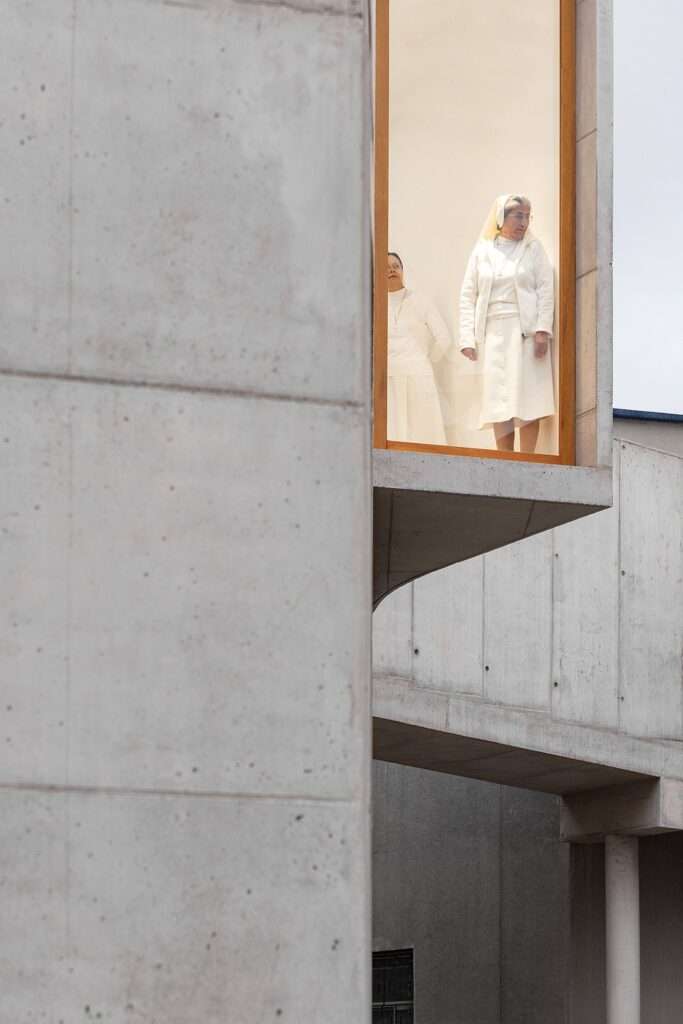
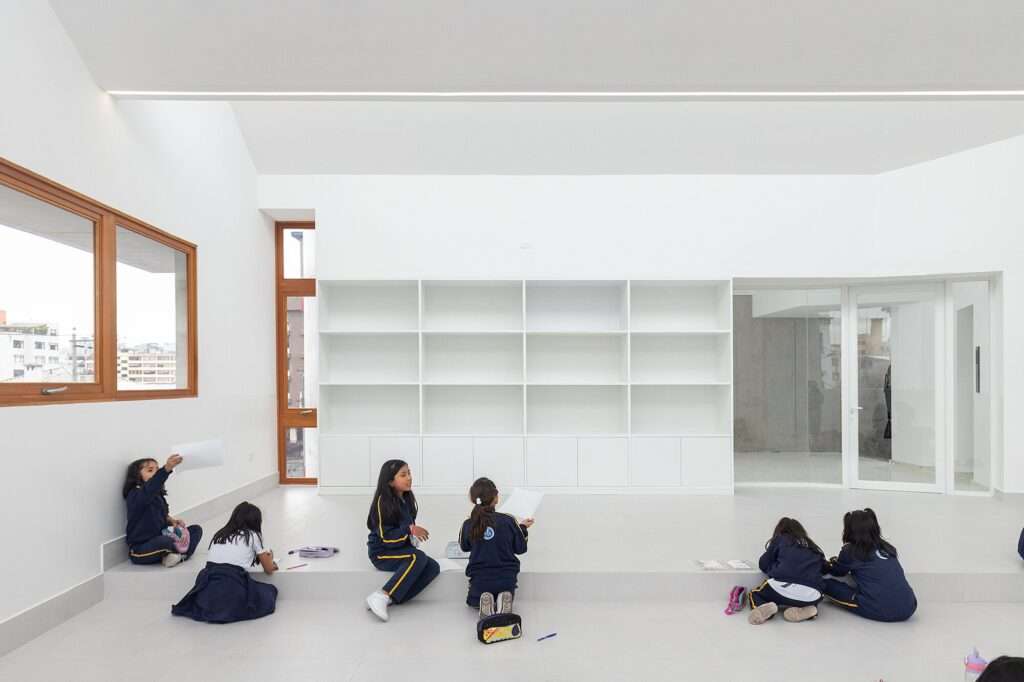
The upper floor emerges as the crowning element of the entire project, designed as a vast, neutral, light-filled painting space inspired by the visual concept of the “camera lucida.” The artist moves within this environment under a diffuse and homogeneous natural light that eliminates sharp shadows, framed by carefully curated visual perspectives under an architectural language reminiscent of Ozenfant and O’Gorman. This transforms the hall into an inspirational refuge isolated from distractions. The scenographic composition is complemented by a connecting bridge that operates as both a spatial and temporal device, allowing users to transition physically and psychologically between the school’s main courtyard and the new art studios, linking historical and contemporary elements within the campus.
Emotional Dimension and Psychological Impact of Space
The deeper purpose of the project transcends structural solutions and functional requirements, settling instead into the perceptual realm of user memory, aiming to inspire students and stimulate their creative imagination. The design employs light and spatial composition as a tangible gift-like presence accompanying students throughout their artistic journey. Users experience daily interactions with shifting light and silent masses, leaving a profound psychological imprint that binds human consciousness to the space and its walls.
Critical Dialectic and Architectural Closure
The dialectical relationship between observer and architect becomes material for philosophical critique that extends beyond the project’s initial objectives. This is evident in “La Roche’s” question directed to “Janerith,” which encapsulates the transformation of architecture from a dry functional container into a poetic space. This scenographic shift becomes apparent when the user reproaches the architect for exceeding the original brief; instead of receiving merely a “framework for the group,” they encounter a “poem of walls” that asserts its own human and artistic presence, leaving the relationship between creator and user suspended in an ongoing question about responsibility for this aesthetic excess.
✦ ArchUp Editorial Insight
The text diagnoses an institutional friction in which programmatic expansion collides with the historical fabric, deconstructing this spatial impasse through intelligent structural acrobatics. By liberating the main plan through the relocation of circulation cores to the perimeter and employing post-tensioned concrete slabs, the design successfully manipulates a complex geometric footprint, transforming functional density into a sensory infrastructure that inspires students through a sophisticated diagonal and material orchestration of light and mass.
However, this romantic celebration of the “architectural poem” reveals a blind spot concerning the long-term economics of institutional expansion. Prioritizing bespoke scenographic design over standardized typological flexibility risks confining the academy within a rigid spatial paradigm. In an era defined by continuously evolving educational requirements, such highly customized architecture may impose operational inefficiencies, transforming from a poetic gift into a frozen financial burden.