The Louvre’s Stretch Marks: An Architectural Reading of a Museum That Never Sleeps

Ibrahim Fawakherji — ArchUp
I first visited the Louvre in the summer of 2006, the year I graduated from architecture school. I was not there entirely as a tourist. I was there in the way young architects often encounter a building for the first time: obsessively, systematically, almost unable to look at anything without immediately asking why it had been designed that way, how it had been built, and what would eventually have to be maintained.
Of course, I remember the glass pyramid. But I remember the water around it even more precisely.
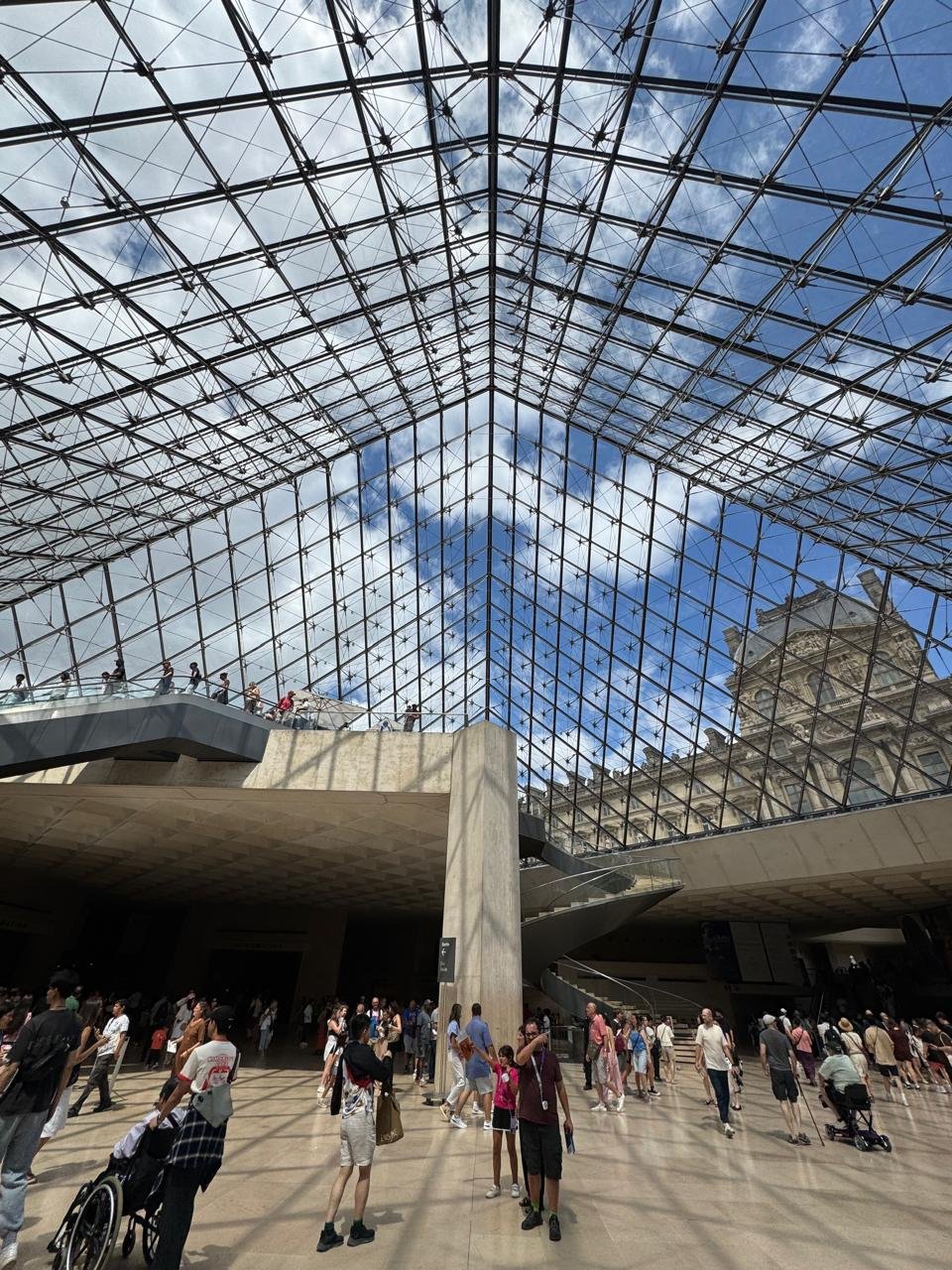
The shallow basins surrounding I. M. Pei’s intervention did something the pyramid could not do alone: they multiplied everything. Glass met water. The sky appeared twice. The old palace reflected itself in a thin liquid surface at the foot of a contemporary geometry. The composition was not simply additive; it became almost exponential. Light struck glass, glass met water, history appeared in reflection, and the whole courtyard seemed to radiate beyond its actual dimensions.
Nearly twenty years later, I returned. The pyramid was still there. The palace was still there. The water was gone.
The basins were dry. Because my memory of the 2006 visit remained unusually precise, this absence did not appear to me as a minor operational detail. It felt like an architectural subtraction. Something had been removed from the composition. Without the reflections, the pyramid seemed more exposed. The courtyard felt harder. The relationship between the old stone and the contemporary glass had lost a mediating layer whose visual importance I had not understood two decades earlier.
When Absence Becomes a Way of Seeing
A careful distinction is necessary here. I cannot claim that the dry basins I observed were directly connected to the infrastructure failures reported elsewhere in the museum around the same period. They may have been emptied for seasonal maintenance, for work on their own hydraulic systems, or for reasons entirely unrelated to the water incidents reported in late 2025 and early 2026.
What I can say is that their absence made me look at the Louvre differently than I had in 2006. And what I discovered by looking more closely was more interesting than the condition of a basin.
Once I began to see the Louvre as a building rather than only as a container for art, another museum appeared: a museum of concrete, stone, waterproofing, pipes, hardware, mechanical systems, thresholds, floors, and hidden networks behind walls. It was not less beautiful. It was simply more physical.
In recent accounts of the Louvre, infrastructure problems and water leaks have been discussed with growing urgency. But when incidents begin to repeat in a building, the architect looks for the system behind them. Buildings rarely fail all at once. They send small signals first. Those signals accumulate, and eventually they become a language.
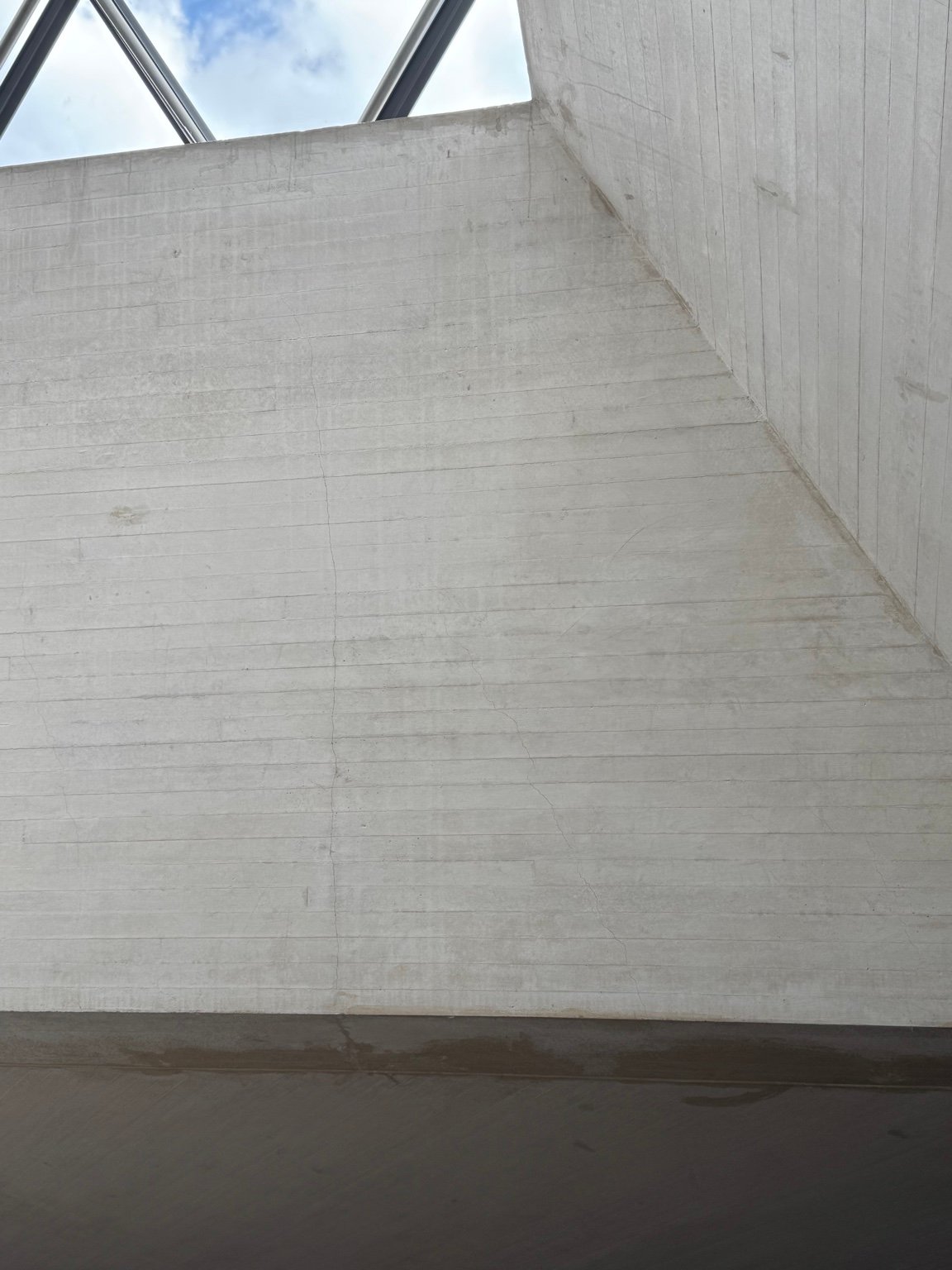
That language is not always catastrophic. Not every mark on a surface is evidence of danger. Some cracks belong to non-structural layers, some to shrinkage, joints, previous repairs, or to the long history of a building that has been opened, modified, and repaired many times. A visitor, even an architect, cannot establish a structural diagnosis from a passing visual inspection, and I do not pretend to do so.
But cracks have a psychological effect on architects that is difficult to neutralize. You see one. Then another. Then, for a moment, you stop looking at paintings and begin looking at concrete.
The Museum as a Body
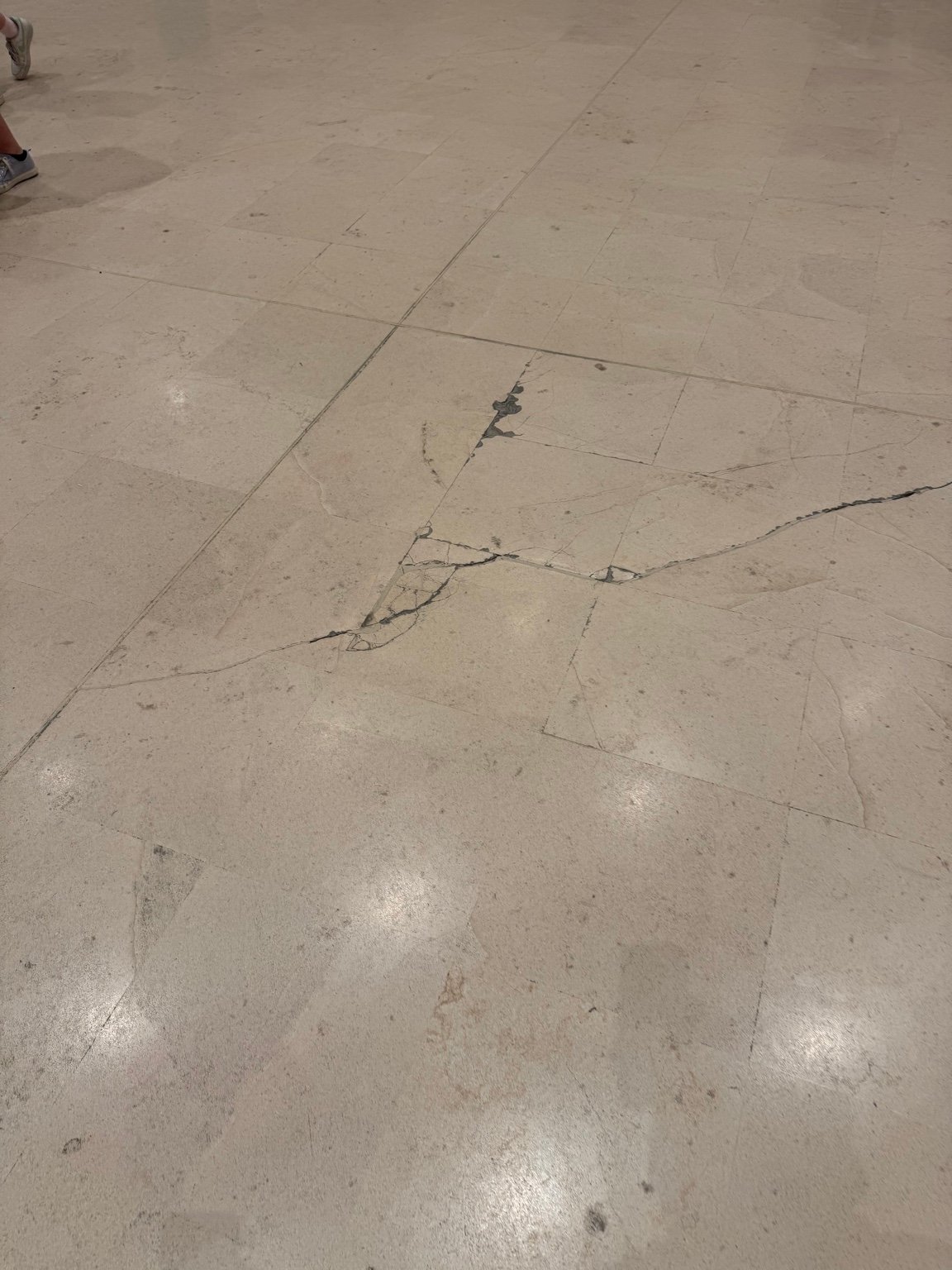
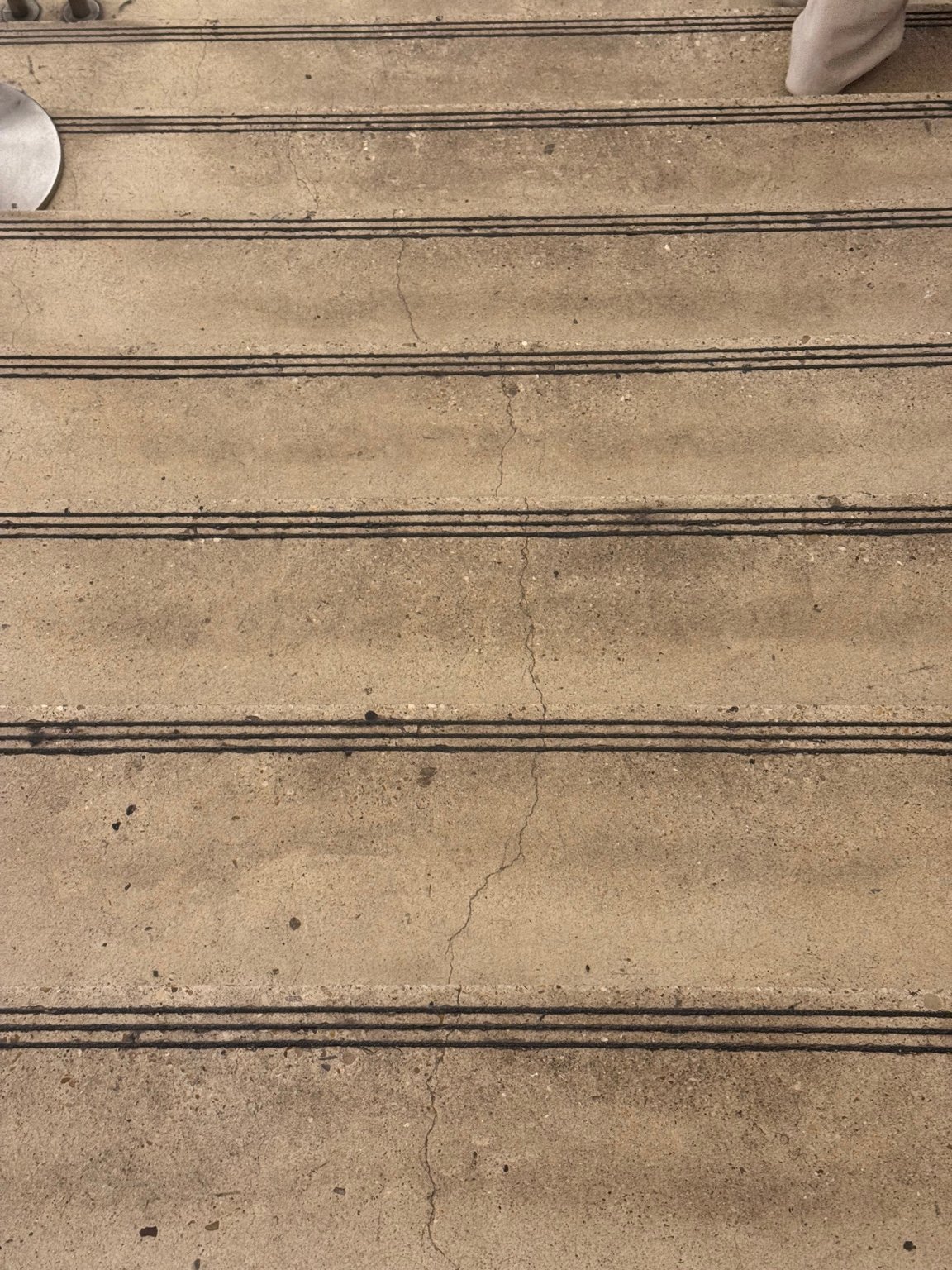
Once you start looking this way, the signs multiply. The steps carry the traces of passage. Anti-slip strips at stair edges become records of millions of feet. Stone floors show patches, joints, repairs, and subtle scars that most rushed visitors do not notice, but which say something about the actual pressure absorbed by the place.
These are not necessarily severe pathologies. They are ordinary signs on an extraordinary building. The Louvre is not a quiet local museum. It is a vast architectural body receiving millions of people, bags, cameras, queues, pauses, turns, hesitations, and returns every year.
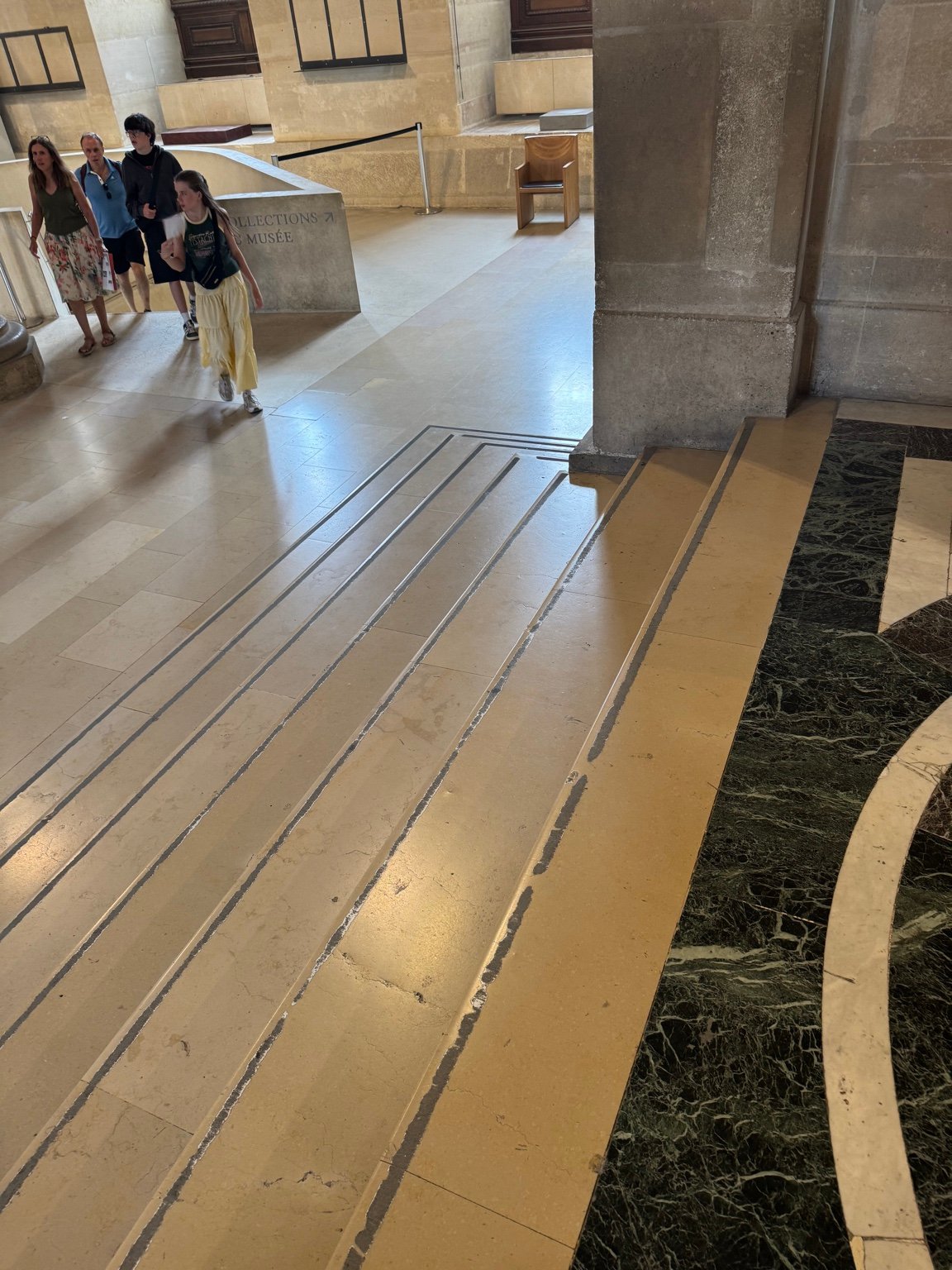
We spend so much time discussing what the Louvre contains that it is easy to forget that the Louvre itself must survive what it contains. It must remain capable of carrying the memory displayed inside it.
Every major museum faces this question in some form: how does one preserve the works, the experience, and the building at the same time? In the Louvre, the question is harsher because the building itself is not a neutral background. It is an architectural history moving from fortress to palace to state machine to museum, before becoming one of the most intensely visited cultural engines on earth.
Billions of Steps Are Not a Metaphor
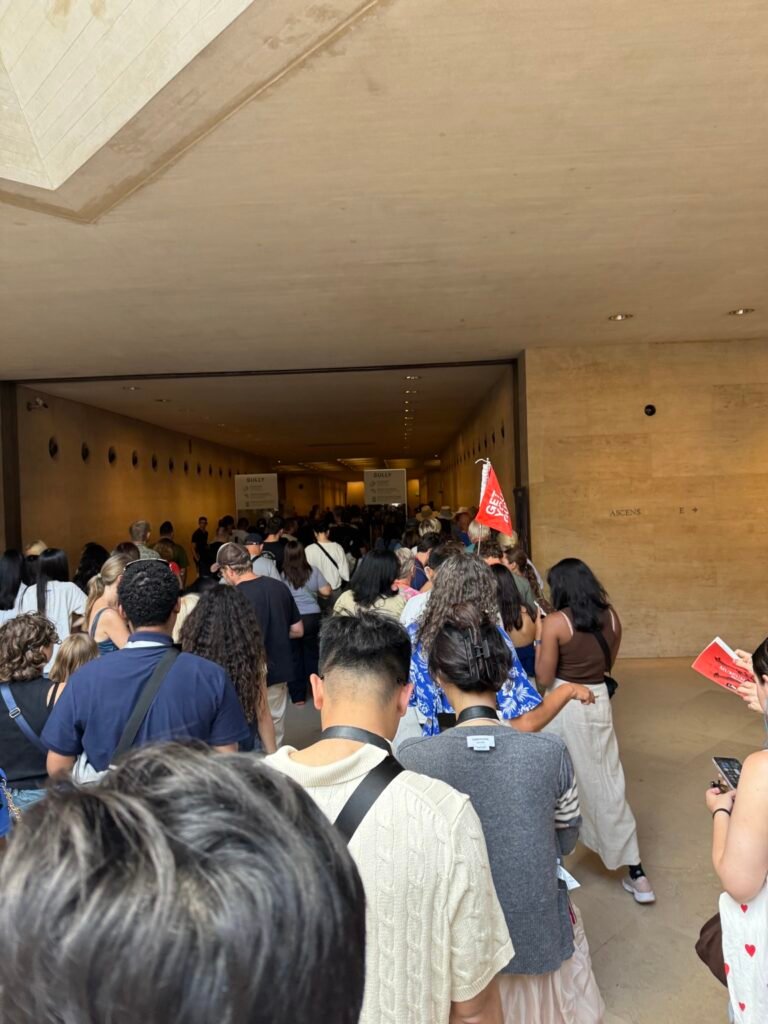
Inside, I began the walk that almost every visitor eventually performs. From arrival and security, through escalators, galleries, stairs, and a crowd that grows denser as it approaches its destination: the Mona Lisa.
The journey to the painting is not merely a museum route. It is a ritual. Within that ritual, the building becomes a receiver of immense human repetition. If the Louvre receives around nine million visitors a year, and if a large share of them takes hundreds or thousands of steps toward the museum’s most visited points, we are not speaking about incidental movement. We are speaking about billions of steps across stone, joints, thresholds, stairs, mechanical systems, and service networks.
Billions of steps are not a metaphor. They are an operating condition.
Architecture does not absorb repetition in the same way it absorbs a single event. A single impact can be identified, repaired, and closed. Repetition never stops. Stone is polished by continuous traffic. Floors wear at the most frequented thresholds while remaining relatively intact a few meters away. Joints move through cycles for years. Mechanical equipment runs continuously. Water, air, and electrical networks age behind walls that neither curators nor visitors usually examine.
The last major architectural transformation of the Louvre, the Grand Louvre project that produced Pei’s pyramid and the vast underground hall beneath the Cour Napoleon, was conceived in the 1980s around a much lower visitor load than the museum carries today. The building has not simply aged. Its use has intensified. Age and intensity rarely combine gently.
The Mona Lisa as an Operating Force
The Mona Lisa is not only a painting in a room. Physically, it is a force that redistributes pressure across an entire building. A relatively small image can indirectly determine routes, concentrate congestion, accelerate wear on particular floors and thresholds, and overload specific points in the museum’s spatial system.
In museums, attention is never evenly distributed. That means wear is not evenly distributed either. Peripheral galleries do not absorb the same load as the routes leading to major icons. When human attention concentrates in specific points, attention itself becomes material: it polishes stone, exhausts corridors, increases the burden on ventilation and conditioning, and turns the museum experience into a flow-management problem as much as a curatorial one.
Redistributing visitor attention across the broader collection would therefore be a curatorial achievement. It would also be an architectural intervention. To relieve pressure from a single point is not only to change how the museum is read; it is to redistribute load across its body.
Architectural Stretch Marks
At a certain point, I found myself doing what many architects do when they can no longer disable the profession inside their heads. I inspected the building. Not officially. Simply in that reflexive way that becomes part of one’s body after years of practice.
I looked at ceilings. Floors. Steps. Thresholds. The meeting of materials from different periods. Stone repairs revealing older repairs. Pinched circulation points where the human flow visibly exceeded the calm for which the spaces seemed to have been designed.
The Louvre knows how to adapt. Its history is, in many ways, a remarkable history of adaptation: contemporary networks inserted into historic walls, climate systems introduced into rooms designed centuries before their invention, infrastructure carved beneath courtyards, and finally a glass pyramid placed at the center of a royal ensemble with enough architectural intelligence to become inseparable from the museum’s identity.
But every adaptation leaves a trace. The traces accumulate. Then they become scars. Or, more precisely, architectural stretch marks.
The metaphor matters because stretch marks do not necessarily imply ugliness. A body that carries them may remain beautiful, alive, active, and charged with histories of pressure, expansion, and transformation. The Louvre is not less beautiful because time has begun to show on it. It becomes more truthful when we see it this way: not as a completed tourist image, but as an architectural body that works, tires, adapts, and requires care.
Maintenance as a Cultural Act
The French state appears to have recognized the scale of the problem. A major transformation program is being prepared, including a new entrance and new infrastructure intended, among other things, to relieve pressure on the pyramid entrance and the concentration of visitors around the Mona Lisa. That addresses the right problem.
But a museum whose infrastructure has already caused damage to its own collections, whose systems have reached critical ages, and which absorbs around nine million visitors every year needs, alongside architectural ambition, something less spectacular but equally serious: maintenance treated with the same institutional gravity as the collections.
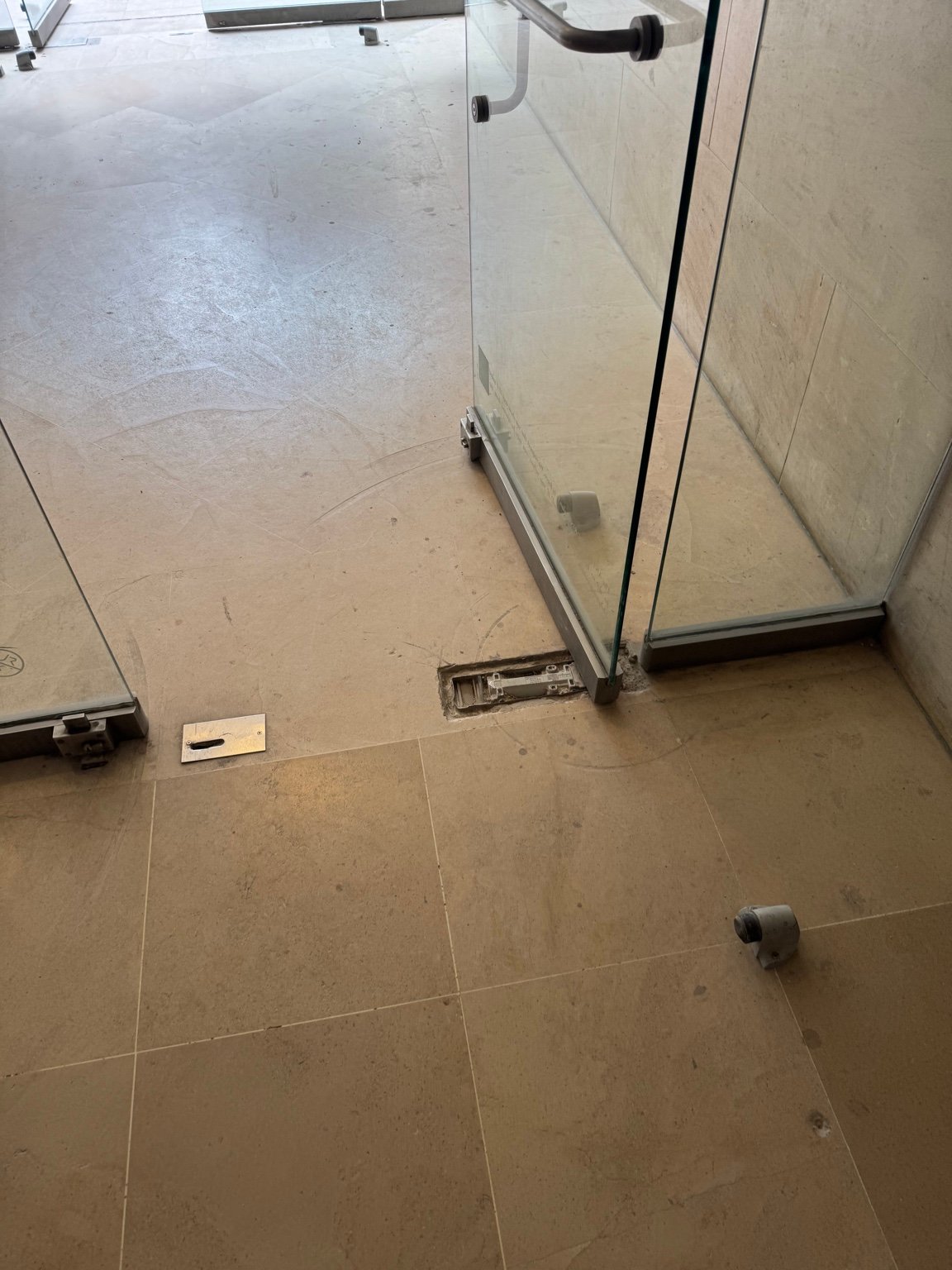
Pipes. Waterproofing. Structural monitoring. Mechanical systems. Flow management. Floor replacement cycles. Hydraulic networks. Thresholds, doors, joints, and surfaces. All of these must be documented, scheduled, funded, and executed before the next failure reveals where attention should have been directed.
Maintenance is not a low-value activity. In a building like the Louvre, maintenance becomes a cultural act. It does not merely protect walls. It protects the possibility of meaning inside those walls. A museum does not only preserve civilizations behind glass. It must also preserve itself as part of that civilization.
Interior Climate as Part of the Critique
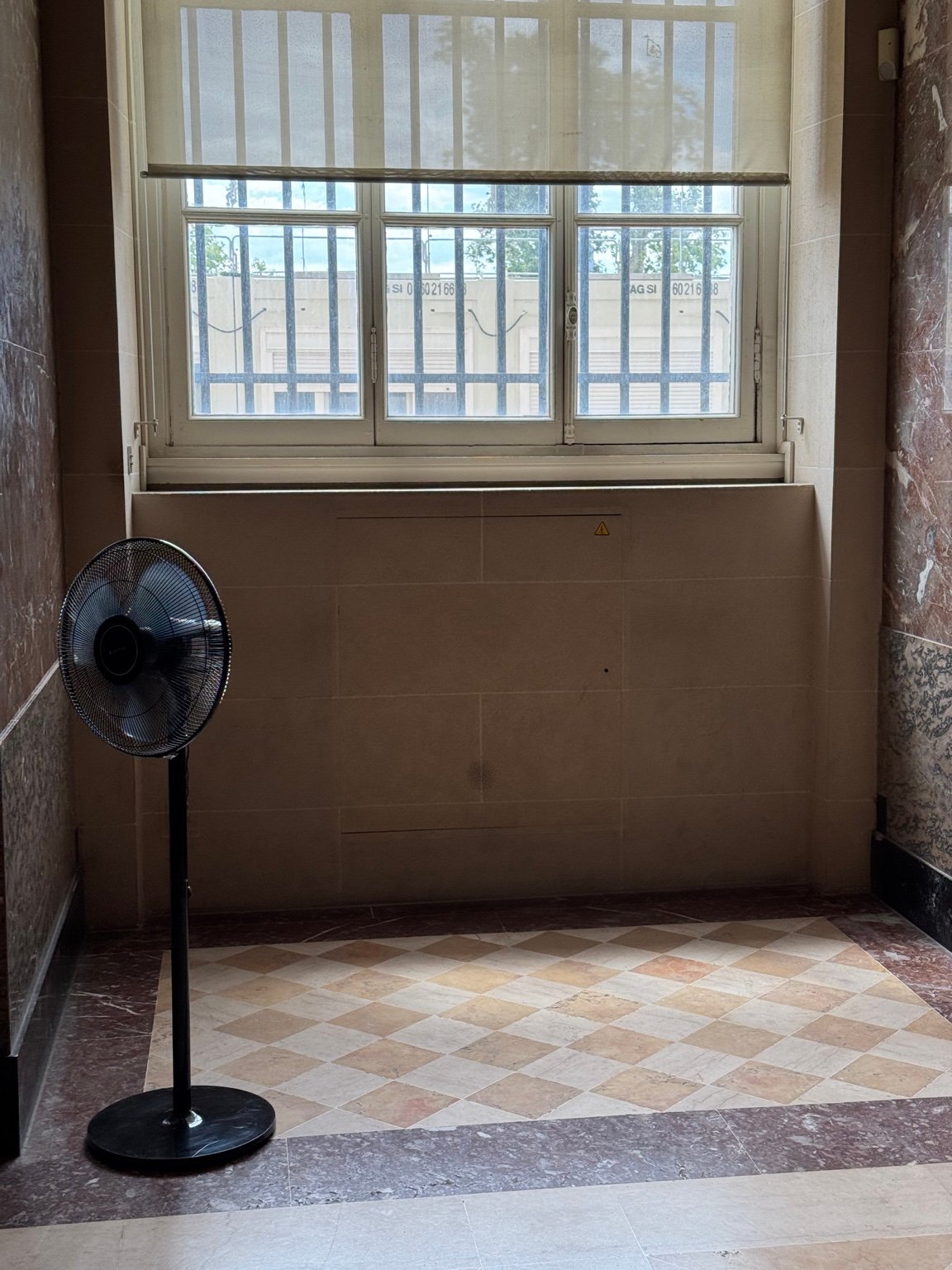
There is another dimension that does not always appear in discussions of great museums: environmental comfort. A visitor may read heat, stuffiness, or weak ventilation as a temporary inconvenience on a crowded day. An architect reads it also as a sign of the relationship between a historic building and contemporary operating demands.
As climate conditions change and heat waves become more severe, ventilation inside a major museum is no longer a question of comfort alone. It is part of the building’s ability to receive the public without turning presence itself into pressure. A great museum is measured not only by what it displays, but by what it allows the visitor’s body to endure while moving through it.
Leaving the Louvre
I arrived at the Louvre thinking about art. I left thinking about aging.
Perhaps that is appropriate. For centuries, the Louvre has gathered evidence that human beings age, rulers disappear, bodies deteriorate, and civilizations sometimes end behind glass. Few buildings in the world understand mortality as well.
The irony is that time has also begun to inscribe itself on the building. Not death. The Louvre remains magnificent, and architecture of this importance does not become a ruin overnight. But age is visible: a certain stiffness in the joints, cracks in the skin, repairs over older repairs, systems that tolerate less easily what they once tolerated, and nine million visitors each year who come to contemplate history while producing billions of steps on the history beneath their feet.
In 2006, I stood before the pyramid and watched the water reflect the Louvre. In 2026, I stood almost in the same place before a dry basin. For the first time, I understood that the building itself was part of what had to be conserved.
The Louvre is no longer simply old. It now carries its stretch marks. They are not necessarily signs of severe illness. They are signs of an architectural body under extraordinary use. And unlike ruin, aging can be managed, provided it is addressed before it becomes something else.
✦ ArchUp Editorial Insight
The essay’s most structurally significant move is its reframing of visitor attention as a material force rather than a curatorial condition — the recognition that in a museum, wear is distributed exactly as attention is distributed, which means the Mona Lisa is not a painting that the building houses but a load-concentration mechanism that the building absorbs, polishing specific thresholds while peripheral galleries remain intact a few meters away.
This converts a maintenance observation into a governance diagnosis, because the Grand Louvre project that produced Pei’s pyramid was calibrated in the 1980s to a visitor load a fraction of the nine million the building now carries, and the gap between the intensity it was designed for and the intensity it absorbs is precisely the CAPEX-OPEX misalignment this archive traced in A Building Becomes an Asset: the transformative capital investment is celebrated, funded, and photographed, while the maintenance that determines whether the investment survives is filed as a low-value activity beneath institutional attention until a failure reveals where the funding should have gone.
The article’s deepest structural contribution is its insistence that maintenance is a cultural act rather than an operational afterthought — a claim that connects directly to what The Louvre Without the Mona Lisa identified as the celebrity object converting a building into a crowd-management system, because the stretch marks the author reads in the stone are the accumulated physical record of a governance model that has always funded acquisition and display more readily than the unglamorous infrastructure that carries them, and the dry basin is the most honest exhibit in the museum: the moment the institution’s own maintenance deferral became visible in the composition, legible to anyone whose memory of the water was precise enough to notice what the budget had quietly subtracted.