The Louvre Without the Mona Lisa

A visit to the Louvre highlights the overwhelming cultural and physical influence of Leonardo da Vinci’s Mona Lisa. Despite its small size, the painting dictates the museum’s social structure and visitor flow, often overshadowing massive masterpieces like Paolo Veronese’s The Wedding Feast at Cana.
Modern tourism and digital media force the institution to prioritize crowd management over traditional curation. While famous icons drive global pilgrimages, the broader collection includes religious and historical paintings that offer complex architectural perspectives, suggesting the museum’s challenge is balancing international fame with its diverse artistic heritage.
Ibrahim Fawakherji — ArchUp
I did not begin my visit to the Louvre with Leonardo da Vinci.
I began with a ticket problem.
I had gone to Paris assuming that entering one of the most visited museums in the world would involve the usual contemporary ritual: choose a date, select a time, pay, receive a QR code, and proceed with the reassuring belief that civilization has solved access.
It had not.
There were no ordinary tickets available for the time I wanted. What I could find instead was one of those combinations produced by the machinery of modern tourism: admission to the Louvre bundled with a cruise on the Seine. I wanted the museum. The river came with it. So I bought the river. This will become relevant again at the end.
We arrived as a small guided group. Our guide was French, lively, fond of stories, and possessed the particular kind of efficiency I have increasingly associated with Paris: friendly enough to help you, but never so friendly that you forget you are still expected to know how to behave.
At one point, while explaining how the group should stay together, she added another instruction. If anyone bothers you, touches you, pushes you, or causes a problem, tell me. Then she gave us the supporting credential. Her father had taught her boxing when she was young. She could handle it. She did not look remotely like someone who had spent her childhood preparing for combat, which somehow made the information better.
I thanked her internally. But I had a small problem with the arrangement. I did not particularly want a woman defending me inside the Louvre. I can defend myself. If things became sufficiently dramatic, I was reasonably confident I could defend several of the families as well. We had come to see Renaissance painting, not organize a lightweight championship beneath the French ceilings. Fortunately, no boxing was required. The only fight that morning was for attention. And the Mona Lisa was already winning.
We entered. The group gathered. The guide began orienting us. And within minutes the entire social structure of the tour revealed itself.
There were several families with us. One appeared to be Chinese. A young woman was wearing a carefully arranged dress and seemed to have people around her helping with photographs or logistics. I could not tell whether she was an artist, an influencer, someone involved in fashion, or simply much better prepared for the Louvre than the rest of us. If you somehow find this article: Hi.
Then came the question. Not gradually. Not after the first room. Almost immediately.
“Where is the Mona Lisa?”
The guide pointed. And that was basically goodbye. One family disappeared. Then another. Then another. I would estimate that close to half of the group dissolved shortly after entry, each unit making its own direct migration toward Leonardo. No resentment from me. In fact, I respect the clarity. They knew exactly what they had purchased the ticket for. No need to perform cultural patience. No need to spend forty minutes pretending to care deeply about fifteenth-century religious iconography when the real objective was waiting behind protective glass somewhere ahead. They had entered the Louvre. They had received the coordinates of the shrine. Mission defined.
To all of you who left us that morning: hello again. I hope you found her. I hope the crowd treated you well. I hope at least one photograph came out without six phones blocking the lower half.
The rest of us continued. Two families, perhaps. And around three individuals. The museum nerds. The ones who still wanted to know what was hanging on the walls before reaching the painting everybody already knew was there. If any of those three are reading this: Hi. You probably did not know my name. That is fine. Call me Arch. A-R-C-H. It is easier that way.
The first room stopped me.
Not because of a single painting. Because of the room itself and what it was asking me to do.
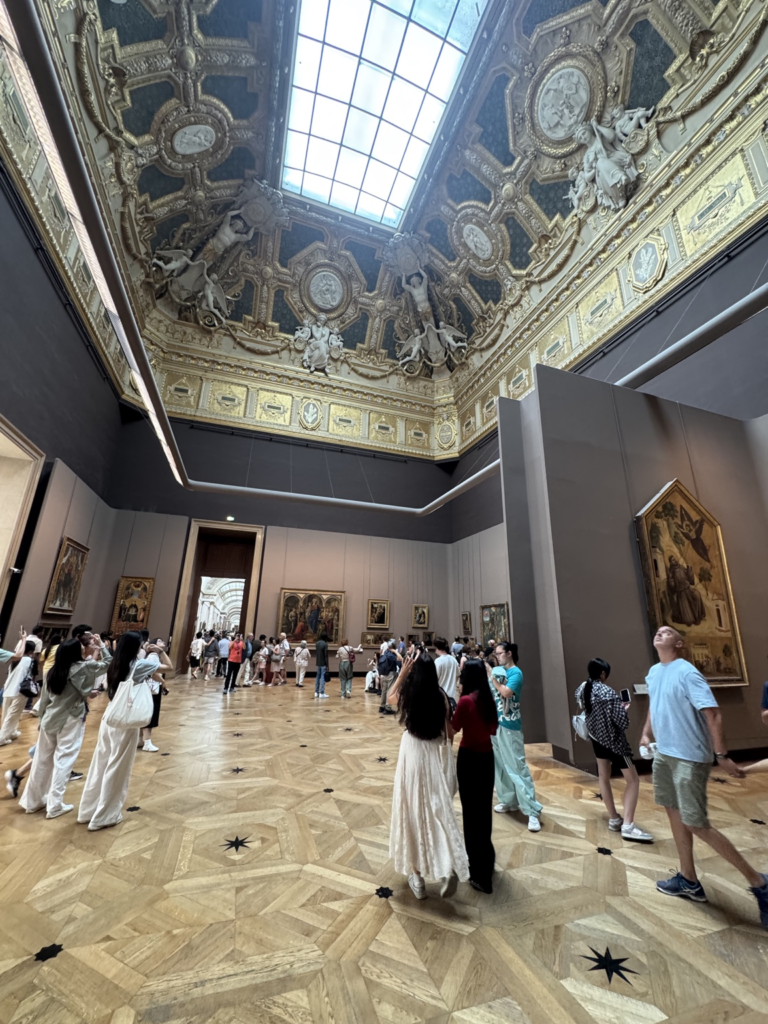
The Salon Carré in the Denon Wing was once the room where the French Academy held its annual exhibitions. Today it houses early Italian Renaissance paintings hung against dark walls under a ceiling so elaborately gilded that looking upward becomes a separate act of attention from looking at the paintings. The architecture does not serve the collection neutrally here. It competes with it. And in doing so, it raises a question the entire Louvre is quietly asking throughout its 72,000 square meters of gallery space: when a building is itself a work of historical significance, does it frame the art or overwhelm it?
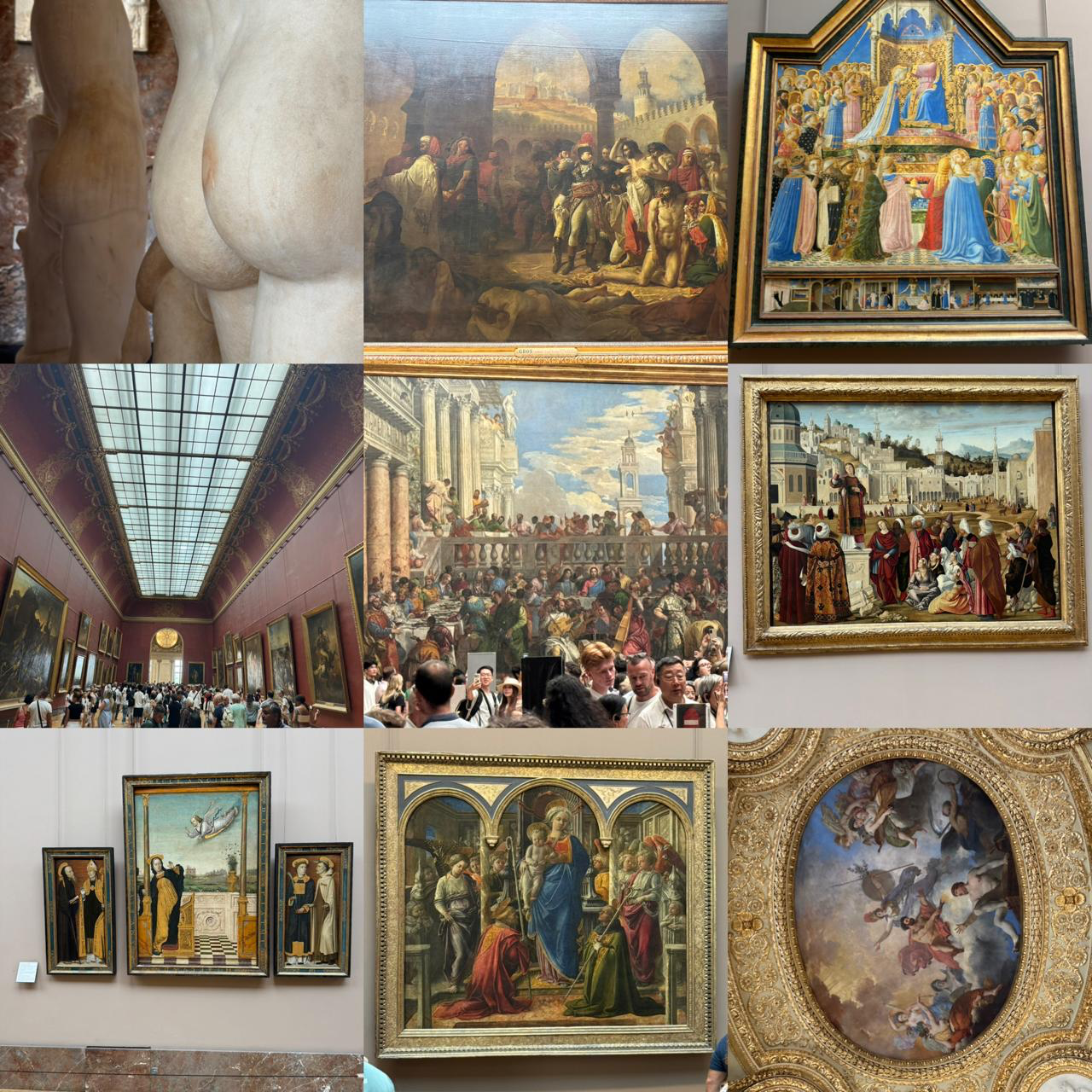
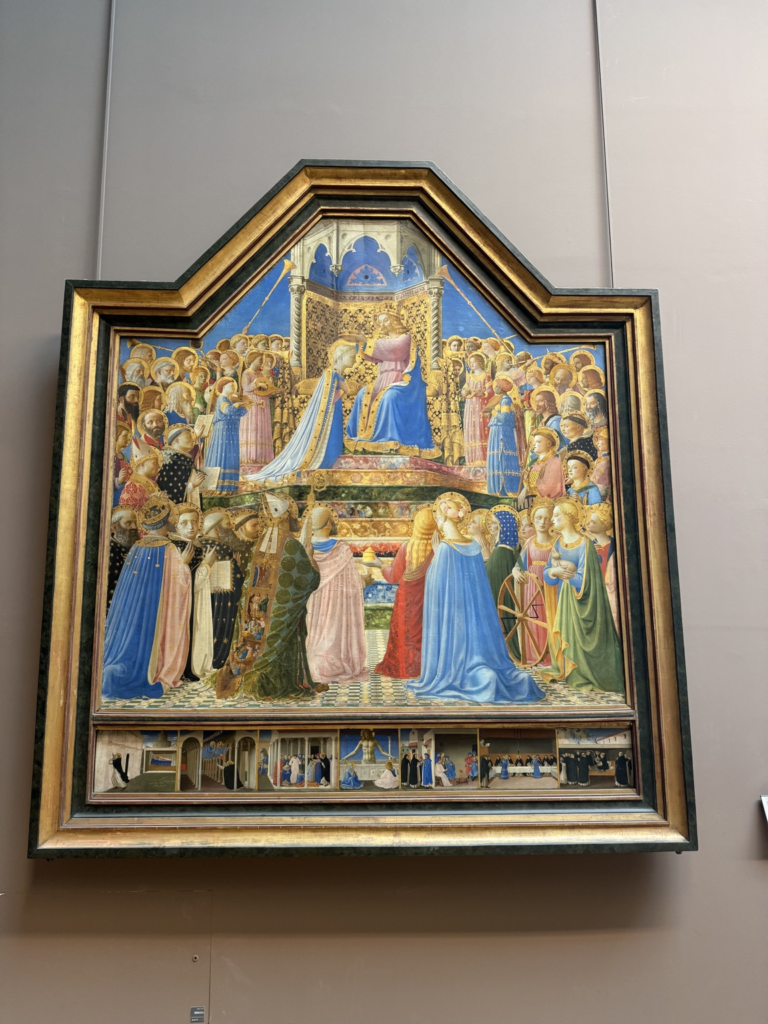
Fra Angelico’s The Coronation of the Virgin was in those early rooms, and it does not behave modestly.
The painting radiates order. Gold, blue, hierarchy, saints, angels, ceremony, throne, steps, repetition. Everything knows where it belongs. There is a confidence in the image that feels almost foreign today: a belief that the universe possesses an order and that painting can make that order visible.
What interested me as an architect was how spatial the logic becomes when you look long enough. Heaven itself is organized. There is rank. There is approach. There is center and periphery. There is procession. There is an audience. Even transcendence has spatial protocol. The painting is religious, obviously. But it is also an organizational diagram. A court translated into eternity. The composition does what a well-designed public building does: it tells you where you stand in relation to what matters. The throne is raised. The approach is axial. The attendant figures are arranged by proximity to the sacred center. The spatial hierarchy is more explicit than most contemporary architects allow themselves to be.
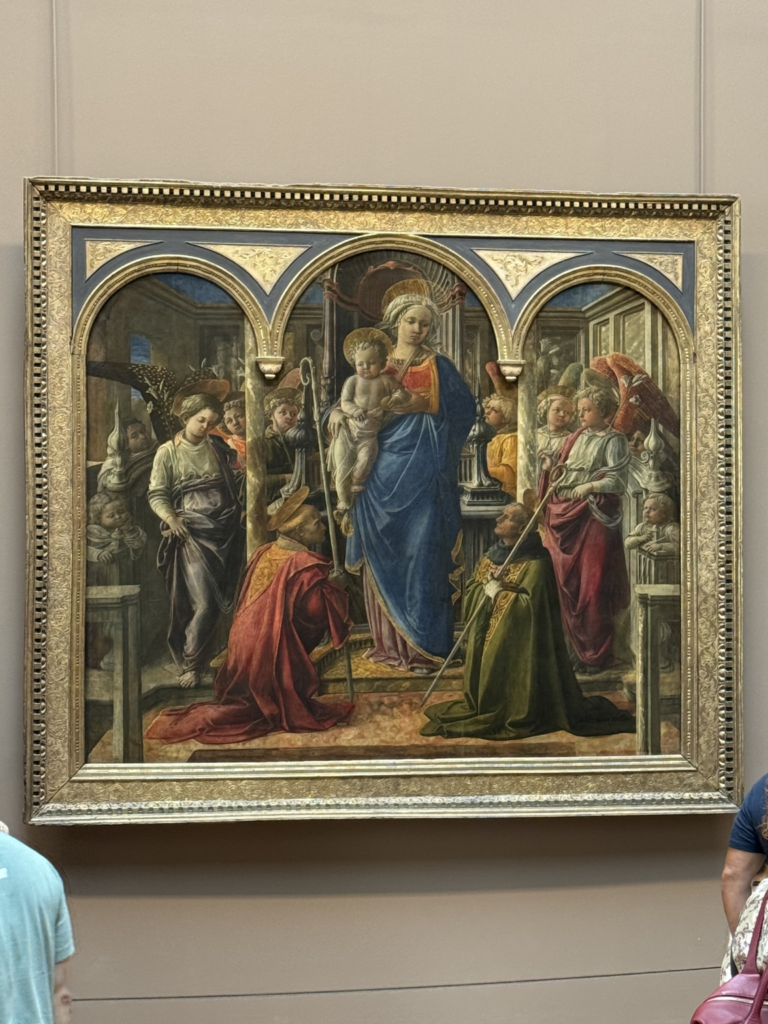
Another Renaissance Madonna continued the same question differently.
Fra Filippo Lippi’s Barbadori Altarpiece places the Virgin within a unified architectural setting rather than against the flat gold ground that had defined devotional painting for the preceding century. Columns define space. A coffered ceiling establishes depth. The sacred scene does not float in theological abstraction. It occupies a constructed room. This was a technical and philosophical revolution that the painting announces calmly and without drama.
What appears first as a devotional composition becomes, if you look longer, a study in controlled proximity. Who stands. Who kneels. Who approaches. Who receives the center. The bodies are positions inside a system. Color reinforces that system. Blue carries more than pigment. Red carries more than pigment. Fabric becomes hierarchy. Gesture becomes access. Faith has a floor plan.
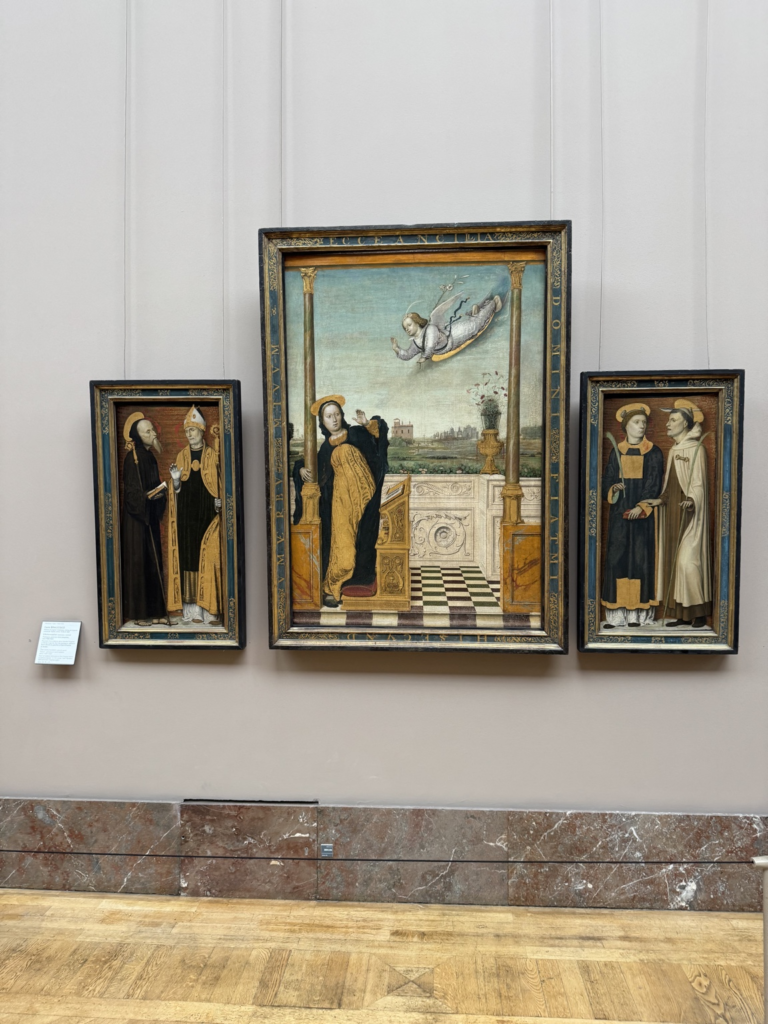
The Annunciation triptych that followed gave me another reason to stop.
An angel descends into a scene framed by architecture. Columns define space. A tiled floor establishes depth using the newly mastered system of linear perspective. A terrace opens toward landscape beyond. The sacred event does not happen in nowhere. It happens in a constructed environment, and the perspective lines of that environment direct the eye toward the point of encounter between the human and the divine.
This may sound obvious, but it is one of the most important achievements of Renaissance painting. Space itself becomes an instrument of belief. Perspective makes the miraculous inhabitable. Architecture gives theology somewhere to occur. The room in the painting is doing what rooms in Gothic cathedrals had done through physical scale and light: creating the conditions under which a particular quality of experience becomes possible. The difference is that the room in the painting exists only in representation, and the painter had to invent the spatial grammar that makes the representation convincing.
As an architect, I find myself looking at these paintings from the wrong direction. I know I am supposed to begin with the figures. Often I begin with the room.
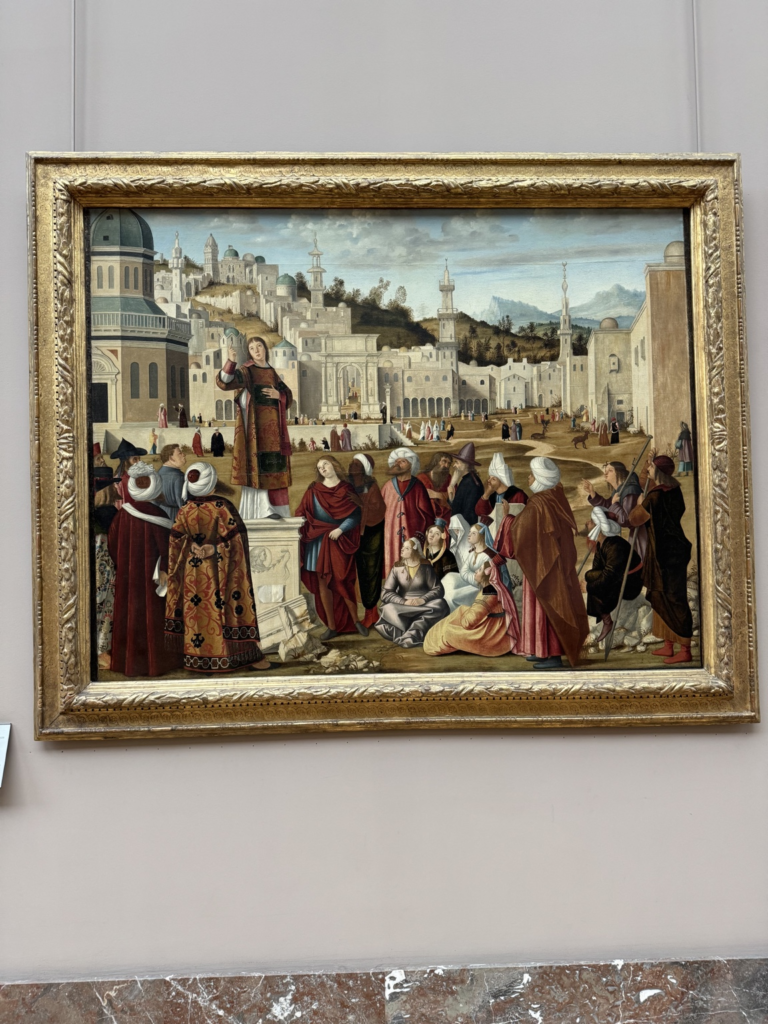
Then came a work in which preaching unfolds before an imagined Eastern city.
Vittore Carpaccio’s Saint Stephen Preaching in Jerusalem gave me a different kind of architectural observation. Domes. Minarets. Walls. Arcades. Towers. A crowd assembled around a speaker while the city spreads behind them as a great piece of visual evidence.
The subject may be religious. My attention went immediately to the background. Because these cities are never simply cities. They are European constructions of elsewhere. They tell us how one culture imagined another culture before photography made that imagination easier to challenge. The architecture becomes evidence of distance. The minarets and domes that Carpaccio painted were drawn from second-hand reports, from earlier paintings, from travelers’ accounts, from objects brought back from trade routes. They were assembled into a plausible Eastern city that no one in Venice had actually seen but everyone recognized as sufficiently foreign to serve the painting’s purpose.
The painting tells you where the event happened. The architecture tells you what Europe thought “there” looked like. Those are not necessarily the same place. But the gap between them is itself a form of historical evidence about the limits and assumptions of a specific moment in European visual culture.
There is something slightly absurd about the gravitational power of the Mona Lisa.
The painting measures approximately 77 by 53 centimeters. That is the physical fact. Seventy-seven centimeters by fifty-three. A relatively small painted panel inside a former medieval fortress that became a royal palace, accumulated centuries of political history, transformed into a museum, expanded into one of the largest cultural institutions on Earth, and now receives people from practically every part of the planet. And yet somewhere near the center of this enormous historical machine sits a woman occupying less wall than many household televisions.
She is the bride. Everything else is attending the wedding.
This is not criticism of the Mona Lisa. Quite the opposite. I am fascinated by the magnitude of what that image has accomplished. But the crowd in the Salle des États tells the real story of what celebrity does to curatorial logic. One painting fills the room socially and emotionally. The painting on the opposite wall, Veronese’s Wedding Feast at Cana, fills the room physically — it covers roughly seventy square meters — and receives a fraction of the attention.
And the strange thing is that Leonardo did not create all of that attention himself. In 1911, Vincenzo Peruggia, an Italian who had previously worked at the Louvre, stole the painting. For more than two years, she was gone. The disappearance became an international story. Newspapers printed her image. Speculation multiplied. The missing painting acquired something almost more powerful than presence: narrative. Eventually Peruggia attempted to return the work to Italy. The painting came back to France. But it did not come back as the same object. The theft had enlarged it. This may be one of the strangest achievements in the history of cultural crime.
When I eventually reached the room, I decided not to join the inner congregation.
I saw her from a distance. That was enough for me. There was a dense body of visitors pressing toward the protected painting, phones raised, arms extended, each person attempting to transform a few seconds of visual access into photographic proof. I considered entering. Then I imagined myself standing among the crowd, participating in the ceremony, and realized there was a real possibility I would start laughing. Not at the painting. At us. At the extraordinary situation we have created around it. So, out of respect for the museum, the rules, Leonardo, the people taking the moment seriously, and my own inability to guarantee appropriate facial discipline, I stayed back.
Sometimes distance is the most respectful seat in the room.
The irony is that one of the most astonishing visual confrontations in the Louvre happens when you stop looking at the Mona Lisa and turn around.
There, occupying an enormous portion of the opposite wall, is Paolo Veronese’s The Wedding Feast at Cana. It is enormous. Not metaphorically. Physically. The largest painting in the Louvre. A monumental field of architecture, bodies, musicians, servants, guests, food, fabric, columns, balconies, sky, ceremony and social choreography.
The architectural reading of this painting is almost overwhelming. Veronese was a Venetian painter with a specifically architectural imagination: the buildings in his compositions are not backdrops. They are spatial propositions. The colonnade in The Wedding Feast establishes a public loggia of considerable scale, opens onto terraces, implies a city extending beyond the frame. The perspective is organized so that the eye moves through the space rather than simply registering its presence. There is air between the columns. There is depth behind the figures. The painting creates the sensation of being inside a scene rather than observing an image.
The Mona Lisa asks you to approach a face. Veronese gives you a civilization. And yet the crowd behaves in almost exactly the opposite proportion to the paintings. One occupies around 77 by 53 centimeters and attracts the human density of an international airport. The other covers roughly seventy square meters and can sit behind hundreds of those same visitors with remarkably little resistance. That may have been the most interesting artwork in the room. Not either painting individually. The relationship between them. One enormous painting filling the wall. One small painting filling the world.
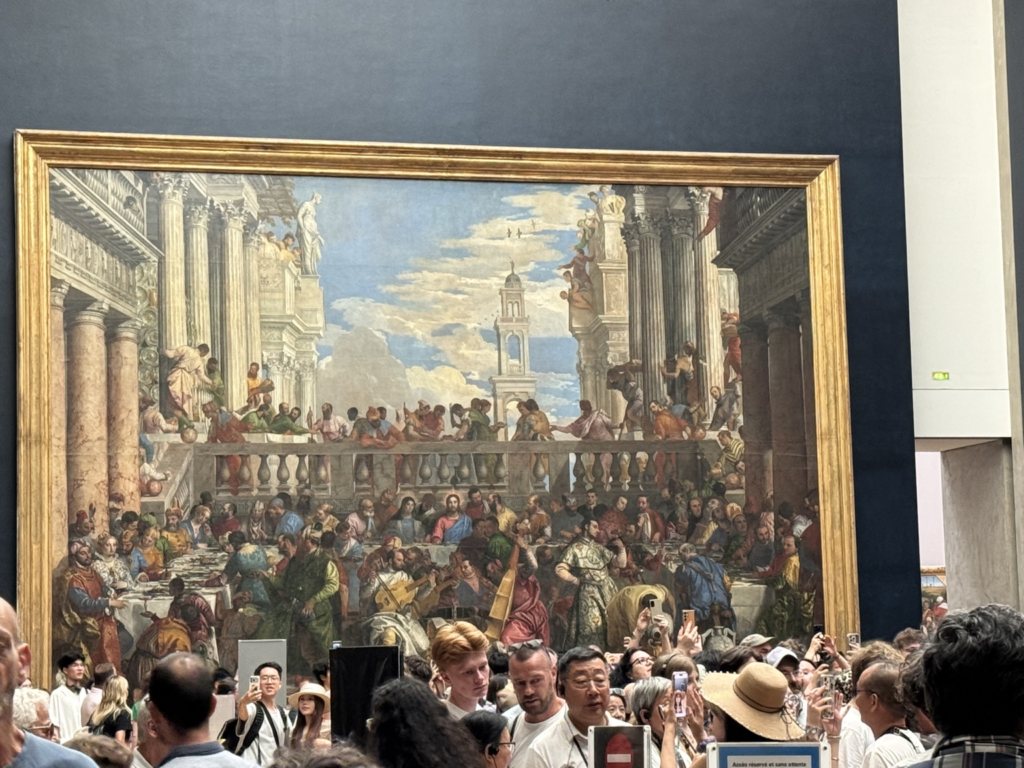
There is an uncomfortable lesson here for museums. Attention is not distributed according to artistic scale, complexity, age, quality, historical importance, or even physical visibility. Attention has its own economy. Once an artwork becomes sufficiently famous, the institution no longer simply displays it. The institution begins organizing itself around the consequences of displaying it. Routes change. Barriers appear. Security increases. Crowds accumulate. Signs direct movement. Rooms become waiting systems. The artwork starts designing the museum. In this sense, the Mona Lisa may be one of the most architecturally powerful objects inside the Louvre. She reorganizes space without moving.
The galleries of large-format nineteenth-century French painting brought a tonal shift I was not prepared for.
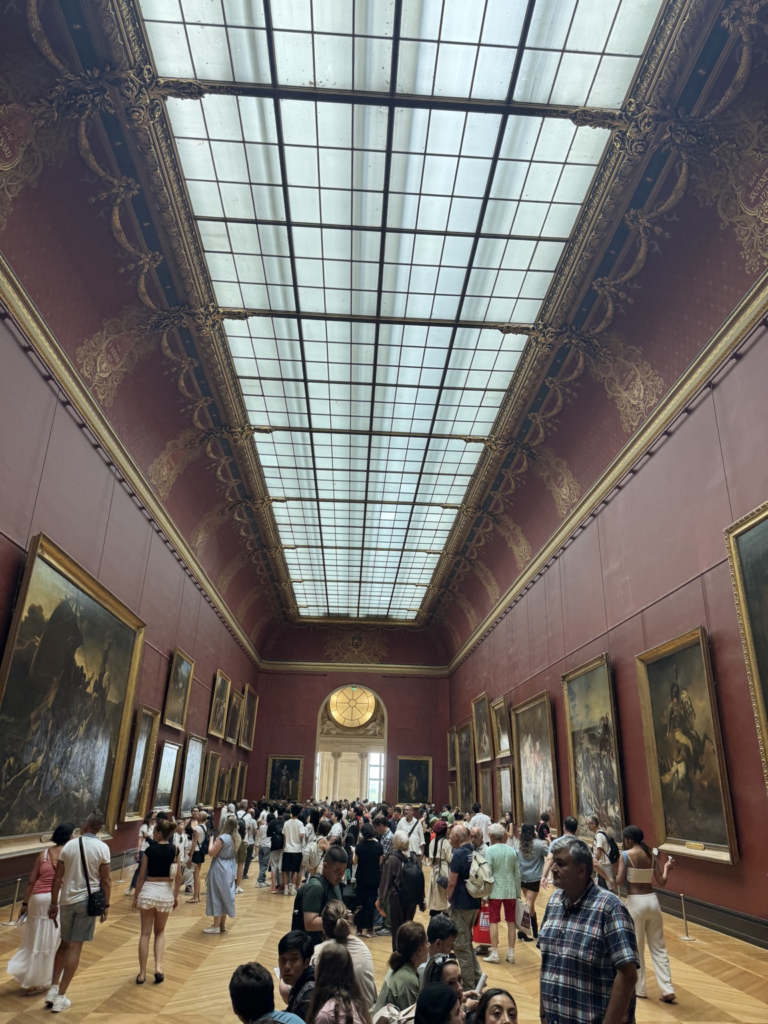
The Salles Rouges — the Red Rooms — are named for the deep crimson walls against which enormous canvases hang in gold frames under a glass skylight that floods the room with diffused natural light. The architectural proposition here is different from the intimate early Renaissance galleries. Scale is the argument. The paintings are designed to be experienced from a distance sufficient to take in the entire composition before approaching for detail. The room accommodates that distance. The parquet floor stretches ahead. The ceiling allows the eye to rise. The red walls intensify rather than compete.
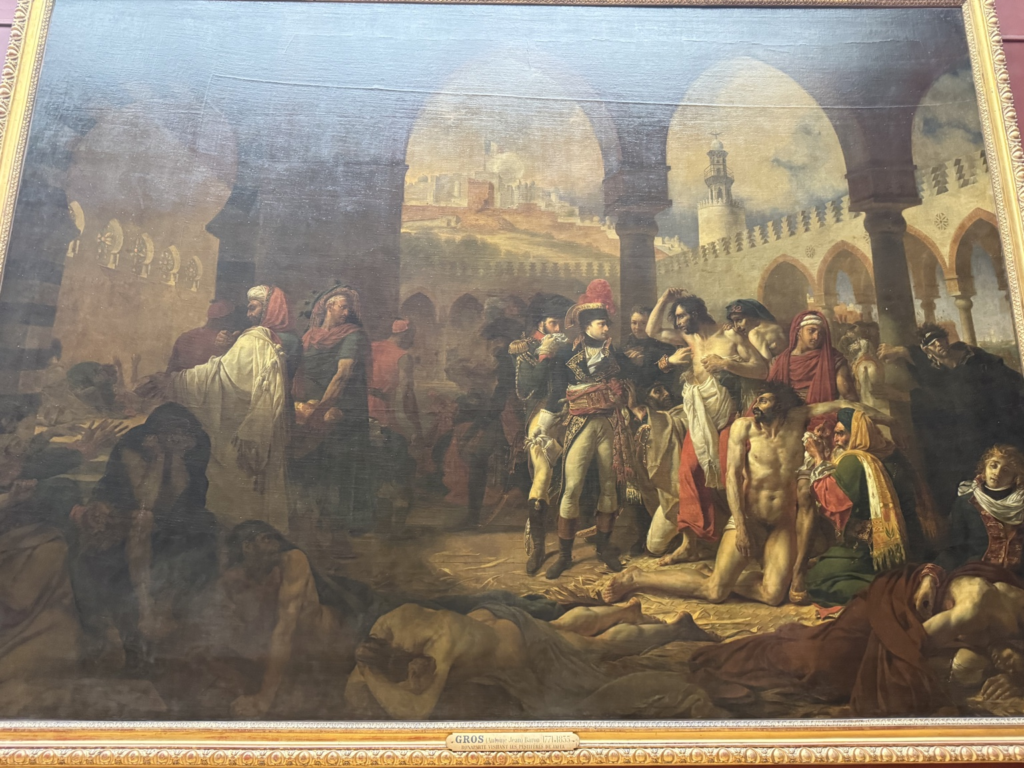
Antoine-Jean Gros’s Bonaparte Visiting the Plague-Stricken in Jaffa shifted the tone completely. Here painting becomes political engineering.
Bonaparte stands among plague victims, composed and physically present, while bodies around him collapse into sickness and fear. The message is difficult to miss. Leadership does not retreat. Leadership approaches danger. Leadership touches what others fear. It is an image designed to construct courage. And this is where paintings of power become especially interesting. We often call them history paintings as though history were simply what they record. But many of them do something more active. They manufacture the memory through which the history will later be understood. Bonaparte is not merely represented here. He is being designed.
The architecture helps. Arches frame the suffering. The distant city establishes geography. Light organizes morality. Bonaparte occupies a position that makes him visually legible within disorder. The painting is doing what political imagery has always done at its most sophisticated: taking an unstable event and giving it a composition. Reality is chaotic. Power prefers symmetry.
And yet the bodies resist. That is what saves the painting from becoming entirely obedient propaganda. Disease remains disease. Skin remains vulnerable. People kneel, collapse, expose themselves, wait. Suffering occupies too much of the canvas to disappear completely beneath the political message. The painting tries to turn catastrophe into leadership. The catastrophe remains visible anyway. That tension is where the work survives its own agenda.
Then there was marble. I photographed one sculpture too closely to identify it confidently afterward. Perhaps that is appropriate. I was not looking at the name. I was looking at the body.
At close distance, marble does something strange. You know intellectually that it is stone. The eye stops believing you. A curve carries softness. A surface appears warmer than its material should permit. Weight becomes flesh. The sculptor has removed enough stone to make the remaining stone deny what it is. This is one of those moments museums produce that photographs rarely preserve properly. You stop looking at “a sculpture.” You look at evidence that someone once persuaded geology to imitate skin.
And all of this happened while the building itself kept interfering. The ceilings are too elaborate to ignore. The rooms are too proportioned to disappear. Light enters through skylights above decorative systems that would themselves be museum objects in many other buildings. At certain moments I found people looking upward more than toward the walls. I understood them. The Louvre has a problem most museums would envy. Its container frequently competes with its collection.
This is also where I think the Louvre deserves institutional criticism. Not hostile criticism. Considered criticism.
The Louvre is operating inside a building that was never conceived in one moment as a contemporary museum. It is an accumulation: fortress, palace, galleries, additions, interventions, adaptations, modern systems placed inside historical shells. That complexity is one of its great strengths. It is also becoming one of its problems. The crowds have changed. Photography has changed. Phones have changed. The speed at which visitors move through cultural space has changed. Social media has changed the hierarchy of what people believe must be seen. And yet parts of the museum still feel as though the scenography assumes a quieter viewer from another century.
The Louvre does not need to become a digital amusement park. I would strongly oppose that. Its age should remain visible. Its seriousness should remain visible. But heritage cannot become an excuse for refusing to reconsider how attention is distributed. Crowd management is not the same thing as curatorship. Moving people efficiently toward the Mona Lisa does not solve the deeper problem if everything they pass on the way becomes visual wallpaper. The museum needs to think not only about circulation. It needs to think about attention.
This may also explain why the museum can be exhausting. Every direction contains significance. The floor has pattern. The ceiling has history. The wall has a painting. The doorway opens onto another axis. A sculpture appears between rooms. A crowd interrupts the view. A guide tells you a story. A phone appears in front of your face. The museum offers no visual silence. Eventually attention becomes the scarce resource. And that, more than physical size, may be the real difficulty of visiting the Louvre. You are not walking through a collection. You are continuously deciding what not to look at.
I think this is why the people who left our tour immediately for the Mona Lisa were not entirely irrational. In a museum where complete viewing is impossible, they had solved the problem brutally. Choose one thing. Find it. Leave satisfied.
I chose the opposite strategy. I accepted that I would fail. I would miss rooms. I would misunderstand paintings. I would forget names. I would photograph things I could not later identify. I would leave without remotely completing the museum. That failure produced a better visit. Because the Louvre is not something you finish. Anyone who tells you they “did the Louvre” has probably misunderstood the verb.
The Mona Lisa remains the jewel in the crown. There is no useful reason to pretend otherwise. Her fame is not an inconvenience attached to the Louvre. It is now part of the Louvre’s architecture, economy, symbolism and global position. She is a cultural fact beyond the painting itself. But a crown containing only its jewel would be a strange object.
The Louvre becomes interesting precisely when you allow the jewel to stop monopolizing the crown. Fra Angelico is there. Veronese is there. Gros is there. Painted cities that never quite existed are there. Madonnas occupy carefully constructed rooms. Saints preach in imagined landscapes. Empires manufacture their heroes. Stone becomes flesh. Ceilings compete with canvases. And somewhere inside all of this, thousands of people are still asking the same question. Where is the Mona Lisa?
I do not blame them. I asked it too. Eventually. I just did not let the answer end the visit.
The Louvre would be extraordinary without the Mona Lisa. But I do not think it would be the same phenomenon. A medieval fortress became a palace. A palace became a museum. A museum accumulated one of the greatest collections ever assembled. And then a 77-by-53-centimeter painting became so famous that it began functioning almost like the museum’s second entrance. Millions enter physically through the architecture. Culturally, they enter through her. That distinction matters. Because it explains both the strength of the Louvre and the problem it now has to solve. The museum has succeeded so completely in possessing one universal image that the image threatens, at moments, to obscure the universe around it. The next evolution of the Louvre should not diminish the Mona Lisa. It should make the rest of the museum harder to miss. That is a scenographic problem. An architectural problem. A curatorial problem. And increasingly, an attention problem.
As for our guide, she survived the day without needing the boxing. So did I. So did the remaining families. The Chinese group, I assume, obtained their photographs. The other families disappeared successfully into the Leonardo pilgrimage. The three individuals who continued with us remained somewhere inside the museum long enough to become part of my memory of the visit.
Again: Hi. Arch here. You chose the long route. I think you made the right decision.
And now the Seine cruise. The cruise that had been attached to my Louvre ticket because apparently admission to civilization required purchasing a river as well. I never went. After the museum, nobody asked about it. Not the guide. Not the remaining group. Not me. We eventually saw the Mona Lisa. Everyone dispersed. Each person went in a different direction. The ticket had done its real job. The boat became irrelevant.
Somewhere on the Seine, I imagine there was an empty seat belonging to a man who had technically paid to look at Paris from the water but had already spent the day looking at several centuries of civilization from inside a former fortress. I bought the river to enter the Louvre. Then the Louvre made me forget the river. Which may be the most convincing review of the museum I can give.
✦ ArchUp Editorial Insight
The observation that the Mona Lisa now functions as the museum’s second entrance is the article’s most structurally precise contribution, because it names a condition that has architectural consequences the piece does not fully pursue: when a single object acquires sufficient gravitational force to reorganize the movement patterns, security infrastructure, barrier placement, and staff deployment of a 72,000-square-meter institution, it has ceased to be a curatorial object and has become a planning constraint — one that the museum did not design, cannot remove, and can only manage at increasing operational cost, while the collection surrounding it absorbs the attention deficit that the celebrity node produces as a structural byproduct. The Veronese that covers seventy square meters and receives a fraction of the attention given to the panel occupying less than half a square meter is not a curatorial failure; it is the spatial evidence of an attention economy that the Louvre’s governance framework was not built to govern against, because the institution that controls which object enters the canon of universal recognition does not retain control over what that recognition subsequently does to the spatial and financial logic of the building that houses it — a condition this archive examined at the scale of the sacred in Masjid al-Haram, where the geometry of devotion and the geometry of throughput converged until the destination became indistinguishable from the infrastructure managing access to it, and which The Louvre established as the foundational institutional condition: a building designed as a weapon, converted into a palace, converted into a museum, and now partially converted, by a 77-by-53-centimeter panel, into a crowd management system that the building’s entire architectural history was never asked to anticipate.
Ibrahim Fawakherji — ArchUp