When 2D CFD Lies: Why Cylindrical Towers Demand 3D Wind Simulation

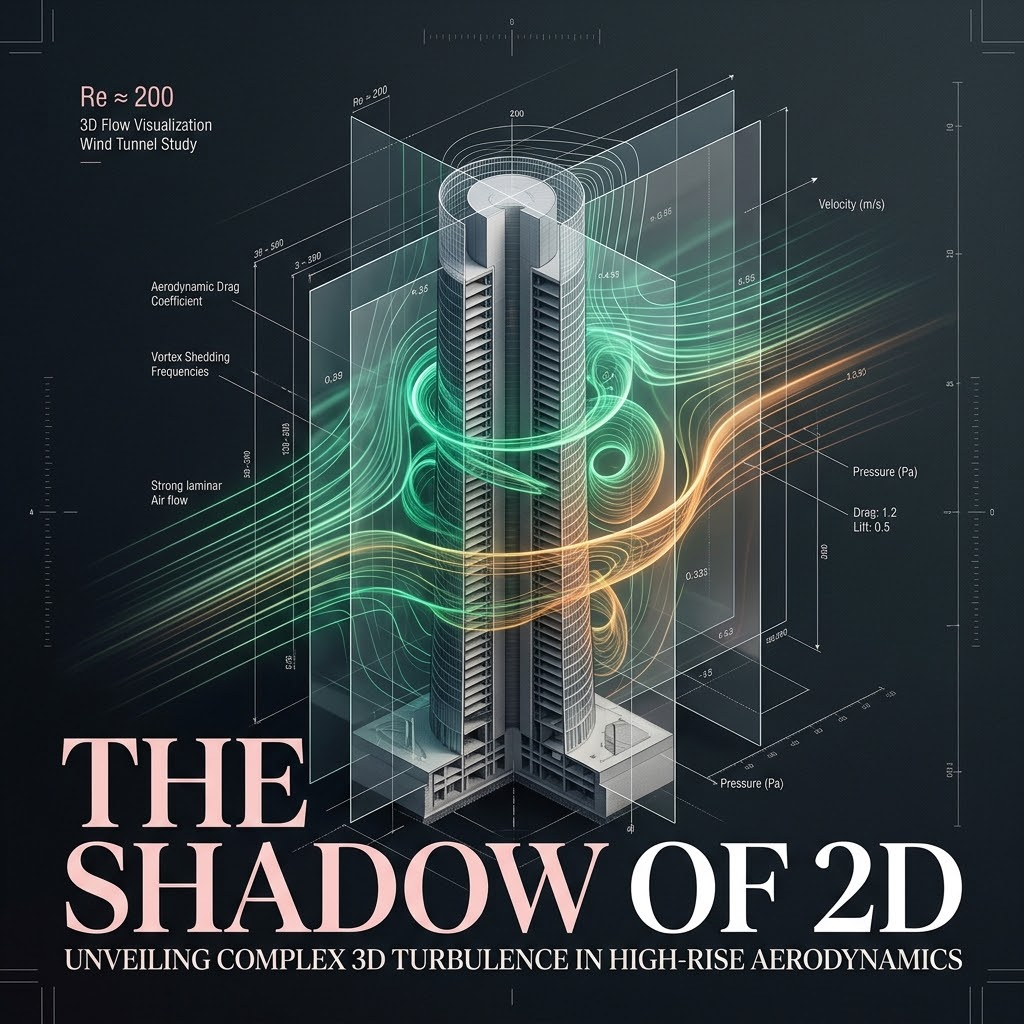
A facade engineer stands before a 200-meter cylindrical tower. The 2D CFD results say: drag coefficient 1.2, Strouhal number 0.21, wind load within limits. The engineer signs off. Two years later, the tower vibrates in winds the model never predicted. Investigation reveals: the 2D simulation assumed flow doesn’t change along the tower’s height — an assumption that collapses above Reynolds 200. Research from Tamura, Ohta, and Kuwahara (1990), Sakamoto, Murakami, and Mochida (1993), and Lei, Cheng, and Kavanagh (2001) agrees on one truth: flow around cylinders becomes fundamentally three-dimensional above Re ≈ 180-200. 2D models overpredict drag by 20-40%, predict higher Strouhal numbers, and delay separation. For a real cylindrical tower, this means wind loads designed with error, and facade details never truly tested.
The Magic Number: 180-200 Where 2D Flow Breaks
At low Reynolds numbers (Re < 180), flow around a cylinder is laminar and truly two-dimensional — vortices form in a single plane, and 2D modeling gives results identical to 3D. Rajani, Kandasamy, and Majumdar (2009) showed that at Re = 100 and 150, 2D and 3D results are nearly indistinguishable. But at Re = 200, “Mode A instability” occurs — vortices with axes parallel to the cylinder axis appear, extending in the spanwise direction. These 3D vortices change everything: they reduce mean drag, flip lift coefficient signs, alter vortex shedding frequency. At Re = 1000, Lei, Cheng, and Kavanagh found 2D simulation gives drag coefficient 1.44 versus experimental 1.0-1.2, Strouhal 0.233 versus 0.20. The difference isn’t a number — it’s tower safety.
Vortices You Can’t See in Cross-Section
The cylinder cross-section shows two neat, symmetric vortex streets — a beautiful image, but a lie. In reality, vortices have “heads” and “tails” stretching along the tower. Sakamoto, Murakami, and Mochida (1993) compared 2D and 3D LES for square cylinders and found the 3D model captures “vortex cells” with characteristic lengths 3-4 diameters. These cells mean wind load isn’t uniform along the height — high-pressure and low-pressure regions alternate. Design assuming uniform load (as 2D gives) under-designs facade on some floors, over-designs on others. Zhao, Cheng, An, and Lu (2014) in vortex-induced vibration (VIV) simulations showed structural response depends fundamentally on spanwise vortex correlation — correlation drops from 1.0 at base to 0.3 at top. The 2D model assumes perfect correlation (1.0 everywhere) — overpredicting vibrational response.
Drag Crisis: The Phenomenon That Doesn’t Exist in 2D
At Re ≈ 3×10⁵, “drag crisis” occurs — drag coefficient collapses from 1.2 to ~0.3 as the boundary layer transitions from laminar to turbulent, delaying separation. This phenomenon is fundamentally 3D: transition starts at specific spanwise locations and spreads. Zhao, Wang, Gong, and Xu (2023) in LES from subcritical to supercritical showed “separation bubbles” forming and vanishing in 3D. A 2D model cannot capture this — its boundary layer is either all laminar or all turbulent. Result: 2D predicts drag 1.2 at Re = 5×10⁵, reality is 0.3-0.4. For a 200-meter tower, this means designing facade for 3-4x the actual load — costly at best, or worse: designing for less than reality because the model mispredicted the transition zone.
Spanwise Length: The Forgotten Parameter in 3D Simulation
Even when moving to 3D, there’s a trap: spanwise domain length. Lei, Cheng, and Kavanagh (2001) tested lengths from 1 to 8 diameters and found convergence only when length exceeds 4-5 diameters. Lengths under 2 diameters prevent natural vortex cell formation, giving results closer to 2D. Bruno, Fransos, Coste, and Bosco (2010) for rectangular cylinders, and Bouris and Bergeles (1999) for square cylinders, confirmed the same rule: the spanwise domain must accommodate the natural wavelength of 3D instabilities. For the architect, this means simulating a “slice” of the tower (as some simplified CFD tools do) isn’t enough — you need a segment of sufficient length, or periodic boundary conditions representing an infinite tower.
The Facade That Breathes with Wind
The architectural implication goes beyond calculation: the cylindrical facade isn’t a passive skin — it’s a surface interacting with 3D flow that varies along the height. Pressure fluctuates spatially and temporally with frequencies and patterns that don’t exist in 2D. Recent studies (Tutar & Holdø 2001, Vidya, Beishuizen, & van der Meer 2016) show turbulence models (k-ε, k-ω, SST, LES) give widely divergent results in subcritical and critical regimes — choosing the right model matters more than mesh refinement. An architect relying on quick 2D “preliminary studies” designs a facade for a tower that doesn’t exist. The real tower lives in 3D flow, has vortex cells, undergoes drag crisis, vibrates with varying spanwise correlation. The facade that survives is designed for this reality — not for convenient mathematical simplification.
✦ ArchUp Editorial Insight
The research reveals that the gap between 2D and 3D wind simulation for cylinders isn’t an accuracy gap — it’s a physics gap. The 2D model doesn’t “simplify” reality; it constructs an alternative reality where flow doesn’t know the third dimension. In this alternative reality, vortices are perfect, symmetric, perfectly correlated along an infinite tower. Wind load is uniform, Strouhal number is constant, drag coefficient knows no crisis. The architect designing from this model isn’t designing a tower — they’re designing a cross-section extruded to infinity. The real tower is a 3D entity: it has a top and bottom, wind changes with height, vortices have wavelength, boundary layers undergo transition, structural response depends on varying spatial correlation. All of these are erased by 2D.
What strikes as counterintuitive is that early research (Tamura et al. 1990, Sakamoto et al. 1993) flagged this three decades ago, yet mainstream architectural CFD tools still offer “2D mode” as a default for quick studies. The justification is always “computational savings.” But the savings are illusory — modern 3D LES with periodic boundaries and sufficient spanwise length (4-5 diameters) runs on workstations in hours, not weeks. The real cost isn’t CPU time — it’s the cost of a failed facade, a vibrating tower, or a lawsuit two years post-occupancy. Studies comparing turbulence models (Tutar & Holdø 2001, Vidya et al. 2016) reveal another paradox: in critical and supercritical regimes, turbulence model choice (k-ω SST vs LES vs DES) affects results more than mesh refinement. The architect choosing “2D k-ε” for speed errs twice: in dimensionality, and in turbulence model.
The implications extend beyond cylindrical towers. Any architectural element with length far exceeding its cross-section — minaret, chimney, suspension bridge, continuous facade — faces the same dilemma. Flow around it is fundamentally 3D at operational Reynolds numbers. Architectural simulation tools (RWDI, Autodesk CFD, SimScale, OpenFOAM) all support 3D, yet their user interfaces still encourage “cross-section first” as a preliminary step. That interface is the design decision: do we start with the slice (simplification) or the volume (reality)? Any claimed reduction in on-site problems from a “3D first” workflow requires published, project-specific evidence. The shift isn’t technical — it’s cultural. The architect must reject the cross-section as a design language for wind.
The hanging question: are we heading toward a “digital twin for wind” where every tower has a live 3D CFD model updated with real wind data from facade-mounted sensors? The tech exists: GPU-accelerated LES, live weather feeds, wireless pressure sensors. The barrier isn’t computational — it’s the contract between architect, structural engineer, and wind consultant. Each holds a puzzle piece, and 2D was the comfortable “common language.” Breaking that language means the architect must understand 3D flow physics, the structural engineer must accept spatially varying wind loads, and the wind consultant must deliver design-actionable results, not just numbers. The tower that survives 21st-century winds isn’t the strongest — it’s the one designed with 3D truth, not 2D shadow.
References:
1. Tamura, Toshiyuki, Ohta, Isao, Kuwahara, Kazuo. “On the reliability of two-dimensional simulation for unsteady flows around a cylinder-type structure.” Journal of Wind Engineering and Industrial Aerodynamics, 1990.
2. Sakamoto, Shigeru, Murakami, Shuzo, Mochida, Akashi. “Numerical study on flow past 2D square cylinder by Large Eddy Simulation: Comparison between 2D and 3D computations.” Journal of Wind Engineering and Industrial Aerodynamics, 1993.
3. Lei, Chao, Cheng, Li, Kavanagh, Kevin. “Spanwise length effects on three-dimensional modelling of flow over a circular cylinder.” Computer Methods in Applied Mechanics and Engineering, 2001.
4. Rajani, B. N., Kandasamy, A., Majumdar, S. “Numerical simulation of laminar flow past a circular cylinder.” Applied Mathematical Modelling, 2009.
5. Zhao, Ming, Cheng, Li, An, Hong, Lu, Li. “Three-dimensional numerical simulation of vortex-induced vibration of an elastically mounted rigid circular cylinder in steady current.” Journal of Fluids and Structures, 2014.
6. Zhao, Zhen, Wang, Jun, Gong, Yan, Xu, Hui. “Large Eddy Simulation of Flow and Separation Bubbles Around a Circular Cylinder from Sub-critical to Super-critical Reynolds Numbers.” Journal of Marine Science and Application, 2023.
7. Bruno, Luciano, Fransos, Dimitris, Coste, Nicolas, Bosco, Alessandro. “3D flow around a rectangular cylinder: A computational study.” Journal of Wind Engineering and Industrial Aerodynamics, 2010.
8. Bouris, Dimitris, Bergeles, George. “2D LES of vortex shedding from a square cylinder.” Journal of Wind Engineering and Industrial Aerodynamics, 1999.
9. Tutar, Mustafa, Holdø, Asgeir E. “Computational modelling of flow around a circular cylinder in sub-critical flow regime with various turbulence models.” International Journal for Numerical Methods in Fluids, 2001.
10. Vidya, M. C., Beishuizen, N. A., van der Meer, T. H. “Direct numerical simulations of flow and heat transfer over a circular cylinder at Re = 2000.” Journal of Physics: Conference Series, 2016.