Monobloc Chairs: How Stacking Changes a Shared Space

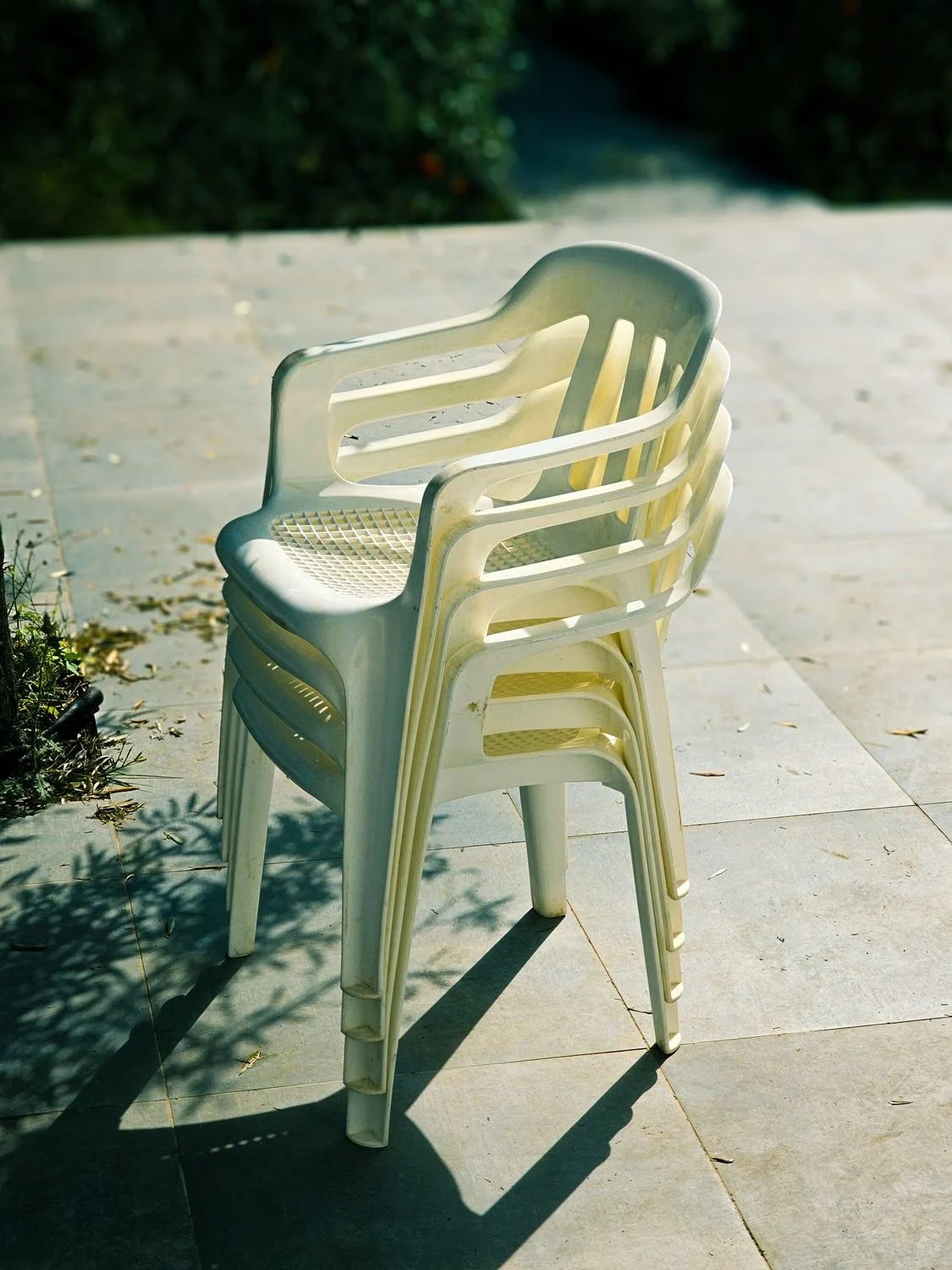
Stacked monobloc chairs. Photograph: Muharrem Alper.
A courtyard can host a meal in the afternoon and become an open play area once the chairs are put away. The white plastic monobloc belongs to that everyday transformation. Its seat, back and legs are molded as one body; in the familiar garden version, the armrests are included too. What matters spatially is not only how the chair looks, but how easily it can enter a room, gather with others and leave the floor clear again.
From a seat to a temporary arrangement
Separate chairs let people adjust their distance from one another. A circle supports conversation, rows face a shared activity, and a cluster around a table creates a place to eat. None of these arrangements has to become permanent. In a café, courtyard or shared hall, movable seating allows the same floor to serve different activities without changing the enclosing walls.
This freedom still depends on the layout. Chairs pulled back from tables need room, people need a clear way through, and unused furniture needs somewhere to go. Lightweight seating makes rearrangement easier; it does not remove the need to plan circulation.
Stacking is part of the shape
A monobloc is shaped for more than one person sitting down. Its legs, seat and back also have to accommodate another chair descending over it. Repeated units nest together, reducing the floor area needed when the furniture is stored. That relationship affects the proportions of the chair as directly as the seated body does.
The stack connects furniture design to the operation of a building. Keeping spare seats close to a gathering area can shorten the work of setting it up. Leaving the same stack beside a doorway can make access awkward. The useful space saved by nesting is therefore only part of the calculation; the position of that saved volume matters too.
A continuous body, shaped for production
Common inexpensive versions use polypropylene formed by injection molding. Heated material enters a mold, cools and emerges as a complete chair. The process removes the assembly of separate legs, seat and back. Investment in tooling is spread across repeated production, which helps explain the economic logic of the familiar form.
The body is not a solid mass of plastic. Curves, turned edges and molded ribs help resist bending without making every surface equally thick. Openings in the back reduce material and can provide a place to grip. These are general design strategies, rather than a guarantee that every model has the same strength or comfort.
The limit appears when a part breaks
A continuous molding avoids joints that can loosen, but also limits the replacement of individual components. A broken leg cannot simply be unscrewed from the seat. Repair involves the plastic itself or added reinforcement, with feasibility depending on the damage and the particular chair.
Polypropylene can be recycled, yet recyclability alone does not describe what happens to a discarded object. Collection, sorting and reprocessing must be available. Similarly, a low selling price does not establish an environmental benefit: the amount of material, manufacturing, transport and length of use all remain relevant.
Design context: “Monobloc” describes a family of one-piece chairs, not a single model with one author. Henry Massonnet’s Fauteuil 300 is one historical reference within that wider development.
✦ ArchUp Editorial Insight
Spaces used for meals, meetings and occasional gatherings face a practical pressure: seating has to be available when needed without occupying the floor all day. The monobloc addresses that pressure through a light, stackable body, making storage geometry part of the design of the room. Its value is therefore better judged as a system of chairs, clear routes and accessible storage than as an isolated object. A stack close to the activity area can make rearrangement easier; a stack placed in circulation simply transfers the obstruction elsewhere. For a café or shared courtyard, this suggests treating the storage location and the work of moving furniture as part of the initial layout. The trade-off emerges over time. Forming everything together simplifies assembly and everyday handling, but a damaged leg cannot be replaced as a separate component. A low purchase price consequently says little on its own about replacement costs or waste. The useful design question is how many changes of use the chair can support, and for how long, within a space that remains comfortable and easy to navigate.