5° Rogelio Salmona Latin American Architecture Prize: Call for Submissions

Organizer record: Fundación Rogelio Salmona · Directory record not yet reviewed
Brief
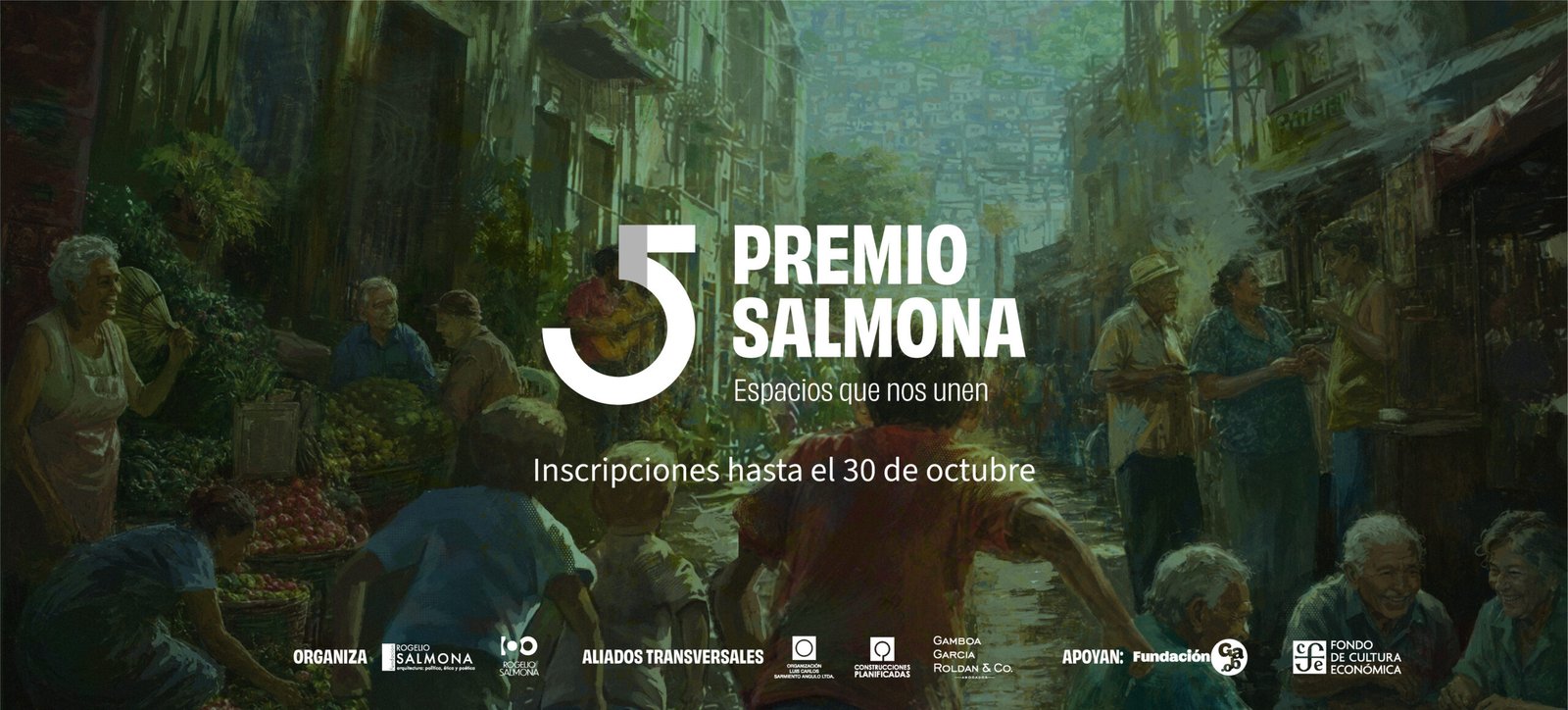
The fifth cycle of the Rogelio Salmona Latin American Architecture Prize examines how completed architecture supports shared urban life. Organized by Fundación Rogelio Salmona, it recognizes built works in Latin America and the Caribbean whose open spaces connect buildings, communities and the city. This is an award for existing work, not a design brief or a commission for a new building.
Eligibility and purpose
Eligible works must have completed construction or intervention between 1 January 2010 and 31 December 2020, lie in an urban context in Latin America or the Caribbean, and demonstrate collective use and community appropriation. Works entered in previous cycles are excluded. Authors connected to the jury, reception committee, academic committee or Foundation board, including professional partnerships or shared offices within the last two years, are also excluded under the rules.
Registration, fees and recognition
| Item | Published terms |
|---|---|
| Entry fee | COP 500,000, including local taxes; approximately USD 153. Conversion calculated on 4 October 2026 using USD 1 = COP 3,266.05 reported for 2 October. The payment provider’s rate and charges may differ. |
| Entry route | Initial registration and payment through the Foundation’s platform; successful payment unlocks the project upload account. Complete all required fields and submit finally. Final submission locks editing unless the Foundation reopens the file for corrections. |
| Recognition | Selected works join the fifth-cycle exhibition, publication and dissemination programme. The jury awards a Latin America distinction and a Colombia distinction; special mentions are possible. No monetary prize or construction contract is specified. |
| Refunds | No refund procedure is stated in the reviewed terms; clarify cancellation conditions before payment. |
Schedule
| Stage | Date |
|---|---|
| Registration and submission | 1 September–30 October 2026; enquiries accepted until 30 October. |
| Compliance review | 2 September–4 November 2026 |
| Corrections due | 6 November 2026 |
| Registered works announced | 10 November 2026 |
| Jury review | 23 November–10 December 2026 |
| Selected works announced | 15 December 2026 |
| Award ceremony and winners | 29 April 2027 |
The official timetable gives no closing hour or timezone. The countdown below is indicative only, set to 30 October 2026 at 23:59 UTC as an editorial reference, not an organizer-confirmed cut-off. Submit early and confirm the operative deadline through the official platform.
Submission requirements
| Material | Requirement |
|---|---|
| Project information | Location, completion and opening dates, authors, applicant contact, contractor and promoter details; completed authorization form. The impact-information field is collected for statistics and does not affect judging. |
| Description | Maximum one page or 250 words, explaining architecture, urban relationships and community use. |
| Drawings | Location plan, plans, sections and elevations, each with graphic scale. SVG, EPS or editable PDF, plus organized DWG source files with layers and references. Raster images cannot replace drawings. |
| Photography | One post-construction context image, optionally one before intervention, and 5–10 photographs of the completed work in use. Minimum 300 dpi and 3600 × 2800 pixels; TIFF preferred, JPG accepted. Include photographer names, credits and dates. |
| Video | One unrestricted permanent link, maximum five minutes, showing users, context and collective life. Selected entrants later provide MP4 or MOV in Full HD or 4K, with production credits and dates. |
| Presentation | Use the official PowerPoint template without altering its format. No independent A1/A0 board size is stipulated in the reviewed requirements. |
| Language and upload | Use the official online form. Spanish and Portuguese terms are available; an explicit submission-language rule was not identified in them. Confirm language acceptance before preparing the final files. |
Jury and assessment
| Juror | Published identification |
|---|---|
| Daniel Bonilla | Architect, Colombia |
| Francesco Careri | Architect, Italy |
| Nicolás Campodónico | Architect, Argentina |
| Gabriela Carrillo | Architect, Mexico |
| Marta Moreira | Architect, Brazil; written “Martha” in the terms, “Marta” on the current call page. |
The named panel brings architectural representation from several countries. The reviewed call does not provide individual biographies or numeric scoring weights, so specific expertise should not be inferred from nationality alone. Each juror has equal voting rights; the panel determines its internal method, seeks consensus and otherwise uses a simple majority. Decisions are final and not appealable; deliberations remain confidential until official communication.
Organizer, rights and document notes
Fundación Rogelio Salmona dates its establishment to 2009. Its history records a first prize cycle in 2014, a third in 2018 and a fourth in 2024; the current call describes the programme’s trajectory as beginning in 2013. These are distinct historical references, not evidence that this is a new organizer.
Entrants must hold all author, owner and image permissions. The Foundation may publish, reproduce and disseminate submitted material within prize activities and commits to crediting authors. DWG files may be used for redrawing and diagrams for the exhibition, publication and related dissemination. Responsibility for rights claims rests with the entrant. The Foundation may issue amendments. The Spanish rules’ section 4.1 still says “fourth cycle”, while the current call, schedule and other clauses identify the fifth; applicants should follow current amendments and clarify any material inconsistency.
✦ ArchUp Competition Review
The strongest architectural question is whether open space has sustained shared use after occupation. Requiring evidence from buildings completed years ago shifts attention toward lived performance. Photographs and video should show access, everyday activity and relationships with the surrounding city, rather than only an empty project at its opening.
The named jury and published decision procedure make the assessment structure legible, although the absence of scoring weights leaves discretion to the panel. The documentary workload, especially editable drawings and a video, is substantial relative to a recognition-based award. Applicants should weigh that preparation and the entry fee against the documented exhibition and publication opportunities; visibility is not payment, and no future commission is promised.
Sources reviewed 4 October 2026: official call, Spanish terms, Foundation history, and USD/COP reference. Reviewed under ArchUp’s competition transparency policy.
Time remaining for registration and submission
30 October 2026 · Indicative countdown assuming 23:59 UTC. The official closing hour and timezone are not stated.