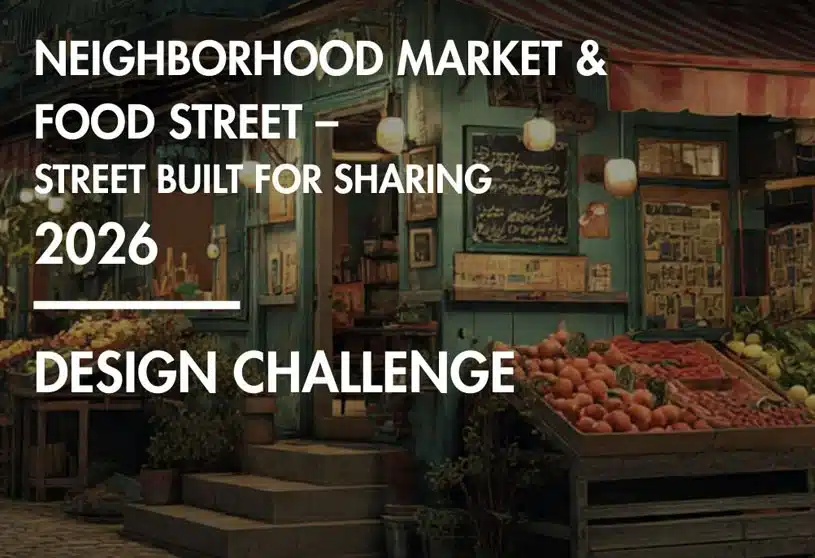
Neighborhood Market & Food Street 2026

Competition Brief
Throughout history, streets in cities have served as locations where people exchange products and share their narratives and different scents and various cultural aspects. The most dynamic parts of city life become visible through Neighborhood markets and food streets which create spaces for informal trading and socializing and shared community identification.
The design competition for The Neighborhood Market & Food Street – Street Built for Sharing invites designers to create a new street design which functions as a public space that accommodates vending and dining and walking and resting and gathering activities. The challenge requires designers to create an urban street design which prioritizes pedestrian needs while providing spaces for businesses to operate and making food traditions public and creating connections among community members.
Intent
The competition aims to explore how streets can move beyond traffic corridors to become inclusive, flexible, and socially rich public spaces. Participants should propose design solutions that:
- Support local vendors and small food businesses
- Enhance pedestrian experience and safety
- Encourage social interaction and cultural exchange
- Adapt to different times of day, seasons, and events
- Respond to local climate, context, and community needs
Purpose
The goal is to investigate how streets can function as platforms for social interaction, commerce, and cultural expression, offering designs that combine human-scale elements with practical utility.
Requirements
Participants may propose a street-scale intervention that includes, but is not limited to:
- Vendor stalls and food kiosks (temporary or permanent)
- Shared seating and dining zones
- Shaded walkways and weather protection elements
- Utility integration (water, waste, power)
- Storage and service zones for vendors
- Lighting, signage, and wayfinding
- Micro-public spaces for performances or gatherings
Designs should emphasize flexibility, modularity, and human-scale design.
Jury
- Experienced architects, designers, and educators from diverse backgrounds
- Evaluation criteria include spatial quality and placemaking
- Integration of vendors, food culture, and street life
- Pedestrian experience, accessibility, and safety
- Flexibility, adaptability, and time-based use
- Contextual response, feasibility, and innovation
Fees
| Stage | Start | End | Fees (INR) | Fees (USD) |
|---|---|---|---|---|
| Early Bird | 1st January 2026 | 22nd January 2026 | ₹ 500 | $ 6 |
| Standard Registration 1 | 23rd January 2026 | 8th February 2026 | ₹ 900 | $ 10 |
| Standard Registration 2 | 9th February 2026 | 22nd February 2026 | ₹ 1300 | $ 15 |
| Standard Registration 3 | 23rd February 2026 | 8th March 2026 | ₹ 1700 | $ 19 |
| Standard Registration 4 | 9th March 2026 | 22nd March 2026 | ₹ 2100 | $ 24 |
| Standard Registration 5 | 23rd March 2026 | 8th April 2026 | ₹ 2500 | $ 28 |
| Standard Registration 6 | 9th April 2026 | 22nd April 2026 | ₹ 2900 | $ 32 |
| Late Registrations | 23rd April 2026 | 10th May 2026 | ₹ 3300 | $ 37 |
Rewards
| Category | Recognition |
|---|---|
| Top 3 Winners | Publication, Certificate of Recognition, Jury Report, Interview, Free Memberships in architectural communities and forums |
| Honourable Mention x5 | Publication, Certificate of Recognition |
| Special Mention x1 | Publication, Certificate of Recognition |
| Shortlisted Entries x30 | Name & project title listed in competition results, Certificate of Participation |
Dates
| Milestone | Date |
|---|---|
| Launch Date | 1st January 2026 |
| Registration Deadline | 10th May 2026 |
| Submission Deadline | 20th May 2026 |
| Results Announcement | 26th July 2026 |
✦ ArchUp Competition Review
The Neighborhood Market & Food Street – Street Built for Sharing 2026 competition, which operates as an international event, challenges contestants to transform a street into an adaptable public area. The jury information provides general details about evaluation criteria although it does not reveal specific members, which reduces transparency. The competition exists as a professional academic competition because it evaluates urban design work which artists create for purposes other than design competitions. The competition fees require minimal payment in relation to work demands while competitors receive only recognition and publication as their primary rewards. Participants gain advantages through their portfolio creation and formal design work however the jury members show broad expertise without providing specific information about their qualifications which makes assessment standards unreliable.
Conclusion
The competition investigates how streets can be changed into active public spaces which people can use together. It requires participants to develop urban designs that create a balance between business operations, public spaces, and walking paths. Proposals need to show their community and cultural connections through three main elements which demonstrate their ability to adapt through human-focused solutions. The exercises show how streets can develop into more than basic walkways because they create understanding about architecture and urban life.
Explore the Latest Architecture Exhibitions & Conferences
ArchUp offers daily updates on top global architectural exhibitions, design conferences, and professional art and design forums.
Follow key architecture competitions, check official results, and stay informed through the latest architectural news worldwide.
ArchUp is your encyclopedic hub for discovering events and design-driven opportunities across the globe.
Registration Deadline
Brought to you by the ArchUp Editorial Team
Inspiration starts here. Dive deeper into Architecture, Interior Design, Research, Cities, Design, and cutting-edge Projects on ArchUp