Nest Chapel: A Hyperbolic Concrete Sanctuary in the São Paulo Countryside

In the rural landscape of Itu, São Paulo, religious typology often leans towards the traditional or the monumental. However, Nest Chapel, a recent intervention by Felipe Caboclo Architecture, presents a counter-narrative. Located on a 2,000-square-meter plot adjacent to the “Nest House,” this standalone structure does not seek to dominate its setting but rather to frame a specific moment of introspection through rigorous geometric control and material restraint.
The project operates as an autonomous sculptural object, defined not by religious iconography, but by the orchestration of movement, light, and the tactile qualities of raw Building Materials.
Spatial Configuration: The Choreography of Compression
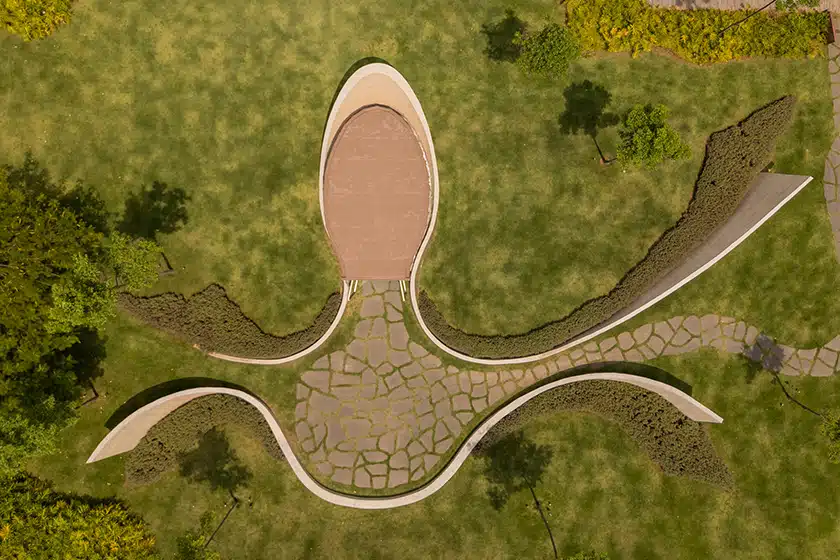
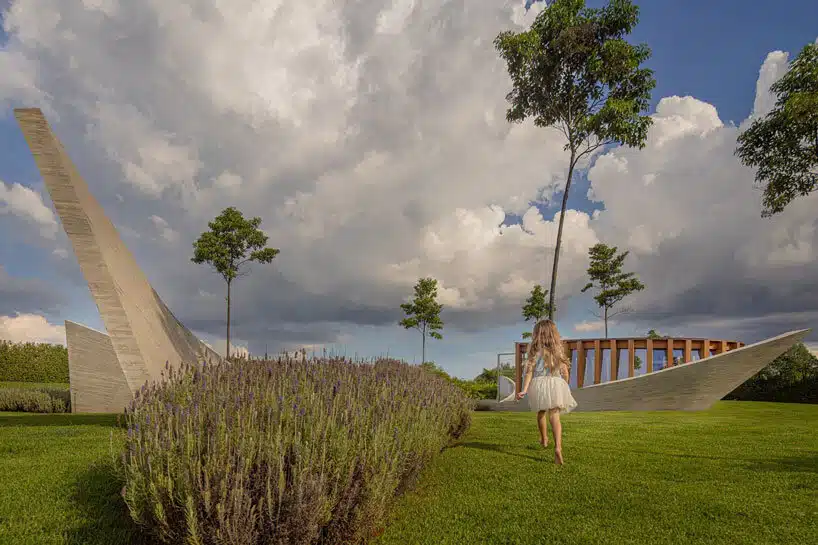
The architectural concept eschews the direct threshold. Instead, the Design is organized around two primary exposed concrete walls that follow a hyperbolic geometry. These walls curve and twist as they rise, creating a pathway that manipulates the visitor’s sense of scale.
This layout enforces a “processional movement.” As one approaches, the walls narrow, creating a sensation of compression that physically slows the user down, preparing the mind for contemplation. This sequence of compression and release creates a deliberate transition from the profane exterior to the sacred interior, emphasizing the act of walking as an integral part of the spiritual experience.
Tectonics and Materiality: Echoing Geology
The project’s materiality is deeply rooted in the geological context of Itu. The primary element, exposed concrete, is treated to reference Varvito, a local sedimentary stone known for its distinct layering.
-
Formwork Logic: The Construction team utilized five-centimeter timber formwork boards manually. This leaves a fine, imperfect horizontal texture on the concrete, reinforcing the handcrafted nature of the structure and mimicking the striations of the native rock.
-
The Inner Core: Inside the concrete shell sits a compact 10-square-meter prayer space. This oval volume is defined by laminated timber elements and finished with Freijó wood slats, providing acoustic warmth and contrasting with the cold exterior shell.
-
Grounding: The floor features brushed São Gabriel black granite laid in a broken-stone pattern. This irregular paving extends from the exterior in, dissolving the boundary between the landscape and the built form.
Landscape and Environmental Response
The landscape strategy is reductive yet sensory. A single-species path of lavender encircles the chapel, providing chromatic consistency and introducing an olfactory dimension to the architectural experience.
-
Ventilation: Despite the enclosed feel, two operable glass panes set at an angle allow for cross-ventilation, a critical passive strategy in the Brazilian climate.
-
Roof Geometry: The timber roof is slightly inclined to direct rainwater outward, utilizing a waterproof membrane to protect the delicate wood interior.
Nest Chapel succeeds as a phenomenological exercise. It proves that a sacred space does not require vast dimensions to evoke awe; it requires proportion and materiality. Felipe Caboclo Arquitetura has successfully translated the concept of a “cave” into contemporary concrete syntax.
However, the extreme compactness of the interior (10 sqm) raises questions about functional versatility for any gathering larger than two or three people. Furthermore, while the “broken stone” flooring reinforces the connection to nature, it may pose accessibility challenges for elderly users, a demographic often frequenting such spaces. Nonetheless, the project stands as a masterful example of how Interior Design and structural form can merge to create a singular, emotive atmosphere.
Project Data
-
Architect: Felipe Caboclo Arquitetura
-
Location: Itu, São Paulo, Brazil
-
Area: ~10 m² (Interior)
-
Materiality: Exposed Concrete, Laminated Timber, São Gabriel Granite
-
Photography: Fernando Guerra
Nest Chapel is a small-scale contemporary chapel set in the countryside of São Paulo, Brazil

the project was designed by Felipe Caboclo Arquitetura as an intimate space for contemplation and prayer
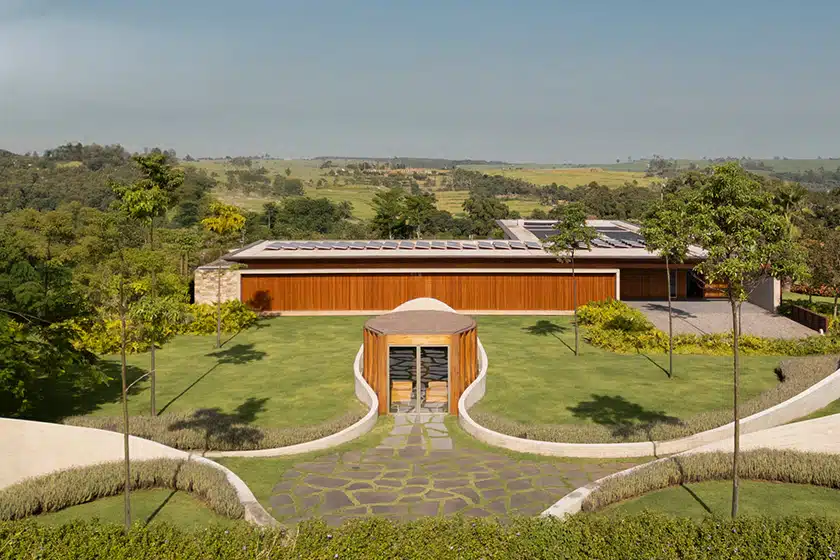
the chapel occupies a separate plot adjacent to Nest House in Itu


✦ ArchUp Editorial Insight
The Nest Chapel in the São Paulo countryside is described as a hyperbolic concrete sanctuary that mediates between sculptural poetics and spiritual stillness, articulating a monolithic presence that resonates with both tectonic gravity and quietude. The descriptive narrative captures its formal audacity, but the article could engage more critically with how such raw massing performs environmentally and experientially in tropical conditions—where rain, heat, and humidity are relentless tests of material and spatial logic. This echoes a recurring observation in Middle Eastern Architectural History, where beautiful forms sometimes evade rigorous performance evaluation. Positively, the chapel signals a renewed interest in embodied space and spiritual resonance, challenging the flatness of generic minimalism. Yet for this project to be more than a singular artifact, discussions of structural viability, thermal behavior, and ritual use over time would deepen its architectural anchoring. Over years, such scrutiny will distinguish enduring sacred architecture from mere formal spectacle.