North Hertfordshire Rural House: Context and Massing


Site Reuse and Integration with the Rural Context
The project is located on a site previously used as a vegetable garden in North Hertfordshire, containing the remnants of a dilapidated house dating back to the 1940s. The site, with its open character and expansive views over the countryside, offered an opportunity to reframe the dwelling as part of the existing natural landscape rather than an isolated object within it.
A Contemporary Reading of Rural Architecture
The project draws on the traditional rural architectural character of the region without resorting to literal replication of historical elements. Instead, the house proposes a contemporary approach that maintains a relationship with the surrounding agricultural environment, focusing on simplicity and visual integration with the site.


Spatial Organization and Its Relationship with the Landscape
The Design responds to everyday functional requirements by providing quiet work-oriented spaces alongside more open areas intended for gathering and hosting. At the same time, the spaces are oriented to take advantage of the surrounding natural views, strengthening the direct relationship between the interior and the external rural landscape.
Architectural Organization and Massing Distribution
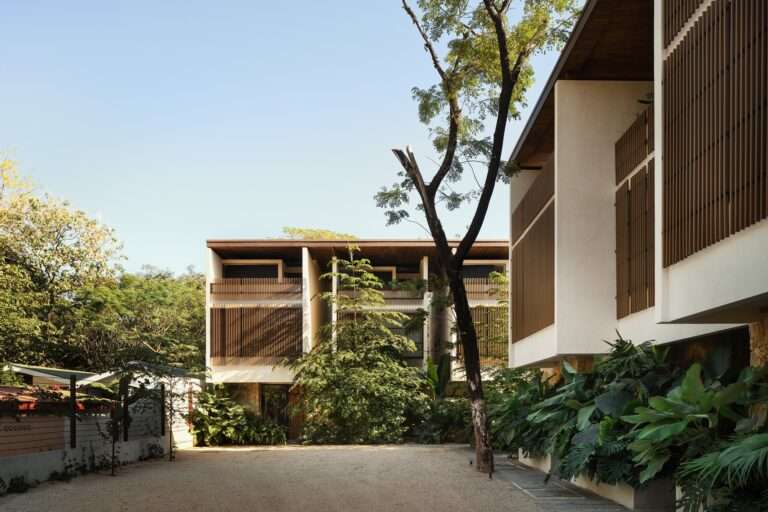
The Design is based on a fragmented architectural layout rather than a single unified volume, distributing functions across a central farmhouse and three independent outbuildings. Each structure reflects a functional and material character informed by the local residential and agricultural context, using simple and familiar materials. These units cluster around the main volume, forming sheltered courtyards that act as transitional buffers between the interior and the exposed site, generating a gradual sequence of calm external spaces.


Interior Treatment and Material Language
The interior design maintains visual continuity through a unified material language across all spaces. This includes exposed brick walls, traditional brick flooring, painted timber cladding, custom joinery, and visible structural timber beams. At the heart of the building, a spacious entrance hall is defined by a double-height void beneath an internal bridge supported by two oak beams, separating the main sleeping wing from the other bedrooms, with access provided via a dedicated staircase featuring a handcrafted handrail. Openings are carefully positioned to frame views toward the garden and the surrounding landscape.
Environmental Performance and Operational Systems
The project adopts an approach centered on optimizing the building envelope as the primary driver of sustainability. Enhanced insulation and airtightness are combined with mechanical ventilation with heat recovery (MVHR), air-source heat pumps, and stratified thermal water storage systems operating in response to occupancy levels. The system also incorporates rainwater harvesting technologies, as well as photovoltaic panels installed on a nearby former pig shed, enabling off-grid operation under suitable conditions.


✦ ArchUp Editorial Insight
This project operates as a material response to a dual pressure between the constrained economics of rural land and the adaptive reuse of low-value, degraded sites within a real estate market driven by value enhancement through transformation rather than expansion. The decision to deconstruct the massing into multiple buildings is not a formal gesture but a direct outcome of zoning constraints and Construction cost pressures that encourage distributing the program across smaller, phase-manageable units. This distribution produces a spatial compromise between the requirements of family living and the necessity of reducing structural risk, while transforming courtyards into instruments of privacy regulation rather than purely compositional voids.
Internally, the consistency of materials reflects a logic of operational simplification rather than aesthetic expression, while the integration of energy and water systems represents direct compliance with efficiency standards and reduced grid dependency. This positions the building within a redefined rural housing model shaped more by operational economics than by any autonomous Design intent.