A Pleated Glass Canopy Opens the First Phase of a Victorian Exhibition Complex’s Reinvention in West London

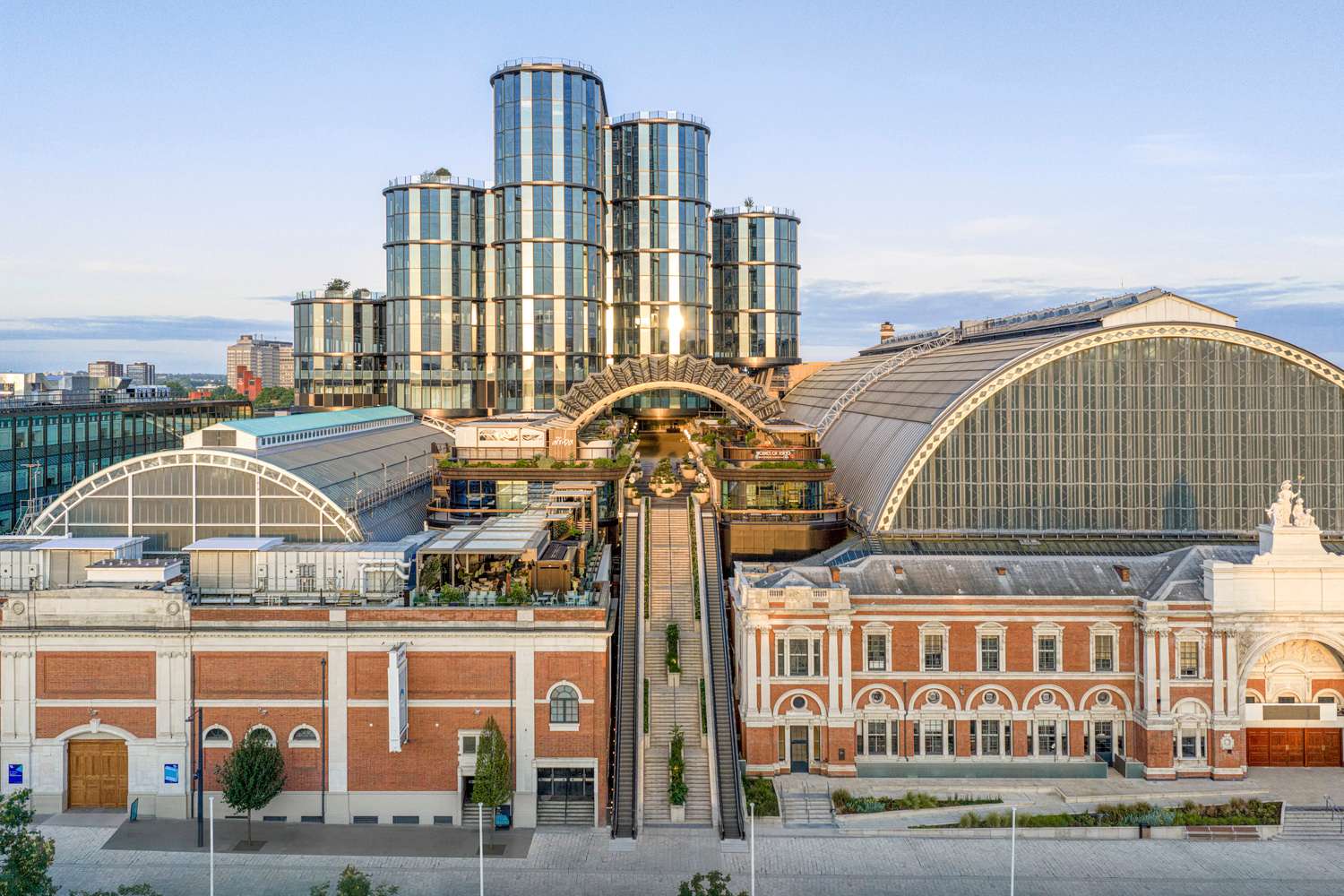
A 14-acre Victorian exhibition complex in West London has completed the first phase of its transformation into an open, mixed-use cultural campus a shift that replaces the site’s historically insular logic with a new network of public streets, elevated walkways, and terraces. The opening move centers on a completed public canopy that introduces a second-floor circulation layer above the Grade II-listed halls, reframing the visitor sequence and establishing a new threshold between city and campus. The broader master plan continues through 2027, layering performance venues, hotels, offices, and community facilities across the existing fabric.
Inverting a Closed Campus Through Public Circulation
Originally opened in 1886, the complex functioned for over a century as a largely self-contained destination. Visitors entered to attend exhibitions and left without engaging the surrounding neighborhood. The redevelopment directly addresses this insularity. The master plan opens previously inaccessible zones through a network of new streets, squares, and terraces woven between and around the existing buildings.
In turn, the project relocated service and logistical infrastructure below ground. This move freed surface-level space for public occupation and re-established pedestrian connections between the listed halls. The strategy treats accessibility not as an add-on but as the organizing principle of the entire campus reconfiguration.
Five Steel Arches and 520 Glass Panels Define the New Threshold
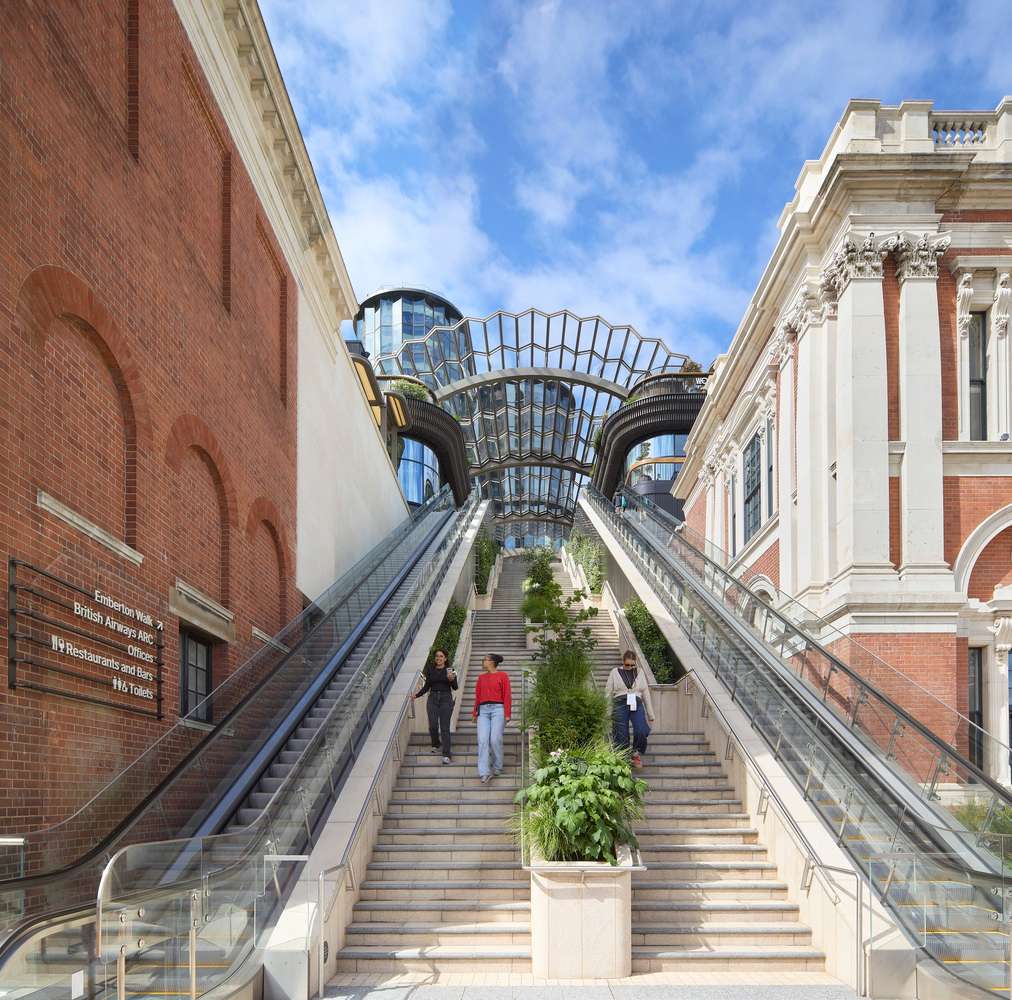
The first completed architectural intervention the new public canopy sits at the second-floor level above the exhibition halls. It provides approximately 1,000 square meters of publicly accessible space and functions as the primary entry point into the campus. A public staircase and escalators extend beneath it, lifting visitors from ground level into the elevated circulation routes above.
Five curved steel arches, each spanning 22 meters, support the canopy structure. A roof composed of 520 pleated glass panels encloses the space. The design team developed the canopy’s form and detailing in dialogue with the Victorian fabric of the original complex, drawing from the architectural language of the historic Grand Hall. At the same time, the contemporary construction registers as a distinct intervention rather than a pastiche.
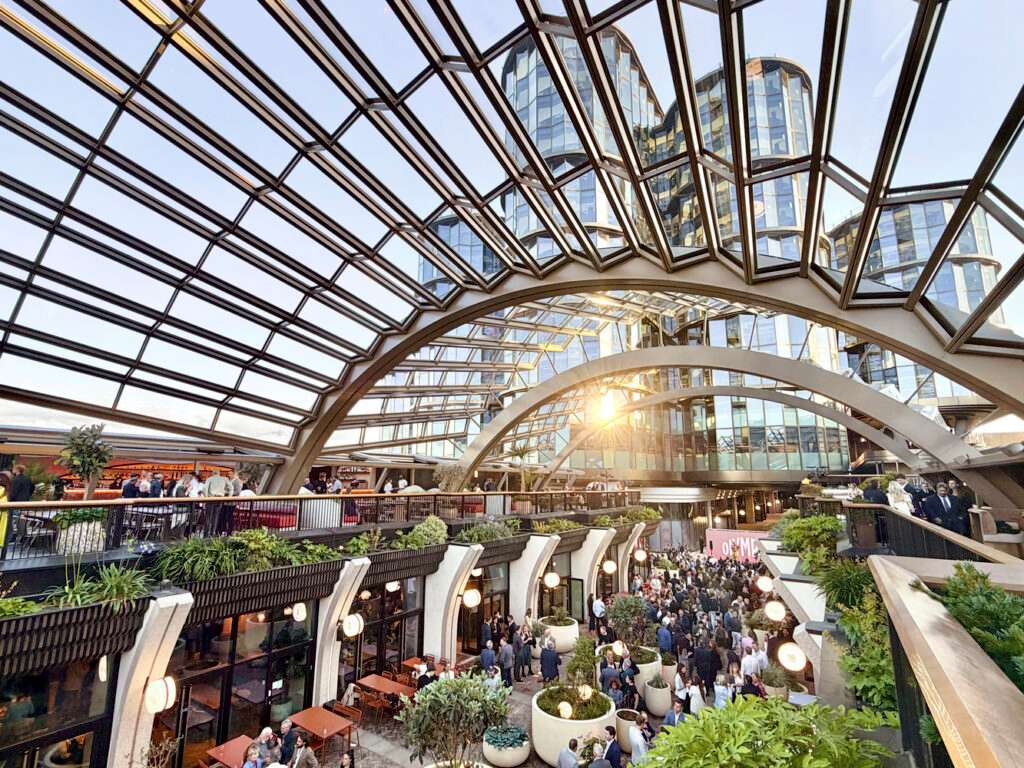
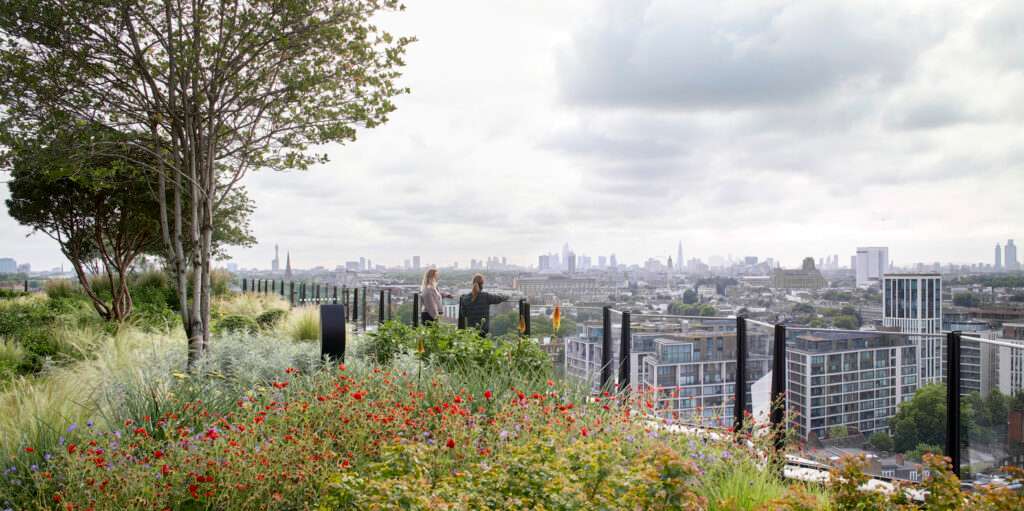
From the canopy level, visitors gain views across Olympia’s historic cast-iron and glass roofscape. The intervention introduces a new reading of the site — one experienced from above, where the layered accumulation of Victorian engineering becomes visible as a continuous landscape of arched forms and glazed surfaces.
Cultural, Hospitality, and Workplace Programs Fill the Master Plan
Beyond the canopy, the wider redevelopment introduces a dense programmatic mix across the 14-acre site. Planned additions include a 3,800-capacity live entertainment venue and a 1,575-seat theater. Two hotels, restaurants, cafés, and approximately 550,000 square feet of office space form the commercial layer. The scheme also reserves dedicated rehearsal facilities for local organizations, embedding community use within the broader commercial campus.
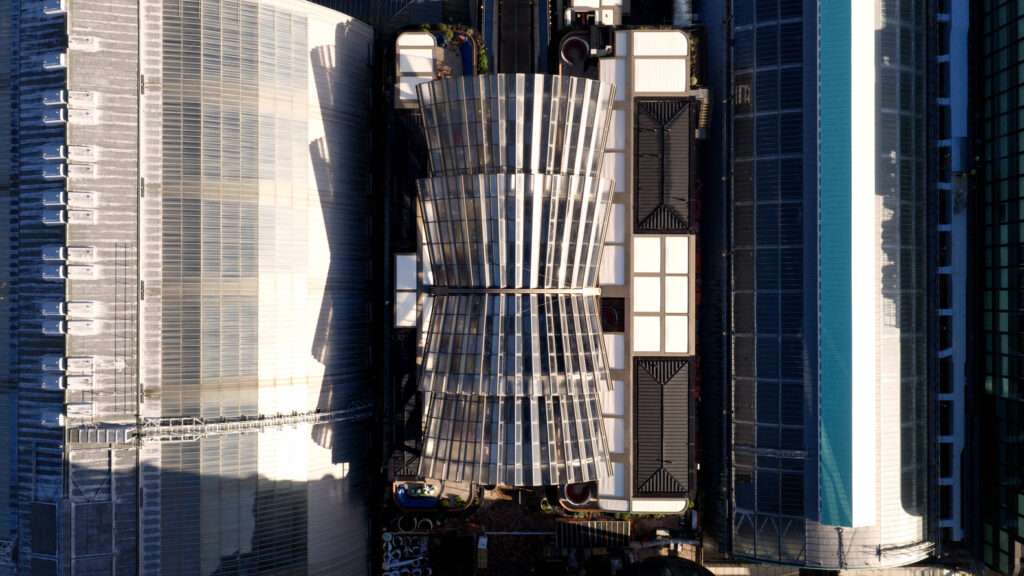
The exhibition halls remain operational throughout the phased transformation. The master plan schedules the remaining phases for completion through 2026 and 2027. More specifically, the phasing strategy allows the complex to continue hosting events while new architecture and public space emerge incrementally around it.
Circulation Hierarchy and the Problem of the Elevated Threshold
The most architecturally significant decision in this first phase lies in placing the primary public threshold at the second-floor level rather than at grade. This move inverts the conventional arrival sequence of a large urban complex. Instead of arriving into a ground-floor lobby or forecourt, visitors ascend through a staircase-and-escalator assembly before reaching the canopy — the point at which the campus reveals itself. The canopy therefore operates simultaneously as enclosure, viewing platform, and gateway. Its structural logic five 22-meter arches carrying 520 pleated glass panels borrows the rhythmic repetition of the Victorian halls below while asserting a different tectonic register through glass rather than cast iron. The scheme’s real test will arrive as subsequent phases introduce the theater, entertainment venue, and hotels. Whether the elevated canopy can hold its role as principal threshold once multiple ground-level programs compete for pedestrian attention remains an open spatial question. For now, the intervention successfully reframes a closed campus as a site of public movement and layered occupation.
✦ ArchUp Editorial Insight
The article frames the project as a generous civic gesture: a sealed Victorian island finally cracked open through buried logistics, woven streets, and an elevated glass threshold that lifts the public into the roofscape. The diagnosis treats accessibility as the organizing intelligence of the entire scheme, positioning the canopy as both structural homage and urban hinge that resolves a century of insularity through layered, pedestrian-first architecture.
Yet pushing the primary threshold to the second floor is not neutral hospitality it is curated filtration. Genuine public space rarely demands an escalator climb past commercial frontage to reach it. With 550,000 square feet of offices, two hotels, and ticketed venues anchoring the program, the “open campus” reads less as restored civic ground and more as choreographed retail circulation dressed in heritage glass for adjacent cities audiences.
Project Team: Heatherwick Studio and SPPARC (design architects). Original Victorian complex designed by Sir Henry Edward Coe. Location: Olympia, West London, United Kingdom.
Project Notes: The first phase, including the public canopy, has completed and opened. The wider master plan continues through 2026 and 2027. The program includes a 3,800-capacity entertainment venue, a 1,575-seat theater, two hotels, approximately 550,000 square feet of office space, restaurants, cafés, and community rehearsal facilities. Developer and client not specified in source.