The Night I Fled Europe

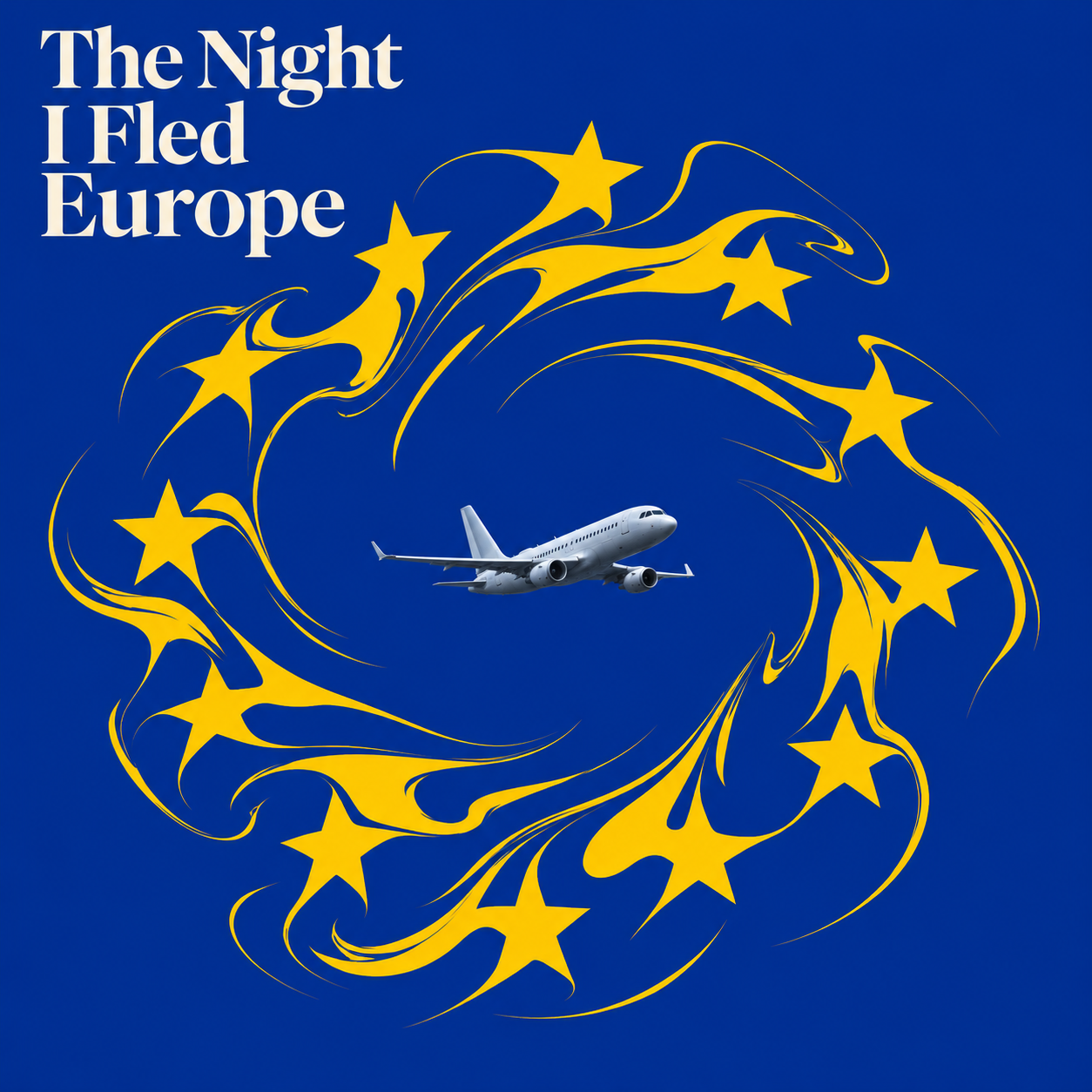
A Chinese robot, a French strike, and a taxi that rearranged the world in the small of my back
By Ibrahim Fawakherji — ArchUp
On 2 November 2026 I landed in Paris, not as a tourist hunting a tower to photograph, but as part of a professional delegation that had come to see the future of hospitality, interior design and building equipment. The programme was packed like a minister’s diary, visits and meetings and a long look at French products and industries, and the truth is I enjoyed it. I will not open an article about France with an insult and then leave the reader thinking I found nothing there worth the trip. We found fine industrial detail, elegant solutions, and a design heritage that still rewards study. All of that is true. What I did not know was that the most striking scene I would carry home from the trip would not be inside any pavilion, but at the gate, and that I would return from a journey about the future with an article titled, without exaggeration, the night I fled Europe.
It seems people love me
Before I travelled, the phone rang more than usual. Friends and acquaintances asking in the tone of someone seeing a man off to the front. Where to? France? At this exact moment? Don’t you know what’s happening there? There was news of protests and strikes and transport trouble, the kind that reaches a traveller before his suitcase does. At first I handled it with the calm of someone who is not travelling for the first time. But as the calls repeated, I discovered a lovely truth about myself. It seems a fair number of people genuinely love me, or at least cannot stand the idea of losing me to a foreign strike. And that, in an age thin on feeling, is a sentiment worth being grateful for. I reached Paris, the first day passed like any orderly day, then came 3 November, and with it came everything.
A girl carrying the future on her shoulder
After a long day I agreed with my colleagues to meet in the square near the gate and take our car from there. I stepped out a little before them and stood watching people, a habit I have never been cured of, since I sometimes find watching people around a building more absorbing than the building itself. Those arriving and leaving crossed paths, this one carrying a bag, that one a sample, a third something whose relation to the place was hard to guess. Then a man in his fifties passed in front of me, beside him walked a girl of seventeen or eighteen carrying a large screen I put at about thirty-two inches, while he carried other equipment. I did not know the nature of the relationship, colleagues perhaps, or a set-up crew. But the scene caught me by the collar. A girl that age carrying a heavy screen and heading to work at an hour when most people were leaving. For a moment I wanted to lighten her load, then I realised I did not know her story, and that what looked to me like a burden might be the first rung of her ladder. So I respected the scene and said nothing. And minutes later came something that made that screen look as though it had arrived from a museum of old devices.
The boy who was not a boy
From a distance I saw someone walking in the company of a man, relatively short, wearing what looked like a face mask, a shirt, and shoes closer to Crocs. Because I did not have my glasses on, I took it at first for a child out walking with a parent. But its gait carried something children do not walk with, something too precise. I looked harder, and discovered the child was not a child. It was a humanoid robot, walking beside someone leading it or watching its step, of the kind Asian companies, the Chinese especially, have been pushing to the front in recent years. An utterly simple scene, a man and a robot crossing an exhibition square, yet to me it said more than half of what I had seen inside, because technology here was no longer an image on a screen carried by a tired girl, but a body walking on two legs among people, entering through the same door we were leaving by.
The glance that comes after the robot has passed
The funny thing is that the robot was not the wonder, the people were. Some saw it and walked on as if nothing had happened, some passed it without a flicker. Then, a few steps later, I saw people turning to look back. As though each first wanted to prove to the world that he was a composed man no machine could shake, then granted himself, bashfully, a licence to look. Others raised their phones and filmed it from behind, like someone taking a photo with an important figure after missing the chance to shake hands. The scene was not loud, no one shouted, no crowd gathered, only glances. And that is exactly what drew me to it. Glances I could not read a single way, astonishment perhaps, or curiosity, or disbelief at a machine strutting in a place that had been the preserve of humans. But, as is my habit in projection, I heard within me a question larger than the scene could bear. Were these people looking at a robot, or at their own professional future walking past them in Crocs, without asking their permission? I do not know, and I do not claim to read minds. But that is what occurred to me, as I watched a screen carried by hand on one side, and a machine walking by itself on the other, in the same place, on the same day, in a country that built much of its glory on industry and skill. Two shots from a single film, a film whose shooting is not yet finished, and whose lead is absent from the set.
Then I remembered I had a plane
Amid all this the messages began to multiply. Ibrahim, you know Thursday is a strike? You’re travelling on the fifth? Have you checked the airport? Will the trains run? And so we entered the second chapter of the novel. I had arranged my return for 5 November, the very day set aside for a wide union action. The first warnings of disruption to some trains and suburban networks had already been published, then it became clear the effect would be uneven, some lines disrupted, most of the metro, tram and buses running, with the possibility of stations closing because of the demonstrations. That is, France was not going to stop entirely, and that is a fairness that must be stated. But my problem was not that I knew what would stop, it was that I did not know. A traveller does not read the transport map the way the employee who takes the same route every morning reads it. The resident knows the alternatives and the lines and the stations, whereas I was trying to reduce a whole city to three things, a hotel, a car, and an airport, and I did not want any of them turning into a fresh adventure at midnight. What if the train was late? What if the road was closed? What if the flight was cancelled and I found myself carrying my suitcase in a city I did not know how to leave? Every question gives birth to two, and the truth is I was not afraid of the French, I was afraid of uncertainty, and between the two there is an essential difference. I am not one to put the worker’s right to demand his dues on trial, nor do I possess the detail of their economy that would qualify me to. But as a user of the city rather than an analyst of its affairs, I am entitled to speak of the effect of ambiguity on a visitor’s experience. A strike, for the worker, is a legitimate means of pressure, and for the traveller it is an obstacle to arrival, and both are true at once. And here the city’s responsibility appears, not merely in allowing people to speak, but in giving the one who comes to it a precise piece of information on which to build his decision, rather than leaving him prey to his own guesses.
Europe and the robot that came through the door
I began to tie the two scenes together, the machine walking in the square, and the strike I was dodging. And I know the connection may seem unfair, for the robot does not cancel a human’s right to strike, and automation alone does not solve the question of wages or pensions or social justice. But the irony was too heavy to ignore. At the moment the old continent was debating the terms of labour and its costs, a machine was walking in front of me on two legs, come from another industrial world that does not debate but manufactures and exports. So I asked myself a question I do not have the answer to, can venerable economies keep their old privileges while the tools of production shift beneath them at this speed? And if a machine can now do what ten once did, will institutions respond by retraining people and raising productivity, or keep defending arrangements cut to the measure of an economy that has ended? This is not a French question alone, and I do not claim that all of Europe is in one sinking boat, for even in France itself there are solid industries, research institutions, and engineering skills not to be underestimated. But the scene I saw carried a symbol hard to resist, a robot walking into an exhibition about the future, and me searching for the shortest way out of the city.
Fleeing to the Middle East
Then began the stranger irony. I decided to return before my date and cut the stay short. But where was I fleeing to? To the Middle East. The region the news bulletin opens on so that you think it lives forever on the edge of explosion, political tensions, military threats, exchanged statements, talk of Washington and Tehran and possible escalation. And the regional scene was not entirely calm, to be honest. And yet I was arranging my return with a sense of reassurance resembling a man’s return to his home. And here I need to put a full stop before I am misunderstood. I am not saying the whole Middle East is safer than the whole of Europe, nor do I think one traveller’s experience can rearrange the continents by safety. But I am saying that, on that particular night, the place the news calls a tension zone was the place I knew how to move in and sleep in and return from to my family, while the European city I had visited on a professional mission had come to carry a measure of ambiguity in the mere plan of my departure. I smiled at the irony. I was fleeing a possible strike in Europe to a region the news fears could catch fire into war at any moment. And this, by plot alone, deserves a short film and a director unafraid of ironies.
Hold the door
When I told some colleagues I was leaving early, they were surprised. Why? The exhibition was not over, and a strike does not necessarily mean everything stops. And that is true, the event was scheduled to run for several more days. But I had done what I came for, and I saw that staying until the last day would not add to the trip anything to match the odds of disruption I was trying to avoid. I had dinner, said goodbye to the company, and went back to the hotel. I suspect some of them thought my decision excessive, but I had already made up my mind, and in such moments I reduce the whole discussion to a single phrase with no second, my friend, hold the door.
The Chinese car that pleased my back
On the morning of departure I ordered a taxi, and a Chinese car came, perhaps the last and most eloquent of the trip’s ironies. Hours earlier I had been contemplating a robot, most likely Chinese, walking in a French exhibition, and now I sat in a Chinese car cutting through the streets of Paris to the airport. And I will be honest with you, reader, I have driven the German, owned the Japanese, tried the French and the Italian, and I now drive an English one I will not name, and I have enough experience to make me a little hard to please. But that Chinese car surprised me, specifically the seat, the backrest, the sitting position, that general comfort you only notice when you lose it. Perhaps it was the model, perhaps the quality of the seat, perhaps the fatigue of the working days, but I found my back resting in a way I had not expected from a taxi. I laughed to myself. Did I need to travel to Paris to discover that a Chinese car might grant the small of my back the mercy that luxury cars I am addicted to had denied it? Perhaps. And in any case, my back was happy, and in travel that is a measure not to be underestimated, perhaps the truest measure of all.
Who is really advancing?
On the way to the airport the images returned, the robot, then the girl and the screen, then the strike, then the comfortable seat. And I began to think about the concept of progress itself. We usually tie it to the vast things, the economy and the GDP and the towers and the airports and the universities. But progress sometimes gives itself away in small details, in a city’s ability to tell its visitor what will happen, in a system’s ability to offer an alternative, in a factory’s ability to produce a comfortable car at a competitive price, in a girl’s ability to reach a chance at work, in a robot’s ability to leave the lab and walk among people. None of these alone proves the rise of one civilisation and the fall of another, but it reveals where the competition has moved as it changes its pitch without announcing it. The future does not wait for cities to agree that it has arrived, nor for companies to finish their meetings, nor does it flatter states out of respect for their venerable past. And here I return to the Europe I love to visit, and love its architecture and museums and streets and industries. But love does not oblige me to applaud everything that happens there. A great architectural and industrial history issues no guarantee for the future, and the city that made tomorrow yesterday is not exempt from the duty of making it again, every morning, with its hands and not its memories.
Home is not a news bulletin
I reached the airport, and my departure that day was entirely ordinary. I did not test for myself the effect of the 5 November strike because I left before it, and that in turn is part of the story. I may have avoided a real problem, and I may have cut the trip short without much need, and I cannot be certain. But a decision to travel does not always need to become a historical verdict to be understood by the one who made it. I boarded the plane, and Paris receded beneath me, and as I reviewed the days I remembered the late Saudi poet Musaed al-Rashidi and his line addressing the homeland, a homeland whose evening is made happy by you, the sun has not set but that it longs for your parting, that line which makes the homeland a person worthy of greeting rather than a mere area on a map. And I thought about the meaning of safety, not the safety for which states draw up a schedule and a ranking, but that particular feeling that lets you know where you will sleep, and how you will reach your home, and who you will find waiting when you return. It may be a feeling that cannot be generalised, but it was mine, and I am not writing a news bulletin, I am writing what I saw.
The night I fled Europe
It was a good trip, I learned from it about industry and design and hospitality, I saw products worth attention, and I met new people and experiences. But what stayed with me most was not a French product, it was three scenes, a girl carrying a screen, a robot walking among people, and a Chinese car that gave my back some mercy on the way to the airport, and between them all a French strike that pushed me to rearrange my trip. I do not think these small events permit me to declare the fall of Europe, or to crown one civilisation on the ruins of another, for things are more complex than an article written by a man whose back was comforted in a taxi. But they do permit me a question harder than any ringing declaration, do we still measure the strength of the world by what it accomplished yesterday, or by what it can accomplish now? Cities are like companies, their history may be great, but history does not come every morning to run their trains, nor build their robots, nor guarantee that their products stay the best, rather they must work at it anew, every day. As for me, I entered Paris for an exhibition about the future of hospitality, and left it thinking about the future of work and industry and transport and safety. And if someone asks me years from now what I remember most about November 2026, I will not say I witnessed a strike, for I did not stay to witness it, and I will not say I discovered the end of Europe, for that is bigger than a single shot. I will say I saw a robot walking in Paris, and saw people turn to it after they had passed it, then decided to leave before the strike, and on the way a comfortable Chinese car came for me, so I boarded the plane and went home. I fled Europe, yes, but it seems the future was entering it through the door at the very moment I was slipping out.
✦ ArchUp Editorial Insight
This is a first-person travel essay, and its register is personal reportage rather than forensic analysis — the author says plainly he is writing what he saw and not a news bulletin — so the editorial note is simply that its conclusions about civilizational decline are impressions the piece itself repeatedly disowns, and the political frame it touches, European labor action and Middle East tension, is a live and contested matter on which the essay offers a traveler’s feeling rather than an account, and wisely declines to adjudicate. What survives as genuinely structural is the one observation the author reaches almost against his own narrative: that his anxiety was never about the strike itself but about uncertainty, the gap between what a resident knows and what a visitor can know, and that the city’s responsibility is not merely to permit its workers to demonstrate but to give the person arriving a precise piece of information on which to build a decision rather than leaving him prey to his own guesses. This is the identical legibility argument this archive traced in The Fare I Paid Without Thinking, where the modern city’s apparatus of reception became so invisible that the traveler could no longer comprehend or navigate the machine receiving him — and the strike exposes the same seam, that a system’s resilience is measured not by whether it stops but by whether it can tell the stranger what will happen and offer an alternative. The essay’s sharper instinct, buried under its robot-and-taxi anecdotes, is its reframing of progress away from GDP and towers toward the small operational legibilities — a city’s ability to inform its visitor, a system’s ability to offer a fallback, a factory’s ability to produce comfort at a competitive price — which is the same relocation of value from the photogenic monument to the unglamorous functioning this archive has tracked through The Shoeshine Problem and The City Decides Whether It Rains; where the piece is weakest is its temptation to read a walking robot and a comfortable seat as a verdict on continents, a temptation it names, indulges, and then honestly retracts, leaving the durable point intact: a great architectural and industrial history issues no guarantee for the future, and the city that made tomorrow yesterday is not exempt from the duty of making it again, every morning, with its hands rather than its memories.
By Ibrahim Fawakherji — ArchUp