Let Them Eat Cake: The Architecture That Blinded a Queen

How power builds a village of paper to feel a people it has sealed itself away from
By Ibrahim Fawakherji — ArchUp
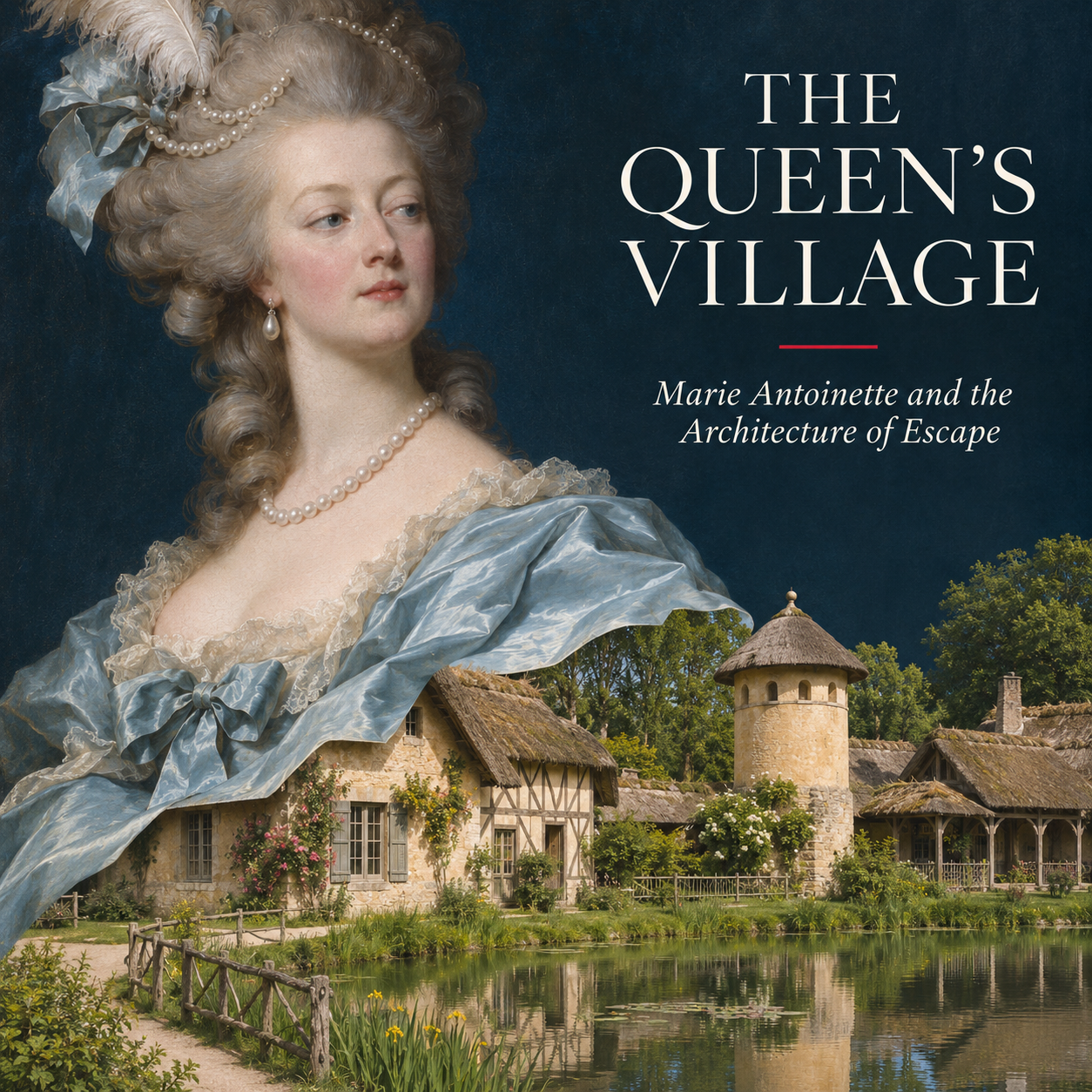
A few steps from the greatest palace the French monarchy ever raised, and behind its gardens drawn with ruler and compass, stands a small and strange village. Houses with thatched roofs, a water mill, a tower overlooking a lake, a barn, a dovecote, a little farm. To the eye it looks like a Norman peasant village lifted whole into a palace garden. But it was never a village. It was a stage set. These houses were built with walls deliberately cracked to look old, with false fissures painted on, and the queen would come to play the shepherdess, in a dress of white cotton and carrying a basket, while real peasants did the real work out of shot. This village, named the Queen’s Hamlet, is in my view the truest architectural document we have of Marie Antoinette, truer than every portrait and every memoir, because it embodies in stone and straw the dilemma that finally brought her down: to see something while seeing nothing, to draw near the idea of the people while having sealed yourself off from them completely.
The line that was never said
Let us begin with a correction that cannot be avoided, because honesty precedes rhetoric. The most famous line attributed to her, let them eat cake, Marie Antoinette never said. Scholarship shows it to be a republican cliché embedded in the French imagination through nineteenth-century schoolbooks, not a documented utterance from her mouth. Serious research into the question of her image goes further, showing that the volume of scandalous pamphlets against her before 1789 was far smaller than the myth assumes, and that those pamphlets were in large part aristocratic in origin, written by hired hands, and confined to Versailles and Paris. The queen we hate or pity is not the real woman, but a woman made of paper, manufactured by texts. I use the line as a title, then, because it has entered the collective consciousness, not because it is true, and because, for all its falseness, it compresses with cruel eloquence something that is true about the structure of power she lived inside: that it was a power which does not see what it does not wish to see, and whose very architecture was built to block the view.
The architecture of isolation
To understand the blindness, one must first understand the architecture that produced it. Versailles was more than a palace, it was a city closed upon itself, a spatial machine designed to separate the king and his court from his kingdom. Here lies the first urban lesson, that the planning of absolute power was a planning of separation. The vast visual axes, the gardens stretching to the horizon, the distances dividing wing from wing, all served a political function before an aesthetic one, placing between ruler and ruled layers of space hard to penetrate. And the queen lived inside this machine almost her whole life. Research shows that, from her arrival in France to her death, she practically never left the Paris region and its surrounding residences, Fontainebleau and Compiègne and Saint-Cloud, and remained unknown to most of her subjects. This is an urban fact before it is a psychological one. The queen the people never saw became an empty screen onto which every imagining, every rumour, every accusation was projected. Spatial isolation produced a symbolic vacuum, and the symbolic vacuum filled with the worst an angry nation could imagine.
And within this great isolation she built herself a smaller, more intimate one. When the suffocating rituals of the court wearied her, she withdrew to her small palace, the Trianon, which no one entered except by her invitation, and on whose door was hung, almost as a symbol, that the place was by order of the queen. Then, when that did not suffice, she built the Hamlet, the artificial village, to escape the palace within the palace garden. Consider this architectural sequence: a kingdom she flees into a palace, a palace she flees into a small palace, a small palace she flees into a fake village. Each deeper layer of withdrawal seemed to her a drawing-nearer to simplicity, nature and truth, while in reality it was a further step away from the reality boiling outside the walls.
The village that sums up everything
The Hamlet is the key, and so I return to it. When a queen builds an entire peasant village to play the peasant in, she does something more complex than luxury and frivolity. She confesses, without knowing it, to the existence of another world she does not know and longs for, the world of countryside and labour and simplicity, but she can approach it only by turning it into décor, into a version stripped of the mud and the hunger and the debt and the tax. This is the essence of class blindness in architectural terms. The ruling class does not always deny the existence of the people, sometimes it even sings their praises, but it praises an image of them it made itself, a clean, happy peasant tending perfumed sheep. The Hamlet is a village without poverty, a countryside without suffering, a people without anger. And that, precisely, was the problem of the whole reign, that power saw a beautified version of its people instead of its people, then was astonished to discover that the real version was hungry and angry and armed.
Here architecture meets politics at a single point. The houses whose walls were deliberately cracked to look old are a perfect metaphor for the whole order, an artificial façade of rural authenticity concealing behind it a limitless extravagance. The real countryside in France at the time was labouring under a genuine agrarian crisis, failed harvests, rising bread prices, and taxes that strangled those who owned nothing. And at the same time the holder of the most famous title among the ruling class was spending on her little village enough to feed real villages. People did not hate her for a line she never said, but because the spatial structure of her entire life was saying that line on her behalf, louder than any words.
To see something and see nothing
It is unjust to portray her as a fool, and bad history to believe the caricature. Modern scholarship shows a woman cleverer and more complex than the myth allows, a woman who mastered the use of her image and controlled her visual representation through a gifted woman painter who made her a new portrait of the queen, joining majesty and youth, and who even tried later to re-present herself as a virtuous mother surrounded by her children when she grasped the danger of her image. She saw, then, a great deal. She saw that the image is power, and saw that she had to manage people’s impression of her. But she saw everything except the one thing that decided her fate, she did not see that the distance between her and her people was not a distance of misunderstanding to be cured by a portrait, but a real material distance of hunger and tax and spatial isolation. She saw the stage and not the hall. She mastered the art of appearing before those who saw her at court, and was utterly unable to imagine those who did not see her beyond the walls.
This is the essence of the failure of her rule, and it is a failure far larger than her person. When power concentrates all its energy on managing its image before the near circle, and neglects the structure that binds it to the far circle, it becomes brilliant at everything except survival. The beautiful portrait does not feed the hungry, the precisely drawn garden does not convince a peasant who lost his harvest, and the artificial village is no substitute for knowing the real one. The queen managed her relationship with a hundred nobles to perfection, and failed in her relationship with thirty million who neither saw her nor were seen by her. And when the anger exploded, it found before it not a human being the people knew, but a symbol they had made themselves in the absence of any real knowledge, so they tried and executed a symbol rather than a woman.
The city that is seen and the city that is not
The urban lesson here reaches beyond Versailles by centuries, all the way to us, but it must be read with care, because it does not generalise. Not every private space is a trap, and not every isolation is blindness; each void carries a sensitivity proportional to its political weight, and every observer reads it from where he himself stands. A person of an upper class may be entirely legitimate in his place, under no obligation to see the space of the lowest class, just as the lowest is under no obligation to see the space of the highest; each looks from where he stands, and a single place admits different readings through different eyes. What undid the queen was not that she had a private space, for every human being and every station has one, but that the political weight of her position demanded a seeing that her architecture made impossible. And the ideal of the ruler who sees is rare, not a rule: not everyone is Umar ibn al-Khattab, whom people searching for the ruler of the Muslims found asleep in the shade of a tree. He is an exception that reveals how exceptional it is, and the measure differs from person to person and from case to case.
And here lies what I see as the heart of the matter. Spatial isolation is not a result of class blindness, it is one of its most important causes. When power lives in a space designed to keep people away, it does not merely lie to its people, it lies to itself, gradually losing the ability to imagine a life it does not see daily. Marie Antoinette was not as evil as she was painted, but she was the prisoner of an architecture that made true seeing impossible, and then she paid for that blindness with her life. And the cruellest irony is that the French monarchy learned the lesson far too late, for when it sought restoration decades after its fall, it made of Marie Antoinette’s surviving daughter a mobile royal presence, a woman who toured the country and was seen and visited hospitals and schools and factories, as though the regime finally understood, too late for the mother, that a ruler who is not seen is a ruler who is not believed.
Conclusion: the stone that speaks
I return, in the end, to that small village with the thatched roofs. It still stands today, visited and photographed, and at its gate are sold colourful sweets attributed to the queen who never said her famous line. And in it, more than anywhere else, we can read the whole story. A power that built itself a version of the people because it could not see the people, and lived inside an architecture designed to hide from it what it most needed to see, and mastered the management of its image before those who saw it and neglected all who did not, until the day came when those it could not see came out from behind the walls. Marie Antoinette did not fall because she told the hungry to eat cake, but because she lived in a place the sound of hunger could not even reach. And that, not the fabricated line, is the real lesson every person who plans a city or governs a people must learn: that the most dangerous thing about power is not its occasional cruelty, but the spatial structure that allows it not to see, and that an architecture which isolates the ruler from the ruled is not luxury and not beauty, but the beginning of the end, written in stone before it is written in history.
✦ ArchUp Editorial Insight
The essay’s governing move is to correct its own title before building on it — establishing that the famous line was a republican cliché embedded through nineteenth-century schoolbooks rather than a documented utterance, and that the scandalous pamphlet campaign was smaller than the myth assumes and largely aristocratic in origin — which is precisely the forensic discipline that lets the architectural argument stand rather than collapse into moralized caricature. The structurally precise claim is the inversion the essay states plainly: spatial isolation is not a result of class blindness but one of its most important causes, because when power lives in a space designed to keep people away it does not merely lie to its people, it gradually loses the ability to imagine a life it does not see daily. The Hamlet becomes the document because it confesses what the whole order concealed — walls deliberately cracked to look old, a village without poverty or hunger or tax, the people encountered only as décor stripped of the mud the real countryside was drowning in — the same heritage-as-applied-surface mechanism this archive traced in The Frozen Date, where the facade claims a reality it has evacuated, here weaponized not as commerce but as a sovereign’s self-deception. The essay’s sharpest contribution is its extension of the Versailles machine of separation into the present, naming the invisible walls made of prices and rankings and the transport lines that pass by here and not there — the gated district, the photographed waterfront concealing the quarter the camera never enters, the beautification project that produces an image of the city rather than the city — which connects directly to what this archive examined in Spatial Identity and Cognitive Warfare and This Is Me, Not My Father: architecture’s capacity to show power what it loves to see and hide what disturbs it, so that a city designed to be a beautiful scene from a single angle blinds its ruler to every other. The durable lesson the piece reaches is a governance one rather than a historical verdict, that the most dangerous property of power is not its occasional cruelty but the spatial structure that permits it not to see, and that the monarchy learned too late — sending the surviving daughter to tour hospitals and factories decades after — what the mother’s architecture had made impossible: that a ruler who is not seen is a ruler who is not believed, the isolation written in stone before it is written in history.
By Ibrahim Fawakherji — ArchUp
Sources
- Hosford D. The Queen’s Hair: Marie-Antoinette, Politics, and DNA. Eighteenth-Century Studies, 2004.
- Biancani S. Quando la regina lascia la corona e va in giardino. IKON, 2012.
- Gruder VR. The Question of Marie-Antoinette: The Queen and Public Opinion before the Revolution. French History, 2002.
- Maza S, Thomas C, Rose J. The Wicked Queen: The Origins of the Myth of Marie-Antoinette. The American Historical Review, 2000.
- Tang X. From beheaded Queen to martyr: the reshaping of historical memory. Chinese Studies in History, 2025.
- Peters RA. Reading royalty in Dumas’ Le Collier de la reine. Textual Practice, 2012.
- Garnai A. One victim from the last despair: Mary Robinson’s Marie Antoinette. Women’s Writing, 2005.
- Brown S. The Princess of Monaco’s Hair: the Revolutionary Tribunal and the Pregnancy Plea. Journal of Family History, 1998.
- Maior-Barron D. Let Them Eat Macarons? Dissonant heritage of Marie Antoinette at Petit Trianon. International Journal of Heritage Studies, 2018.
- Mensch M. Seeing and Being Seen: The Itinerancy of Marie-Thérèse Charlotte of France. The Court Historian, 2024.