Persian Garden Suite

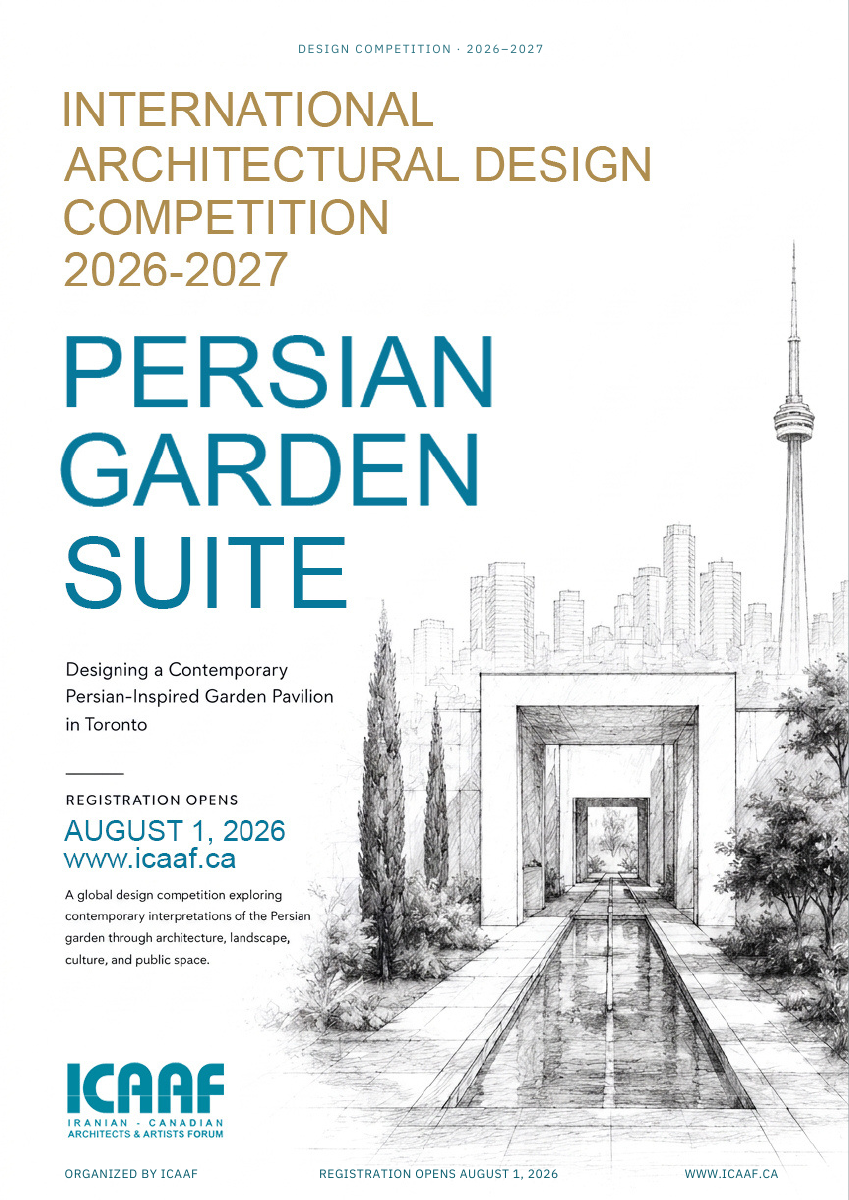
Organizer record: Iranian Canadian Architects & Artists Forum (ICAAF) · Directory record not yet reviewed
Competition Brief
Persian Garden Suite is an international ideas competition organised by the Iranian Canadian Architects & Artists Forum (ICAAF). The detailed guideline asks entrants to design a detached dwelling in the backyard of an existing home in North York, Toronto, interpreting Persian garden and pavilion traditions through contemporary housing. The call is open to professionals and students worldwide, individually or in teams of up to three.
Brief clarification: the website describes a garden pavilion, while the downloadable guideline specifies a residential Garden Suite on a real site. Entrants should obtain the technical package and confirm the required programme before developing their design.
Design Requirements
The guideline calls for privacy, hospitality, adaptable living and a connection with the garden, alongside a response to Toronto’s climate. It requires compliance with the city’s Garden Suite rules and the Ontario Building Code; these are competition requirements, not a planning approval. Registered entrants receive the survey, drawings, CAD files and technical information. No construction commission is promised in the reviewed guideline.
Submission and Assessment
English is mandatory on presentation sheets; English–Persian submissions are also accepted. Registration and payment precede access to the participant package. The public guideline does not specify final board dimensions, page limits, file size or the final upload endpoint. Confirm these through the package instead of relying on an older announcement.
Anonymous assessment follows a technical compliance screening. Weights are architectural quality 30%, innovation 20%, environmental performance 15%, interpretation of the Persian garden 15%, technical feasibility 10% and presentation 10%.
Organiser and Jury
ICAAF describes itself as a nonprofit cultural organisation connecting Iranian-Canadian creative practitioners. The call names Rahshahr Canada, Urbanscape Architects and Rahshahr International Group as collaborators. The reviewed material does not establish a dated archive of previous editions of this competition; the programme should be assessed on its published commitments.
Among the jurors identified on the organiser’s published cards are Farrokh Derakhshani, associated with the Aga Khan Award for Architecture; Brigitte Shim of Shim-Sutcliffe Architects and the University of Toronto; Farshid Moussavi of FMA and Harvard GSD; and architect and painter Mohammad Moheet. Their stated backgrounds relate to architectural practice, teaching and cultural interpretation. This is a selection of the published panel, not a complete roster.
Entry Fees and Awards
All figures are in Canadian dollars. Early registration through 15 October 2026 is CAD 10 for students and CAD 20 for professionals; regular registration is CAD 15 and CAD 30 respectively. The guideline does not clarify whether mixed teams pay per person or per team, or whether taxes are additional. Check the payable total before registering.
Cash awards are CAD 1,500, CAD 700 and CAD 300 for first, second and third place. Places four to seven receive honourable mentions. Certificates, publication and a Toronto exhibition are additional forms of recognition, not extra cash prizes. The reviewed guideline does not explain refund terms, payment dates or the extent of publication and reuse rights.
Key Dates
Registration opened on 1 August 2026. Early registration ends on 15 October; participant questions close on 1 January 2027. Submissions are due on 31 March 2027. Results are scheduled for 1–5 May, with an exhibition and symposium planned for 16 May–1 June. A final registration cutoff is not specified in the current guideline.
✦ ArchUp Competition Review
The architectural value of the exercise lies in translating a spatial tradition into an everyday dwelling. A convincing response would show how an entrance protects privacy without wasting a compact footprint, how hospitality coexists with sleeping and work, and how garden connections remain usable in winter. A decorative water axis alone would leave those questions unresolved.
Published assessment weights give entrants a useful basis for allocating effort. However, the difference between a pavilion and an independent dwelling changes servicing, enclosure and accessibility decisions. Resolving that programme is more consequential than polishing an image. Treat the proposal as a housing study with a fixed time budget, and confirm submission specifications and rights before paying.
Submission Countdown — Indicative Date
No closing hour or time zone is stated. This counter marks 31 March 2027 at 00:00 UTC as an editorial date reference, not the official closing instant. Confirm the cutoff with ICAAF and submit early.
Sources checked on 29 September 2026: ICAAF’s competition page, downloadable 2026–2027 guideline, registration form, jury cards and organisational profile. Prepared under ArchUp’s competition transparency policy.