Refrain: Furniture That Depends on the Room Around It

A bench resting partly against a wall is not placed in a room in quite the same way as a freestanding seat. A mirror with opening doors also occupies more than its closed outline. These small differences anchor Refrain, a collection of five sculptural furniture pieces presented at M Kardana on London’s Hackney Road. The useful question is not whether the works belong to art or furniture, but how their supports, moving parts and surfaces change their relationship to an interior.
Giving each object room to be read
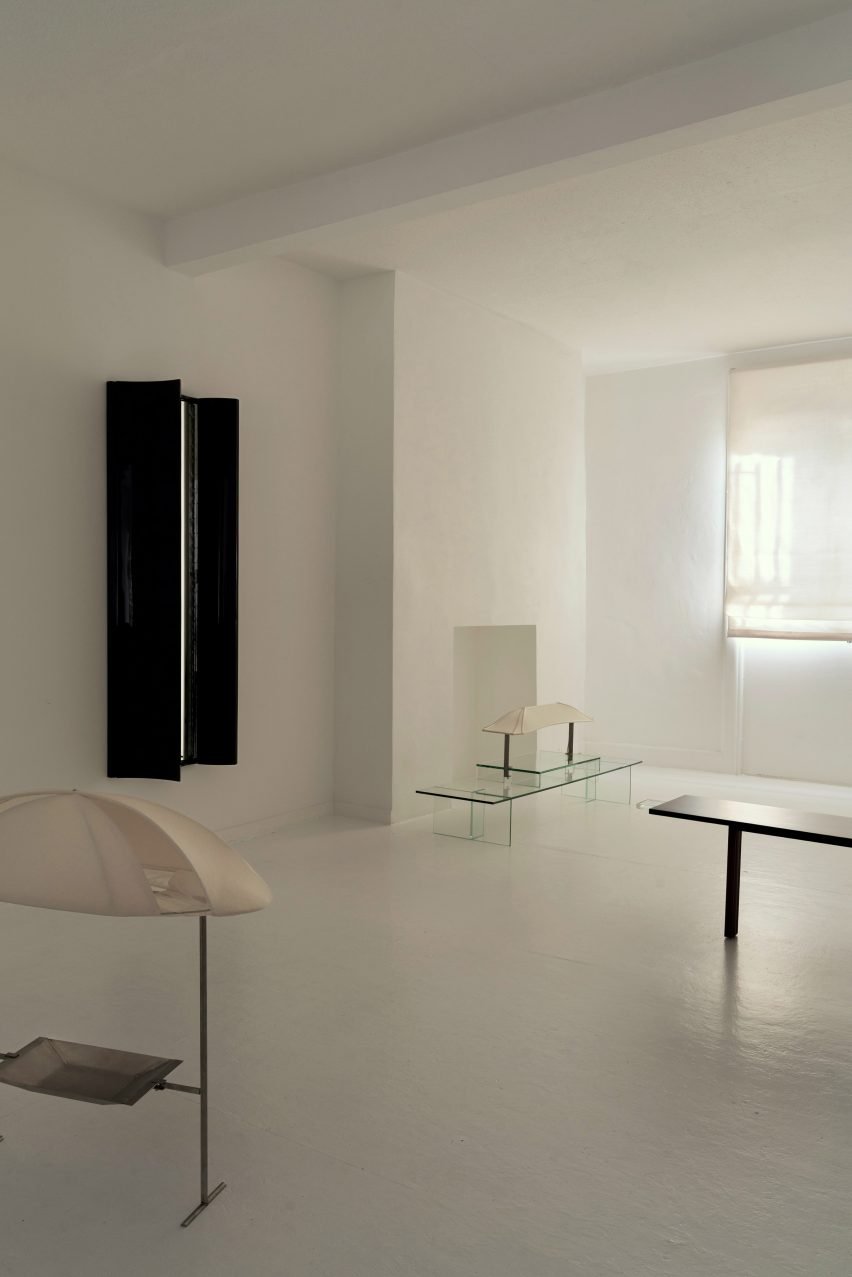
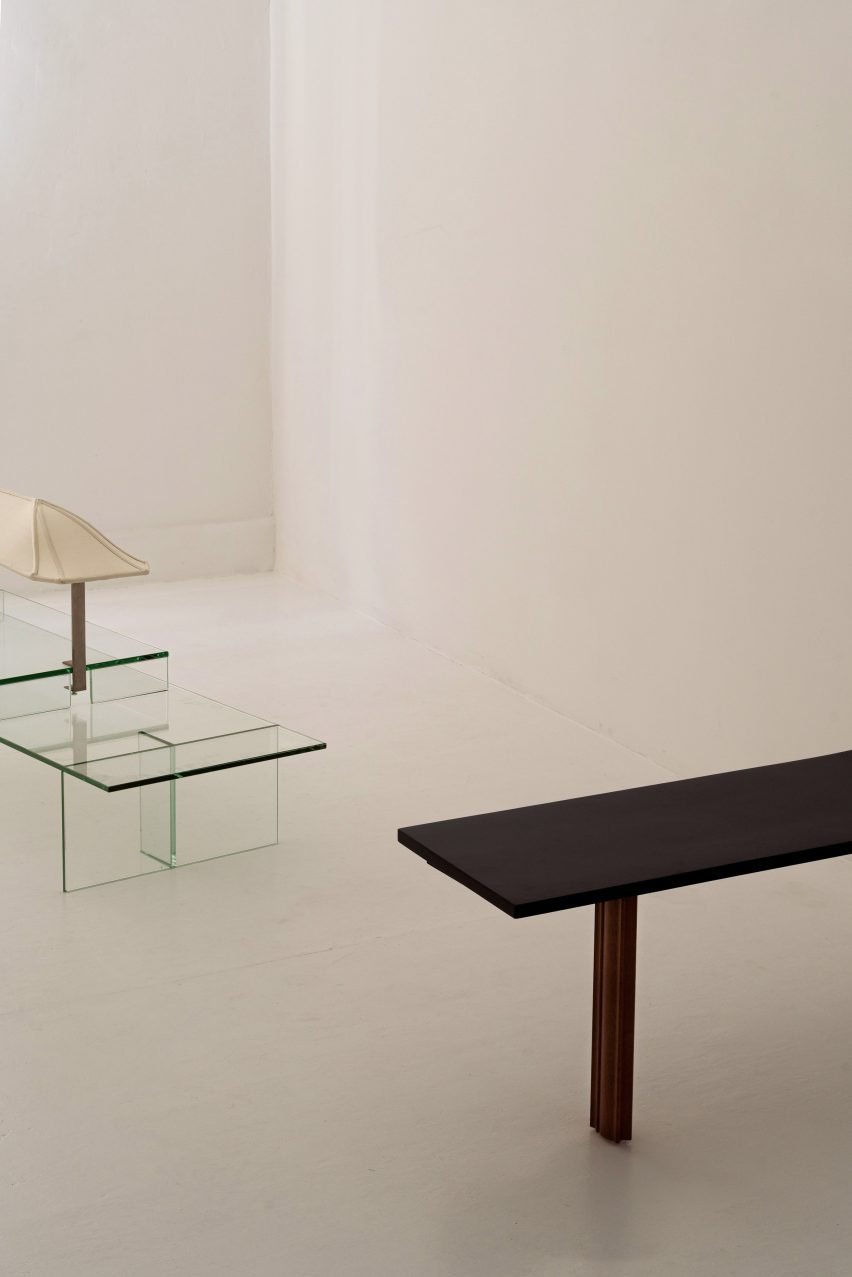
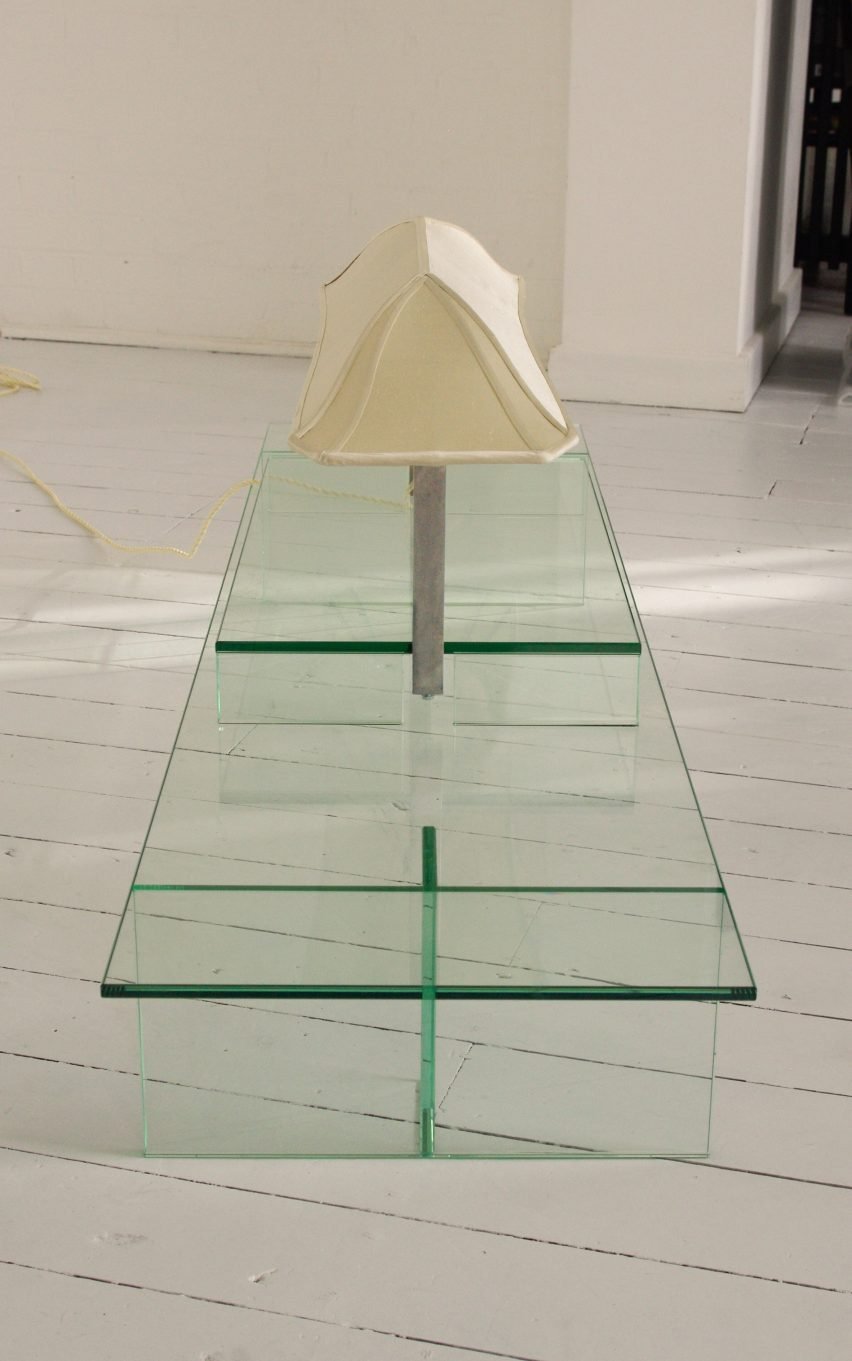
The antiques shop was stripped back to provide a gallery setting for the collection. In the installation photographs, pale walls and a largely open floor leave space between the pieces. This separation makes their profiles and points of contact easier to distinguish: a dark object against a wall, thin metal legs on the floor, transparent glass carrying a textile canopy.
That arrangement differs from a furnished domestic room, where circulation and other belongings compete for the same space. Here, the gaps are part of the presentation. They allow attention to move between the pieces without turning the setting into a complete model interior.
A mirror that changes when opened
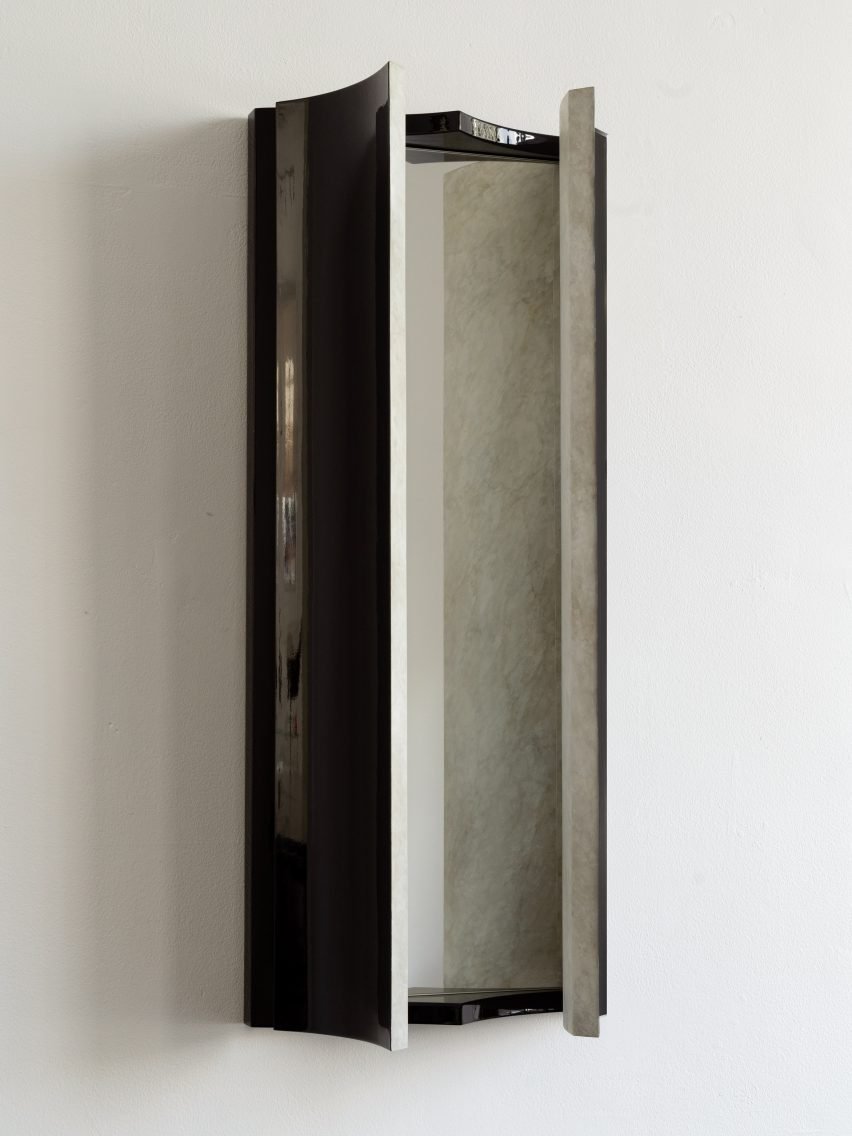
One wall-mounted mirror is flanked by two black-lacquered doors on full-length piano hinges. Its birchwood construction includes hand-painted faux-marble surfaces. What appears stone-like is therefore a painted timber finish, not a solid stone slab. This distinction is central to the object: the image of material weight meets the visible action of hinged panels.
Opening the doors reveals the mirror and changes the object’s outline. In an interior, that action would also need clearance beside and in front of it. The hinge is not merely a concealed fitting; it is the device that permits two different states, one more closed and object-like, the other reflective and outward-opening.
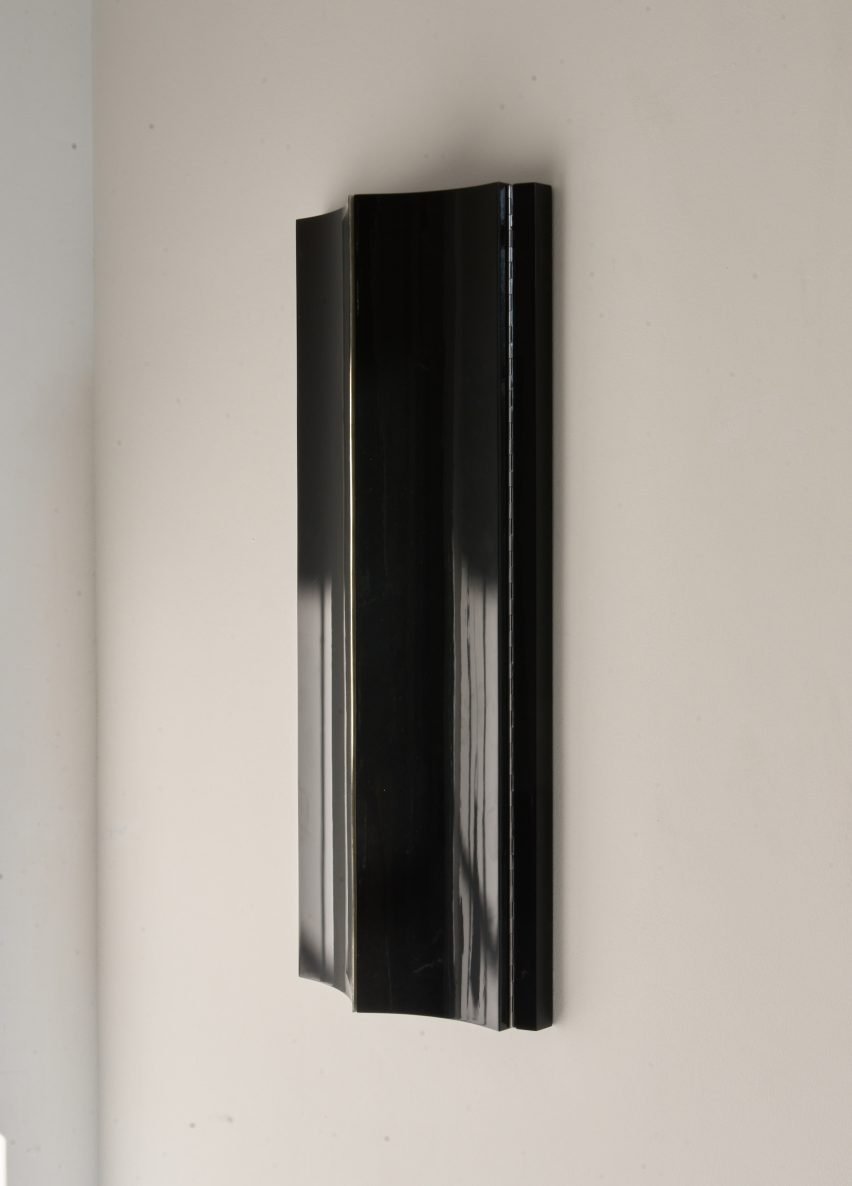
A second, full-length wall mirror uses an entirely black-lacquered finish. Its closed doors form a compact dark silhouette. Read alongside the first mirror, it shifts emphasis from the contrast of painted surfaces to the change between closure and reflection.
When the wall becomes part of a seat’s placement
Underscore is carved from sapele wood, with one end supported by a single leg and the other resting against a wall. Its profile draws on Georgian architectural mouldings and the parallel lines of musical notation. The designer also relates its curve to a glissando, the movement from one musical note to another.
The spatial consequence is more immediate than the musical analogy. Unlike a bench supported independently at both ends, this piece is tied to a suitable wall position. The wall is not simply a backdrop selected after the furniture is made; it participates in the arrangement that supports it. Moving the piece would therefore mean reconsidering that relationship, rather than treating it as a seat that can stand anywhere.
Two ways for fabric to occupy space
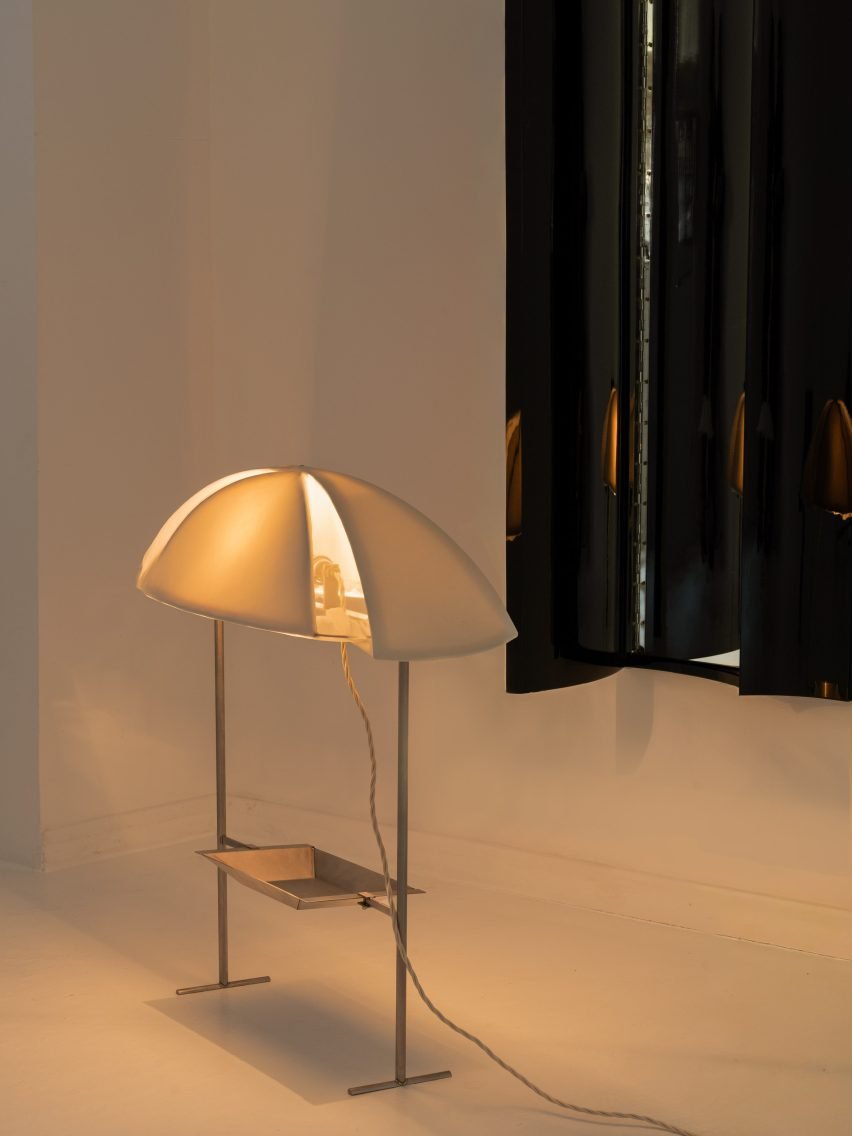
The floor lamp combines hand-formed wire with an ellipsoid shade of silk organza overlaid with gazar. A stainless-steel frame supports the assembly and incorporates a central rectangular tray. The photograph shows the textile enclosing the light source as a luminous volume, while the narrow frame remains visually distinct below it.
A different relationship appears in the low glass table. An elongated ivory-silk canopy is held above it by stainless-steel arms clamped to the upper glass panes. Transparency makes the supporting glass less visually dominant, while the fabric establishes a more opaque upper boundary. It reads as a small spatial composition rather than a tabletop alone.
From display to use
These pieces show why visual lightness and practical mobility are different questions. A thin frame may be easy to see through, but wall contact, hinged panels and projecting supports still impose conditions on placement. Similarly, a stone-like painted finish should not be treated as stone when choosing how to clean or repair it.
For use beyond a gallery, the relevant questions would include access around opening doors, protection of textile surfaces, and the condition of glass edges and connections. These follow from the specified assemblies; they are not evidence of faults in the works. The collection’s contribution is to bring those usually background relationships into view, making support, opening and enclosure part of the design itself.
Credits: Refrain, five furniture and lighting pieces designed by Georgia Merritt; installation at M Kardana, London. Photography, including the cover: Tazy Jessett Nash.
✦ ArchUp Editorial Insight
Five pieces occupy a cleared antiques shop, and several depend on an edge, a hinge or a supporting frame to establish their position. These are the concrete conditions behind Refrain’s apparent lightness. The design decisions make ordinary furniture relationships unusually visible: a bench borrows support from a wall, a mirror conceals or reveals its reflective face, and fabric sits above glass or around a light source. The result is a small collection that asks to be read through placement and operation rather than as a row of self-contained silhouettes. In ArchUp’s reading, the bench offers the clearest architectural lesson because its relationship to the room is also part of how it stands. The mirrors extend that argument through movement: opening a door changes both the object and the space it occupies. These relationships also limit easy relocation. Wall contact, door swing and access around delicate surfaces need to be considered whenever the pieces move into another setting. Their value is therefore not a promise of universal flexibility, but a precise demonstration that an object’s character can emerge from the way it meets a room.