Resilient Futures: Architecture for a Changing Climate Competition

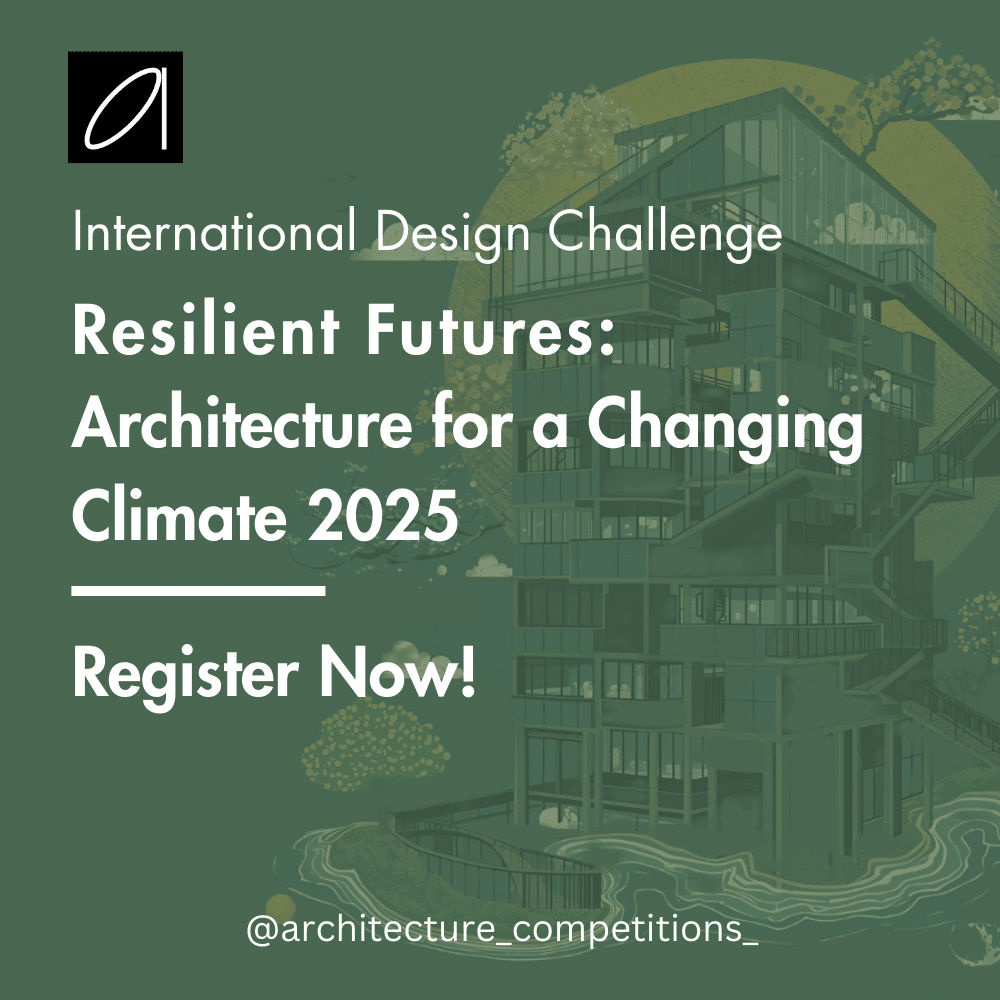
The Resilient Futures competition is challenging architects, designers and students to present ingenious solutions for the future which is uncertain due to climate. It admits that the 21st century has been a tough period which has brought along a series of unprecedented challenges like the increase in sea levels, violent floods, long-lasting heat waves and wildfires. The competition requires the participants to think out of the box and redesign the future in a way that we can live, adapt, and prosper in the environments that are changing.
Competition Overview
The participants are required to create either architectural or urban interventions which will mitigate the impact of climate-related disasters such as floods, droughts, or storms. The competition regards resilience not only as survival but also as an ecological regeneration and social well-being. The proposals can be speculative or specific to a site and cover a wide range from small shelters to large-scale urban visions.
Timeline
| Event | Date |
|---|---|
| Registration Deadline | 2 December 2025 |
| Submission Deadline | 10 December 2025 |
| Result Announcement | 5 February 2026 |
Entry Fees
| Stage | Fee (USD) |
|---|---|
| Early Registration (1 Sept – 12 Sept) | 10 |
| Standard Reg 1 (13 Sept – 26 Sept) | 12 |
| Standard Reg 2 (27 Sept – 12 Oct) | 15 |
| Standard Reg 3 (13 Oct – 26 Oct) | 18 |
| Standard Reg 4 (27 Oct – 12 Nov) | 20 |
| Late Registration (13 Nov – 2 Dec) | 25 |
Awards
| Prize | Details |
|---|---|
| Top 3 Winners | Publication, Certificate of Recognition, Jury Report, Interview, Free Memberships |
| Honourable Mentions | Publication and Certificate of Recognition |
| Special Mention | Publication and Certificate of Recognition |
| Shortlisted Entries | Name & Project Title Listed, Certificate of Participation |
Architectural Analysis
The architects of the competition are driven by the design logic of resilience and adaptation. The architects are challenged to come up with the forms and systems that are flexible, robust, and socially relevant to the climate uncertainty. The Material used becomes a very important decision: the local, low-carbon materials together with the traditional wisdom are combined with the use of the innovative technologies to create the architecture that regenerates rather than merely survives. The context is very important. It does not matter whether the design is responding to an actual site or a hypothetical future condition, the work has to take into consideration the climate risks, the community’s ability, and the ecological impact. From a critical point of view, the competition rewrites architecture as a process of change and adaptation instead of a static form.
Competition Importance
It is the hopeful vision of the design that will eventually prevail over the challenges of nature and man in the long run. In other words, the competition is not just about location, environmental conditions, and future scenarios; it also redefines and outlines the role of architecture as a change rather than a static form. This competition teaches architects and designers that contemporary architecture concerns not only aesthetics and functions but also resilience, systems, and, most importantly, long-term thinking. It contributes to the formation of architectural ideas by highlighting the categories of adaptive and regenerative design. It questions: how can architecture contribute to the solution of climate change instead of being part of the problem? The competition is very timely and relevant in today’s world where ecological and social systems are stressed. It provides a venue for the dissemination of ideas that are now important and will continue to be so in the future.
✦ ArchUp Competition Review
Resilient Futures: Architecture for a Changing Climate is a worldwide competition, which is open to architects, designers, and students. The competition challenges to submit designs dealing with climate change issues, such as floods, droughts, and heat waves. Aimed at encouraging both ecological resilience and social well-being, it offers publication, certificates, and recognition to the best entries, with deadlines from September to December 2025. The jury judges the adaptability, innovation, and environmental relevance. Although the competition has a clear structure and timeline, it lacks transparency in terms of the evaluation framework due to the limited information available on the composition of the jury and the site contexts. Thus, the competition is an engaging and relevant challenge to the design thinking of the climate-responsive and regenerative type.
Conclusion
The Resilient Futures competition is a great opportunity for architects, designers, and students to tackle climate change through design. It demands a lot of innovations, visions, and thoughtful responses to a constantly changing built environment. Competition focuses on the accessibility of the concept, the importance of society, the responsibility towards nature, and the quality of architecture.
The competitors are asked to propose ideas that not only expand the limits of architecture but also contribute to the shaping of a resilient future. In this way, they are in the loop of the design’s role in responding to global challenges and opening new avenues.
Explore the Latest Architecture Exhibitions & Conferences
ArchUp offers daily updates on top global architectural exhibitions, design conferences, and professional art and design forums.
Follow key architecture competitions, check official results, and stay informed through the latest architectural news worldwide.
ArchUp is your encyclopedic hub for discovering events and design-driven opportunities across the globe.
Registration Deadline
Brought to you by the ArchUp Editorial Team
Inspiration starts here. Dive deeper into Architecture, Interior Design, Research, Cities, Design, and cutting-edge Projects on ArchUp