
Rise by Athlon Community in Dubai Architecture Redefining Movement and Living

Introduction
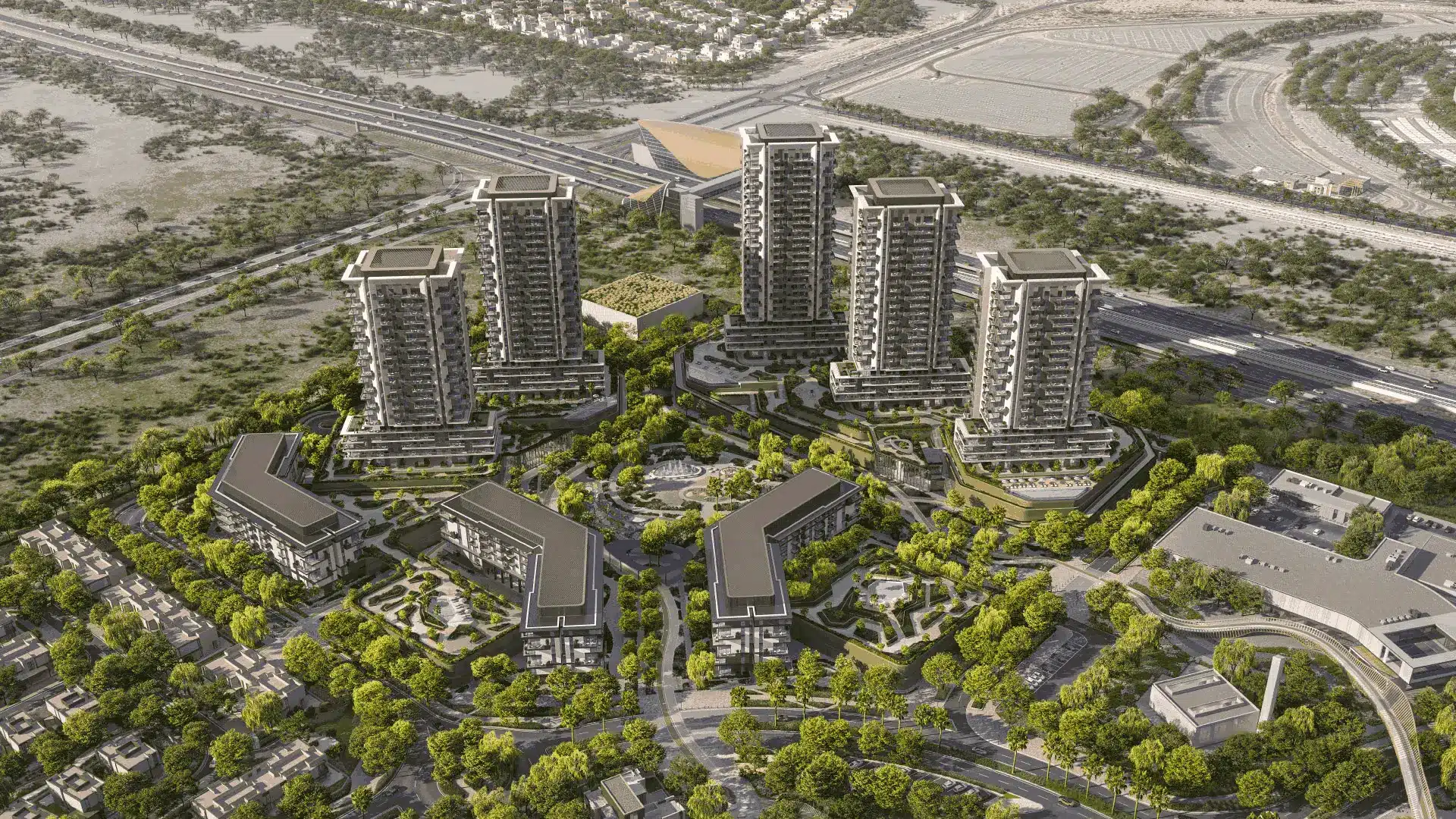
At the heart of Dubai, Rise by Athlon Community is redefining how people connect with their environment. This urban project introduces a dynamic architectural vision where living is not static. Instead, the spaces respond to the human body and the city’s rhythm. The development serves as an urban laboratory for new modes of living. Its design interacts with light, air, and nature, creating environments that promote continuous movement and activity. Rise by Athlon Community transforms everyday life into a visual and spatial experience, where architecture becomes an active part of daily routines rather than a passive backdrop.
Urban Composition and Spatial Concept
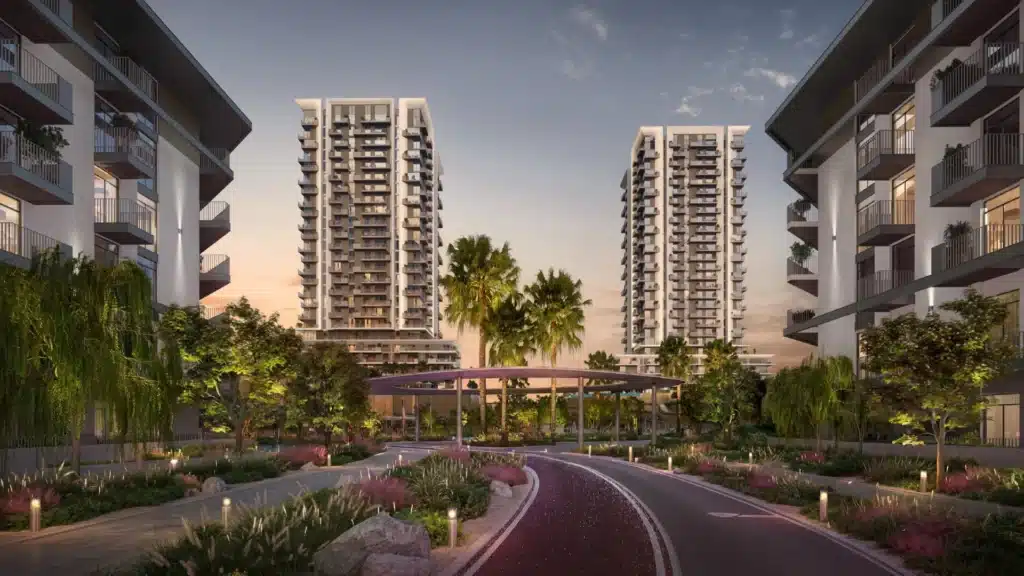
The project is set within an open urban fabric, centered around a large green park that serves as its vibrant core. Residential towers and low-rise buildings surround the park, arranged to enhance visual openness, light, and airflow. The design rotates the towers at precise angles to capture northwest winds. This natural ventilation helps moderate the microclimate and creates a comfortable environment in the park. This orientation is more than a technical choice; it reflects an architectural philosophy that uses design to harmonize with the climate rather than resist it.
Architectural Language of Mass and Space
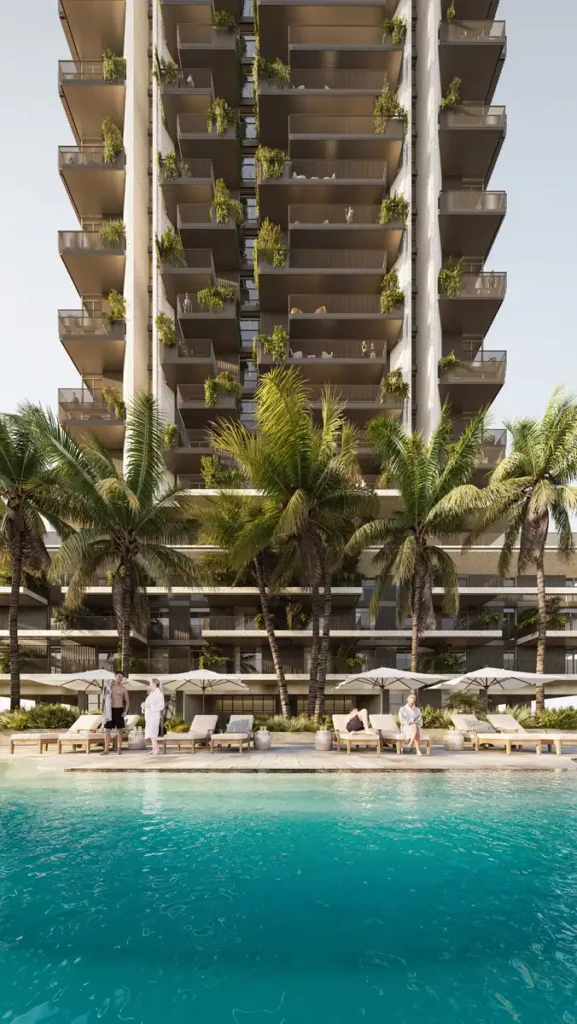
The composition includes five high-rise towers and three low-rise blocks. They share a unified architectural language based on vertical and horizontal movement. The masses unfold rhythmically, with interwoven balconies and façades that create semi-open spaces for natural light and ventilation. Each residential unit opens onto green views through interlocking balconies. This design ensures a continuous visual and spatial connection between interior and exterior. In doing so, living becomes a visual and environmental experience that goes beyond conventional building boundaries.
The Central Park as a Living Core
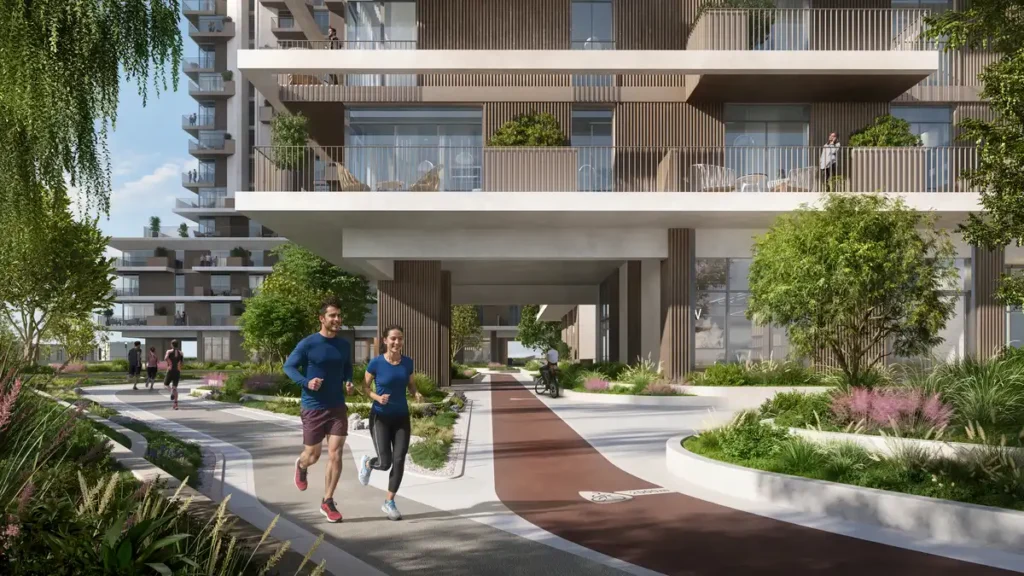
At the project’s heart lies a lush central park an urban breathing space connecting towers, pathways, and sports facilities within a unified network of movement. This park is more than a green space; it is an organizing element that redefines the relationship between architecture and community.
Around it, the walking, jogging, and cycling trails form part of a spatial system that integrates activity into daily life rather than isolating it. This concept expresses one of the project’s core ideas: transforming housing into an ecosystem of balanced living between comfort and vitality.
Sustainability as Architectural Value
The project represents a contemporary architectural attitude that views sustainability not as an accessory but as a foundation of design. By relying on natural ventilation, diffused lighting, and environmental orientation, energy dependence is minimized.
The design also integrates vertical gardens and layered green terraces, turning architecture into an extension of nature rather than a barrier to it. This harmony between form and environment positions Rise by Athlon as a model of climate-responsive architecture in Dubai.
The Podium: Bridging Public and Private Life
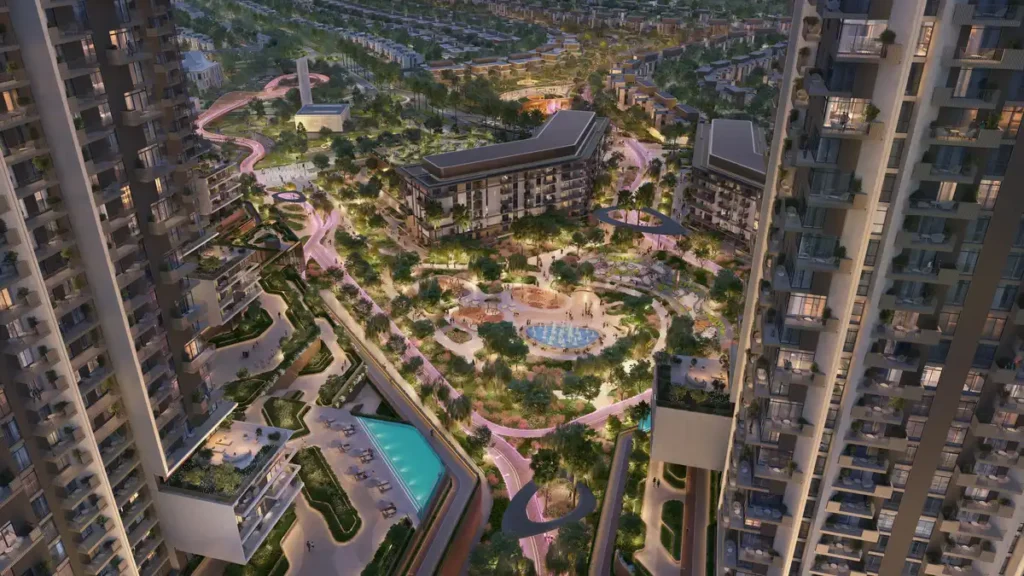
The stepped terraced podium at the base of the towers acts as a transitional layer between public and private realms. Yet it is far more than a structural base it becomes a socially active space, hosting cycling and walking paths along with small communal zones that encourage interaction among residents and visitors.
This part of the project materializes the idea of “architecture in motion,” where the building itself participates in daily life rather than merely containing it.
Design Philosophy: Living as a Way of Being
Rise by Athlon Community is designed around the principle that space shapes human behavior. Rather than creating housing for isolation or mere consumption, the project emphasizes connection and activity. The residential environment is reimagined as a living system that engages both body and mind. This approach transforms traditional housing concepts. Architecture here is not only functional it becomes an ongoing experience of life, encouraging movement, social interaction, and well-being within the community. Rise by Athlon Community demonstrates how thoughtful design can foster a dynamic, active lifestyle while maintaining comfort and environmental harmony.
Conclusion
Rise by Athlon represents more than a residential community; it is an architectural manifesto for the future of urban living—one that redefines how architecture engages with time, motion, and nature.
Through the synthesis of design intelligence and environmental awareness, the project sets a benchmark for human-centered, sustainable architecture, where beauty becomes not an end in itself, but a means of creating balance and vitality in everyday life.
Project Summary
| Aspect | Documented Architectural Details |
|---|---|
| Project Name | Rise by Athlon Active Living Community |
| Location | Dubai, United Arab Emirates |
| Function | Integrated residential and urban community |
| Design Concept | Transforming housing into an environment of daily motion and vitality |
| Spatial Structure | Five high-rise towers and three low-rise buildings surrounding a central park |
| Sustainability | Natural ventilation, environmental orientation, integrated greenery |
| Visual Features | Interlocking balconies, open façades, terraced podium connecting public and private zones |
| Architectural Vision | Housing as a complete life experience, not a static structure |
| Architectural Value | A model of interactive, sustainable design that respects both people and climate |
✦ ArchUp Editorial Insight
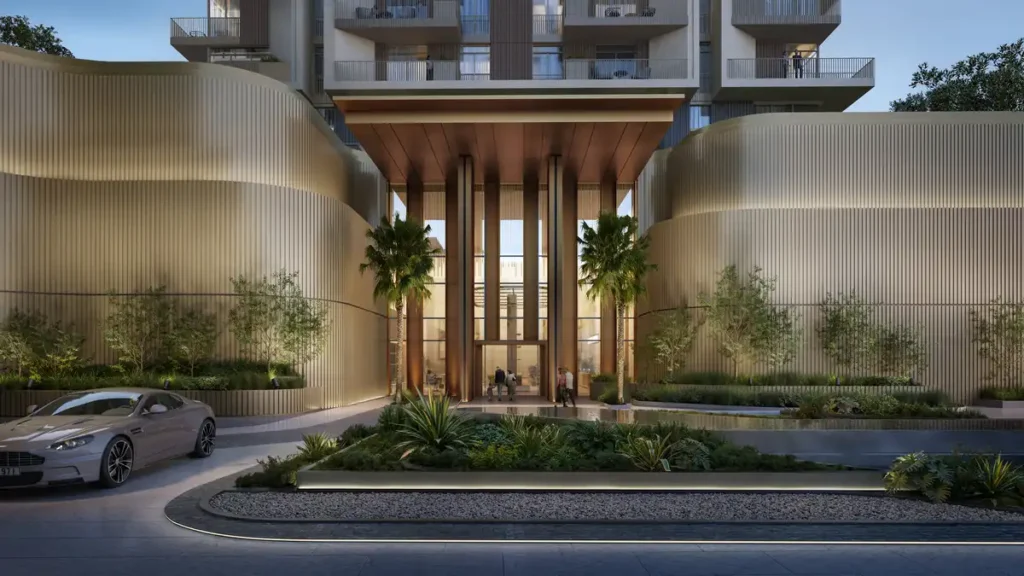
Rise by Athlon presents a visually intricate interplay between high rise towers and low-rise blocks, framed by central green spaces and interlocking balconies that create continuous visual flow. The terraced podium harmonizes with open pathways, expressing a dynamic architectural relationship between the built environment and community. The design approach demonstrates a careful balance between movement and comfort, utilizing tower rotation to optimize natural ventilation and lighting, though the low rise façades show limited spatial variety. Nonetheless, the project stands as an icon of sustainable architecture, integrating environmental responsiveness in ways that enhance daily life and highlight the interactive potential of urban space.
ArchUp continuously documents leading architecture exhibitions and conferences, offering verified coverage of international competitions and official results within an open-access database.


🟥 Editor’s Notice:
This article on Rise by Athlon in Dubai delivers an engaging visual presentation, yet it prioritizes rendered imagery over architectural substance. While the renders capture attention, the article would gain greater value by addressing design intent, spatial flow, and material strategy—elements that give meaning to the concept of “movement and living.” Including factual data such as total area, site integration, or construction method would help achieve analytical balance.
(Related reference: a similar discussion on visual emphasis versus structural authenticity appears in the review of Haus zum Falken in Zurich — https://archup.net/haus-zum-falken-a-dialogue-between-stone-and-glass-in-zurich/
)