The Mattress Is Not the Problem The Room Is

What deep-sleep research reveals about a silent architectural failure inside every residential unit
There is a contradiction worth examining carefully. Over the past two decades, humanity has spent billions of dollars on smart mattresses, thermally responsive foam, individually wrapped pocket springs, and wearable sleep-tracking devices all in pursuit of the slow-wave sleep that neuroscientists identify as the brain’s genuine restoration phase: the stage during which neurons repair themselves, memories consolidate, and hormonal balance resets. However, it’s not just gadgets and beds that affect sleep quality—understanding sleep architecture is also crucial. What mattress advertising does not disclose is that the finest mattress in the world underperforms inside a poorly designed bedroom. Walls, windows, ceilings, and openings are not passive scenery surrounding a sleeping body — they constitute the first and most consequential layer of the mattress itself.
When Research Measures What the Eye Cannot See
Before engaging with mattress materials and construction, it is necessary to understand the instrument of measurement. Deep sleep cannot be assessed by how a person feels in the morning, nor by the total hours spent in bed. It is measured by polysomnography (PSG) — the full electroencephalographic record that captures delta brain waves, those slow, wide oscillations that signal the brain’s entry into its deepest restorative state. Peripheral wearable devices that measure wrist movement, known as actigraphy, can distinguish sleep from wakefulness, but they are entirely unable to differentiate light sleep from deep sleep. This limitation goes largely unacknowledged in much of the commercial research on mattresses, as critical reviews of the field have consistently noted.
What the studies that did employ full polysomnography demonstrate is that a mattress influences deep sleep through two precisely defined pathways: the mechanical pathway — how well the surface maintains spinal alignment and distributes pressure across the body — and the thermal pathway — how the surface conducts body heat away or traps it. Both pathways, as the evidence makes clear, are entangled with decisions that a designer makes long before a resident sets foot in the room.
Spinal Support: A Lesson in Distribution Engineering, Not Firmness
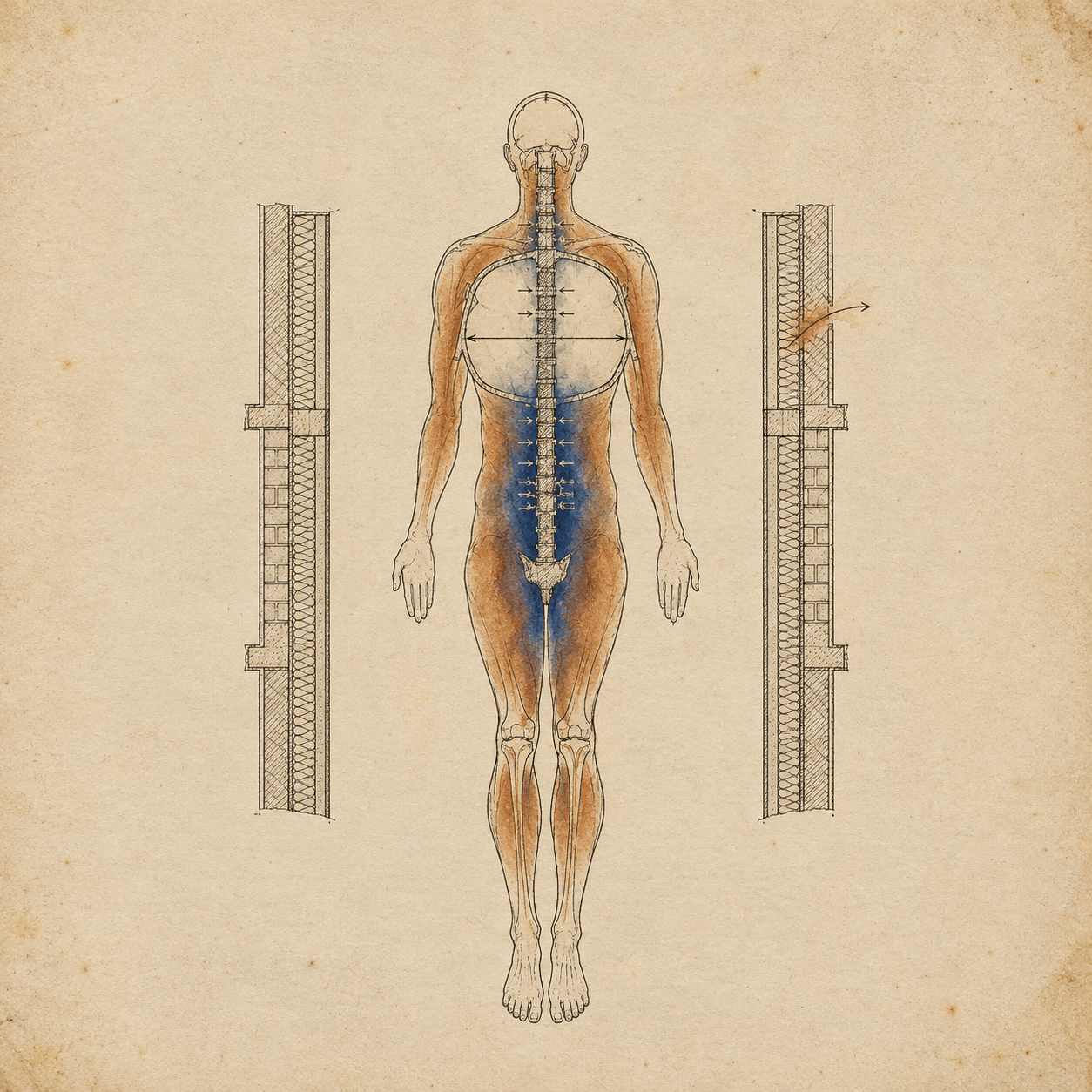
In 2006, researchers Lee and Park conducted a precise experiment. They selected “comfortable” and “uncomfortable” mattresses not by subjective preference but by objective criteria: a comfortable mattress was one that reproduced the natural curvature of the standing spine with accuracy and distributed body pressure evenly across a broad contact surface. When sixteen healthy young adults slept on both mattresses in alternating order, the comfortable surface produced deep sleep accounting for approximately 20 percent of total sleep time, compared with only 16 percent on the uncomfortable surface — accompanied by measurably higher sleep efficiency and a clear reduction in light-sleep stages. Crucially, skin temperatures were higher on the comfortable mattress, indicating that the body was not engaged in the muscular effort of constant postural correction. Adequate support eliminates the unnecessary movements that interrupt deep sleep before it completes its restorative cycle.
The architectural implication is direct. Every decision about bedroom dimensions affects which mattress can function adequately within that room. An undersized bedroom forces a resident toward a mattress smaller than the body requires for full postural support. A warehouse conversion with walls never calculated for vibrational loads generates low-frequency mechanical noise that disrupts sleep before any mattress is even tested. Uninsulated timber floors transmit vehicular vibration through bed frames as micro-arousals signals the conscious mind does not register but the sleeping brain records and responds to.
The Thermal Question: The Hidden Wall That Decides How Deeply You Sleep
This is where the subject reaches its most consequential intersection, and where the connection between building science and sleep physiology becomes most legible.
Neuroscientists have established for decades that the body’s entry into deep sleep depends on a decline in core body temperature — a drop of no more than half a degree Celsius, yet one that constitutes the precise biological signal permitting the brain to enter the delta phase. That excess heat must dissipate through the skin into the surrounding space — into the architectural volume that encloses the sleeper.
Sleep physiologist Kräuchi and colleagues, in a 2018 study, demonstrated that a high-heat-capacity mattress — with a surface density of approximately 1,000 kilograms per cubic meter compared with 80 for conventional mattresses — draws heat from the sleeper’s back in the same way that a dense concrete mass draws warmth from a hand pressed against it. The result was a measurable decline in core body temperature and a selective 16 percent increase in slow-wave sleep. A more detailed investigation published in 2019 by Herberger, Kräuchi, and colleagues reproduced those findings and extended them to quantitative EEG measurements of delta-wave energy — confirming that not only the duration but the biological intensity of deep sleep improved. The architectural translation of this finding is unambiguous: a thermally effective mattress surface does precisely what a high-mass wall does — it absorbs heat and releases it slowly. The principle of thermal mass that architects study in environmental building physics is the same principle that sleep researchers are now demonstrating at the scale of a mattress surface. The implication for contemporary residential design is uncomfortable: the air-conditioned unit with lightweight partition walls, expansive glazing, and open-plan layouts — the dominant model in residential development today — may systematically undermine whatever the most carefully selected mattress attempts to do.
Thermal Foam and the Architectural Choice Between Ventilation and Insulation
The study that most directly challenges widespread assumptions is the one conducted by Chiba and colleagues in 2018. They compared two toppers identical in geometry but radically different in composition: a high-rebound topper constructed from interwoven polyethylene resin fibers forming an open, three-dimensionally porous structure that allows air to pass through, and a low-rebound memory-foam (viscoelastic urethane) topper that retains heat. The high-rebound, air-permeable topper produced a faster and deeper decline in core body temperature during the first half of the night — the critical window for building the deep-sleep reservoir — and generated 25 to 28 percent higher cerebral delta power. The memory foam, widely promoted in residential sales literature, performed less effectively for precisely the reason that distinguishes it: it retains heat and delays the cooling that the body requires.
The parallel that goes largely unremarked is this: a developer’s decision about interior wall insulation type directly conditions what a mattress can accomplish inside that wall. A bedroom enclosed by lightweight, poorly ventilated construction will trap body heat in precisely the way a thick memory-foam topper does — and at that point, no price point on the mattress market recovers what the room’s design has already forfeited.
When Winter Produces Deeper Sleep: The Thermal Environment as Design Condition
The relationship is not unidirectional. Research by Raymann, Swaab, and Van Someren, published in 2008, demonstrated that raising proximal skin temperature by just 0.4 degrees Celsius within the thermoneutral range — without altering core body temperature — was sufficient to nearly double slow-wave sleep in elderly subjects and substantially reduce early-morning waking. The body does not seek absolute thermal reduction; it seeks a precise equilibrium: warm enough that it expends no energy on thermoregulation, cool enough that excess heat can still escape. Sleep researchers express this target as a narrow operational band: skin temperature between 34.5 and 35.5 degrees Celsius, bed microclimate between 30 and 32 degrees.
In cold environments, a study by Xia, Lan, and colleagues published in 2020 found that heating the beds of elderly residents in unheated rooms at approximately seven degrees Celsius increased total sleep time by around twenty minutes and reduced sleep-onset latency by eighteen minutes. In a well-heated, well-insulated bedroom, that intervention becomes unnecessary — but the finding reminds the designer that the room, the mattress, and the bedding constitute a single thermal system. When any one component fails, the burden falls on the other two.
What You Are Building When You Design a Bedroom
When a designer selects the thermal transmittance value for a bedroom’s exterior wall, that decision is simultaneously a decision about the mattress the resident will sleep on. When ceiling height and air-change rates are determined, the designer is deciding whether carbon dioxide accumulating around the sleeper’s head will impair cognitive performance the following morning. When windows are oriented eastward without adequate visual screening, the designer is permitting early morning light to interrupt the melatonin cycle before it completes. When hard, reflective interior finishes are specified rather than sound-absorbing ones, the probability of involuntary micro-arousals — the sleep interruptions a person never consciously experiences but the brain registers and responds to — increases measurably.
The accumulated evidence leaves a precise and unsettling conclusion: the deep sleep that a multi-billion-dollar mattress industry pursues through material innovation is, at its foundation, a question of environmental physics — a design question. The high-heat-capacity mattress with an air-permeable surface does exactly what a thermally massive wall, an insulated ceiling, and an effective ventilation system are supposed to do: it allows the body to shed enough heat to enter the restorative sleep it requires. When the built enclosure fails to perform that function, no mattress compensates for what the architecture has already decided.
✦ ArchUp Editorial Insight
The residential bedroom as it is procured today is not the outcome of sleep science, ergonomic research, or physiological need — it is the outcome of land economics, construction speed, and the separation of liability between developer, contractor, and end user. Minimum bedroom dimensions in most building codes were established to satisfy fire egress and furniture clearance, not thermal mass ratios or acoustic isolation values. The result is a construction typology — lightweight partitions, maximized glazing, sealed mechanical ventilation — that systematically prevents the core body temperature decline that polysomnography identifies as the biological precondition for slow-wave sleep. The mattress industry then absorbs the cost of that failure commercially, selling thermal and mechanical compensation for conditions the enclosure itself produced. What the sleep research collected here reveals is not a product problem. It is a procurement problem dressed as a consumer choice.
References
Lee, Hyun; Park, Siyeon. “Quantitative Effects of Mattress Types (Comfortable vs. Uncomfortable) on Sleep Quality Through Polysomnography and Skin Temperature.” International Journal of Industrial Ergonomics, 2006.
Shen, Li; Chen, Yixia; Guo, Yi; et al. “Research on the Relationship Between the Structural Properties of the Bedding Layer in Spring Mattresses and Sleep Quality.” WORK: A Journal of Prevention, Assessment and Rehabilitation, 2012.
Verhaert, Vincent; Haex, Bert; De Wilde, Tom; et al. “Ergonomics in Bed Design: The Effect of Spinal Alignment on Sleep Parameters.” Ergonomics, 2011.
McCall, W. Vaughn; Boggs, Nancy; Letton, Anne. “Changes in Sleep and Wake in Response to Different Sleeping Surfaces: A Pilot Study.” Applied Ergonomics, 2012.
Kräuchi, Kurt; Fattori, Eliana; Giordano, Alessandro; et al. “Sleep on a High-Heat-Capacity Mattress Increases Conductive Body Heat Loss and Slow-Wave Sleep.” Physiology and Behavior, 2018.
Herberger, Simon; Kräuchi, Kurt; Glos, Martin; et al. “Effects of Sleep on a High-Heat-Capacity Mattress on Sleep Stages, EEG Power Spectra, Cardiac Interbeat Intervals, and Body Temperatures in Healthy Middle-Aged Men.” Sleep, 2019.
Chiba, Susumu; Yagi, Takeshi; Ozone, Masahiro; et al. “High-Rebound Mattress Toppers Facilitate Core Body Temperature Drop and Enhance Deep Sleep in the Initial Phase of Nocturnal Sleep.” PLOS ONE, 2018.
Tonetti, Lorenzo; Martoni, Monica; Fabbri, Marco; Natale, Vincenzo. “Relationship Between Mattress Technological Features and Sleep Quality: An Actigraphic Study of Healthy Participants.” Biological Rhythm Research, 2011.
Tonetti, Lorenzo; Martoni, Monica; Natale, Vincenzo. “Effects of Different Mattresses on Sleep Quality in Healthy Subjects: An Actigraphic Study.” Biological Rhythm Research, 2011.
Vitale, Antonino; Devetag, Francesco; Colnago, Simon; La Torre, Antonio. “Effect of Mattress on Actigraphy-Based Sleep Quality and Perceived Recovery in Top-Level Athletes: A Randomized, Double-Blind, Controlled Trial.” Biological Rhythm Research, 2018.
Raymann, Roy J. E. M.; Swaab, Dick F.; Van Someren, Eus J. W. “Skin Deep: Enhanced Sleep Depth by Cutaneous Temperature Manipulation.” Brain, 2008.
Xia, Lulu; Lan, Li; Tang, Jun; et al. “Bed Heating Improves Sleep Quality and Health of the Elderly Who Adapted to No Heating in a Cold Environment.” Energy and Buildings, 2020.
He, Ming; Lian, Zhengwei; Chen, Ping. “Effect of Quilt Materials on Sleep Quality and Thermal Comfort for Young People in East China.” Procedia Engineering, 2017.
Li, Yu-Chi; Lin, Chih-Yun; Wang, Mao-Jiun. “Better Combination of Thickness and Hardness of Mattress Topper for Supine Sleeping Posture: A Physiological Measurements Evaluation.” International Journal of Industrial Ergonomics, 2020.
Wong, Darius W. C.; Wang, Yi; Lin, Jowen; et al. “Sleeping Mattress Determinants and Evaluation: A Biomechanical Review and Critique.” PeerJ, 2019.
Troynikov, Oleg; Watson, Christopher G.; Nawaz, Nazia. “Sleep Environments and Sleep Physiology: A Review.” Journal of Thermal Biology, 2018.
Lahm, Randy; Iaizzo, Paul A. “Physiologic Responses During Rest on a Sleep System at Varied Degrees of Firmness in a Normal Population.” Ergonomics, 2002.