Cognitive Load and the Built Environment


The Building That Knew You Before You Knew Yourself
What the ADHD Crisis Among Women Reveals About a Deeper Flaw in Everyday Spatial Design
Picture a woman standing at a hospital reception desk, unable to recall why she came, her eyes lost among identically colored corridors with not a single sign to guide her. This is not dramatic exaggeration but a daily scene for many women with attention-deficit/hyperactivity disorder, one in which the architectural space itself becomes an additional adversary, draining a mental energy reserve that is already limited. What is stranger still is that the solution science has begun proposing for this crisis — turning to AI language models to compensate for missing “social support” — has existed for centuries in another form: good architecture. The question this article raises is not purely clinical but distinctly architectural: can a building do what artificial intelligence does, namely “think” on behalf of an exhausted human being?
When Everyday Thinking Becomes an Uphill Task
Clinical evidence indicates that adult ADHD is not merely occasional mental wandering but an actual deficit in working memory — the capacity to hold and process information in the moment. A meta-analytic review spanning 38 studies found that adults with the condition show moderate deficits in phonological and visuospatial memory, deficits that intensify specifically in tasks requiring effortful mental recall — precisely the kind of cognitive operation demanded by simple administrative and healthcare tasks such as booking an appointment or filling out a form, as researcher Alderson and colleagues demonstrated.
Women carry this burden disproportionately. They are more likely to be diagnosed late, and more inclined to conceal their difficulties and blame themselves rather than recognize the neurological root of the problem, as the review by Williamson and Johnston showed. The social irony is that women are typically assigned the “organizational manager” role within the family, so when the disorder strikes them, the entire household loses its organizing system, while an affected man more often finds someone to compensate for him — as researcher Waite documented in her analysis of women’s experience with the condition.
When a Partner or Family Becomes “Human Infrastructure”
Studies reveal that people with the condition do not rely on themselves to organize their lives but on an informal network of partners and family members who function as “external memory.” A study led by Wymbs and colleagues reviewed striking data: 96 percent of partners of adults with ADHD reported that symptoms disrupted family functioning, and 92 percent said they actively compensated for their partner in organizing, reminding, and scheduling. In another qualitative study conducted by Zeides Taubin and Maeir on 13 women living with affected partners, participants described themselves as the household’s “chief executive,” handling everything from booking doctor’s appointments to managing finances, often at the expense of their own health.
This dependency extends directly into the healthcare system. A British qualitative study of 30 affected adults described navigating the health system as “an uphill battle,” where bureaucracy is “torture” for someone with organizational difficulties, patients forget appointments, and some break down emotionally during consultations, unable to articulate their needs, as Matheson and colleagues explained. On the financial front, a large longitudinal study led by researcher Liao showed that the severity of childhood ADHD symptoms predicts financial distress in adulthood: late bill payments, repeated recourse to payday loans, and an absence of precautionary savings — and that the family network alone mitigates this effect, meaning its absence leaves the individual with no protection at all.
The Hidden Parallel: Architecture Was History’s First “Artificial Intelligence”
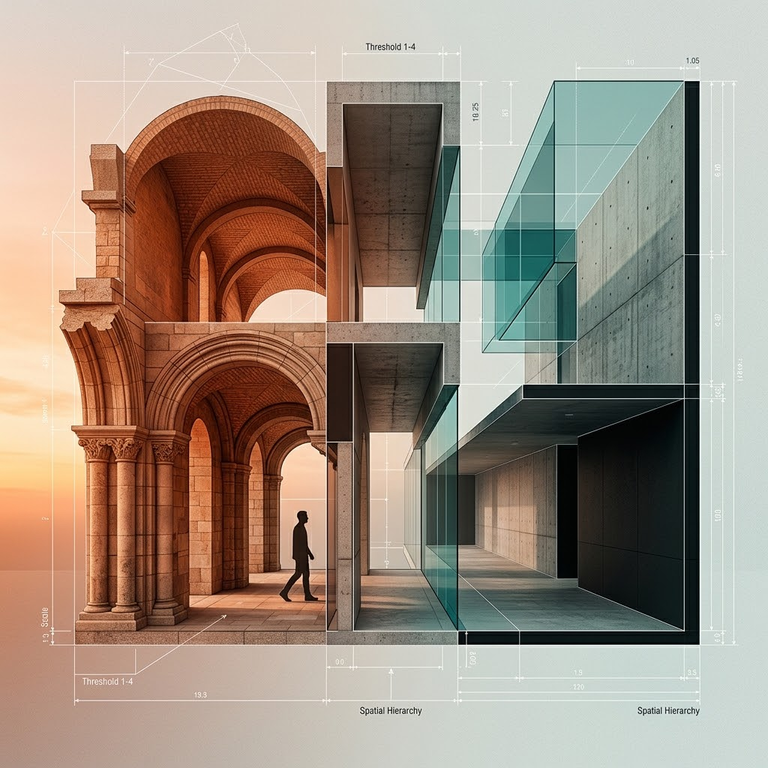
Before researchers began speaking of large language models as an available alternative that requires no social relationship or reciprocal obligation, architecture was already performing an entirely similar function: reducing the number of decisions the brain must make at every moment. Wayfinding signage in a metro station, the sequencing of spaces in a hospital from reception to clinic, the gradation of natural light that implicitly signals the direction of movement — all of these are tools that “think on behalf of the user” without asking for any social or emotional exchange in return, precisely as a chatbot available around the clock does.
The difference is that Armoundas and Loscalzo described large language models as capable of simplifying medical information, drafting documents, and supporting shared decision-making around the clock, regardless of location or socioeconomic status. This is exactly where most of our buildings fail today: repetitive corridors, absent signage, multiplying identical doors, waiting rooms with no logical sequence — all of it forces the visitor to “carry” the cognitive burden alone instead of having the building lighten it. This design failure is not a cosmetic detail; it effectively turns the building into a silent adversary that compounds symptoms for people with ADHD, autism, or even older adults whose capacity for rapid mental processing has weakened.
Neuro-Inclusive Architecture Versus Artificial Intelligence: The Same Goal, Two Different Tools
What contemporary architectural literature calls “neuro-inclusive design” shares with the idea of AI assistance a single, precise objective: compensating for a deficit in mental processing capacity through external tools. When an ADHD patient struggles to retain verbal instructions during a consultation — a difficulty confirmed by evidence of working-memory deficits — an AI application can convert their scattered speech into an organized symptom timeline and a clear list of questions, as Armoundas and Loscalzo proposed. By the same logic, a well-designed building can convert a confusing journey from the parking lot to the examination room into an intuitive sequence that requires no conscious decision from the visitor.
Practical evidence for the value of “pre-visit preparation” comes from a comprehensive review of 42 studies on question-prompt lists given to patients immediately before consultation, conducted by Sansoni and colleagues. The finding was that such lists increase the number of questions patients ask and push physicians to provide more information — but the decisive condition is timing: lists sent a week in advance are entirely forgotten, while those delivered directly in the waiting room achieve the highest effectiveness. This is precisely what a well-designed architectural environment does: it delivers the “reminder” at the right moment and in the right place — neither before nor after.
A pilot study of a chatbot application called “Todaki,” which delivered cognitive behavioral therapy and psychoeducation to adults with attention deficits, showed a measurable reduction in symptom severity, with users citing ease of access and the interface’s “friendly” character as its most important feature, according to research documented by Jang and colleagues. This reinforces the notion that a tool — whether digital or architectural — need not be “human” to provide effective support; it need only be available, simplified, and predictable in its response.
Spatial Equity: Who Owns an Intelligent Building, and Who Is Left in the Maze
Here lies the most serious paradox. Studies indicate that reliance on informal networks is distributed unevenly: those without a supportive partner or a cohesive family are left with no “human infrastructure” whatsoever, as Liao’s data on financial distress demonstrated, and as Bui and colleagues observed in their study on the transition to adulthood, where the ability to afford alternative supports such as specialized coaching varies by socioeconomic class.
Artificial intelligence is presented as a potentially democratizing solution to this gap, available regardless of geographic location or financial circumstance, as Armoundas and Loscalzo argued. But researcher Moro warned that digital technologies may create “digital divides” that exclude older adults and economically disadvantaged groups, while Puri and Veldkamp pointed to a deeper risk: that when artificial intelligence directs simpler content toward less capable users, it may exacerbate “cognitive inequality” rather than address it, by weakening the very attention skills the user actually needs to strengthen rather than offload.
The same logic applies to the built environment: an “intelligent” building in an affluent neighborhood, equipped with clear signage and neurologically considered pathways, is not a universal standard but a privilege. Hospitals, schools, and metro stations in less fortunate areas are often designed at the lowest possible cost, doubling their visual and navigational complexity — much as the digital divide widens between those with a smartphone and fast internet and those without. Equity here is not a marginal ethical detail but a fundamental condition for any tool — digital or architectural — to shift from privilege to right.
Conclusion: The Intelligent Building Is the One That Thinks Instead of the Human, Not the One That Merely Watches
When the idea of the “intelligent building” is reduced to sensors, cameras, and automated control systems, something far more important is overlooked: the true intelligence of architecture lies in its capacity to reduce the number of decisions a person must make to reach their destination. Just as a good AI language model does not impress the user with its complexity but with its ability to convert mental chaos into a clear list of questions before entering the clinic, a good building is not measured by the number of its smart devices but by its ability to “know” the visitor’s path before the visitor has to ask. Women with ADHD, whose experiences expose this flaw with exceptional clarity, remind us that the built environment is never neutral: it is either a silent partner that lightens the mental burden, or an additional weight added to a burden already heavy.
✦ ArchUp Editorial Insight
The repetitive corridor and the unmarked waiting room are not design failures in the aesthetic sense; they are the residue of how wayfinding gets budgeted. In most healthcare and transit procurement, signage sits outside the architect’s core fee structure, classified as fit-out or facilities-management expenditure, scheduled after occupancy, once value-engineering has already stripped contingency funds. Building codes mandate egress signage for fire safety but rarely mandate cognitive legibility, so regulatory compliance satisfies liability without addressing comprehension. The outcome is a building optimized for sign-off and construction cost per square meter, not for the sequence of decisions a disoriented user must make. Cognitive load, in this light, is not an unintended byproduct of poor taste — it is the predictable output of a procurement hierarchy that treats wayfinding as decoration rather than infrastructure.
References
Zeides Taubin, D., and Maeir, A. “I Wish It Wasn’t All on Me: Women’s Experiences Living with a Partner with ADHD.” Disability and Rehabilitation, 2023.
Wymbs, B. T., Canu, W. H., Sacchetti, G. M., and Ranson, L. M. “Adult ADHD and Romantic Relationships: What We Know and What We Can Do to Help.” Journal of Marital and Family Therapy, 2021.
Matheson, L., Asherson, P., Wong, I. C. K., et al. “Adult ADHD Patient Experiences of Impairment, Service Provision, and Clinical Management in England: A Qualitative Study.” BMC Health Services Research, 2013.
Jang, S., Kim, J. J., Kim, S. J., Hong, J., Kim, S., and Kim, E. “Mobile App-Based Chatbot to Deliver Cognitive Behavioral Therapy and Psychoeducation for Adults with Attention Deficit: A Development and Feasibility/Usability Study.” International Journal of Medical Informatics, 2021.
Sansoni, J. E., Grootemaat, P., and Duncan, C. “Question Prompt Lists in Health Consultations: A Review.” Patient Education and Counseling, 2015.
Armoundas, A. A., and Loscalzo, J. “Patient Agency and Large Language Models in Worldwide Encoding of Equity.” npj Digital Medicine, 2025.
Liao, C. “ADHD Symptoms and Financial Distress.” Review of Finance, 2020.
Williamson, D., and Johnston, C. “Gender Differences in Adults with Attention-Deficit/Hyperactivity Disorder: A Narrative Review.” Clinical Psychology Review, 2015.
Moro, E. “How Can We Stop Digital Technologies from Worsening Existing Health Inequalities?” Nature Reviews Neurology, 2023.
Alderson, R. M., Kasper, L. J., Hudec, K. L., and Patros, C. H. G. “Attention-Deficit/Hyperactivity Disorder (ADHD) and Working Memory in Adults: A Meta-Analytic Review.” Neuropsychology, 2013.
Sharma, A., Lin, I. W., Miner, A. S., Atkins, D. C., and Althoff, T. “Human-AI Collaboration Enables More Empathic Conversations in Text-Based Peer-to-Peer Mental Health Support.” Nature Machine Intelligence, 2023.
Waite, R. “Women and Attention Deficit Disorders: A Great Burden Overlooked.” Journal of the American Academy of Nurse Practitioners, 2007.
Puri, I., and Veldkamp, L. “Artificial Intelligence and Cognitive Inequality.” Journal of Monetary Economics, 2026.
Bui, H. N. T., Marsh, N. P., and Chronis-Tuscano, A. “Perspectives on Parental Support of Attention Deficit Hyperactivity Disorder Self-Management at the Transition to Adulthood.” Nature Mental Health, 2024.



![Bathroom Bundle Kit [Flat End] – Walnut / Walnut / Steel Ring & Screws](https://archup.net/wp-content/uploads/2021/12/13200-bathroom-bundle-kit-flat-end-walnut-walnut-steel-ring-screws-scaled.jpg)