Buried Anchors Halt Singapore Tunnelling, Bringing the Disruption Above Ground

Singapore’s Land Transport Authority announced on October 16 that buried ground anchors have interrupted Cross Island Line tunnelling at Ang Mo Kio. Crews extracted approximately 800 kilograms of wire ropes. Recovery work will require traffic changes along Ang Mo Kio Avenue 3 from November 14, 2026 to May 2028. The anchors’ origin and the effect on the rail construction timetable remain under investigation; May 2028 is not an announced railway completion date.
When the construction boundary moves
For contractors, the significance extends beyond an obstruction in front of a machine. An underground recovery operation can require space at street level, changing the relationship between the worksite and the neighbourhood. The construction boundary becomes an operational question: where can crews work safely while people continue to reach buildings and services?
For architects and urban designers, this is a reminder that access drawings cannot stop at a property line. Entrances, pedestrian routes and servicing arrangements depend on a street network that may itself become part of a construction operation. A design that works under normal conditions may need a different access strategy during prolonged works nearby.
A question of records, not an accusation
The wider professional question is how underground construction is documented for the next project. A useful record should help future teams understand not only what was built, but what remains beyond the visible structure. That does not establish a recordkeeping failure in this case, nor identify a responsible contractor. It identifies a question that the investigation, rather than speculation, must answer.
In procurement terms, the distinction matters. An obstruction is a physical condition; responsibility for it is a separate contractual and evidential issue. Treating the two as interchangeable can turn a technical recovery problem into a premature accusation.
✦ ArchUp Editorial Insight
Infrastructure procurement divides a continuous city into individual contracts, each with a defined scope and an endpoint. The ground does not necessarily respect that division. A component useful to one construction operation may occupy space needed by another, creating a future interface that no single completion certificate can resolve on its own. The lesson to examine is therefore not simply whether a machine is powerful enough, but whether institutions preserve usable knowledge about what successive projects leave behind. This is a governance question before it is a question of tunnel geometry. Contractors need evidence against which to price uncertainty, designers need credible constraints, and public authorities need to understand when recovery work may consume space used by others. None of this establishes negligence in the Singapore case. It explains why the investigation’s account of origin and extent matters beyond the immediate repair. The long-term value of a construction record lies in whether a later team can act on it, not merely whether a previous team submitted it.
Source: Land Transport Authority, Singapore, “Temporary Traffic Reconfiguration Along Ang Mo Kio Avenue 3 to Facilitate Cross Island Line Tunnelling Operations,” October 16, 2026. The professional implications above are ArchUp’s analysis.
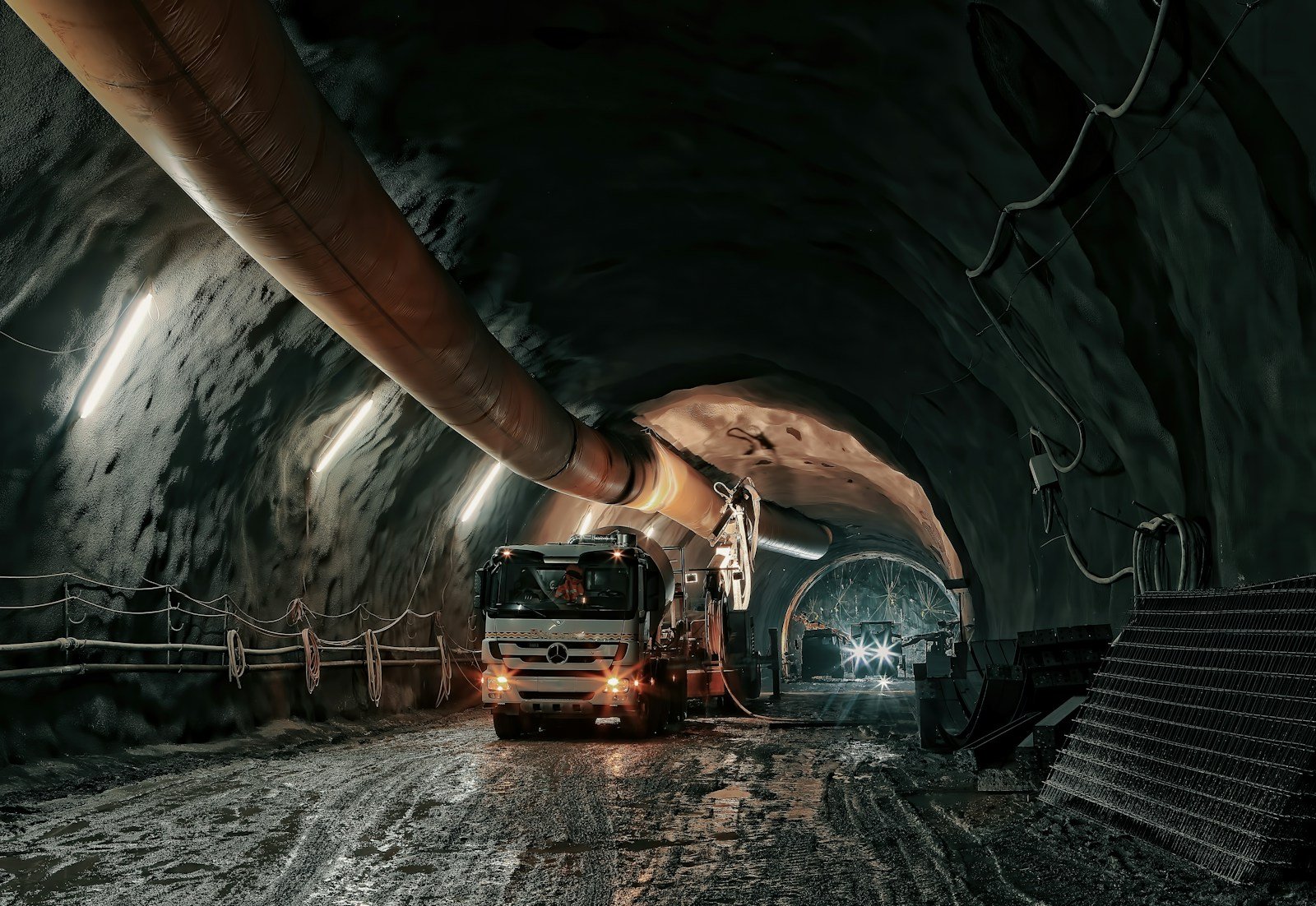
Featured image: A truck and overhead ventilation duct inside a tunnel under construction. Illustrative photograph, not the Ang Mo Kio site. © Ricardo Gomez Angel / Unsplash.