Affective Architecture: How Walls and Corridors Shape Spatial Belonging and Counter Digital Isolation


The Psychology of Inclusive Design: From Exclusionary Frameworks to Spaces Nurturing Human Identity
Can a dim vantage point in a building lobby, or a long, narrow school corridor, nudge an individual toward the depths of depression? Intersecting data between environmental psychology and architecture demonstrates that space is not merely an inert physical envelope, but a dynamic catalyst shaping our self-awareness and the degree of our connection to others. As waves of digital isolation sweep through contemporary societies, a critical architectural and planning dilemma emerges: how do we transition from constructing spaces that merely shelter bodies to designing nurturing environments that satisfy the innate human need for belonging and dry up the sources of depression and psychological distress?
Spatial Engineering and the Psychology of Presence: Beyond the Four Walls
Foundational literature in social psychology, particularly research led by American scholar Bonnie Hagerty and her colleagues, reveals that belonging rests on two pillars: an individual’s sense of being valued and needed in their environment, and the presence of spatial and social harmony with others. From a planning perspective, this feeling remains inseparable from the quality of the built environment. Exclusionary architecture that relies on vast, cold volumes or darkened corridors reinforces the concept of spatial alienation. Conversely, design that prioritizes fit and alignment gives users an implicit sense that the space comprises features tailored for them, validating their presence and positively impacting self-reported mental health.
The Spatial Gap: When Social Needs Outpace Design Efficiency
In an analytical study led by researcher David Mellor, evidence demonstrates that loneliness does not stem from a desire for isolation itself, but integrates into a gap generated between an individual’s deep need to belong and the actual level of satisfaction derived from their relationships and environment. This gap widens significantly in urban environments that lack “third places”—such as cafes, public squares, and urban parks—which allow for spontaneous, unconditioned interaction. Utilizing advanced response surface modeling in data analysis, studies show that acute psychological disorders surface when belonging needs exceed the satisfaction levels available in the surrounding environment, regardless of apparent population density. Living in a crowded city surrounded by soaring skyscrapers does not guarantee the mitigation of isolation unless those structures are organized to generate active, micro-communities.
Educational Space as a First Line of Defense: Designing Inclusive Learning Environments
In early childhood, the educational environment transcends its traditional utility to become a crucial psychological mediator. Research led by Sandra Castro-Kemp on a sample of children reveals that the relationship between socioemotional well-being and the prevention of loneliness is indirect, mediated inherently through a sense of school belonging. Here, the responsibility rests entirely with the architect. Classrooms that lack directed natural light, and school courtyards that omit design pockets allowing for both structured group play and quiet retreat, fail to forge this connection. Improving a child’s psychological well-being will not yield results unless the architectural layout of the school translates into an environment that stimulates spatial belonging, ensuring the child feels part of an extended spatial entity.
The Urbanism of Care: Sustainable Residential Spaces for Older Adults
The spatial dilemma shifts to the furthest spectrum of the lifespan when examining nursing homes and dedicated senior residential complexes. A specialized study by J. Park demonstrates that high physical performance and sensory preservation associate directly with the quality of the surrounding architectural space. Layouts that neglect mobility support, or overlook visual decline by utilizing dim lighting and low-contrast colors, accelerate the pace of social withdrawal among older adults. In this context, spatial belonging acts as a critical mediating variable. Designs that encourage spontaneous social participation—such as providing shared living rooms overlooking street activity and safe, barrier-free pedestrian pathways—directly address and reduce clinical depression and severe psychological distress among residents.
The Dynamics of the Nurturing Space: Breaking the Cycle of Isolation Through Design
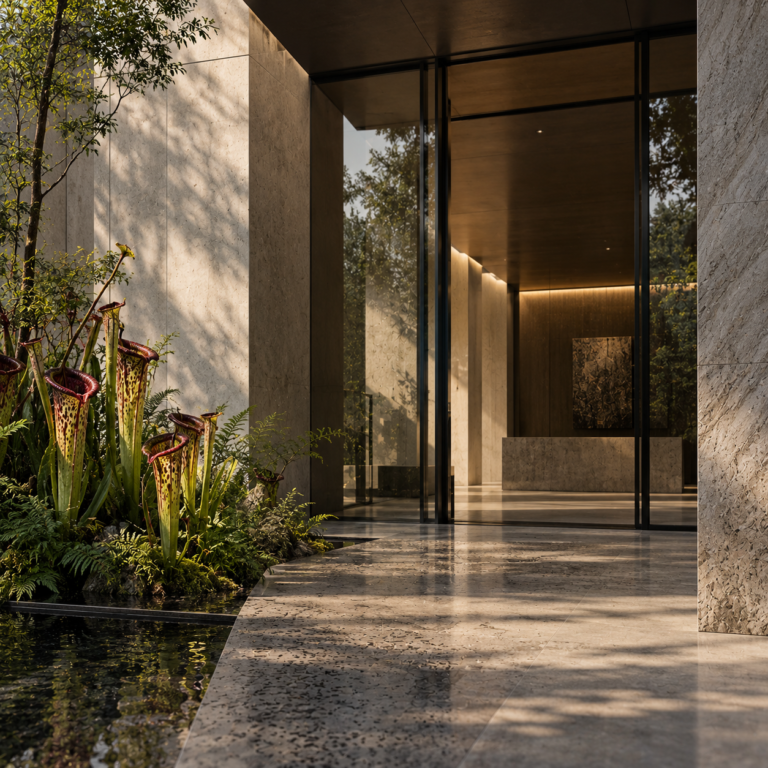
Research published recently by Matteo Di Tella indicates that individuals experiencing high levels of isolation encounter significant difficulties in socioemotional skills, including diminished empathy and challenges in emotion regulation, drawing them into a vicious cycle of spatial and social withdrawal. The architect can intervene to break this cycle through biophilic design strategies that integrate nature into structures and movement pathways that foster spontaneous visual encounters. Providing psychologically comfortable environments that employ warm, natural materials and a calculated distribution of light and shadow helps reduce anxiety and stress levels among users, increasing their motivation to emerge from the shell of isolation and engage with the broader public realm.
✦ ArchUp Editorial Insight
Rising anxiety about loneliness is less a design failure than a structural by-product of economic and technological systems that reorganize daily life around screens, efficiency, and liability control. As work, education, and care migrate into digitized and risk-managed frameworks, physical environments are procured to optimize supervision, circulation efficiency, and cost predictability rather than social reciprocity. Building codes privilege visibility and control; funding models reward standardization; urban land values compress “unproductive” communal space. The resulting corridors, lobbies, and classrooms are not emotionally barren by accident—they are spatial translations of governance models that treat interaction as incidental. When social policy externalizes mental health to individuals while cities eliminate informal gathering grounds, architecture absorbs the contradiction. Dim halls, oversized atria, and residual courtyards thus become the logical outcome of systems that measure throughput and compliance, but rarely belonging.
References
Mellor, David, Stokes, Mark, Firth, Lucy, Hayashi, Yoko, and Cummins, Robert. “Need for belonging, relationship satisfaction, loneliness, and life satisfaction.” Personality and Individual Differences, 2008. Silvia, S. S. “From the Outside Looking In: Sense of Belonging, Depression, and Suicide Risk.” Psychiatry, 2015. Hagerty, Bonnie M., Williams, Robert A., Coyne, James C., and Early, Mary R. “Sense of belonging and indicators of social and psychological functioning.” Archives of Psychiatric Nursing, 1996. Malone, Glenn P., Pillow, David R., and Osman, August. “Developing the Sense of Belonging Scale and Understanding Its Relationship to Loneliness, Need to Belong, and General Well-Being Outcomes.” Journal of Personality Assessment, 2023. Lim, Michelle H., Eres, Robert, and Vasan, Shreya. “Introducing a dual continuum model of belonging and loneliness.” Australian Journal of Psychology, 2021. Castro-Kemp, Sandra, et al. “The mediating role of school belonging in the relationship between socioemotional well-being and loneliness in primary school age children.” Australian Journal of Psychology, 2021. Verhagen, Marilou, Lodder, Gerine M. A., and Baumeister, Roy F. “Unmet belongingness needs but not high belongingness needs alone predict adverse well-being: A response surface modeling approach.” Journal of Personality, 2017. Wilczyńska, Agnieszka. “The Need of Belonging and Sense of Belonging versus Effectiveness of Coping.” Polish Psychological Bulletin, 2015. Park, Jihye. “Assisted Living Residents’ Sense of Belonging and Psychosocial Outcomes.” Western Journal of Nursing Research, 2020. Di Tella, Matteo, Adenzato, Mauro, et al. “Loneliness: Association with individual differences in socioemotional skills.” Personality and Individual Differences, 2023.