Cat’s Eyes

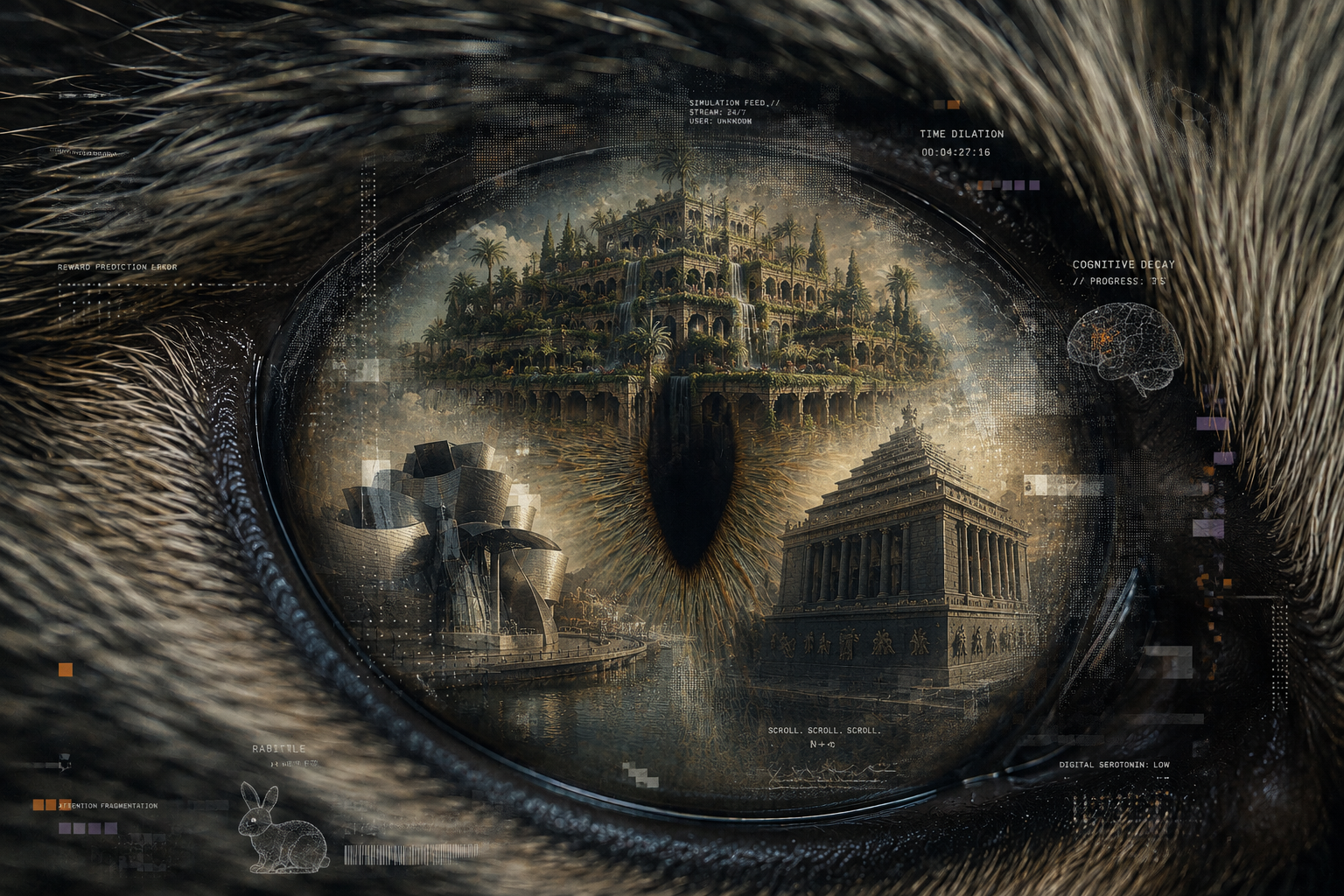
Architectural history is shaped by the gap between the physical experience of buildings and the linguistic tools used to describe them. Throughout history, writers used strategies like exaggeration and symbolism to communicate architectural scale and meaning when direct observation or precise vocabulary proved insufficient for their audiences.
Modern documentation and technology, including artificial intelligence, continue to face limitations in capturing the sensory and emotional impact of built environments. This ongoing negotiation between experience and language suggests that the essence of architecture remains irreducible to technical records, requiring a continuous effort to translate physical presence into words.
Ibrahim Fawakherji — ArchUp
Imagine a mother cat. Not a fierce one. Not particularly perceptive. Her instincts are intact but her judgment is slow, her processing imprecise. She has raised several kittens, each different, each seeing the world through its own particular aperture. And one day she tries to describe to them what she has seen: the yard, the wall, the light that comes through a specific gap at a specific hour.
Her descriptions are honest. They are simply incomplete. The vocabulary she has available does not match the complexity of what she is trying to convey. She says “very big” when the thing she saw was structurally impossible. She says “bright” when the phenomenon she witnessed was a particular quality of reflection that has no name in her language. She says “beautiful” because she has no more precise word and because beauty is what remains when the analytical capacity runs out.
Her kittens listen. They build pictures in their minds. The pictures are not what she saw. They are constructions assembled from her words, filtered through their own prior experience, shaped by what they already know and what they cannot yet imagine.
This is how most of architectural history was transmitted.
Not through measured drawings. Not through photographs. Not through the experience of the building itself. Through descriptions produced by minds working at the edge of their perceptual and linguistic capacity, trying to communicate something that exceeded the tools available to them.
The gap between what was seen and what was said is not a failure of the historical record. It is the record. And reading it carefully tells us something important about the relationship between perception, language, and the built environment that no technical documentation can.
Herodotus visited Babylon in the fifth century before the common era, or came close enough to gather testimony from those who had. What he produced was not a survey. It was a description assembled from the accounts of soldiers, merchants, and travelers, filtered through a Greek sensibility trying to make the incomprehensible legible to a Greek audience.
His account of the city walls is the most famous example. He described them as wide enough for two four-horse chariots to pass each other on the top surface without collision. He described the tower at the center as eight platforms stacked upon each other, ascending toward heaven. He gave measurements. He gave proportions. He was precise in the way that a witness is precise when they are trying to convey something that overwhelmed their capacity for precision.
What Herodotus was doing, without having the vocabulary to describe it, was writing the first architectural meta-description in recorded history. He was telling his readers not simply what Babylon looked like but what category of experience it represented. He was saying: this is a thing that exceeds your existing framework. This is a thing that requires you to expand what you think a human construction can be.
The compression he used was not deception. It was the available technology for communicating architectural scale across a cultural and linguistic divide.
The SEO of the ancient world, if you will, was the story that made people need to know more.
Several centuries later, the Venerable Bede sat in a monastery in northern England and wrote about a building he had never seen and could never see. Solomon’s Temple had been destroyed for centuries. What remained were textual descriptions, measurements embedded in scripture, proportions that carried theological weight alongside their geometric specifications.
Bede did not describe the Temple as a building. He described it as a diagram of divine intention. The gold of Ophir covering the walls was not decoration. It was a statement about the nature of sanctity. The cedar beams from Lebanon were not structural elements. They were a claim about what materials were worthy of proximity to the sacred.
He was working entirely in the realm of the imagined building. But the imagined building he produced was not arbitrary. It was disciplined by the textual record, shaped by theological necessity, and communicating something real about how a particular civilization thought about the relationship between constructed space and transcendent meaning.
The building that cannot be seen forces the describer to find what the building means rather than what it looks like. Sometimes this produces distortion. Sometimes it produces a clarity that direct observation obscures.
The medieval Islamic geographical tradition produced its own version of this phenomenon. The Masudi’s accounts of the copper city, and the elaboration of vanished or legendary architectures in the tradition that produced the Thousand and One Nights, operated on a specific principle: when you cannot show the building, you describe the materials as if they were the building.
Walls of alternating gold and silver brick. Balustrades of ruby and emerald. Gates of polished copper so reflective they functioned as mirrors that blinded approaching travelers. The architecture was described as treasure rather than space. The rooms were catalogued by what they contained rather than by how they were organized.
This is not naive. It is a precise response to the problem of describing the unvisitable. In a culture where the physical properties of gold and precious stone carried established symbolic weight, to say that a building was made of these materials was to locate it precisely in a taxonomy of value. The reader knew immediately what category of significance the building occupied. The description was communicating class and meaning rather than form and proportion.
The encoding was different from Herodotus. The purpose was the same: to produce in the reader an accurate sense of what encountering this building would do to them, using whatever vocabulary was available.
Marco Polo arrived in China and faced a different translation problem. His audience in Europe knew stone. They knew thick walls and small windows and the structural logic of the gothic. What he had seen in Xanadu was a palace of lacquered bamboo and gilded reed, held together with silk cords, designed to be disassembled and transported in its entirety.
He described it accurately and it read as fantasy.
Because the architectural intelligence encoded in that building, the understanding that permanence can be achieved through precision of assembly rather than through mass and weight, was genuinely outside the conceptual vocabulary of his audience. He was not exaggerating. He was trying to communicate a structural principle for which his readers had no existing category.
The fantasy was in the gap between what he saw and what they could imagine. Not in the building.
Filarete, working in fifteenth-century Italy, made a different move. He stopped describing buildings that existed and began describing buildings that should exist. His Sforzinda, a city planned as an eight-pointed star with radial streets converging on a central plaza, was never built. It was a written argument about what a city could be if its form expressed its social organization correctly.
The shift was fundamental. From describing the overwhelming to imagining the ideal. From the mother cat trying to communicate what she saw to the kitten who has grown enough to describe what has not yet been built.
The mathematical precision of Filarete’s description was itself an argument. The symmetry was not aesthetic preference. It was a claim about the relationship between geometric order and social health. The city as diagram. The building as proposition.
This is where architectural writing separated from architectural description and became architectural thinking.
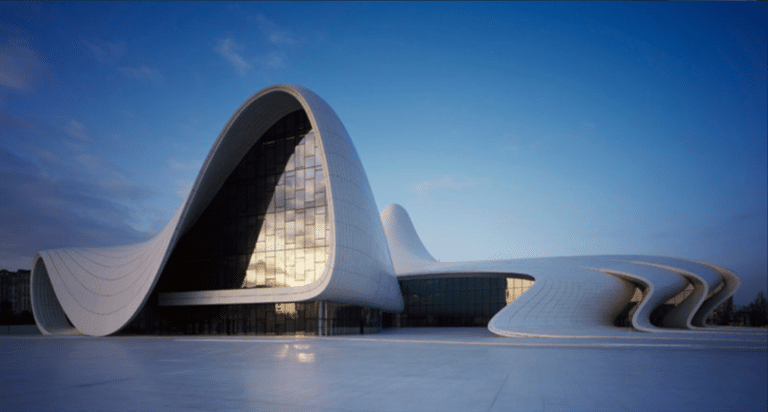
In 1997 Philip Johnson stood in front of the Guggenheim Bilbao and wept.
He was not a sentimental man. He was, if anything, one of the most analytically precise critics the discipline had produced. What undid him was not beauty in any simple sense. It was the recognition that the building had done something he had not believed possible: it had produced an experience of space that exceeded the categories he had spent a lifetime developing.
He said the building was no longer walls and floors and ceilings. It was a pure festival of curves that moved human feeling.
This is a cat’s eyes description. Not because Johnson lacked sophistication, but because the building had temporarily exceeded his processing capacity. He had encountered something that his existing framework could not fully absorb in real time, and what came out was the emotional response that fills the gap when analysis is momentarily unavailable.
The description is not precise. It is true. It tells us something about the experience of encountering the building that no measured drawing of the titanium panels can communicate. The weeping is data.
Today, when a traveler stands for the first time in front of the Grand Mosque in Mecca and tries to comprehend a structure that accommodates two million human bodies in simultaneous worship, what vocabulary is available?
When someone arrives at a major international airport and tries to process the fact that they are inside a single enclosed space larger than many medieval cities, what language does the experience produce?
When a passenger emerges from a tunnel into the interior of a contemporary rail terminal and the volume of the space produces the involuntary physical response that large enclosed spaces have always produced in human beings, what does the description sound like?
It sounds like Herodotus. It sounds like Bede. It sounds like Marco Polo trying to explain lacquered bamboo to someone who has only known stone.
The tools change. The gap between the building and the language available to describe it remains constant. We are all, at the moment of genuine architectural encounter, working at the edge of our perceptual and linguistic capacity. We are all, in that moment, a mother cat trying to tell her kittens what she saw.
The history of architectural description is the history of this gap and the various strategies that different cultures and different centuries developed to bridge it.
Herodotus used numerical exaggeration to communicate scale. Bede used theological symbolism to communicate sanctity. The Islamic geographical tradition used material excess to communicate value. Marco Polo used structural defamiliarization to communicate difference. Filarete used mathematical order to communicate aspiration. Philip Johnson used involuntary emotion to communicate the experience of encountering genuine innovation.
Each strategy was a response to the same underlying condition: the building is doing something that the available vocabulary cannot fully contain, and the description must compensate for the gap somehow.
Today that gap has a new dimension. The AI systems now capable of generating descriptions, analyses, and responses to architectural images are working with the same fundamental limitation. They can process what the image contains. They cannot process what the building does to the body standing inside it.
The weeping is still beyond them.
The cat’s eyes, for all their limitations, are still producing data that no algorithm has learned to gather.
When you read a description of a building, what you are reading is always a negotiation between what was experienced and what language can hold. The most honest architectural writing acknowledges this. It knows that the building exceeds the sentence. It writes anyway, because the attempt to close the gap is what the discipline requires.
We are all descendants of that first mother cat, trying to tell the kittens what we saw.
The kittens who grow up, who develop their own perceptual capacity through practice and exposure and the slow accumulation of experience, eventually go to see for themselves.
And then they find that what they find exceeds their description too.
This is not a failure of language.
It is the condition that makes architecture worth writing about.
✦ ArchUp Editorial Insight
What this essay presents as a meditation on linguistic inadequacy is, structurally, an argument about the epistemological limits of every documentation system that architectural culture has produced — and by extension, an argument about what is systematically lost when a discipline decides to privilege the reproducible record over the irreducible experience. Herodotus did not exaggerate Babylon’s walls because he lacked rigor; he exaggerated them because the available transmission technology — language circulated through manuscript copies across centuries — could not preserve the somatic response the walls produced in the body standing before them, and numerical excess was the closest available proxy for that physiological data. The same compression governs every medium that has since replaced it: the photograph flattens depth, the render eliminates time, the parametric model abstracts material behavior, and the AI image, as examined in I Miss the Render, generates visual confidence precisely at the point where bodily knowledge would require the most caution. The article’s deepest structural observation is therefore not about history but about the present: each acceleration in documentation technology has closed the gap between the building and its image while simultaneously widening the gap between the image and the experience, and the discipline has consistently mistaken the former closure for progress while absorbing the latter widening as an acceptable professional cost — a cost that is never paid by the architect or the platform, but always by the body that eventually inhabits the space the description promised.