A Place of Worship, a School, or a Hospital?

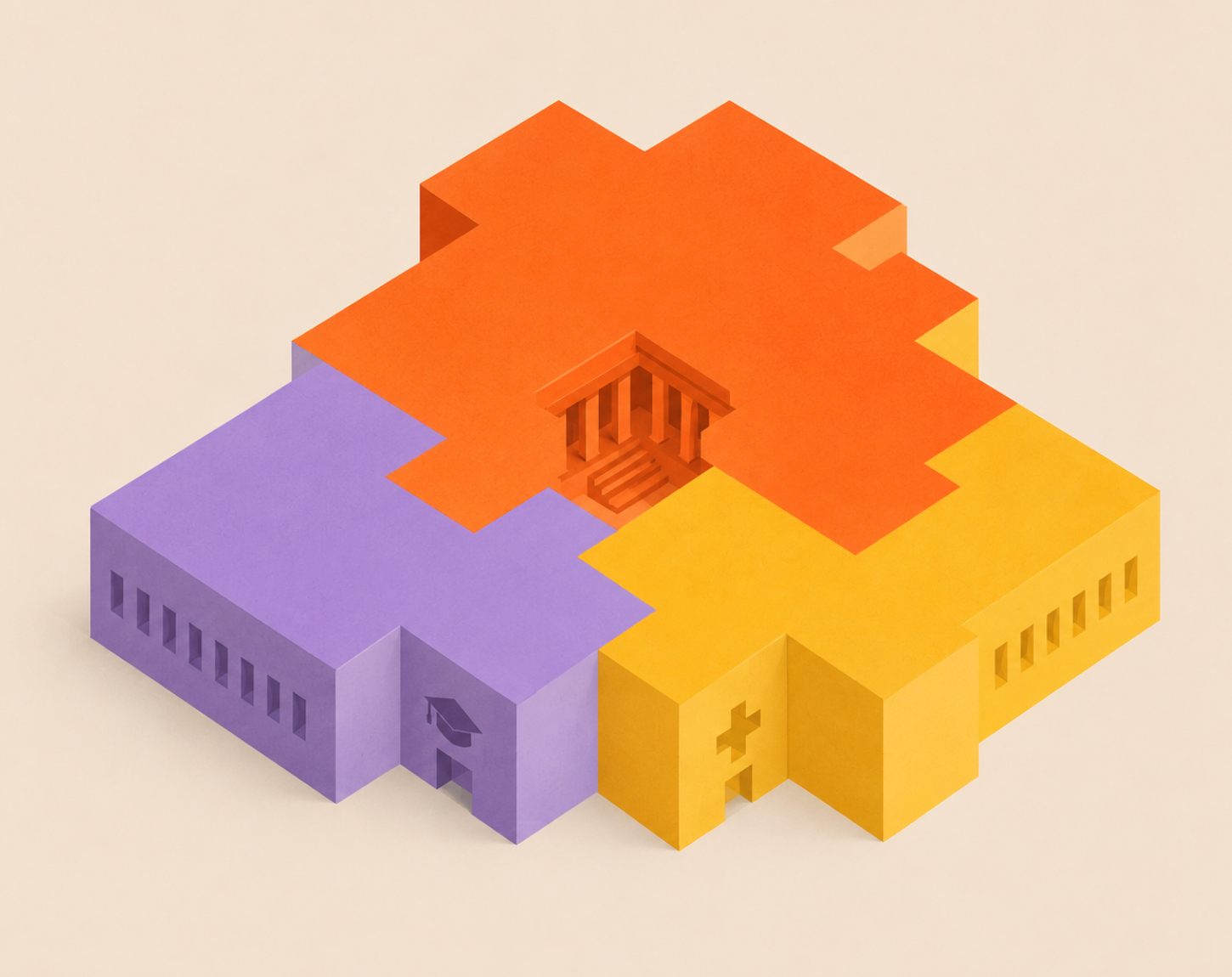
A question posed by an architecture student — whether to build a place of worship, a school, or a hospital given only one choice — frames a broader inquiry into how communities determine their most urgent needs. The author reflects on each option’s merits, noting that places of worship historically served civic and social functions beyond religion, while schools face questions about what physical presence uniquely provides in an era of digital learning.
The author ultimately favors the hospital, arguing that health is the foundational precondition for education, faith, and civic life. A hospital can also absorb functions of the other two building types, while neither a school nor a place of worship can substitute for medical infrastructure. The deeper point is that the value of the question lies not in a single answer but in the careful reading of a community’s specific conditions that must precede any architectural decision.
Ibrahim Fawakherji — ArchUp
During one of this summer’s training sessions, I was sitting with a group of architecture students. The conversation moved through the usual territory: projects, design decisions, the shape of a career. Then one of them raised his hand and asked a question that I initially mistook for a social media prompt.
He said: if you owned a plot of land, had the budget to build, but were permitted to build only one thing, what would you choose? A place of worship, a school, or a hospital?
I almost answered immediately. Then I stopped.
Because the question, the longer I sat with it, was not about buildings at all. It was about how a civilization decides what it needs most. And that is one of the hardest questions architecture is ever asked to answer.
Many people would choose the place of worship, and the choice is not difficult to understand.
In the Islamic tradition specifically, the mosque was never a building with a single function. It was a school, a council chamber, a court, a center for social organization, a place where disputes were resolved and delegations received and the life of the community was administered. The architecture of the mosque encoded a conception of society in which the spiritual and the civic were not separate domains but expressions of the same underlying order.
To choose the place of worship is not simply to choose religion. It is to choose a particular theory of what holds a community together, what gives it coherence and identity across generations. That is a serious architectural argument, and it deserves to be treated as one.
Twenty years ago I might have placed the school first.
Today I am less certain, and the uncertainty is not about the value of education. It is about what a school building actually does that cannot be done otherwise.
The pandemic demonstrated something that will not be easily unlearned: a significant portion of formal instruction can be delivered without a physical building. The knowledge transfer function of the school, which was once inseparable from the institution’s physical presence, has been partially decoupled from it. The AI tools now available to students have accelerated this further, making information access easier than it has ever been while simultaneously making the question of what information is worth having more difficult to answer.
What remains irreplaceable about the school is not the lecture. It is the argument, the shared experience, the formation of judgment through encounter with other minds working on the same problems. These require presence. But they do not necessarily require a building designed and designated as a school. They require conditions, and those conditions can be created in various architectural contexts.
The school may be becoming less a building and more a set of relationships, which does not diminish its importance, but it does complicate the case for the building specifically.
If the question were put to me today, I would choose the hospital.
Not because medicine is more important than education or faith. But because health is the precondition for everything else. The person who cannot access medical care when they need it cannot learn effectively, cannot work, cannot participate in the life of their community, cannot practice their faith with the full capacity of their body and mind. Health is not one value among others. It is the condition under which the other values become accessible.
When the Black Death moved through fourteenth-century Europe, the populations who gathered in places of worship seeking protection were not wrong to seek it. The faith was real and the need was genuine. What was absent was not devotion but knowledge: the understanding of how disease moved between bodies, what practices reduced transmission, what interventions could change outcomes. The gatherings sometimes amplified the catastrophe not because faith failed but because medicine had not yet developed the tools to protect the people who came together.
The lesson is not that worship is wrong. The lesson is that without the capacity to protect human life, every other institution becomes fragile. The school cannot teach the dying. The place of worship cannot fully serve a community that has been reduced by preventable death. The hospital is the building that preserves the preconditions for everything else.
There is a practical architectural argument as well.
A hospital can contain a place of worship. Most serious healthcare institutions include a chapel, a prayer room, a space for the spiritual dimension of illness and recovery, because the people who work and heal and grieve inside hospitals are whole human beings, not medical cases. A hospital can contain training facilities, seminar rooms, research spaces. It can be designed as an institution of learning as well as healing.
A school cannot become a hospital when the community needs surgery. A place of worship cannot perform the functions that modern medicine requires. The hospital is the most capacious of the three options, the one most capable of absorbing the functions of the others without losing its primary purpose.
But the honest answer to the student’s question is that there is no single correct answer.
In a community that lacks any place of collective spiritual practice, the place of worship may be the most urgent need. In a region where illiteracy is high and access to education is genuinely scarce, the school may be the decision that changes the trajectory of the next generation. In a city facing a health crisis without adequate medical infrastructure, the hospital requires no argument.
The question reveals its real value not in the answer it produces but in the thinking it demands. Before you can decide what to build, you have to read the community. You have to understand what is already present, what is critically absent, what the specific conditions of this specific place at this specific moment actually require. That reading is the architectural act. The building is its consequence.
Architecture students are sometimes taught to believe that the discipline begins with the design problem. The site, the brief, the constraints, the formal response.
What this question suggests is something different. The discipline begins earlier, at the moment when someone asks what should exist here, and why, and for whom, and at what cost to what other possibility.
That question is not a prelude to architecture. It is architecture.
It is architecture.
The first line drawn on a plan is not a geometric act. It is a declaration of priorities. It says: this community has decided that this need is more urgent than that one, that this function deserves to be made permanent and solid and expensive and lasting.
Every building is an argument about what matters.
The student who asked that question in a summer training session was not asking about three building types.
He was asking what we believe the human being needs most.
And the fact that the question has no single answer is not a weakness.
It is the reason architecture remains a serious discipline rather than a solved problem.
✦ ArchUp Editorial Insight
The question that frames this article is a resource-allocation problem disguised as a philosophical one, and its real analytical value lies not in the answer the author reaches — which is defensible — but in the structural conditions it exposes about how communities arrive at building decisions in the first place. In contexts where land is scarce, capital is constrained, and institutional priorities are contested, the choice between a place of worship, a school, and a hospital is rarely made through the kind of careful community reading the article recommends; it is made through the mechanisms that actually govern public and philanthropic construction: donor priorities, political signaling, institutional prestige, and the legibility of the building type to its primary financier. The mosque that receives private endowment in a community that lacks a functioning clinic is not the outcome of a civilization’s considered judgment about what it needs most — it is the outcome of a procurement model in which the building that generates spiritual credit for its funder is easier to finance than the building that generates public health outcomes for its users, a dynamic that connects directly to what Who Really Builds Our Cities identified as the decisive structural condition: the party who controls the capital controls the brief, and the community’s actual needs are legible in the final built form only as whatever was left after that negotiation concluded.