When the Building Becomes a Forced Stage

How Modern Architecture Reproduced Humanity’s Oldest Fears in Every Glass Wall and Open-Plan Office
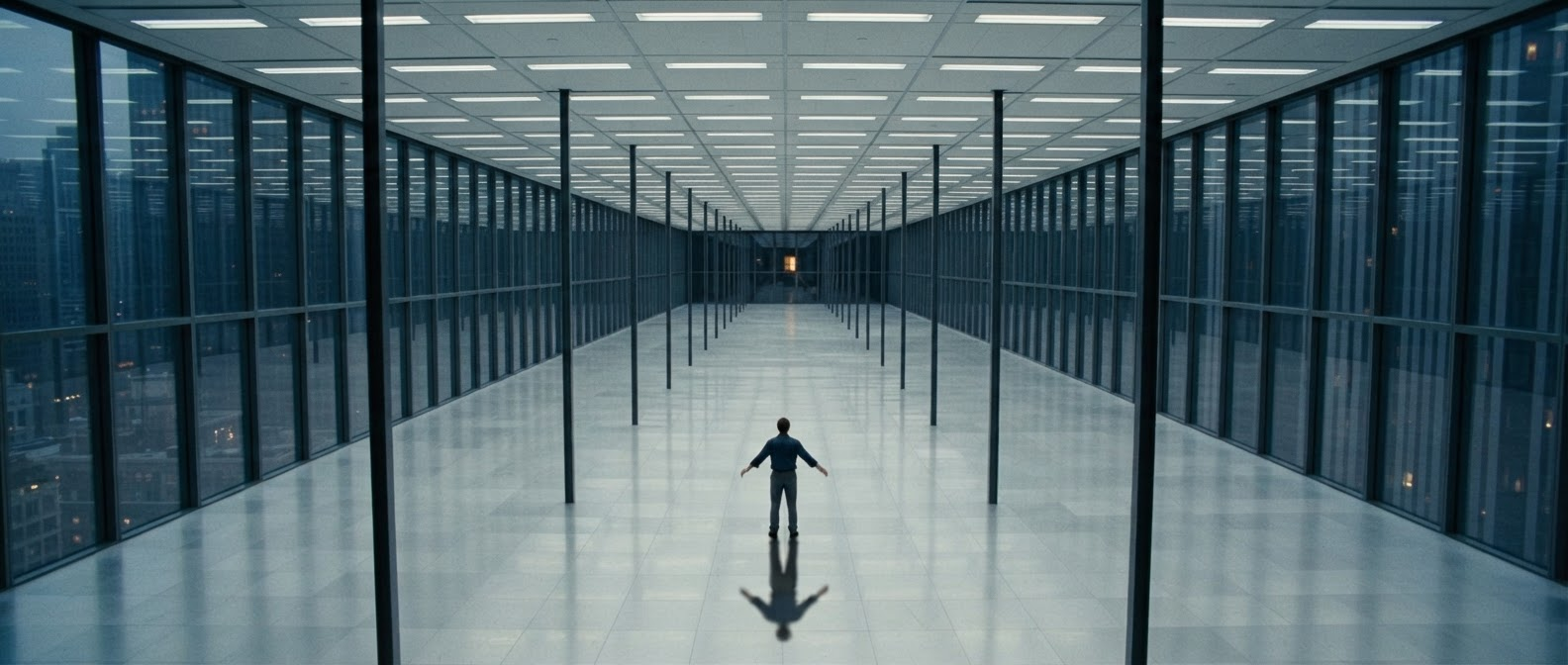
Imagine standing before a thousand people in a packed hall, spotlights trained on you, every eye fixed on your slightest movement. Your heart races, your palms sweat, and your only desire is to flee. Now imagine that this feeling does not last a few minutes on a podium but accompanies you for eight continuous hours every day: in your open-plan office where colleagues monitor your screen, in your glass-walled apartment where neighbours watch you eat, and in the exposed public plaza where no corner offers shelter. This experience is a form of spatial terror, affecting millions of people living inside architectural spaces designed — whether in good faith or through miscalculation — to turn ordinary existence into a permanent performance on a stage whose curtain never falls.
The Fifty-Year Myth: How the Podium Phobia Legend Was Born
To understand how the architecture of transparency became a machine for producing anxiety, we must first dismantle the myth that fueled it. For more than half a century, speechwriters and personal-development coaches have repeated a claim that sounds self-evident: “Humans fear public speaking more than they fear death.” But when researchers K. K. Dwyer and M. M. Davidson traced this claim to its origin, they discovered that it rests on a single omnibus survey conducted in April 1973 by R. H. Bruskin Associates, covering roughly 2,500 American adults. Participants in that survey were not asked to rank their fears from most to least terrifying; they were simply asked to indicate which of fourteen items provoked any degree of fear, however slight. In that context, 40.6 percent of respondents endorsed “speaking before a group” as frightening, while only 18.7 percent endorsed the “death” item. The gap is real, but it does not mean death is less terrifying; it means a checklist captures transient daily anxieties more effectively than deep existential dread.
Nevertheless, the London Sunday Times picked up the result, and the 1977 book The Book of Lists promoted it as the “fourteen worst human fears,” after which university public-speaking textbooks recycled it for decades without returning to the original data. An analysis by Pearson and colleagues of the ten best-selling public-speaking textbooks confirmed that speech-anxiety material is dominated by charged negative descriptors — “terror,” “panic,” “anxiety” — rather than a balanced research-based picture, a presentation style that may amplify students’ own fear and entrench the folklore that the podium is a terrifying exception in human life.
Transparency as Spatial Violence: When Glass Becomes a Weapon
This is precisely where psychology intersects with architecture in a way that has not received sufficient attention. If the fear of being the center of others’ gaze is a real and documented fear — whether exaggerated or not — then every transparent glass building is a building that reproduces this fear daily for thousands of users. Pioneers of architectural modernism such as Mies van der Rohe and Le Corbusier celebrated transparency as a moral value before it was an aesthetic one: the glass wall signifies democracy, the absence of secrets, an open society without barriers. What these pioneers did not account for is that forced spatial “openness” closely resembles forced “openness” on the podium: both strip the individual of the right to disappear.
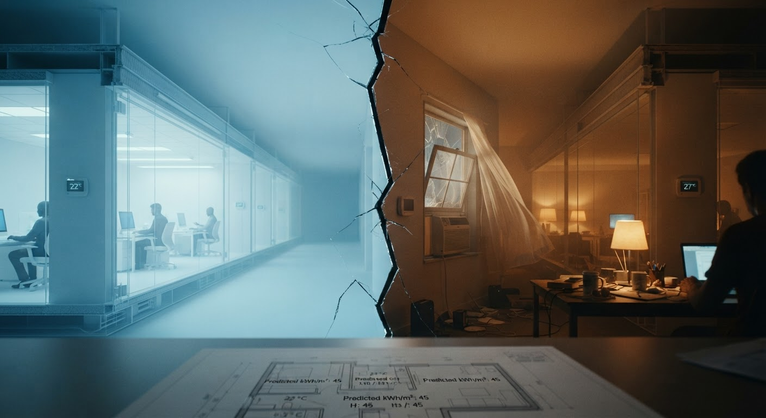
The open-plan office, which spread through technology companies from the late 1990s onward, is the clearest embodiment of this paradox. An employee sitting at a screen in a wall-free space is not working in an office but standing on a small stage surrounded by an audience of colleagues who see every gesture and every expression on his face. The physiological response this situation triggers — accelerated heartbeat, elevated cortisol levels, the involuntary urge to withdraw — is the same response researchers have documented in those who suffer from public-speaking anxiety. The only difference is that the speaker steps onto the podium for a few minutes and then steps down, while the open-plan employee remains “on the boards” for the entire workday.
The Architecture of Forced Exposure: From the University Lecture Hall to the Residential Tower
The issue is not confined to offices. If we widen the lens, we find that many common architectural typologies reproduce the same psychological mechanism with varying degrees of intensity. Tiered university lecture halls, for instance, place the student in exposed rows where he feels that everyone seated behind him is watching his back and his movements — a spatial arrangement that mimics the structure of a hall in which a speaker faces a silent audience. In the glass residential towers that are proliferating across Arab and global capitals, the occupant finds himself in a state of permanent exposure before the neighbors in the building opposite: they see him eating, reading, and crossing his apartment corridor in sleepwear. Privacy here is not violated by a legal framework but by a purely visual one that the architect himself designed.
A study by Ferreira Marinho and colleagues of more than 1,100 university students demonstrated that the proportion who acknowledged a fear of public speaking reached roughly 64 percent, a figure far exceeding the 15 to 30 percent recorded in general community surveys depending on the sample and country. This disparity indicates that institutional environments — universities, corporations, government agencies — amplify social anxiety through their spatial designs far more than ordinary daily life does. In other words, the problem lies not in the user’s psychology alone but in the space that forces him to be a “public speaker” without his choosing to be one.
Death or the Spotlight? What the Numbers Actually Reveal About the Hierarchy of Fears
But what if we ask people a direct question: “What is your single greatest fear?” Here the picture flips entirely. When Dwyer and Davidson re-administered the original survey to 815 college students, this time asking them to identify and rank their top fear, death came first at 20 percent, followed by public speaking at 18.4 percent, and financial problems at 15 percent. The only subgroup that placed public speaking at the top was the cohort already suffering from high speech anxiety — which is akin to saying that people who fear heights place heights at the summit of their fears: a valid result but one that cannot be generalized to everyone.
More revealing is what happened when these students enrolled in a public-speaking course. After completing the course, their fear of speaking dropped sharply until it fell out of the top five fears entirely, while death clearly rose to first place. This means that the fear of exposure before others is a fear amenable to treatment and adaptation, whereas the dread of death runs deeper and is more entrenched. Yet modern architecture continues to design spaces that treat the fear of exposure as an individual weakness to be overcome through forced openness, rather than as a psychological reality that deserves spatial respect.
From a broader epidemiological perspective, Tore Furmark notes in his comprehensive review of social-phobia surveys that full social phobia affects between 7 and 13 percent of Western populations over their lifetimes, while the proportion suffering from phobia limited to public speaking does not exceed 3 to 5 percent. This means that the vast majority of those who acknowledge a fear of the podium do not suffer from a genuine clinical disorder but from transient situational anxiety — precisely the kind of anxiety that exposed architectural spaces exacerbate without pushing it to the threshold of pathology.
Open Plazas and Watching Neighbors: The Terror of Infinite Space
Spatial terror takes a sharper form in vast public plazas that lack elements of visual and sensory gradation. When a person stands in the middle of an immense square — whether Tahrir Square in Cairo or Times Square in New York — he becomes an exposed point in an endless space, with no wall to lean against and no ceiling to shield him from an open sky. This feeling of total exposure mirrors, in neurological terms, the sensation of a speaker standing alone on a barrier-free podium before an audience whose edges cannot be seen. Agras and colleagues observed in their classic epidemiological study that situational fears — such as fear of heights, insects, or speaking — follow different developmental trajectories from fears of death, illness, and injury, with the former appearing in childhood and the latter rising in later adulthood. This qualitative difference means that the attempt to place both fears on a single scale — as the 1973 Bruskin survey did — is methodologically flawed from the outset, and that an architectural space treating all forms of human fear as a single mass will inevitably produce environments that respect the specificity of none.
From a deeper evolutionary perspective, Kirkpatrick and Navarrete argue that the idea of a universal innate “fear of death” driving human behavior is overstated, and that the effects of death-related thoughts on the human psyche are more accurately understood as outputs of other evolved social-psychological systems. If this is correct, then the real terror triggered by exposed space is not an existential dread of annihilation but a social dread of negative evaluation, rejection, and humiliation — which is precisely what the open plaza, the glass tower, and the open-plan office produce when they place a person under permanent surveillance.
The Architecture of Calm: Toward Spaces That Respect Fear Instead of Denying It
If we accept that the fear of exposure before others is a documented psychological reality — even if it is not the greatest fear in a person’s life — then the essential architectural question becomes: what kind of spaces respect this fear instead of denying it? The answer does not lie in a return to the architecture of fortresses and dark corridors but in adopting the principle of “graduated privacy,” in which the user transitions from public to private through a series of clear spatial layers rather than being suddenly thrown into a fully exposed space.
This approach encompasses emerging directions that have begun to appear in serious architectural projects around the world: “quiet rooms” integrated into open-plan offices, where an employee can withdraw for a few minutes into a visually and acoustically enclosed space to restore sensory equilibrium; sensory design in hospitals and schools that addresses the variation in neurological sensitivity among users by controlling lighting, noise, and the degree of visual exposure; and a return to deep balconies and interstitial spaces in housing that provide a transitional layer between the private interior and the public exterior. This is not a regressive architecture that rejects transparency but a mature architecture that treats human fear as a design reality rather than a flaw to be erased.
In the end, the large meta-analysis conducted by Dumitru and colleagues across 129 studies involving more than 34,000 participants reveals that death anxiety correlates moderately with psychological distress, but the quality of the studies themselves remains modest and bears signs of publication bias. The deeper methodological lesson — one that the architect must absorb before the psychologist — is that “the most common fear” is not synonymous with “the greatest fear,” and that conflating the two is what gave birth to the fifty-year myth of the podium and death. Architecture that confuses visual openness with psychological openness will continue to produce spaces that are beautiful in photographs and terrifying in lived experience.
✦ ArchUp Editorial Insight
The chronic exposure engineered into contemporary architecture is not an aesthetic miscalculation, but the structural outcome of corporate real-estate optimization and real-time labor surveillance. The open floor plate and the dematerialized glass envelope proliferated primarily because they maximize rentable floor-area yield while significantly reducing internal fit-out capital expenditure. To justify this hyper-densification, institutional governance adopted the ideological rhetoric of egalitarian transparency, reframing the systematic elimination of spatial boundaries as cultural openness. Consequently, the occupant is embedded in a continuous panoptic field where acoustic vulnerability and unobstructed sightlines function as informal mechanisms of peer discipline. The psychological distress of involuntary visibility is therefore not an accidental defect of modern design, but the spatial symptom of an economic procurement model that prioritizes operational efficiency and asset liquidity over biological and neurological equilibrium.
References:
Dwyer, K. K., and Davidson, M. M. “Is Public Speaking Really More Feared Than Death?” Communication Research Reports, 2012.
Dwyer, K. K., and Davidson, M. “Take a Public Speaking Course and Conquer the Fear.” Journal of Education and Educational Development, 2021.
Ferreira Marinho, A. C., Mesquita de Medeiros, A., Côrtes Gama, A. C., and Caldas Teixeira, L. “Fear of Public Speaking: Perception of College Students and Correlates.” Journal of Voice, 2017.
Furmark, T. “Social Phobia: Overview of Community Surveys.” Acta Psychiatrica Scandinavica, 2002.
Agras, S., Sylvester, D., and Oliveau, D. “The Epidemiology of Common Fears and Phobia.” Comprehensive Psychiatry, 1969.
Bippus, A. M., and Daly, J. A. “What Do People Think Causes Stage Fright? Naïve Attributions About the Reasons for Public Speaking Anxiety.” Communication Education, 1999.
Kirkpatrick, L. A., and Navarrete, C. D. “Reports of My Death Anxiety Have Been Greatly Exaggerated: A Critique of Terror Management Theory from an Evolutionary Perspective.” Psychological Inquiry, 2006.
Dumitru, E. P., Cardoș, R. A. I., Milea, I., et al. “A Meta-Analysis of the Association of Death Anxiety with Psychological Distress and Psychopathology.” Nature Human Behaviour, 2025.
Neimeyer, R. A. “Special Article: Death Anxiety Research — The State of the Art.” OMEGA — Journal of Death and Dying, 1998.
Pearson, J. C., DeWitt, L., Child, J. T., Kahl, D. H. Jr., and Dandamudi, V. “Facing the Fear: An Analysis of Speech-Anxiety Content in Public-Speaking Textbooks.” Communication Research Reports, 2007.