When the Sky Redesigns the Earth

From the Age of Pisces to the Age of Aquarius: The Buildings That Read the Cosmos, and the Cities That May Pay for Forgetting It
When an architect designs a building today, the calculations begin with the sun its angle of incidence, the prevailing winds, the choreography of human movement through space. Rarely, however, does the architect pause to ask whether the sky being designed against is the same sky that guided the generations who built before. The answer, across scientific, archaeological, and civilizational evidence, is no. The sky moves slowly, but without pause through a grand cycle spanning twenty-six thousand years, during which the vernal equinox, that precise moment when day and night hold equal measure, drifts from one constellation to the next over approximately 2,140 years. Each astronomical age was never merely a shift in the heavens: it was a different architectural prescription for the Earth.
Construction as Astronomical Doctrine: When Temples Read the Universe
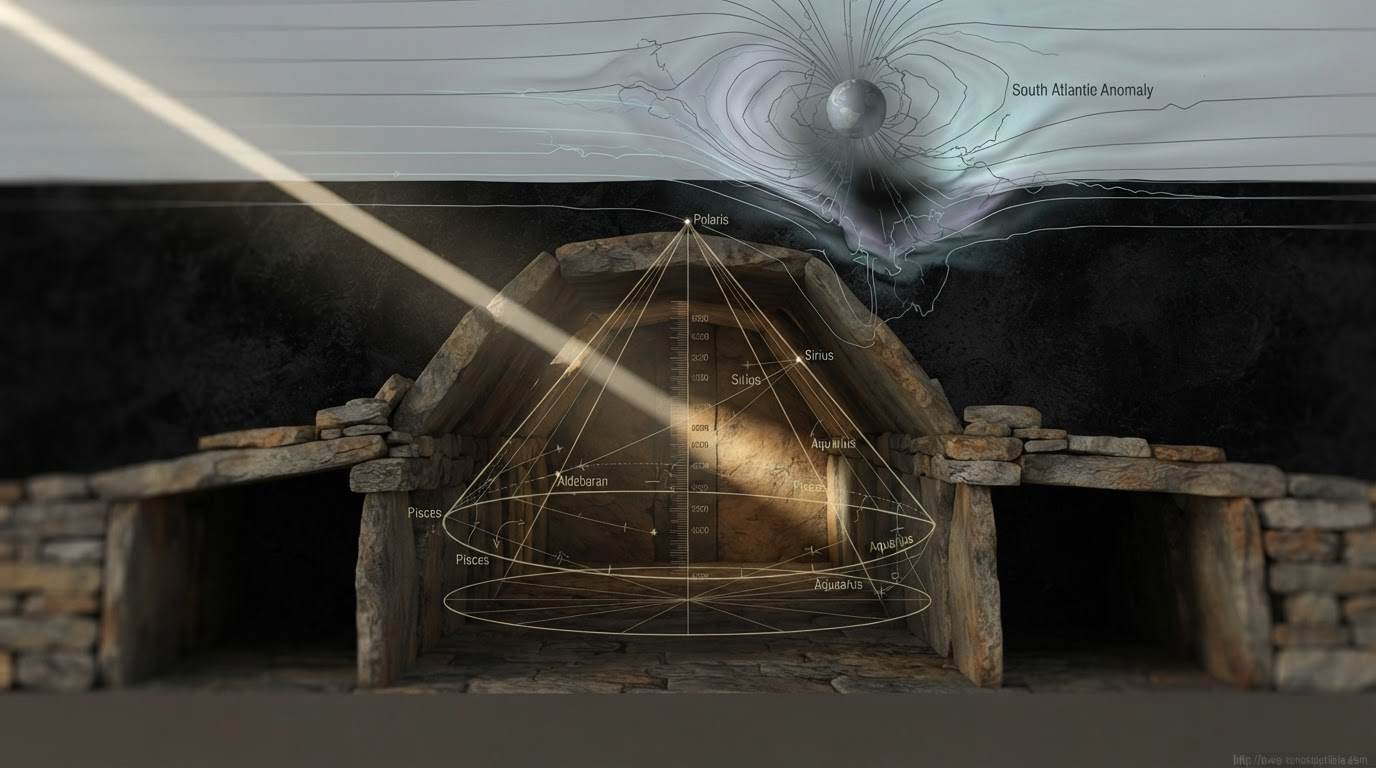
There is a compelling moment, visible to the naked eye once each year, inside the subterranean chambers of the massive rock-cut monuments at Arles-Fontvieille in southern France — megalithic passage graves constructed around 3,000 BCE. At the moment of equinoctial sunset, a shaft of golden light penetrates the narrow corridor entrance, moves through the dark stone chamber, and illuminates the rear wall in what archaeoastronomers term a “hierophany”: the manifestation of the sacred through light. Saletta’s 2011 study confirmed this phenomenon is documented in three of the four intact monuments. The significance, however, extends well beyond visual effect. The builders integrated into their orientational calculations the heliacal risings and settings of the Pleiades and Orion as calendrical markers tied to the agricultural cycle and the rhythm of seasons. This occurred during the Age of Taurus (4000–2000 BCE), when the vernal equinox stood in that constellation, making the east-west architectural orientation a cosmological act rather than a technical preference.
A thousand years later, the equinox shifted into Aries, and a new age began inscribing its architecture onto the surface of the Earth: the pyramids. Larichev’s 1997 study observed that the Great Pyramid was not simply a pharaonic tomb — it represented a civilizational response to an astronomical shift detected by the ancient Egyptian intellect. When the sage Imhotep recognized that the stars previously marking the four cardinal points of the solar path — the equinoxes and solstices — had drifted from their established positions due to axial precession, a new architectural system was required to announce this cosmic realignment to the world. The three pyramids were oriented toward the cardinal directions with extraordinary precision, functioning as an architectural declaration of a new age’s sovereignty. The Great Sphinx, in its leonine form, most likely did not guard the tombs alone: it embodied the summer solstice point, which during the pyramid age fell in the constellation Leo — a symbolic fortification of an astronomical era rendered in permanent stone. The Egyptians did what the most accomplished architects always do: they translated a cosmic condition into a constructive one.
The European Megaliths: Astronomical Laboratories in Earthbound Stone
The pyramids were not alone in this project. Alexander Thom demonstrated in his foundational 1974 study that the megalithic stone structures distributed across Western Europe — from Stonehenge in England to Carnac in Brittany and the Ring of Brodgar in Orkney — functioned not only as ceremonial sites but as coordinated, precision astronomical observatories. The Ring of Brodgar employs natural landscape features at distances of six to thirteen kilometers as sighting points for the 18.6-year lunar standstill cycle. The Carnac alignments operate through mathematical relationships that allowed their builders to derive lunar declination with sufficient accuracy to anticipate eclipses.
This precise architectural orientation was not a purely geometric exercise. Its core principle held that a building must be calibrated to the moving sky, not only to the fixed terrain. It is a lesson that many contemporary schools of architecture have not yet absorbed.
The Maya and the Design of Time: When the Calendar Becomes the Building
Across the Atlantic, the Maya civilization developed the most precise calendrical system the ancient world produced, and translated it into monuments and built fabric that functioned as enduring testimony. Monument Six at Tortuguero, Mexico — dated to the seventh century CE — is the only known Classic Maya text that explicitly references the completion of the thirteenth b’ak’tun cycle in 2012. Epigraphers have established that the text describes a cosmic investiture ceremony for the deity Bolon Yokte’, the god of deep-time transitions, rather than any form of terminal destruction. The event is a re-robing of the universe, a reorganization at the opening of a new age. The architectural metaphor is precise: the removal of one garment and the assumption of another.
The Maya temples themselves embody this principle structurally. At Chichén Itzá, the platform alignments are calibrated to the movements of the sun and Venus such that at the equinox, the shadow cast by the main pyramid’s stepped terraces assembles into the form of the feathered serpent Kukulcan descending toward the earth. The orientation here is not decorative — it is a cosmic clock carved into stone.
The Magnetic Field: The Protective Wall That Is Thinning
Beyond cosmological symbolism, a rigorous scientific dimension makes the question of age transitions directly relevant to the future of urban planning and infrastructure. Earth’s magnetic field — the invisible shield that deflects the solar wind from the atmosphere — carries a long geological history of polarity reversals and field excursions, documented with precision in the stratigraphic record. De Santis and colleagues, analyzing field measurements from 1840 to the present, determined that dipole intensity has declined by approximately ten percent, and that the South Atlantic Anomaly — a region of pronounced field weakness — is expanding and deepening at an accelerating rate that may reach a threshold condition around 2034, representing what could be described as an onset boundary.
What does this mean architecturally? Glassmeier and Vogt established in their 2009 paper that if the field were to reach its minimum value during a polarity transition — approximately ten percent of its current strength — solar energetic particles would penetrate the atmosphere across nearly 95 percent of Earth’s surface, rather than being confined to polar regions as they are today. The resulting production of nitrogen oxides would degrade the ozone layer, generating increases in surface UV-B radiation of up to twenty percent. This presents a direct and material challenge to outdoor urban environment design: public spaces, glazed façades, roof systems, and daylighting strategies would each require fundamental reconsideration under substantially different radiation conditions.
More pressing still is the finding by Duan and colleagues in 2018. Drawing on precisely dated stalagmite records from caves in China, they demonstrated that one documented historical polarity transition occurred in approximately 144 years — meaning that the modern civilizational infrastructure of satellites, power grids, and digital navigation systems could face a complete technological disruption within the span of successive human generations. No coherent design protocol currently addresses this scenario.
Indigenous Knowledge: When Stone Says What Science Says
What merits serious reflection is not the distance between spiritual heritage and contemporary science, but the points where they demonstrably converge. The Hopi of the American Southwest speak of four successive worlds, each concluded by a purifying catastrophe that opened the path to a higher condition. The structure of this cyclical narrative — emergence, degradation, purification, renewal — maps with notable consistency onto the geophysical curves of polarity transition cycles: field collapse followed by reconstruction. The Hopi’s central architectural symbol in this cosmology is the sacred central courtyard — the gathering space that unites the four spatial directions — which translates architecturally into the form of the communal assembly ground.
Robertson’s 2012 study documents a further convergence: exiled Tibetan Buddhist oracles indicated that lamas should seek out the “red-faced people” — the indigenous peoples of the Americas — to transmit wisdom at the time of transition. One lama traveled to Hopi lands, where the elders confirmed that both traditions described the same event. Contemporary Maya spiritual leaders in the highlands of Guatemala speak of the Ak’aj Sqixa — the New Dawn — not as an external occurrence but as a transformation in the interior structure of consciousness. This convergence across three civilizations that had no historical contact gives the careful historian reason to pause.
The idea shared across all three traditions, and the one that connects most directly to the architectural project, is this: the external form mirrors the internal structure. When the structure of the cosmos shifts, the structure of built space must shift with it. Purification is not demolition — it is reorientation.
Architecture Before the Coming Age: What Must Change
If the accumulated weight of scientific research and human heritage is taken as a single body of evidence, the essential question is no longer “when will the transition occur?” but “how does the architect design for a time of transition?”
Several concrete directions emerge clearly. First, astronomical orientation as a living design standard — not merely architectural history observed in museums — requires reintegration into active practice. Studies consistently demonstrate that buildings calibrated to seasonal celestial phenomena achieve superior energy performance and a more grounded human experience. Second, given scientific projections of potentially elevated UV-B levels, shading design ceases to be a matter of visual comfort and becomes an existential health condition. Cities that rely on expansive open plazas and large glazed façades will require comprehensive reassessment. Third, and most urgently, the documented decline in magnetic field intensity and the expansion of the South Atlantic Anomaly impose on designers of digital infrastructure — data centers, communications networks, transmission towers — a requirement to treat electromagnetic shielding not as an optional enhancement but as a foundational design specification.
At the level of deeper design philosophy, the spiritual heritage of the Hopi, the Maya, and the Tibetan traditions collectively points toward what might be termed an architecture of conscious durability: spaces designed to accommodate and adapt to change, spaces where nature is read rather than obscured, where community gathers rather than the isolated individual retreats, where memory and future coexist. This is precisely what the megalithic structures that have endured for millennia were doing. They did not resist the cosmos — they maintained a conversation with it.
Six thousand years ago, when the builders of Arles-Fontvieille recognized that the sun entered their passage differently with each passing age, they did not demolish the corridor. They reread their relationship to it. The architect who understands the universe being built within is the only one capable of building what endures inside it.
✦ ArchUp Editorial Insight
Modern architecture has abandoned the observational discipline that produced its most durable structures. Ancient builders — Egyptian, Mesoamerican, European megalithic — operated within a constraint that contemporary practice has discarded: buildings had to read and respond to measurable celestial phenomena. This was not mysticism but a rigorous feedback system. The sky’s slow precession forced periodic architectural reinvention; infrastructure that misaligned with observable reality simply failed functionally and was corrected. Today’s architecture operates within the inverse logic: buildings are designed against standardized climate data and regulatory codes, creating the illusion of permanence in a system fundamentally blind to deep-time geophysical change. The emerging evidence of magnetic field decline and accelerating polar transition markers suggests the builders of Arles-Fontvieille and Chichén Itzá possessed an adaptive epistemology that contemporary practice — locked into static design parameters — cannot access. The question is not whether monuments should be “cosmically aligned,” but whether the profession has surrendered the capacity to recognize when its inherited design assumptions have become obsolete.
References
Saletta, M. “The Archaeoastronomy of the Megalithic Monuments of Arles-Fontvieille: The Equinox, the Pleiades, and Orion.” Proceedings of the International Astronomical Union, 2011.
Thom, A. “Astronomical Significance of Prehistoric Monuments in Western Europe.” Philosophical Transactions of the Royal Society of London, Series A: Mathematical and Physical Sciences, 1974.
Larichev, V. E. “On the Origin of the Zodiacal Constellations.” Vistas in Astronomy, 1993.
Glassmeier, K. H., and Vogt, J. “The Sun, Geomagnetic Polarity Transitions, and Possible Biospheric Effects: Review and Illustrating Model.” International Journal of Astrobiology, 2009.
Sitler, R. K. “The 2012 Phenomenon: New Age Appropriation of an Ancient Mayan Calendar.” Nova Religio, 2006.
Robertson, R. “Visions of the Millennium: Hopi and Mayan Prophecies of the End Times.” Psychological Perspectives, 2012.
Larichev, V. E. “The Evolution of the Zodiac in the Context of Ancient Oriental History.” Vistas in Astronomy, 1997.
Campion, N. “The 2012 Mayan Calendar Prophecies in the Context of the Western Millenarian Tradition.” Proceedings of the International Astronomical Union, 2011.
Laj, C., and Kissel, C. “An Impending Geomagnetic Transition? Hints from the Past.” Frontiers in Earth Science, 2015.
MacLeod, B. “The God’s Grand Costume Ball: A Classic Maya Prophecy for the Close of the Thirteenth B’ak’tun.” Proceedings of the International Astronomical Union, 2011.
Duan, B., et al. “Multidecadally Resolved Polarity Oscillations During a Geomagnetic Excursion.” Proceedings of the National Academy of Sciences, 2018.