Rammed Earth Construction: Materials, Process and Benefits


The rammed earth technique is an ancient construction technique,
with roots extending deep into architectural history.
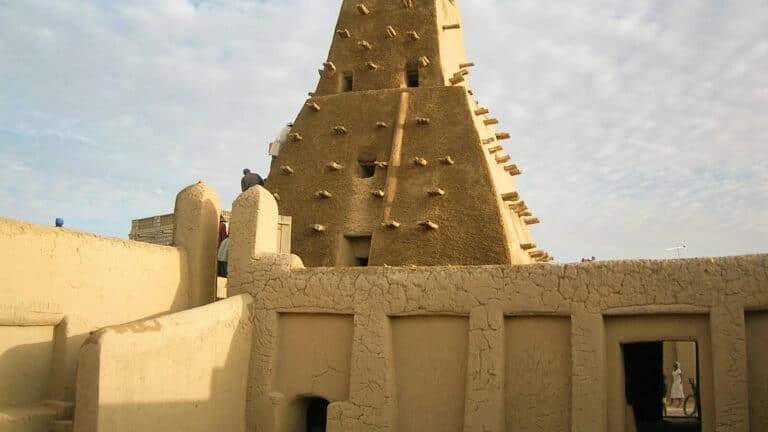
This technology dates back to ancient civilizations,
and bears witness to humanity’s ingenuity and ability to adapt.
Construction using rammed earth
Construction with rammed earth involves compressing a mixture of moist soil between solid forms to form a dense wall with strength determined by its mix and compaction.
Although this technology is ancient in its origins,
it carries within it the beauty of simplicity and the dream of sustainability.
It is simply the process of compacting or compressing ground materials into a solid, dense wall.
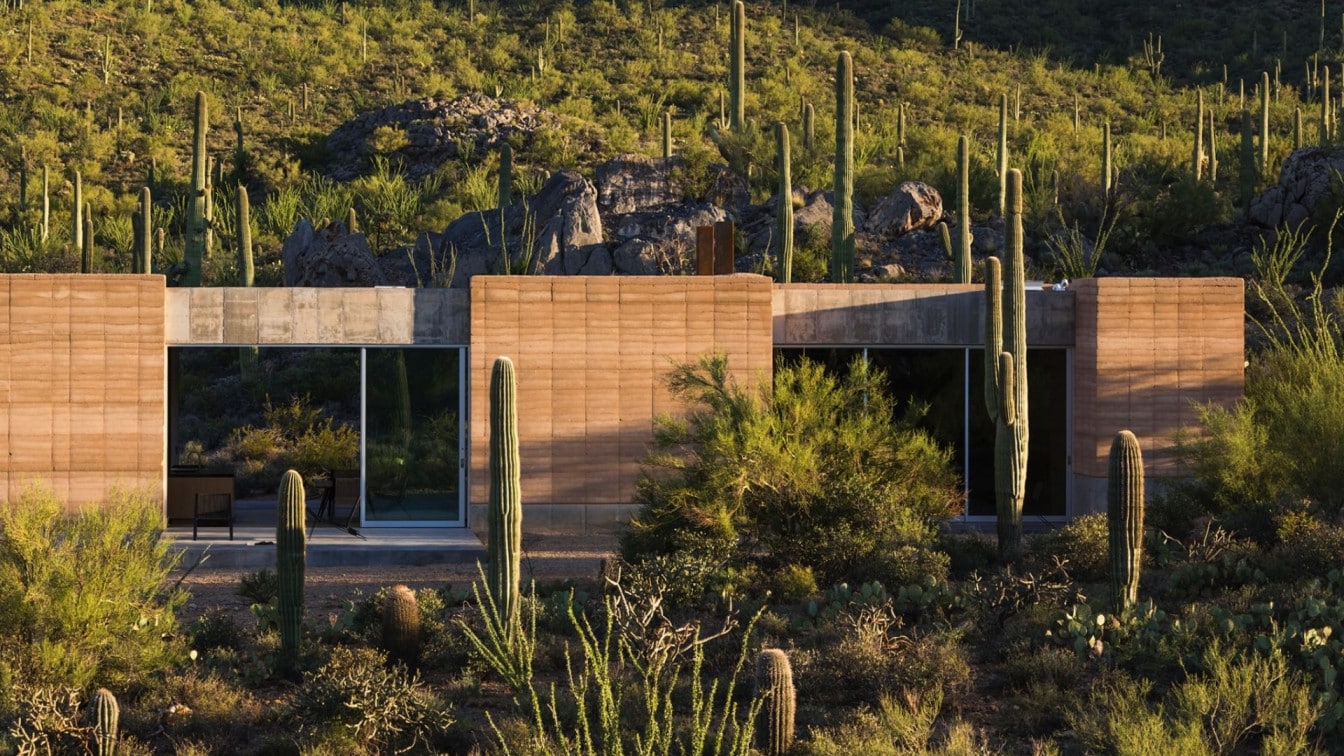
The result is a durable and aesthetically unique structure with visible layers that record to its construction layer by layer.
Components of rammed earth
Sand: It constitutes the bulk of the mixture and provides the necessary granules for compaction,
with particles coarse enough to interlock.
But it is not so large that it leaves voids or weakens the structure.
Gravel: Gravel enhances the structural integrity of the mixture,
and its percentage can vary depending on the design specifications and required strength.
Clay: Clay helps bind an unstabilised earth mixture. Its proportion must be balanced with sand and aggregate to limit shrinkage.
Stabilizers: In traditional rammed earth construction,
the earth mixture can be stabilized using natural elements such as straw or lime.
However, in modern applications, cement may be added as a stabilizer to increase the strength and corrosion resistance of the mixture.
There is no universal mix ratio. Soil grading, stabiliser content and compaction should be specified and tested for the required strength, exposure and local conditions.
How can we build using rammed earth?
Construction using rammed earth includes some basic steps that must be applied,
which we will mention below:
Preparation
Leveling the ground and laying the foundation before construction begins.
The foundation must be designed for the ground conditions and loads, providing a base for the rammed earth walls.
Formwork installation
Install two parallel panels of plywood to determine the thickness and shape of the wall,
so that the space between these panels is where the rammed earth will be placed.
Layers
Distribute a thin layer of the wet earth mixture between the boards.

The pressure
The ground must be compacted, preferably with a pneumatic ram.
Layer thickness and compaction are controlled to achieve the specified density; the reduction in height is not a fixed ratio.
Repetition
The layering and compacting process is repeated until the wall reaches the desired height.
Processing
Once the formwork is removed, the wall is left to dry and harden,
a process that can take from a few days to several weeks, depending on the climate.
By mastering basic principles and techniques,
builders can create structures that not only stand the test of time,
but also tell the story of the land from which they originate.
What are the advantages of building using rammed earth?
As one of the oldest construction techniques, rammed earth offers many benefits that make it increasingly important today for sustainable and resilient building solutions.
Its advantages extend to the environmental, structural and aesthetic areas.
Environmental benefits and sustainability:
Lower energy footprint
Compacted soil uses mostly local materials, reducing the need for transportation and associated energy costs.
Transport, cement content and construction methods all affect the final environmental footprint.
Minimal waste production
Since the primary ingredients come from natural sources,
excess materials can be reincorporated into the environment without harmful effects.
Furthermore, the construction process itself has been simplified to ensure minimal waste.
Natural regulation
Rammed earth has high thermal mass, which can moderate temperature swings when combined with suitable climate-responsive design. Thermal mass is not the same as insulation, and additional insulation may be needed.

Durability and flexibility:
Long lasting
With the right precautions, rammed earth walls can last for centuries,
as historic structures around the world attest to their longevity.
Fire and pest resistance
Unlike many traditional building materials, rammed earth is inherently fire-resistant and an undesirable habitat for pests, ensuring greater safety and less maintenance.
Ventilation
Some earth finishes allow moisture vapour to diffuse, but this is not a substitute for ventilation. Moisture control, weather protection and detailing remain necessary.

Aesthetic appeal and versatility:
Unique textures and colors
Rammed earth walls have a unique texture and color palette depending on the soil and aggregate used,
providing a natural, rustic and organic aesthetic that many find attractive.
Flexibility in design
While they have a traditional and earthy look, they can adapt to various architectural styles,
from more traditional to contemporary designs.
Audio benefits
Rammed earth walls can provide excellent sound insulation due to their density,
making spaces quieter and more peaceful.

Conclusion
In conclusion, the advantages of building with rammed earth are numerous,
as it provides a sustainable building solution without compromising on strength, durability or beauty.
For those looking for an environmentally friendly,
aesthetically pleasing and long-lasting construction method, rammed earth stands out as an ideal option.