Swarm Robots Invert Timber Construction from the Ground Up

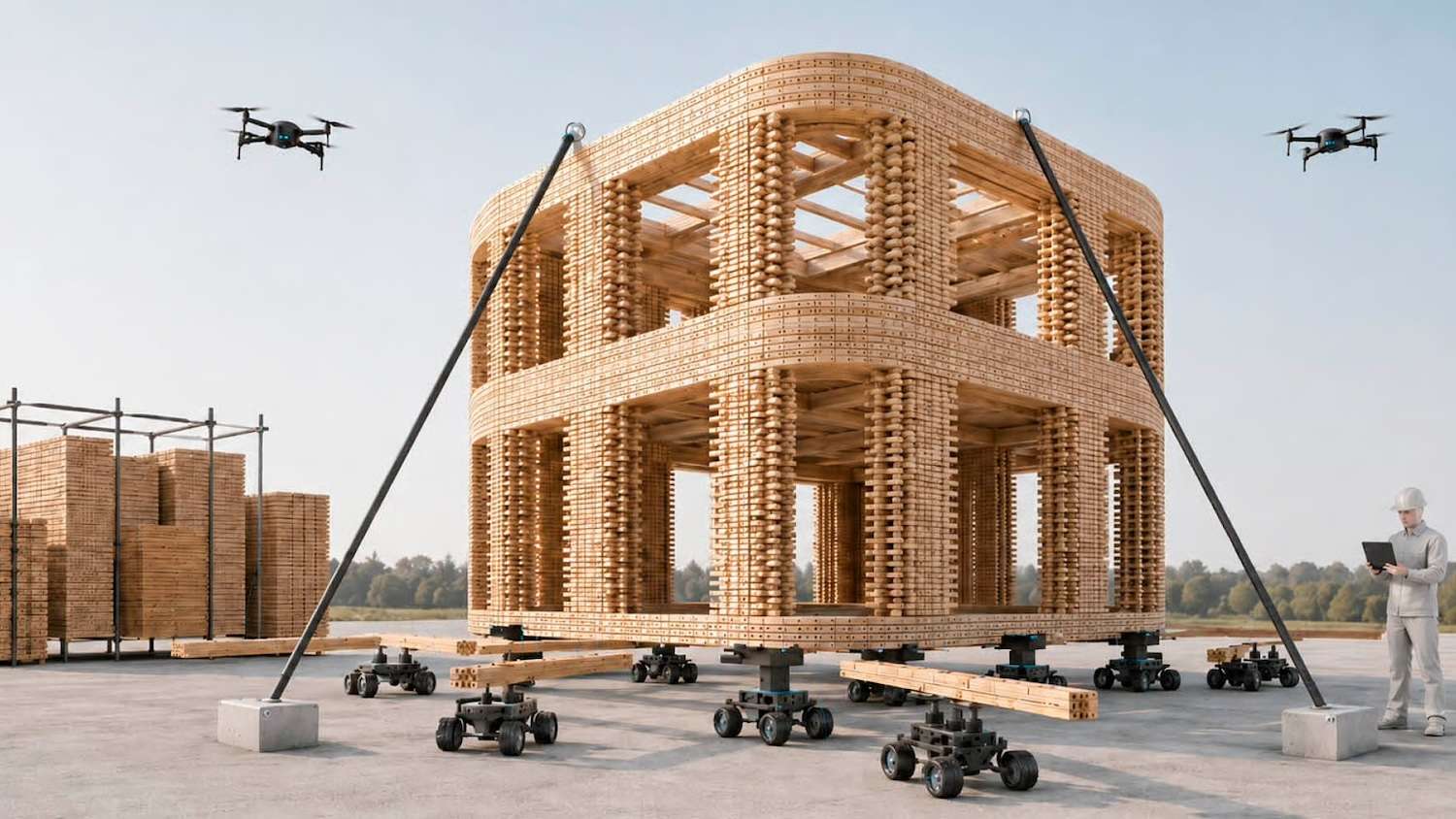
A research consortium develops an inverted robotic system that builds modular timber structures from the top down. Ground robots assemble each floor at ground level and then lift it upward to create space for the next layer. The method supports adaptable buildings that teams can disassemble on demand while advancing automated timber construction.
The system uses swarms of robotic assemblers and lifting units. Ground-based machines handle assembly and elevation layer by layer. Drones fly overhead to monitor progress and flag issues in real time. The robots share information continuously so they adapt and operate safely without constant human intervention.
Inverted Fabrication Sequence and Material Strategy
The approach focuses on timber as the primary structural material. This choice combines automated construction with sustainability, flexibility and cost control. Teams assemble modular components at ground level. They then raise completed floors to free the working plane for the next stage.
The inverted sequence reduces work at height for much of the process. It also allows continuous adjustment as the structure grows. The design keeps every connection mechanically reversible so later disassembly recovers materials intact.
Demonstration Pavilion and Circular Intent
The three-year programme will culminate in a full-scale demonstration. An autonomous robotic swarm will construct a timber pavilion. The finished structure will remain mechanically reversible by design. Selective disassembly and material recovery will demonstrate circularity in practice.
The system can adapt to various scales and uses. Integrated tools guide the robots so the same logic applies across different building types. The focus stays on modular timber that teams can reconfigure or reclaim over time.
Coordinated ground units and aerial monitors form a single operational loop. Data exchange lets the swarm respond to site conditions without stopping the lift sequence. This closed feedback supports safer autonomous work on timber frames.
Structural Approach and Spatial Sequence
The inverted logic reverses conventional stacking. Floors take shape in a stable ground plane before elevation creates the next working volume. This sequence clarifies load paths at each lift stage and keeps joints accessible for later reverse assembly. Timber modularity pairs cleanly with swarm coordination because discrete components match the robots’ handling range. The pavilion demonstration will test whether continuous data sharing maintains alignment across rising levels. Circularity sits inside the structural joints themselves rather than as an afterthought. The method therefore treats disassembly as a designed spatial operation equal to the original build sequence.
✦ ArchUp Editorial Insight
The inverted swarm treats timber construction as a reversible ground-plane operation. Robots assemble complete floors low then raise them, turning elevation into a controlled spatial act. Continuous data exchange between ground units and drones keeps the rising frame aligned without fixed scaffolding. This logic embeds circularity directly into the joints and lift sequence, letting future teams reclaim modules intact. Yet the same autonomy that promises flexibility also concentrates risk in software coordination and site calibration. Real-world timber movement, weather exposure and joint tolerance may outpace the swarm’s adaptive loop. Large-scale construction still demands human override capacity that pure swarm models underplay. The pavilion test will reveal whether the inverted method scales beyond controlled demonstration into everyday sustainability practice.
Project Team: Foster + Partners as industry partner with the University of Bristol, the University of Southern Denmark, the Technical University of Munich, the University of Pisa, the Delft University of Technology, the University of Birmingham and the Ludwig Maximilian University of Munich. Location: Not specified in source.
Project Notes: The consortium wins a £4m three-year research grant from the European Innovation Council’s Pathfinder programme for SWIFT-BUILD. The team will culminate the work in an autonomous robotic swarm constructing a reversible timber pavilion. Irene Gallou contributes senior partner commentary on the method’s adaptive potential.