Herzog & de Meuron to Redevelop Tirana’s Palace of Congresses

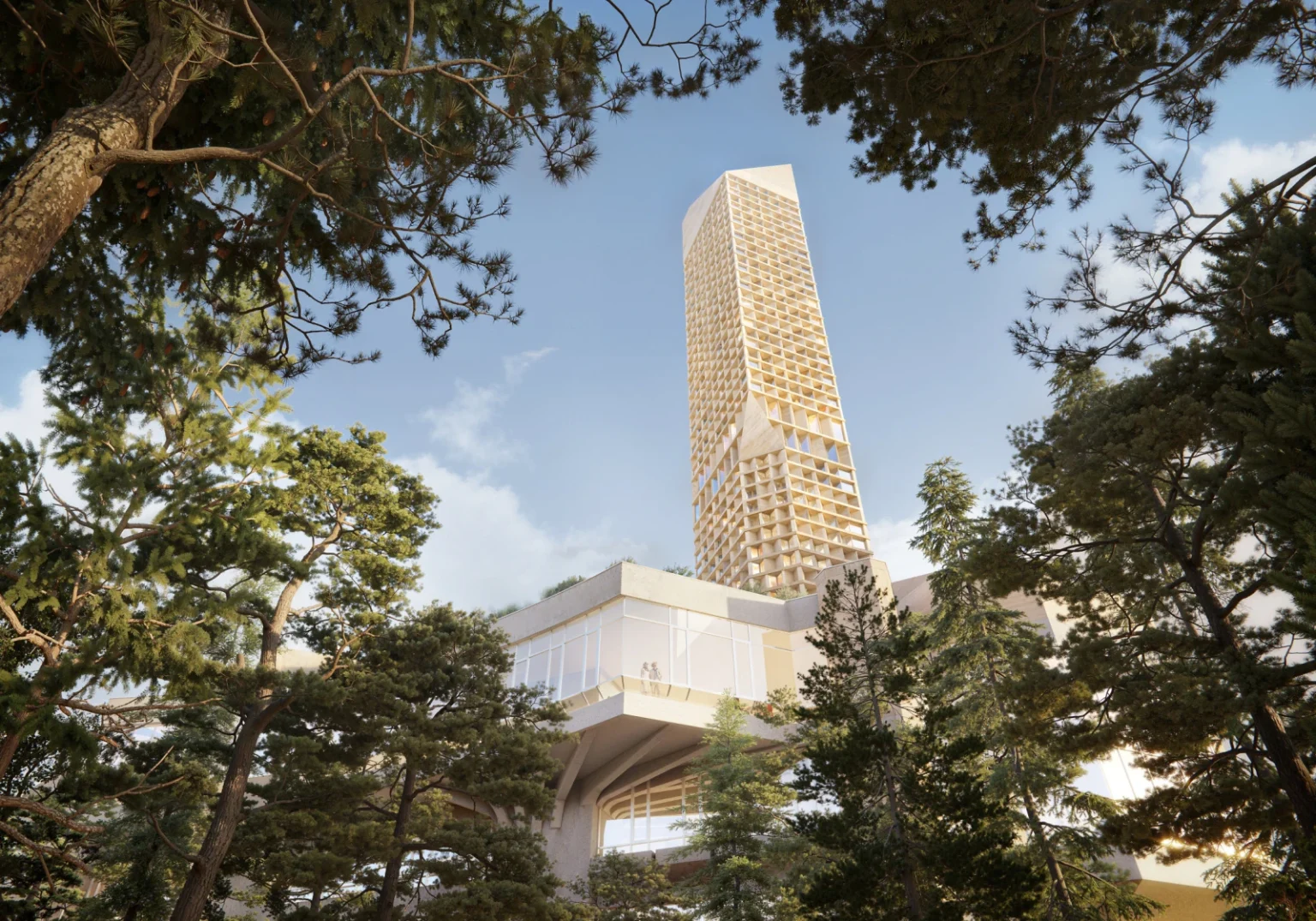
Herzog & de Meuron won the international competition to redevelop the Palace of Congresses in Tirana, Albania. The proposal integrates the restoration of the 1986 socialist-era landmark with a new mixed-use tower and significant public landscape interventions. The Albanian government selected the design to modernize the civic venue while maintaining its historical role as a center for political and cultural assemblies.
The original building, completed in 1986, currently hosts conferences, exhibitions, and festivals within a 2,100-seat main auditorium and several smaller halls. The new strategy focuses on performance and accessibility upgrades that respect the building’s status as a witness to Tirana’s urban history. The architects prioritize preservation by concentrating interventions where they most effectively improve functionality.
Interior reorganization improves cultural infrastructure
The project reorganizes key public interiors to create a more flexible environment for modern use. A large central atrium serves as a new public space for circulation and spontaneous gatherings. This intervention establishes a clear spatial hierarchy within the buildings, allowing for simultaneous events and exhibitions.
Renovations to the main auditorium include improved acoustics and contemporary finishes to meet international standards. A redesigned ceiling element introduces filtered daylight into the performance space, altering the atmosphere of the large hall. These technical upgrades modernize the aging infrastructure without compromising the defining character of the original socialist-period design.
Terraced gardens connect the city and complex
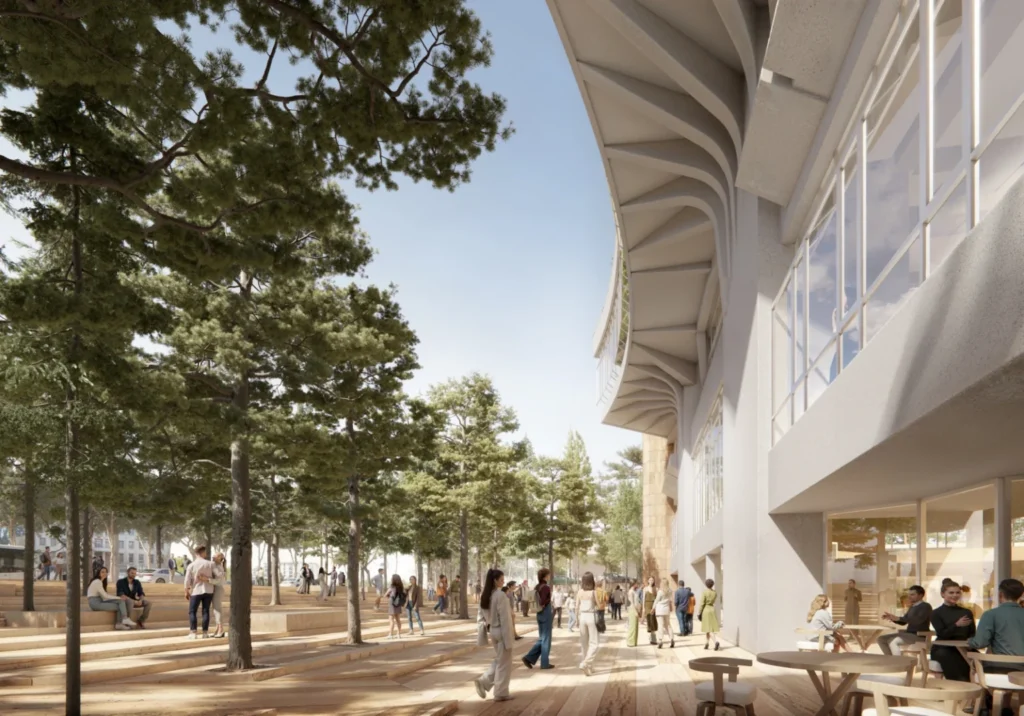
Landscape architect Michel Desvigne designed a series of terraced public spaces that descend toward the building entrance. This “Palace Garden” transforms the existing forecourt into a permeable zone framed by trees and pedestrian routes. These terraces create a gradual transition between the urban fabric of Tirana and the cultural complex.
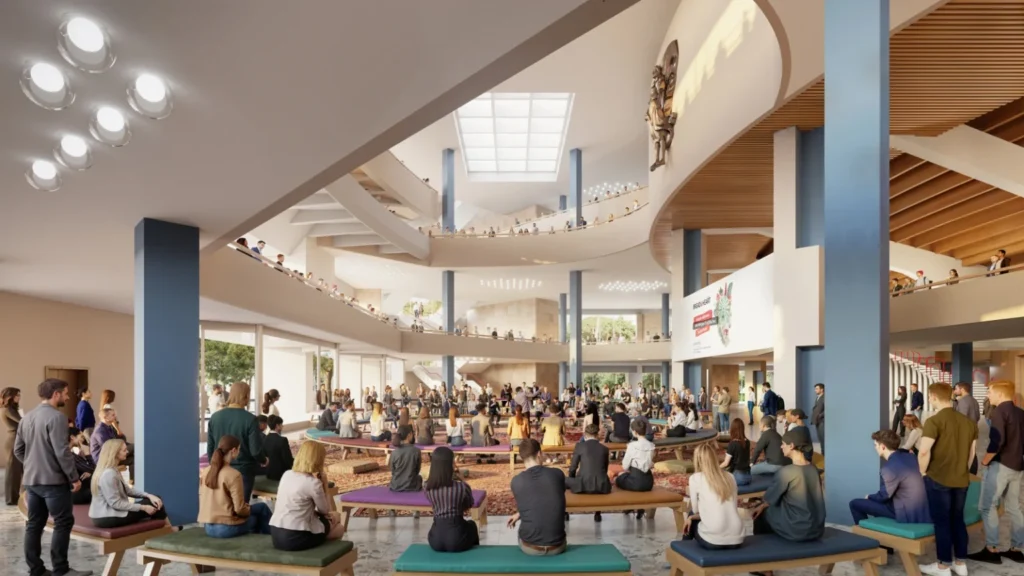
The landscape strategy encourages public activity by establishing direct connections between indoor spaces and the exterior realm. This reconfiguration strengthens the role of the Palace within the urban planning framework of the capital. The new public realm supports both daily pedestrian use and large-scale cultural events at the ground level.
Mixed-use tower expands the program
A new multifunctional tower rises from a podium integrated with the cultural complex to provide office spaces and a hotel. The tower’s geometry features a repetitive grid and faceted forms that draw from local construction principles. This vertical addition introduces constant daily activity to a site previously dominated by event-based programming.
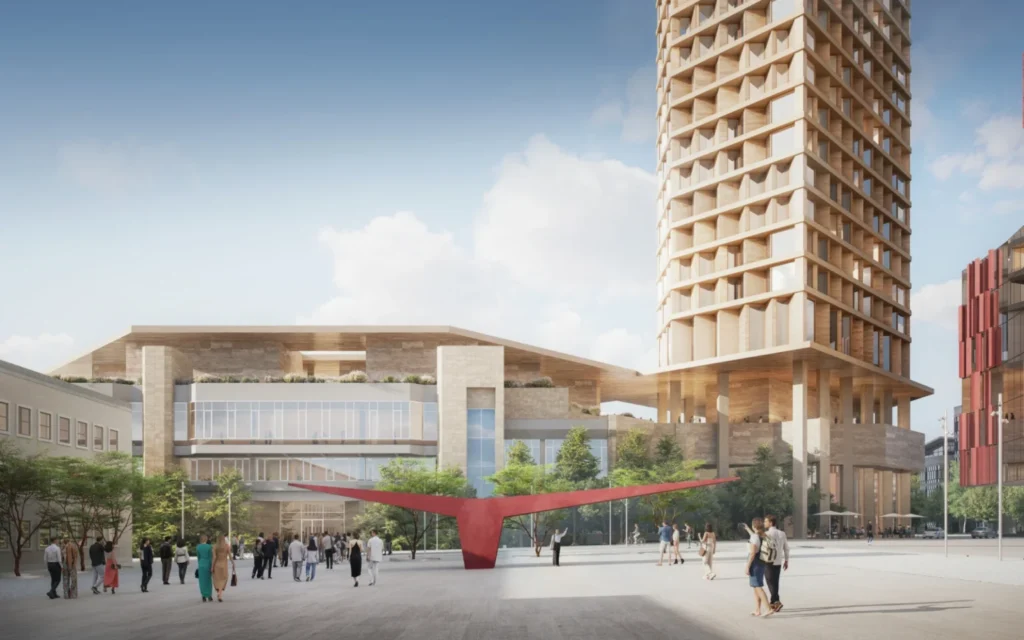
The redevelopment covers a site of approximately 4,760 square meters and delivers a total gross floor area of 55,000 square meters. Stepped public spaces and landscaped terraces link the base of the tower to the existing landmark. This combination of functions transforms the site into a diverse urban destination within the city center.
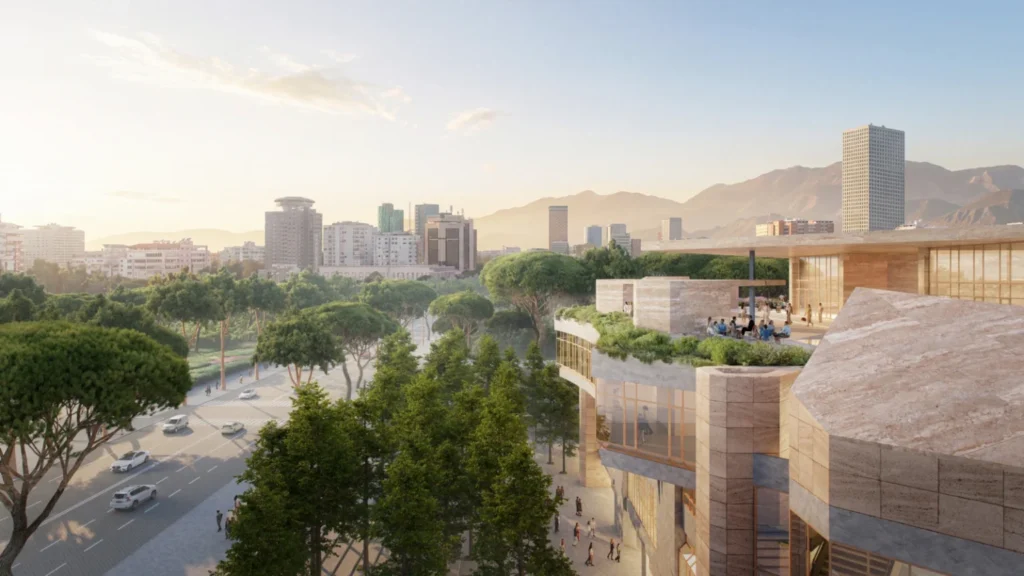
Project Team: Herzog & de Meuron and Michel Desvigne Paysagiste. Location: Tirana, Albania.
Project Notes: The project remains in the competition-winning proposal phase with a total planned gross floor area of 55,000 square meters.
✦ ArchUp Editorial Insight
The proposal reframes Tirana’s Palace of Congresses as an active civic organism rather than a frozen relic. It preserves the 1986 structure while inserting new circulation, daylight strategies, and a mixed-use tower that extends economic life beyond episodic events. Through landscape terraces and interior reorganization, the project aligns heritage with contemporary urban productivity and positions the complex within evolving cities dynamics.
Yet the strategy risks diluting the ideological weight of the original monument. By anchoring preservation to hotel and office revenue, the scheme subordinates civic symbolism to market logic. The new vertical mass may recalibrate the spatial hierarchy, shifting emphasis from collective assembly to commercial visibility. In this reading, heritage survives—but only through negotiated coexistence with capital-intensive architecture.