The Secret of Slow Wood: Why a Slow-Growing Tree Outperforms a Concrete Tower

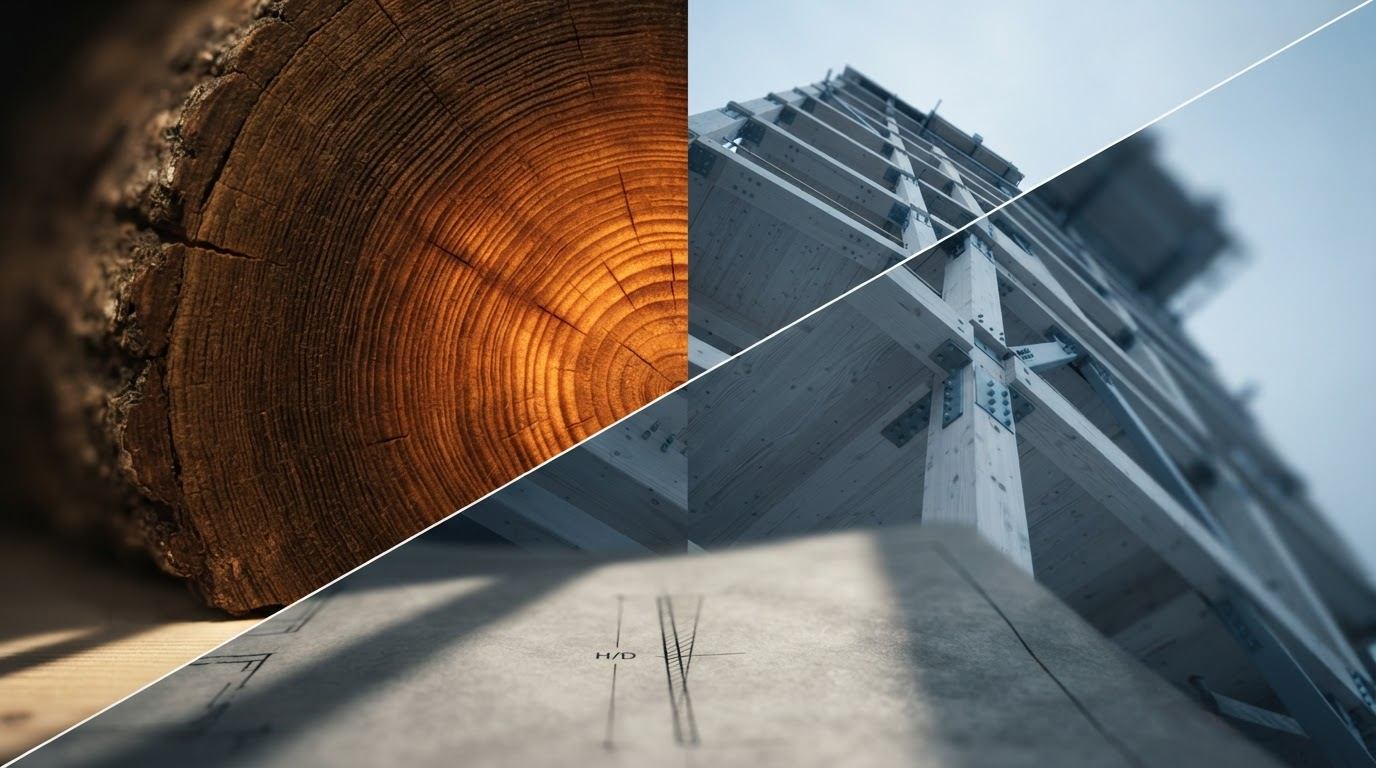
How the “Slenderness Ratio” in Tree Stems Exposes a Structural Equation the Architecture Profession Overlooked in the Age of Concrete
Every structural engineer keeps a foundational equation close at hand — one taught in the first year of any engineering program: the higher the ratio of a column’s height to its diameter, the greater its susceptibility to buckling under load, and the lower its capacity to resist lateral forces. What is less commonly acknowledged is that forests have been applying this same equation, with remarkable precision, to their own stems for millions of years — long before the first structural code was drafted. Every tree, whether standing in a dense plantation or an open commercial timber grove, carries within it a slenderness ratio that determines its fate under wind, snow, and ice loading, in precisely the same way that a concrete column’s slenderness ratio governs its performance under the weight of a twentieth floor. The question this body of research raises — and it is a question with direct consequences for the sustainable construction industry today — is whether fast-grown commercial timber, the material underpinning the expansion of engineered timber architecture and cross-laminated timber (CLT) construction, carries a concealed structural liability inherited from the speed of its own growth.
The Buckling Equation the Forest Wrote Before the Engineers Did
The relationship between a tree’s height and its diameter at breast height is expressed as the tree slenderness coefficient (TSC), or more commonly the height-to-diameter ratio (H/D), and it ranks among the most widely applied indicators of tree and stand stability in forest science worldwide. The structural logic is direct: a tall, slender tree with a narrow stem carries a higher center of gravity, sustains a larger bending moment, and demonstrates weaker resistance to wind and snow loads than a shorter, stouter tree of equivalent height. Forest research has established that conifers with H/D ratios exceeding 80 to 100 are considered structurally unstable, while values below 70 to 80 indicate adequate stability, and open-grown trees free from competitive pressure can register ratios below 45. The convergence between the forest’s slenderness logic and the engineer’s buckling equation is not a linguistic coincidence. The biomechanical models developed by Wilson and Oliver treat the tree stem explicitly as a structural cantilever with uniformly distributed resistance, in which bending resistance scales with the cube of stem diameter and inversely with height — precisely the logic governing the design of slender columns in concrete and steel-framed structures.
When Growth Slows, the Stem Grows Strong
The clearest empirical evidence for the relationship between growth rate and slenderness comes from a stem-analysis study led by Kang, examining Hinoki cypress and Japanese cedar stands across South Korea, in which his team dissected stems layer by layer across the full lifespan of each tree. The findings were unambiguous: small-diameter trees exhibited high slenderness ratios ranging from 83 to 98 percent, paired with slow radial growth rates of only 4.6 to 5.1 millimeters per year, while large-diameter trees registered low slenderness ratios between 49 and 54 percent, with radial growth rates nearly twice as fast, reaching 8.2 to 10.0 millimeters annually. In other words, a tree that grows rapidly in diameter is not simply larger — it is measurably less slender and structurally more stable, while a tree left to compete slowly becomes progressively taller relative to its narrow girth, and therefore structurally more vulnerable.
This pattern carries a clear practical explanation in stand management. When growing space is expanded — either through wider initial planting spacing or through thinning operations that remove competing stems in favor of selected trees — the remaining trees respond with a disproportionately large increase in diameter growth while height growth changes comparatively little, producing a net decline in the H/D ratio. In a thinning experiment on Masson pine led by Deng, the intervention caused the allometric scaling coefficient between height and diameter to fall below 1.0, meaning that the relative increase in diameter outpaced the relative increase in height — and this effect intensified in direct proportion to thinning intensity.
Crowding Produces Slender Columns
The inverse relationship between growth and slenderness is, at its core, a consequence of resource competition, which makes it closer in character to an urban planning phenomenon than a purely botanical one. Just as buildings in densely developed cities are compelled to rise vertically to capture light and floor area, trees respond to crowding in exactly the same way. Under high stand densities, diameter growth is almost entirely suppressed while height growth continues largely unchanged, so trees become progressively taller relative to their girth — that is, progressively more slender. In Chinese fir plantations studied by Zhang and colleagues, the tree slenderness coefficient rose directly with increasing stand basal area — a proxy for stand density — and with planting densities reaching ten thousand trees per hectare in some cases. Trees in dense stands were significantly more susceptible to failure under wind, snow, and ice loads than trees grown in open conditions. Notably, competition indices — including relative diameter and neighbor count — consistently ranked as the strongest drivers of H/D variation, substantially outweighing the influence of climatic factors. Even in young plantations, Opio proposed the H/D ratio as a practical competition index, precisely because it rises sharply as competing vegetation increases. The underlying mechanism is photochemical: the reduced red-to-far-red light ratio produced by canopy competition triggers internode elongation in stems, directing the tree’s resources toward height gain at the expense of stem thickening.
Why Diameter Responds Faster Than Height
Three interlocking mechanisms explain why an accelerated growth rate translates more strongly into a reduction in slenderness than into an increase in height. The first is resource reallocation following competitive release: height growth is largely predetermined by apical meristem activity and prior-year conditions, while radial growth responds flexibly to current resource availability. Mitchell interpreted this as adaptive growth, describing how trees recalibrate their structural form in response to the greater wind loading they experience once the shelter of neighboring stems is removed. The second mechanism is purely biomechanical: since bending resistance scales with the cube of stem diameter, rapid diameter growth is virtually the only means by which a tree can “afford” its increasing height — and maintaining a stable H/D ratio through the phase of rapid height growth, roughly between 10 and 30 meters, demands a substantial and continuous increase in basal area at the stem base. The third mechanism is temporal: the H/D ratio is not fixed across a tree’s life. It tends to decline in very young trees, rise sharply through the competitive height-growth phase, peak at intermediate stand heights, and then fall gradually as height growth decelerates. In unthinned Masson pine, Deng’s team found that the allometric scaling coefficient followed a unimodal curve peaking between ages 10 and 15 years, after which radial growth progressively assumed dominance.
When the Equation Reverses: Fast-Growing Species and the Timber Construction Industry
Here lies the most consequential warning for the sustainable construction sector. The relationship described above holds within a single species, but it reverses entirely when comparisons are drawn across species. Fast-growing, shade-intolerant pioneer species — those that prioritize canopy access over structural consolidation — invest far more in height than in diameter, and consequently maintain higher H/D ratios at any given size than slow-growing, shade-tolerant species. In an analysis spanning 151 Chinese tree species conducted by Zhao and colleagues, diameter growth rates correlated positively with maximum attainable height: large-statured canopy species grew faster and produced taller, more slender stems, while smaller understory species grew more slowly and maintained stouter proportions. This means that “fast growth” alone conveys nothing definitive about structural timber quality. It may indicate a stouter stem when the accelerated component is radial growth — as occurs after thinning — or a more slender stem when the accelerated component is height growth, as in light-demanding pioneer species planted commercially at high densities for timber production. This is precisely the structural dilemma confronting the engineered timber industry today: many of the species used in CLT panel production are cultivated at high densities and harvested at early ages to compress production cycles, which places them biologically in the category of the most slender and structurally least consolidated trees — before they are ever felled.
Density Management: The Lesson Timber Tower Designers Need to Learn
Since planting density is the dominant determinant of both growth rate and slenderness ratio simultaneously, density management becomes the principal instrument for controlling stem stability over time — analogous to the way a structural engineer regulates column spacing to govern structural behavior under load. But timing is critical. In Douglas-fir stands, Wilson and Oliver demonstrated that thinning applied after stand height exceeds approximately 10 meters no longer reduces H/D — it only slows its continued increase. Higher initial planting densities further compress the “thinning window” within which stability can be restored, narrowing it from around 11 meters at a density of 1,000 trees per hectare to considerably lower heights at 3,000 trees per hectare. The more acute paradox is that thinning stands already characterized by extreme slenderness may actually increase wind damage risk, because removing mutual shelter exposes stems to greater wind loads before they have had time to recalibrate their structural form. Mitchell observed that the most slender trees at baseline demonstrated the greatest and most rapid post-thinning reduction in their H/D ratios — meaning that the structurally weakest trees benefit most from early intervention. The direct implication for the construction industry is that decisions about harvest timing and planting density deserve as much analytical attention as species selection when the goal is structurally reliable engineered timber.
A final methodological caution, raised by Henry and Aarssen, deserves attention from any organization seeking to apply this science as an actual criterion for timber procurement. Much of what appears to be a “growth rate effect” on slenderness ratios may in fact be a statistical artifact produced by pooling cross-sectional data from trees with different ages and competitive histories, rather than a genuine signal in the longitudinal growth trajectory of any individual tree. Reliable conclusions therefore require repeated-measurement or stem-analysis data tracked over time — not one-time comparisons across trees of different backgrounds — a methodological standard that any procurement or grading framework for structural timber would need to satisfy before the findings translate into dependable specification practice.
✦ ArchUp Editorial Insight
The research on tree slenderness ratios reveals a structural irony embedded at the core of the sustainable construction industry’s current trajectory. The engineered timber sector — driven by carbon-reduction mandates, investor appetite for green-certified assets, and the procurement logic of compressed harvest cycles — has systematically selected for the biological conditions that produce the least structurally consolidated wood. Fast-rotation, high-density plantation forestry, organized around financial rather than silvicultural timelines, delivers timber that is biologically younger, more slender at harvest, and grown under the precise competitive conditions that forest science identifies as structurally disadvantageous. The CLT tower is therefore not simply a material choice — it is the architectural outcome of an upstream supply chain governed by yield economics, in which the interval between planting density decisions and structural performance consequences spans decades, making the feedback loop invisible to both developers and certifying bodies.
References
Zhang, X., Wang, H., Chhin, S., and Zhang, J. “Effects of Competition, Age and Climate on Tree Slenderness of Chinese Fir Plantations in Southern China.” Forest Ecology and Management, 2020.
Opio, C., Jacob, N., and Coopersmith, D. “Height to Diameter Ratio as a Competition Index for Young Conifer Plantations in Northern British Columbia, Canada.” Forest Ecology and Management, 2000.
Kang, J., et al. “Relationship of H/D Ratio and Crown Ratio to Tree Growth for Chamaecyparis obtusa and Cryptomeria japonica in Korea.” Forest Science and Technology, 2021.
Wilson, J. S., and Oliver, C. D. “Stability and Density Management in Douglas-Fir Plantations.” Canadian Journal of Forest Research, 2000.
Deng, C., et al. “Thinning Effects on the Tree Height–Diameter Allometry of Masson Pine (Pinus massoniana Lamb.).” Forests, 2019.
Henry, H. A. L., and Aarssen, L. W. “The Interpretation of Stem Diameter–Height Allometry in Trees: Biomechanical Constraints, Neighbour Effects, or Biased Regressions?” Ecology Letters, 1999.
Vanclay, J. K. “Tree Diameter, Height and Stocking in Even-Aged Forests.” Annals of Forest Science, 2009.
Liu, S., Liu, Y., and Xia, R. “Using Random Forest to Disentangle the Effects of Environmental Conditions on Height-to-Diameter Ratio of Engelmann Spruce.” New Forests, 2023.
Mitchell, S. J. “Stem Growth Responses in Douglas-Fir and Sitka Spruce Following Thinning: Implications for Assessing Wind-Firmness.” Forest Ecology and Management, 2000.
Zhao, M., et al. “Allometric Relationships, Functional Differentiations, and Scaling of Growth Rates Across 151 Tree Species in China.” Ecosphere, 2021.