
Trim House: Architecture Shaped by Planning Constraints

Changing Planning Regulations
The project reflects a common condition in architectural practice when planning requirements change during the design phase. Work on the “Trim House” project began in a forested suburb of Vilnius, within a context that initially envisioned a simple private residence on a site characterized by a quiet natural setting. The plot had previously contained wooden cottages that no longer exist, leaving a mostly open landscape with a light distribution of trees.
Adapting to Constraints
Midway through the design phase, changes were introduced to local building regulations, resulting in a reduction of the permitted building area by half, along with a modification of the access route so that it would cut directly through the garden. These changes led to a reassessment of the project’s viability on the site, with abandonment initially considered as an option, before an alternative approach was adopted based on continuing the project within the new constraints.


Reconfiguring the Plan
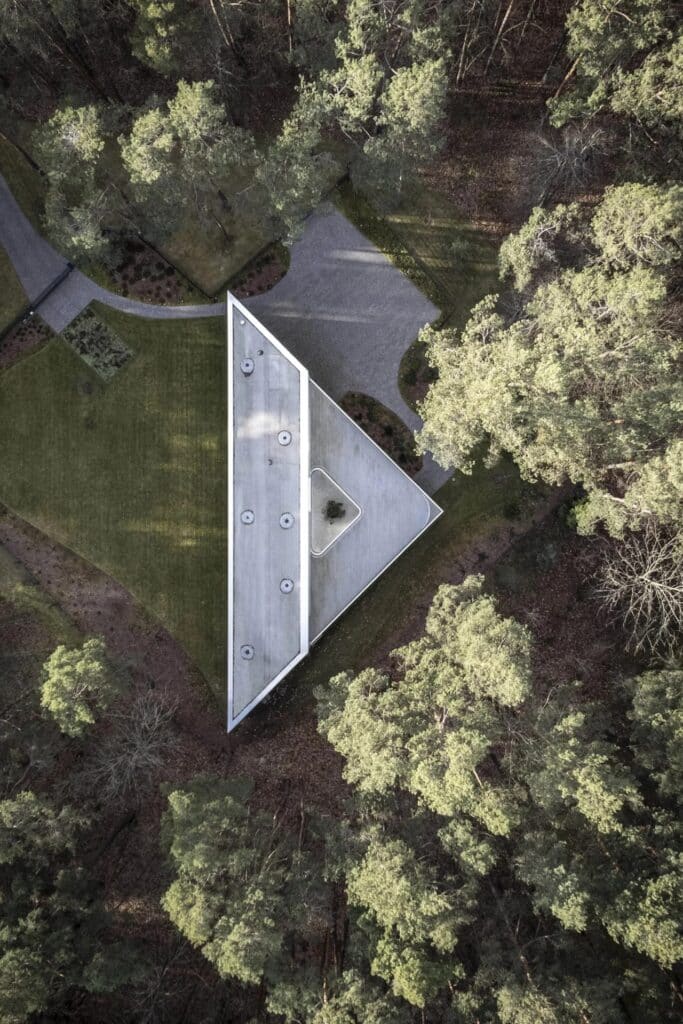
Instead of cancelling the project, the total area was reduced by approximately 40%, and the regulatory constraints were reinterpreted as a defining driver of the design concept. As a result, a triangular floor plan was developed, emerging from a direct interaction between the site conditions and the new regulations, ultimately taking shape as a rational response to the imposed parameters.
Redefining Form through “Trimming”
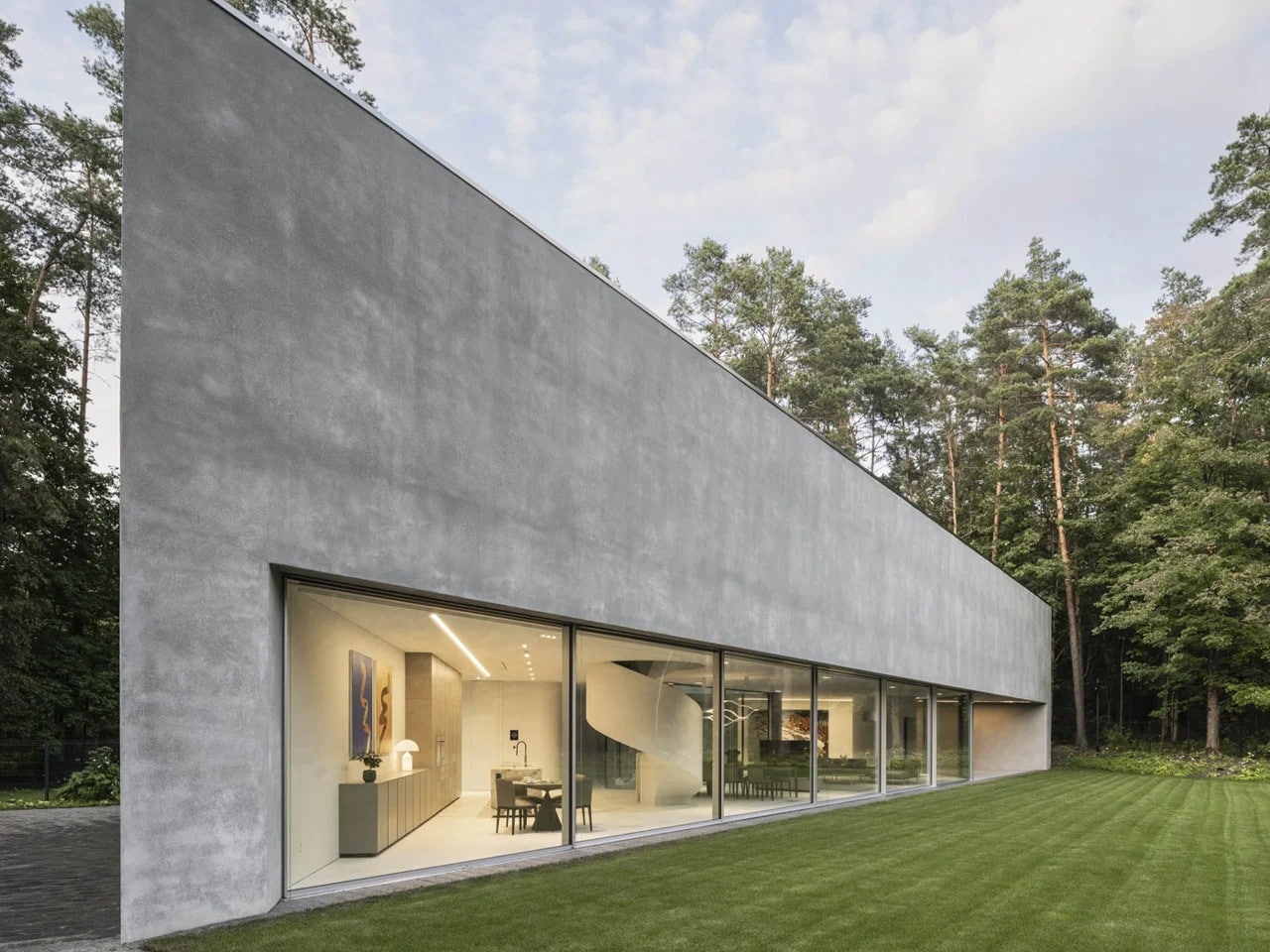
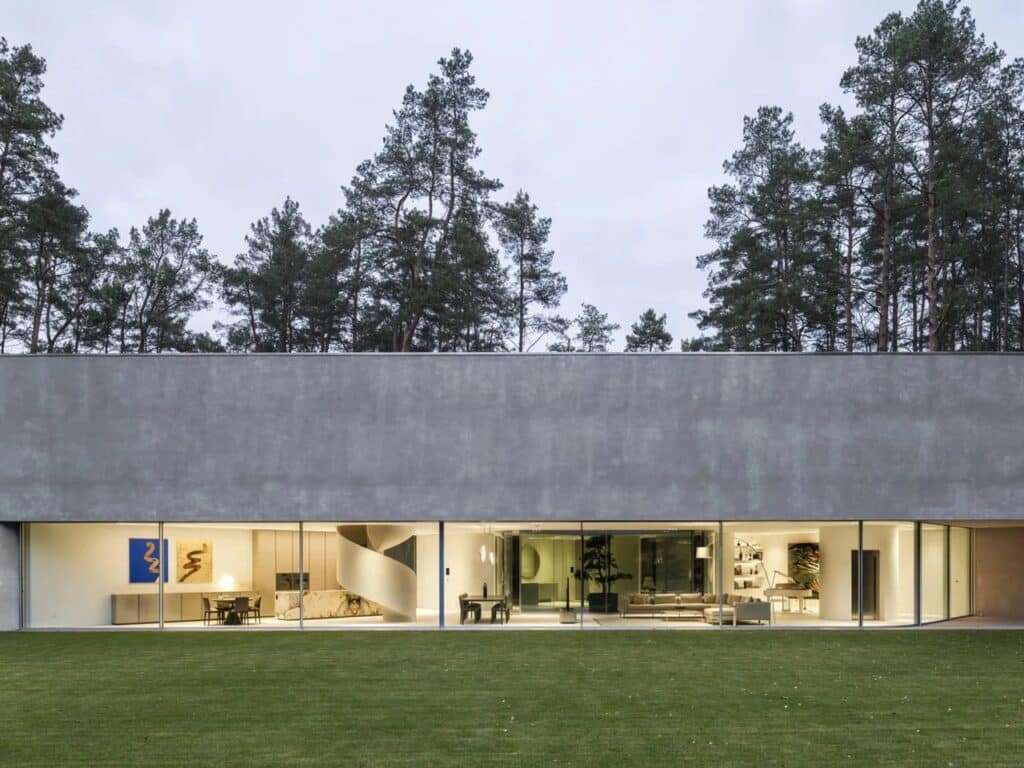
The project’s name directly reflects its design concept, where the architectural mass was reduced within strict boundaries, resulting in a more concentrated and geometrically refined building. The “Trim House” spans 299 square meters and is composed of concrete and glass, engaging the surrounding landscape through sharp angles and clear, deliberate compositions. The surrounding tree cover, particularly the pine trees, helps soften the visual rigidity created by this geometric configuration.
Organizing the Interior Space
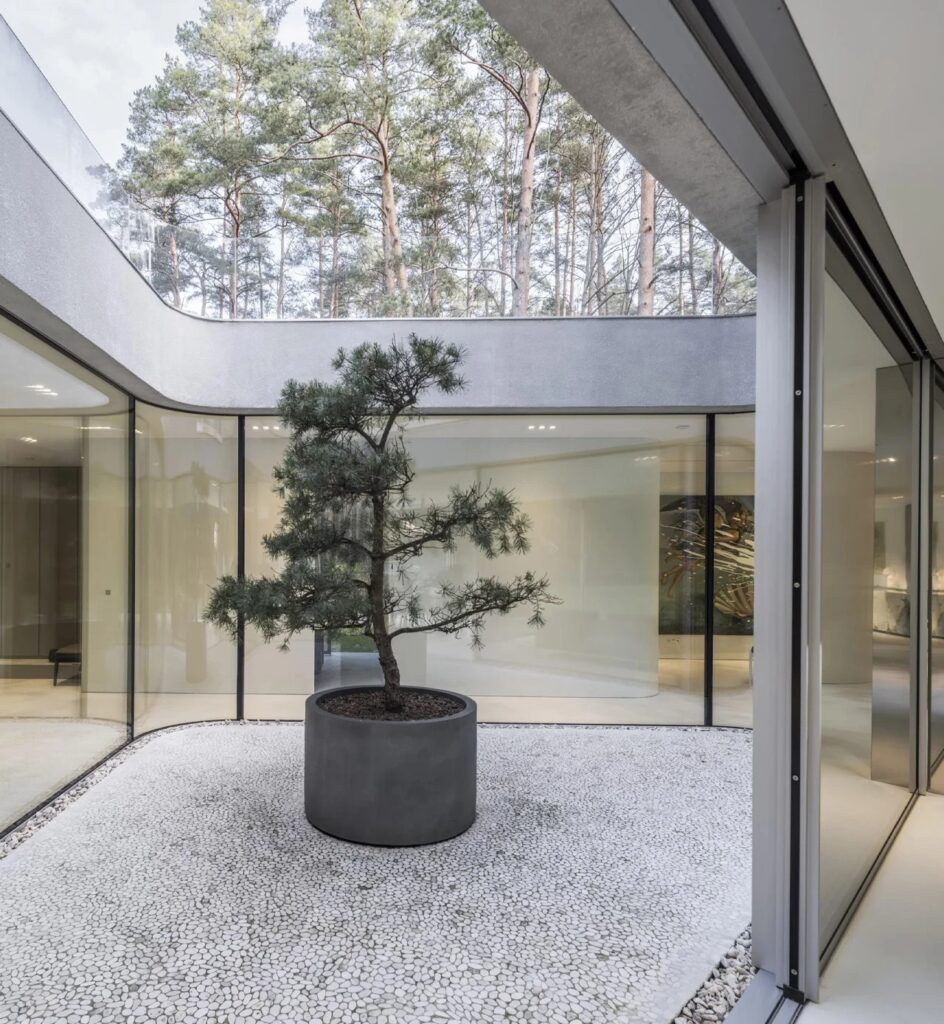
The building consists of two floors organized around a central courtyard that allows natural light to penetrate deep into the interior spaces. The ground floor contains the living areas directly connected to the garden, while the upper floor accommodates private bedrooms linked to balconies overlooking a lower level of the building. This vertical gradation establishes a clear relationship between the more open public spaces below and the more secluded, elevated private spaces above.
The Relationship Between Constraints and Architectural Form
The project does not rely solely on its final shape, but rather on the way this shape was formed through the surrounding constraints. The project reflects an understanding of limitations as an integral part of the generative process rather than an obstacle to it. In this sense, the “Trim House” becomes an example of how regulatory requirements can be transformed into a design logic that produces a distinct and clearly defined architectural form.
✦ ArchUp Editorial Insight
The Trim House project operates as a spatial outcome of successive regulatory constraints within the urban planning framework of Vilnius’s suburbs. Amendments to municipal regulations reduced the allowable building volume by half and redirected the access route through the garden, turning the act of entry into a controlling element in the architectural composition. This shift required a reassessment of the project’s feasibility, before a conditional continuation was approved, involving a 40% reduction in scale in line with financial and spatial limitations.
As a result, a triangular plan emerged in response to the remaining buildable boundaries. Internally, a central void organizes patterns of occupation, separating ground-floor living functions from the upper private units. The final configuration reflects a negotiated balance between institutional control, site accessibility, and the limits of the residential program.

★ ArchUp Technical Analysis
Technical and Documentary Analysis of the Trim House Project – Vilnius, Lithuania:
This article presents an architectural analysis of the Trim House project as a case study in redefining architectural composition through regulatory and planning constraints. To enhance its archival value, we would like to present the following key technical and design data.
The project spans an area of 299 square meters, in a forested suburb of Vilnius, where a simple private home was initially planned on a site that previously housed wooden cabins. During the midpoint of the design phase, changes to local regulatory constraints led to a halving of the allowable built area, along with an access route modification that cuts directly through the garden. Consequently, the total area was reduced by 40% and the constraints were repurposed as a form-determining factor, resulting in a triangular-shaped floor plan.
The building consists of two stories of concrete and glass organized around a central courtyard that allows natural light to penetrate deep into the interior space. The ground floor houses the living areas directly connected to the garden, while the upper floor contains the private bedrooms linked to balconies overlooking a lower level of the building.
The surrounding tree canopy (pine trees) helps mitigate the sense of visual rigidity resulting from the sharp geometric composition.
Related Insight: Please refer to this article to understand the context of modern architectural preservation:
Architectural Adaptation to Regulatory Constraints: Design Strategies in Changing Planning Contexts.





✅ Official ArchUp Technical Review completed for this article.