Unveiling a 36-storey urban retreat in Tokyo

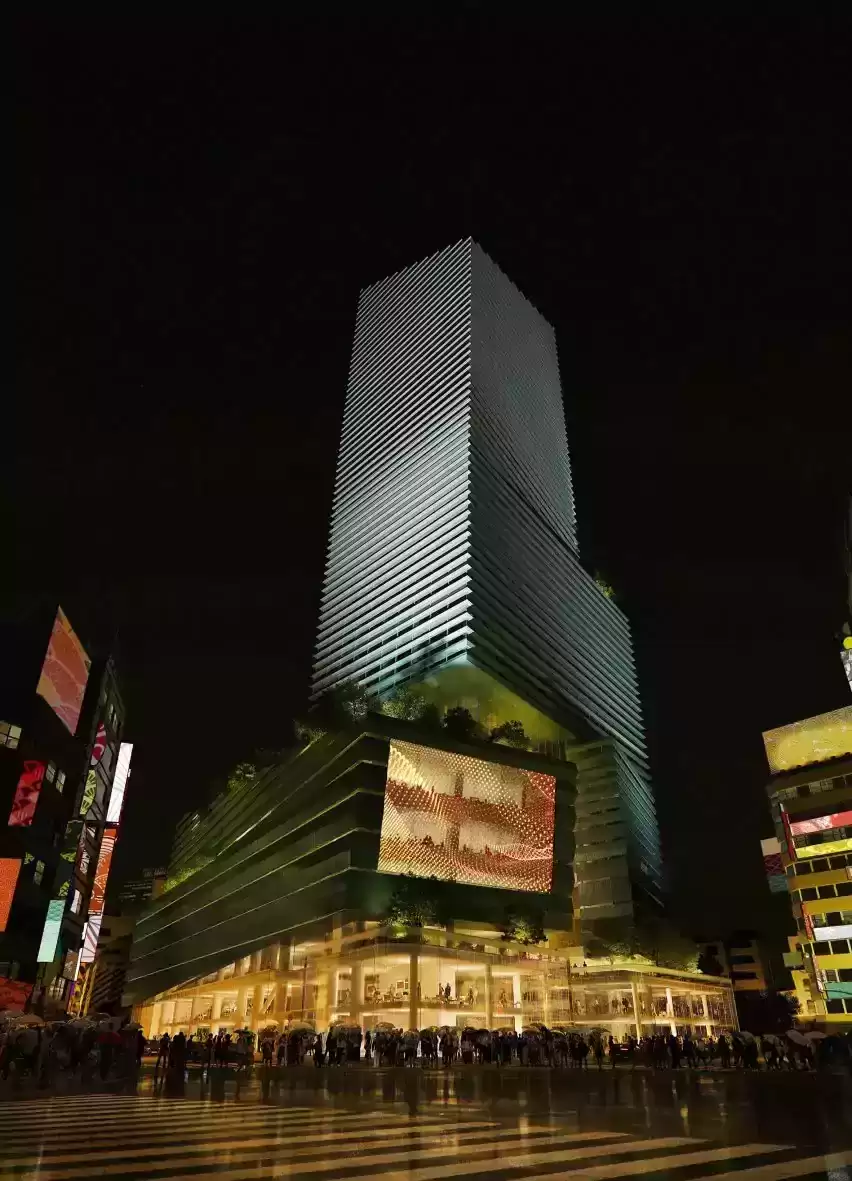
Architecture studio Snøhetta has unveiled the design of a skyscraper in Tokyo, called the Shibuya Upper West Project.
Which aims to be “a haven of peace and relaxation in the hustle and bustle of the city.

Design Features
With a height of 164.8 meters, the project will be the largest studio in Japan,
and the project will include shops, apartments, a luxury hotel and facilities for artistic and cultural events.
Snøhetta’s design aims to connect the vibrant retail district of the Shibuya Upper West Project with the quieter residential neighborhood of Shoto,
which occupies the site of the former Tokyu department store between the two areas.
Located on the edge of the Shibuya Upper West Project where energy meets calm,
the project aspires to become Tokyo’s newest ‘urban sanctuary’.
According to the studio, the 117,000 square meter mixed-use development is inspired by the past and present of Tokyo.
The stepped steps that rise from the ground are designed to honor the distant slopes of Mount Fuji,
while the building’s ceramic facade is meant to pay homage to an ancient Japanese building practice.
Tokyo lies in the duality of time-honoured tradition and fame, a city of twists and turns, contrasting qualities that go well with one another.
The Shibuya Upper West Project intends to represent all this while imagining a new vision for the famous and vibrant Shibuya district of Tokyo.
Known for its raucous crowds, big screens and Shibuya Upper West Project crossing in front of Shibuya Upper West Project Hachiko Station.
Scheduled to be completed in 2027, the center will be built around a 164.8-meter central elevation
with planted recesses and angled geometric shapes.

Design shape
The horizontal volume extends to the side of the tower, with floor-to-ceiling windows flanking the first two floors and a large outdoor screen placed on the upper floors,
which will be topped by a multi-level landscaped garden.
Alternating layers of cladding and blue tinted glass will also extend over the rest of the tower,
which will reach an angled top.
A lounge called The Hive will be located at the center of the project, while a more relaxed space,
The Sanctuary, will offer rooftop terraces where visitors can relax and unwind.
Formed as a single gesture, the design moves from the horizontal ground level to the vertical horizon, symbolizing the energy of the area in one stroke.
The project will be developed in collaboration with the neighboring Bunkamara Cultural Complex,
an art and cultural center in Tokyo, with Snøhetta as design engineer and Nikken Sekkei Ltd and Tokyu Architects & Engineers INC working together as executive engineer.

Snøhetta
Founded in 1989, Snøhetta architecture studio in Oslo has recently completed an underwater restaurant in Norway,
whose boardwalk vanishes with the tide.
For more architectural news