WDC 2028 Busan Pavilion International Design Competition

Brief
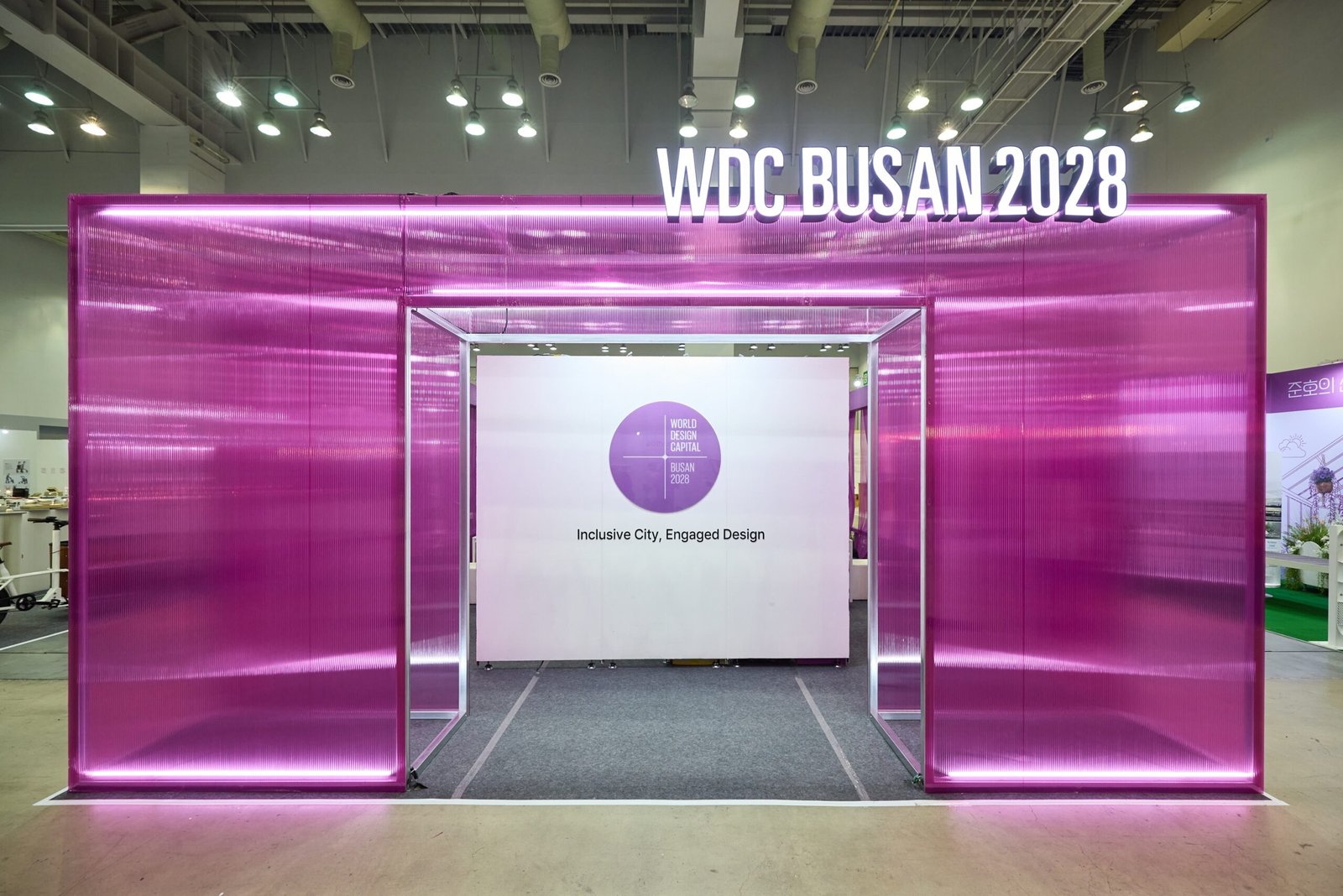
WDC 2028 Busan Pavilion International Design Competition is an open, two-stage international call to establish one integrated design system for a fixed civic pavilion and a mobile pavilion that can travel across Busan. The project is intended to turn the World Design Capital 2028 programme into a public platform for information, exhibitions, education, exchange, participation and rest.
Purpose, scope and location
| Item | Published terms |
|---|---|
| Organizer | Busan Metropolitan City. |
| Host | Design Council Busan. |
| Competition type | Open international, two-stage design competition. |
| Core task | Create an integrated identity, component system, user experience and operating strategy linking a fixed pavilion with a mobile pavilion. |
| Fixed pavilion | Entrants select a representative setting within Busan and propose one adaptable base design. The actual installation site is not confirmed and may change. |
| Mobile pavilion | One transportable base design shown in at least three environments, such as an urban plaza, waterfront and event venue. |
| Implementation horizon | Mobile pavilion fabrication and pilot are targeted for 2027; the fixed pavilion and integrated system are targeted for 2028, with reuse and legacy beyond 2029. |
| What is excluded | Statutory professional design, engineering, fabrication drawings, construction, installation and supervision are outside this competition. |
Eligibility and team composition
Eligible entrants are companies, organisations and sole proprietors in design, architecture, spatial, exhibition, environmental, service, experience, industrial, modular or fabrication fields. Every entrant must hold a business registration or equivalent legal registration and be able to contract, receive service fees and transfer the required rights. International entries and joint entries are permitted, but every joint-entry member must independently satisfy the eligibility conditions. Individuals without business registration are not eligible.
Stage 1 submission requirements
| Requirement | Published specification |
|---|---|
| Concept proposal | Up to six A3 landscape pages in one PDF, maximum 50 MB. |
| Recommended sequence | Vision and interpretation; integrated principles; fixed pavilion; mobile pavilion; operational scenario; sustainability and legacy. |
| Administrative file | Forms 1–5 and eligibility evidence combined into a separate PDF and withheld from the jury. |
| Language | The proposal must use Korean or English consistently. The project title, key concept and summary must appear in both Korean and English. |
| Anonymity | The proposal may show only the assigned entry code. Names, affiliations, logos, identifiable histories and identifying PDF metadata are prohibited. |
| Submission method | Official online system only. Entrants must complete the “Final Submission” action before the deadline; email, postal and in-person delivery are not accepted. |
| Public disclosure | Proposal images and specific content must not be made public before the final results are announced. |
| Generative AI | Use must be declared in Form 3. Entrants remain responsible for originality and third-party rights. |
Schedule
| Stage | Official time | UTC |
|---|---|---|
| Stage 1 submission | 2–26 October 2026; closes 17:00 KST | 26 October 2026, 08:00 UTC |
| Questions close | 12 October 2026, 17:00 KST | 12 October 2026, 08:00 UTC |
| Official answers | 16 October 2026 | Date only |
| Stage 1 results | 29 October 2026 | Date only |
| Stage 2 submission | 30 November 2026, 17:00 KST | 30 November 2026, 08:00 UTC |
| Final result | 7 December 2026 | Date only |
| Winning design refinement | 8–23 December 2026 | Date range |
Stage 1 has no separate registration deadline: eligibility documents and the anonymous proposal must both reach the official system by 26 October 2026 at 08:00 UTC. The remaining period is slightly over the minimum 14-day threshold, so prospective entrants should assess document readiness immediately.
Entry fee and service fees
| Stage | Financial terms |
|---|---|
| Entry fee | Free. |
| Stage 1 | Unpaid concept proposal. |
| Stage 2 | Two selected teams receive KRW 20,000,000 each (approximately USD 14,900 at the 9 October 2026 exchange rate) after completing the agreed development and presentation. |
| Winning refinement | The final winning team receives KRW 50,000,000 (approximately USD 37,250 at the 9 October 2026 exchange rate) after acceptance of the refinement deliverables. |
| Taxes and remittance | Amounts include VAT and other applicable taxes or charges. International conversion and intermediary or receiving bank charges may reduce the net amount. |
Jury and assessment
The five jury names have not yet been published. The announced expertise covers WDC and international collaboration, spatial and public design, modular systems and fabrication, and service, experience and accessibility. Stage 1 allocates 25 points to Busan identity and urban interpretation, 20 to creativity, 20 to integration between the fixed and mobile pavilions, 15 to spatial and programme usability, 10 to scalability, and 10 to sustainability and circularity.
Rights, implementation and organiser
Busan Metropolitan City organises the competition and Design Council Busan administers it. Unselected Stage 1 proposals remain with their creators and are not intended for public or project use without a separate agreement. Paid Stage 2 submissions grant the host a non-exclusive licence for evaluation, records, exhibitions, press and non-commercial promotion. Subject to the applicable service fee and separate agreement, the final winning proposal and refinement deliverables assign their economic and design-related rights to Busan Metropolitan City; moral rights remain with the creator.
Professional design, technical review, fabrication and installation will be separately procured in 2027. The winner receives no automatic negotiation right, direct-award claim, later design commission, fabrication right or installation contract.
✦ ArchUp Competition Review
This is less a search for a single pavilion object than for a repeatable urban system. The brief tests whether one design language can operate across a permanent civic hub and temporary settings while accounting for climate, accessibility, transport, assembly, maintenance and reuse. That combination gives the concept direct relevance to public-space design and event infrastructure.
Free entry and paid development stages are strengths, as is the detailed scoring matrix. The trade-offs are substantial: unregistered individuals cannot participate; Stage 1 is unpaid; the schedule is compressed; and the final rights assignment is broad. Entrants should also distinguish the paid design-development services from the separately procured professional design and fabrication work, which is not promised to the winner.
Reviewed on 9 October 2026 against the official competition website, notice and guidelines issued by Busan Metropolitan City and Design Council Busan.
Related competitions — Editorial team selection
For related pavilion and place-based design calls, see Persian Garden Suite and the Eulsukdo Land Ecological Art Open Call in the ArchUp archive.
Time remaining for Stage 1
26 October 2026 · 08:00 UTC.
Competition page
Read the current official guidelines and submit through the designated system.