Toronto’s Winter Stations Exhibition Returns for 12th Year with AI-Themed Installations

Five International Teams Transform Woodbine Beach
The Winter Stations public art exhibition has returned to Toronto’s Woodbine Beach for its 12th consecutive year. Five installations now occupy the sandy waterfront, created by designers from Canada, Germany, Ukraine, Taiwan, and the United States.
This year’s theme, Mirage, challenged participants to examine reality in the age of artificial intelligence. Jurors reviewed more than 300 submissions before selecting the final five proposals. The exhibition opened on February 16 and continues through March 30.
Exploring Identity Through Convex Mirrors
Designers Denys Horodnyak and Enzo Zak Lux created Chimera, a grid of convex mirrors. The installation reflects visitors in multiple fragmented images. Each mirror creates what the designers call a constellation of selves, exploring themes of control and security.

Hand-Shaped Structure Rises from Sand
Will Cuthbert designed Embrace, a large-scale hand emerging from the beach. The architectural design features polychromatic strips lining the fingers. The gesture suggests human connection within the coastal landscape.
Framed Apertures Question Perception
Andrew Clark’s Specularia features five openings facing Lake Ontario. Each frame captures the water differently, blending deception and reality. The structure was built using treated lumber and positioned to maximize interaction with the natural environment.

Student Teams Contribute Wave and Ice Installations
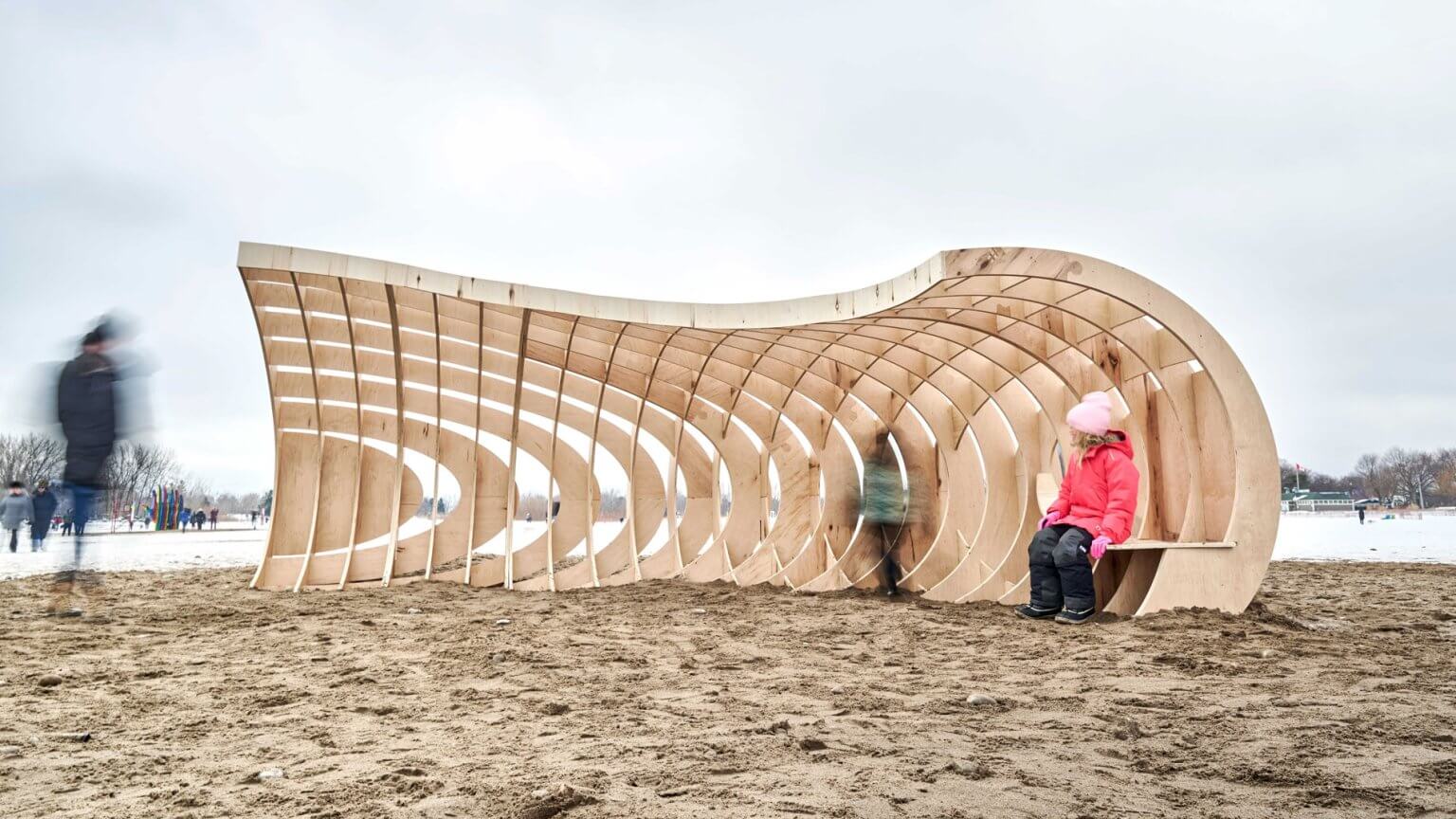
University of Waterloo students created Crest, an immersive wave simulation. Plywood arranged in a waffled pattern mimics the motion of water. The installation invites visitors to walk through rippled formations.
Meanwhile, a collaborative team from Toronto Metropolitan University and Ming Chuan University designed Glaciate. Vertical polycarbonate panels filled with lake water freeze into ice lenses. Fog obscures the figures of people inside, further emphasizing the exhibition’s theme of uncertain reality.
International Response Highlights Design Innovation
The Winter Stations exhibition continues to attract global news attention. Each installation demonstrates unique approaches to building materials and environmental integration. The lakeside setting provides natural elements that enhance each design concept.

The installations respond directly to Toronto’s winter climate. Ice, water, and cold weather become integral components rather than obstacles. This design competition format encourages experimental approaches that might not emerge through traditional architectural research.
Moreover, the exhibition transforms public space into an interactive art experience. Visitors can engage with each installation physically and visually. The temporary nature of the structures allows bold experimentation.
Will you visit Woodbine Beach before the exhibition closes on March 30?
A Quick Architectural Snapshot
The Winter Stations exhibition occupies Woodbine Beach in Toronto through March 30. Five installations utilize materials including convex mirrors, treated lumber, plywood, and polycarbonate panels. Each structure responds to the Mirage theme, exploring perception and reality in contemporary design. Student teams and independent designers participated in creating the waterfront installations.
✦ ArchUp Editorial Insight
Temporary public art competitions follow a recurring cycle. Municipal governments face pressure to activate underused winter waterfronts. Tourism data and cultural funding timelines dictate the schedule. The open call model generates volume, with 300 submissions producing five selections. This ratio reveals a filtering system optimized for visual impact and fabrication speed, not long-term spatial research.
The theme of AI and reality mirrors a broader institutional anxiety. When cities cannot address permanent public space deficits, they commission temporary spectacles. Recyclable materials and short installation windows reduce financial risk. University partnerships lower labor costs while generating institutional credit.
The architectural outcome, temporary structures on open sand, is the logical product of limited municipal budgets, seasonal tourism pressure, and a design competition model that rewards photogenic immediacy over lasting spatial transformation.