Yongsan International Business District AI Smart City Idea Competition

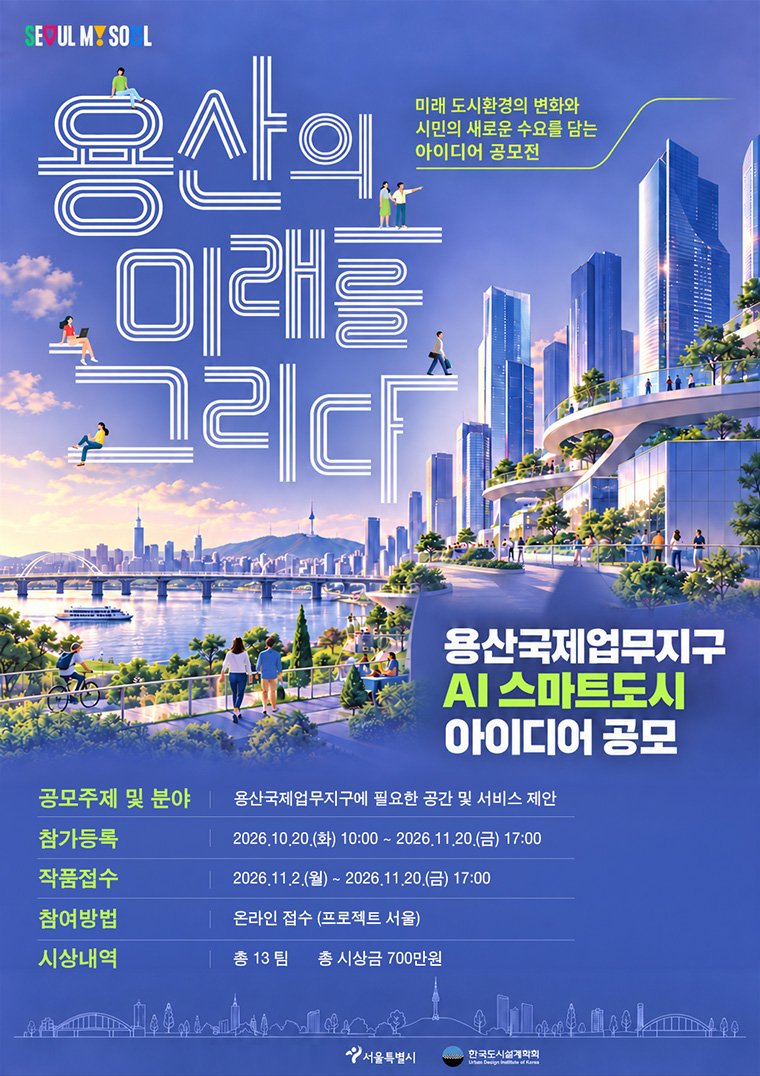
Yongsan International Business District AI Smart City Idea Competition is a Seoul Metropolitan Government ideas call for people aged 19–39. It asks how the 456,099 m² redevelopment area can support everyday life in 2040 through either a people-centred spatial proposal or a technology-enabled urban service.
This is a youth ideas competition, not a professional design commission. The city says selected ideas may inform infrastructure and data-based urban operations, but the published call does not promise appointment, construction or payment beyond the listed awards.
Competition overview
| Official title | Yongsan International Business District AI Smart City Idea Competition |
|---|---|
| Organizer | Seoul Metropolitan Government, Yongsan Three-Dimensional City Division; supported by the Urban Design Institute of Korea. |
| Design question | What spaces or services will the Yongsan International Business District need for working, living and visiting in 2040? |
| Site | 40-1 Hangangno 3-ga and surrounding parcels, Yongsan-gu, Seoul; 456,099 m². |
| Tracks | Spatial proposal or urban-service proposal; entrants select one. |
| Eligibility | People aged 19–39 under the Seoul Youth Basic Ordinance; individual entry or a team of up to five. |
| Entry fee | No entry fee is stated in the official guide reviewed. |
| Public language | The guide, forms and portal instructions reviewed are in Korean; an alternative submission language was not identified. |
| Registration | 20 October–20 November 2026, closing 17:00 Korea Standard Time (08:00 UTC). |
| Submission | Opens 2 November and closes 20 November 2026 at 17:00 Korea Standard Time (08:00 UTC). |
The spatial brief
The spatial track asks entrants to work from the district’s published development plan and anticipate changes in lifestyle and user demand by 2040. The official description highlights walking, rest and climate response as examples, while the service track asks entrants to forecast problems experienced by residents, workers and visitors and propose technically supported responses.
A strong architectural entry should therefore make the relationship between a problem and a place visible. Routes, shaded stopping points, thresholds between towers and ground-level public space, seasonal comfort and maintenance responsibility can be tested through drawings rather than presented as generic “smart city” promises. Any claimed performance of AI, mobility or environmental systems should be identified as a proposal unless it is supported by evidence.
Submission requirements
| Main panel | One digital panel, 14,400 × 8,100 pixels at 300 dpi, submitted as JPG and named with the assigned PIN. |
|---|---|
| Panel image | Separate JPG at 300 dpi, maximum 5 MB, following the prescribed PIN filename. |
| Documents | Application, participation agreement, individual personal-data consent forms, idea proposal and integrity pledge, using the organizer’s forms. |
| Document package | Combine the completed forms into one ZIP file no larger than 10 MB and upload it under the documents field. |
| Delivery | Register and upload through Project Seoul. Non-compliant or missing forms may exclude an entry. |
| Anonymity | The panel uses the assigned PIN rather than entrant names; entrants should follow the original Korean file-naming rules exactly. |
Schedule, awards and disclosure
| Questions | Closed 23 October 2026; answers are scheduled for 30 October. |
|---|---|
| Registration | 20 November 2026, 08:00 UTC. |
| Submission | 20 November 2026, 08:00 UTC. |
| Results and public verification | 1–10 December 2026; awards ceremony scheduled for 11 December. |
| Cash awards | KRW 7,000,000 total (approximately USD 5,290 on 25 October 2026 at KRW 1,323 per USD): grand prize KRW 3,000,000; two top awards of KRW 1,000,000; four excellence awards of KRW 500,000. Six commendations receive a commemorative item. |
| Jury | Individual juror names and professional biographies were not found in the public material reviewed. |
| Rights and use | The city states that selected ideas may be used in infrastructure and data-based operations. A complete publication or intellectual-property licence was not visible in the accessible extracts; entrants should read the original Korean attachments before submission. |
Organizer and implementation status
Seoul Metropolitan Government is the public client for the wider Yongsan redevelopment. The ideas call is administered through Project Seoul and supported by the Urban Design Institute of Korea. It is separate from procurement of architectural services: the awards recognise proposals, and the announcement describes possible policy use rather than a contractual route to detailed design.
✦ ArchUp Competition Review
The opportunity is most relevant where technology is treated as an urban instrument rather than the subject itself. A useful proposal might define who encounters a recurring problem, where it occurs, what physical or operational change addresses it and how that change is maintained. That sequence can connect AI or data systems to an accountable spatial decision.
The principal limitations are the age restriction, Korean-language process, short four-week window and absence of a disclosed jury list in the material reviewed. The single-panel format also rewards clarity over breadth. Entrants should avoid trying to redesign the entire district and instead choose a bounded question that can be tested at street, block or public-space scale.
Sources reviewed: Seoul Metropolitan Government announcement, Project Seoul listing and the official Korean competition guide; accessed 25 October 2026.
Related competitions — Editors’ selection
For related public-realm work, the Harem Bus Station competition addresses a major waterfront transport site, while the Police Academy Danilovgrad competition tests a defined public programme and implementation context.
Time remaining to register and submit
Registration and submission close together on 20 November 2026 at 17:00 Korea Standard Time, shown here as 08:00 UTC. Submission opens on 2 November.
Official guide and entry
Read the Korean guide and forms, obtain a PIN through registration and verify the upload fields before the deadline.