Why the Newsroom Hesitates

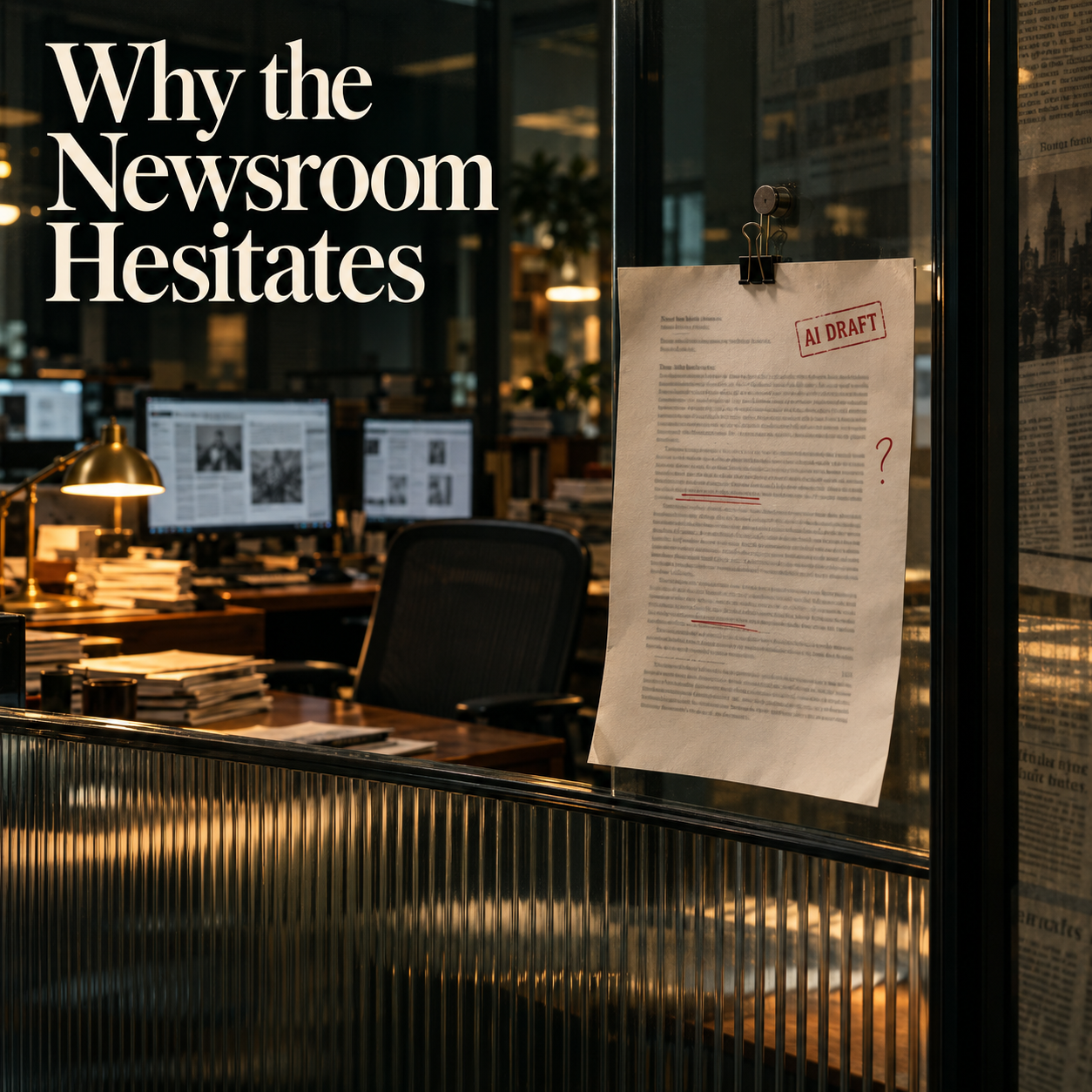
Newsroom caution toward generative artificial intelligence stems from rational economic, psychological, ethical, and professional concerns rather than basic technophobia. Publishers face threats regarding job displacement, uncompensated copyright exploitation, audience distrust, and factual unreliability, particularly concerning synthetic images that compromise accountability and accuracy.
To navigate these challenges, media organizations must establish clear usage policies rather than outright refusal or uncritical adoption. Maintaining transparent disclosure, human bylines, and verified human judgment protects the foundational trust and editorial authority that readers expect from specialized architectural journalism.
A question arrived inside this platform before this article did, and it is worth stating plainly because it is the reason the article exists. The editorial team noticed how cautiously news organisations across the world are treating artificial intelligence, and it recognised the same caution in itself, a genuine unease about the editorial images that AI artists now generate, the pictures that could illustrate a story about a building without any camera ever having stood in front of that building. The instinct was to hesitate, and then the better instinct followed, which was to ask why, and to research the question rather than merely feel it. What the evidence shows is that the hesitation is neither irrational nor cowardly. It is a rational, differentiated, institutionally conditioned response, and understanding its real sources is the first step toward deciding what an architectural publisher should actually do.
The temptation is to read newsroom caution as technophobia, a profession clinging to old habits while the world moves on. The surveys and studies from the last two years dismantle that reading completely. Journalists are not uniformly afraid, and they are not uniformly resistant. Their caution clusters by professional role, by the resources of their newsroom, and by their position in the global media economy, and it is far more often a conditional acceptance under contested conditions than any blanket refusal. The caution is a bundle of overlapping and legitimate rationales, economic, psychological, ethical, and professional, and each of them maps with uncomfortable precision onto the situation of a publisher working in architecture and the built environment.
A Labour Saving Tool Inside a Labour Losing Industry
The first source of caution is economic, and it is the most honest one. Artificial intelligence arrives in journalism as a cost cutting technology entering an industry that has already absorbed decades of cuts. A survey of Danish journalists found that the single highest rated concern was not the loss of one’s own job but that the technology would cause job cuts across the news industry, an industry level pessimism combined with a more hopeful individual level reading. The same survey found that the journalists most worried about the technology were, in some roles, also the ones using it most, because management pushes the tool hardest exactly where content production is most easily automated. This is the crucial point. The caution is not a reaction to the tool in the abstract. It is a reaction to the tool arriving as a productivity mandate from above rather than as an instrument the journalists themselves chose.
This economic layer has a dimension that matters enormously for a publisher, which is copyright. News institutions argued to regulators that their work is unusually valuable training material, clear sentences, precise word choices, rigorous and multilayered editing and fact checking, and that this value should not become free input for systems that will then compete against the people who created it. A comparative legal reading of several jurisdictions concludes that copyright as an institution has been weakened in favour of well resourced technology investors and large publishers, over individual journalists and small newsrooms, accelerating what one scholar calls the deinstitutionalisation of journalism and the institutionalisation of algorithms. For an architectural publisher this is not abstract. The drawings, the photographs, the critical essays, the carefully verified accounts of projects that a platform like this one produces are exactly the kind of high quality, labour intensive material that becomes training data, and the question of whether that labour is compensated or simply absorbed is a question of survival, not of principle alone.
The resource dimension is sharper still outside the wealthy media centres. Journalists in South Africa described artificial intelligence as inevitable yet noted that no formal newsroom discussion had happened, partly because adoption requires an investment the newsroom simply does not have. Nigerian and Indian journalists reported the same absence of institutional policy, the same lack of training, the same barriers of subscription cost and outdated hardware and training data centred on other parts of the world. The technology therefore functions as a stratifying force, widening the distance between newsrooms that can afford to shape it and those that can only rent it, and resistance in much of the world is partly a refusal of a dependency relationship with distant platform providers. An architectural publisher outside the Anglophone centre sits in exactly this position, and its caution is partly the sound sense not to build its editorial identity on tools it does not control.
Distrust, Dependency, and the Fear of Going Quiet Inside
The second source is psychological, and it runs deeper than economics. Audiences distrust AI produced news, and that distrust feeds back into newsroom conservatism. A large representative survey in the Netherlands found that perceived benefit strongly predicted trust in AI produced news, while distrust predicted concrete acts of resistance, including a refusal to pay for AI produced news and a refusal to share data for AI personalisation. Because audiences can simply leave, a publisher has a direct commercial and psychological incentive to stay conservative, even though the same study notes the trap in this, that resistance forecloses the very experimentation needed to rebuild trust over time. Risk perceptions around misinformation and privacy were high and, tellingly, were not explained by how much people claimed to know about the technology. The unease is not ignorance. It persists alongside understanding.
Beneath the distrust of the machine sits a fear about the self. Journalists in Nigeria worried explicitly that over reliance would make them lazy, would erode their critical thinking, would alienate them from their own judgement, that one stops growing when one begins to treat the machine’s output as better than what one’s own mind could conceive. Journalists in India described the same fear in terms of agency, that the more one depends on the tool for writing or creating, the more one grants it the power to remove oneself from the work. These are not instrumental complaints about a tool’s performance. They are identity level anxieties about what a person becomes when the craft is delegated, and for a discipline like architectural criticism, whose entire value lies in a trained and independent eye, that anxiety is not neurotic. It is a correct perception of what is genuinely at stake.
There is even a reputational calculation in the caution. In some newsrooms AI proficiency carries prestige, a marker of being current and capable, while in others it carries stigma, so that a journalist is reluctant to be seen advocating a tool that peers may read as a sign of outsourcing the craft to a machine. In the absence of any clear policy, every individual is left to make that reputational bet alone, which produces exactly the discreet, cautious, unspoken use that the surveys keep finding.
Accuracy, Accountability, and the Black Box
The third source is ethical and professional, and it is where the caution is most defensible of all. Journalists across every context studied name factual unreliability as the decisive limit. The output can be bland and formulaic and prone to fabrication, and using the tool for fact checking can increase the workload rather than reduce it, because everything it produces must then be verified. In one newsroom studied over many months, journalists built a protective repertoire around the tool, restricting it to tasks with clearly specified inputs, keeping verification in house, cross referencing against colleagues and documents, precisely because, as one of them put it, they could not let it decide what is true and what is false. This is the heart of the matter for any publisher that stakes its name on accuracy.
Underneath accuracy sits accountability, and here the research frames the tool as a prosthesis that extends a journalist’s reach while making the origin of a claim harder to explain. When a journalist cannot account for how an output was produced, they cannot take responsibility for it, and accountability is the ground on which audience trust actually rests. This is why the Danish survey ranked fact checking of output, internal guidelines, and clear responsibility for errors as the most important implementation issues. And it connects directly to the specific fear that started this inquiry, the AI generated editorial image. A photograph of a building carries an implicit claim, that this is how the thing looks, that a camera stood here and recorded this. An AI generated image of a building makes the same implicit claim while being a fabrication, and a reader who later discovers that the striking image of a project was never a real photograph has every reason to question everything else the publication told them. The construction of trust in a media outlet is slow and cumulative, and a single undisclosed synthetic image can spend it all at once.
Compounding every one of these concerns is a vacuum of rules. Newsroom after newsroom, in South Africa, Nigeria, India, reported the absence of any formal AI policy even as individual staff adopted tools informally, policies made up on the fly, mixed messages, or outright bans that remove the need for regulation but also remove any possibility of learning. This echoes an older pattern from the arrival of social media, where guidelines were improvised and reporters received contradictory signals. The caution, in other words, is partly just the sensible refusal to act decisively in the absence of any agreed standard.
Autonomy and the Defence of the Craft Itself
The fourth source is the deepest, and it explains why this moment feels different from earlier ones. Historically, the strongest newsroom resistance to technology has been about control rather than capability. When social media arrived, journalists accepted that it helped with sourcing and distribution, yet described an increase in editorial surveillance, pressure to match competitors, homogenised coverage, and a narrowing of independent news judgement. The objection was never really to the tool. It was to the redistribution of control inside the newsroom. With artificial intelligence the same logic now attaches to editorial judgement itself, which is why the journalists whose authority rests most on independence and objectivity show the greatest reluctance of all.
This is boundary work, the defence of what counts as the craft, and it is more explicit now than in any earlier technological shift for a precise reason. Earlier technologies automated production and distribution, the typesetting, the transmission, the layout. Generative systems imitate the representational and reasoning work that grounds journalism’s claim to authority in the first place. That is a categorically different encroachment, and it is why the language of boundaries, of who counts as an author, of what is genuinely journalistic labour, is so much louder today. The evidence even shows that audiences preserve a human authorship premium, rating identical content as more credible and more authentic when it is attributed to a person rather than an algorithm, a small but real effect that gives a publisher a legitimate reason to keep a visible human hand on anything sensitive. For architectural criticism this premium is the whole business. A platform’s design judgements, its readings of buildings and cities, are worth reading precisely because a knowledgeable human stands behind them, and the moment that is in doubt the value evaporates.
What History Actually Teaches
It would be comforting to recall that newsrooms absorbed the computer easily and conclude that they will absorb this too, but the history is more double edged than the comforting version admits. An oral history of newsroom computerisation found that journalists remember computers as tools easily folded into their habits, resisters dismissed as a few dinosaurs, the typewriter clatter giving way to the quiet of screen work. But that same account notes what the survivors barely mention, that the quiet newsroom was produced by the extinction of the compositors, the copy readers, the linotype operators, the proofreaders, an entire layer of labour that disappeared. Two lessons follow, and both bear on the present. Journalists’ memories of easy adoption systematically under record the labour dislocation that accompanied it, and the current anxiety may be the anticipation of a displacement that computerisation already inflicted on the composing room now reaching the editorial desk itself.
What is genuinely new, then, is not that a technology provokes resistance. It is that this technology imitates the craft rather than merely the production around it, and that it arrives wrapped in a hype apparatus and an entrenched platform industry. A review of many studies even finds a marked negativity bias in the scholarship itself, heavy on critique and light on workable alternatives, which leaves practitioners with plenty of warning and few actionable designs. The honest position for a publisher is therefore neither the enthusiast’s rush nor the pure refusal, but a clear eyed reading of which anxieties are protecting something real and which are merely protecting the familiar.
Where This Platform Stands
So the answer to the question that started this, whether the team was right to hesitate over AI generated editorial images, is yes, and the research explains why with more clarity than instinct could. The hesitation protects the four things that are genuinely worth protecting, the economic value of original architectural labour, the trust of a readership that can and will leave, the accuracy and accountability that a synthetic image quietly endangers, and the human judgement that is the entire reason anyone reads architectural criticism rather than generating their own. What the evidence equally shows is that refusal alone is not a strategy, because it forecloses the experimentation through which trust is eventually rebuilt, and because a tool adopted without rules does more damage than one adopted within them.
The settlement the research points toward is not dramatic, and that is its strength. Disclosure is cheap and carries little downside, so any synthetic image or AI assisted text should be labelled as what it is, because the scandal of the hidden fabrication is far more costly than the honesty of the disclosed one. Guidelines and clear chains of accountability should exist before the tools are used widely, not improvised after a failure. The human byline should remain visible on anything that carries editorial judgement. And the structural questions, who owns the training value of this platform’s drawings and essays, what dependency a given tool creates, should be decided deliberately rather than by default. The serious architectural research and criticism this platform exists to publish is exactly the high value, verification intensive, human grounded work that the surveys identify as both most threatened by careless automation and most defended by careful practice. The news will keep announcing that AI has transformed media, and the industry competitions will keep rewarding whoever adopts fastest, but the durable position is the one the newsroom’s hesitation was pointing at all along, that a publication’s only irreplaceable asset is the trust that a knowing human stands behind its account of the world, and that this asset, like the long term sustainability of any institution built on credibility, is far easier to spend than to earn back. The team was right to pause. The task now is to turn that pause into a policy rather than a permanent flinch.
✦ ArchUp Editorial Insight
This piece is a self-examination — the platform turning its analytical method onto its own editorial hesitation about AI-generated images — and that reflexivity is worth naming, because it is the rare case where the institution submits its own governance to the scrutiny it usually reserves for buildings. Its most structurally precise contribution is the demonstration that newsroom caution is not technophobia but a rational response to the tool arriving as a productivity mandate from above rather than an instrument the practitioners themselves chose, which relocates the entire debate from capability to control: the journalists most worried are often the ones using it most, because management pushes automation hardest exactly where content production is most easily displaced. This is the same labor-formation and extraction thread this archive traced in The Consulting Pyramid Is Collapsing From the Bottom Up and Addicted Architecture, where the high-value verification-intensive work is simultaneously the most threatened by careless automation and the hardest to replace — and the essay extends it into a precise account of the copyright mechanism, that the drawings, photographs, and critical essays a platform produces are exactly the high-quality training data absorbed without compensation by systems that will then compete against their makers, the double extraction this archive named in Who Pays for the AI Hallucination. The sharpest architectural observation is the one that started the inquiry: a photograph of a building carries the implicit claim that a camera stood here, and an AI-generated image makes the same claim while being a fabrication, so a single undisclosed synthetic image can spend the slow cumulative trust of a publication all at once — which connects directly to The Value Is in the Verb, Not the Noun, where value tracked the governed human act behind the surface rather than the surface itself. What distinguishes this piece from the resolution this archive has elsewhere criticized as individual-virtue deflection is that it refuses to locate the answer in personal restraint: it insists the structural questions — who owns the training value, what dependency a tool creates, what policy governs disclosure — be decided deliberately at the institutional level rather than improvised after a failure, which is the correct register, because the hesitation it defends is finally an argument that a publication’s only irreplaceable asset is the trust that a knowing human stands behind its account of the world, an asset, like the credibility of any institution this archive has examined, far easier to spend than to earn back.
Sources
- Møller LA, Cools H, Skovsgaard M. One Size Fits Some: How Journalistic Roles Shape the Adoption of Generative AI. Journalism Practice, 2025.
- Sarısakaloğlu A. Artificial intelligence as a game changer or passing tech fad in journalism? A qualitative study on journalists’ perceptions and technology adoption in a Global South country. Journalism, 2025.
- Schjøtt A, Schaetz N. Taming AI: how AI courses for journalists shape the global appropriation of AI. Information, Communication and Society, 2026.
- Solomons S, Ndlovu MW. AI Adoption in South African Newsrooms: Exploring Journalists’ Perceptions. Communicatio, 2024.
- Onebunne AP. Journalists’ Perception of Artificial Intelligence: The Case of Nigerian Newsrooms. Digital Journalism, 2025.
- Boyles JL. A News Copyright Balancing Act: How American Journalism Institutions Approached the Early Era of Artificial Intelligence and Fair Use. Journalism Studies, 2024.
- Kuai J. Unravelling the Copyright Dilemma of AI Generated News and Its Implications for the Institution of Journalism: The Cases of US, EU, and China. New Media and Society, 2024.
- Fridman M, Krøvel R, Palumbo F. How not to Run an AI Project in Investigative Journalism. Journalism Practice, 2023.
- Morosoli S, Resendez V, Naudts L, Helberger N, de Vreese C. I Resist. A Study of Individual Attitudes Towards Generative AI in Journalism. Digital Journalism, 2025.
- Ashuri T, Zalmanson L, Goldstein D. Journalistic Epistemic Authority in the Age of AI: The Incorporation of Generative AI in Newsrooms. Digital Journalism, 2026.
- Chadha K, Wells R. Journalistic Responses to Technological Innovation in Newsrooms. Digital Journalism, 2016.
- Waddell TF. The Effects of AI Attribution, Source Priming, and Story Topic Polarization on News Credibility. Digital Journalism, 2025.
- De Maeyer J, Delva J. When Computers were New: Shifts in the Journalistic Sensorium, 1960s to 1990s. Digital Journalism, 2020.
- Zhang X, Huang W, Zhu JJH. How journalism researchers navigate the AI hype: research orientations and intervention recommendations. Information, Communication and Society, 2025.