2027 Concrete Masonry Competition

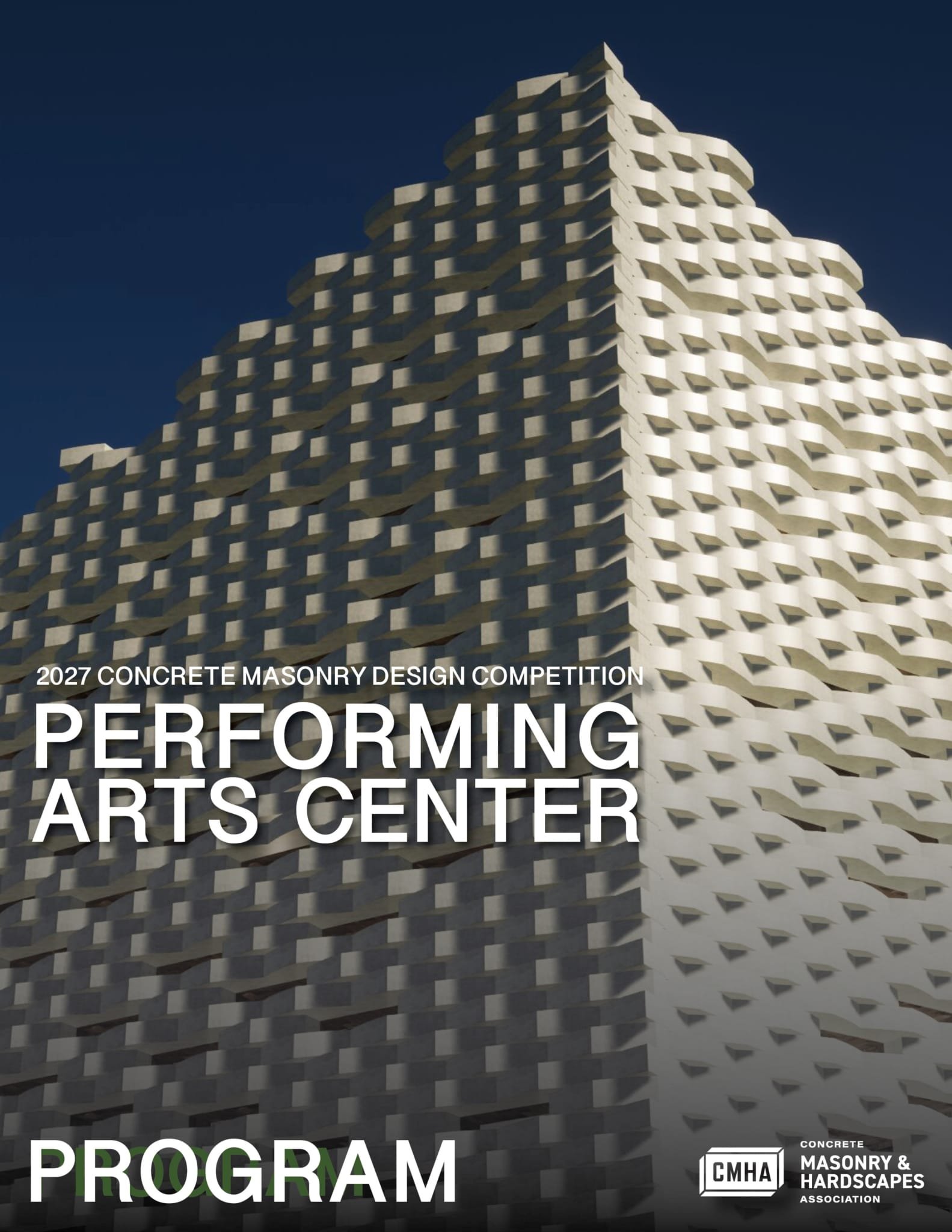
Competition brief
The 2027 Concrete Masonry Competition asks architecture students to design a performing arts center in which concrete masonry units are both the primary structural system and a principal finish material. The brief treats the center as more than a venue: it should combine professional performance, rehearsal, education and public gathering while fitting the fabric of a community chosen by the entrant.
This is a student design competition, not a commission. Eligibility is limited to specified ACSA member-school categories in the United States, Canada and Mexico, and every entry requires a faculty sponsor. The named jury has not yet been published.
Key information
| Organizer | Association of Collegiate Schools of Architecture (ACSA). |
| Eligibility | Students or teams from ACSA Full and Candidate Member Schools, plus ACSA Affiliate Member Schools in the United States, Canada and Mexico; a faculty sponsor is required. |
| Entry fee | None. |
| Registration deadline | 7 April 2027. The official rules do not state a closing hour for registration. |
| Submission deadline | 2 June 2027, 11:59 p.m. Pacific Time — 3 June 2027, 06:59 UTC. |
| Total prize fund | US$20,000 total: student awards of $8,000 / $4,000 / $2,000 and faculty-sponsor awards of $3,000 / $2,000 / $1,000 for first, second and third place. Honorable mentions may also be selected. |
| Sponsor and partner | Concrete Masonry & Hardscapes Association (CMHA). |
| Format | One-stage student ideas competition for a performing arts center; no construction contract is promised. |
| Site | Selected by the student or faculty sponsor and justified in the submission. |
| Team size | Individual or team of up to five students. |
Program and architectural requirements
| Minimum area | 30,000 sq ft. The program may expand where the selected community and site justify it. |
| Core spaces | Public entry and reception, café, flexible outdoor public space, a large performance studio, two medium studios, dressing and lounge facilities, classrooms, administration and production/support spaces. |
| Performance requirement | The large studio must accommodate up to 150 seats and a minimum 20 ft clear height; the two medium studios require a minimum 16 ft clear height. |
| Community role | The proposal should make performance and education more publicly accessible and integrate the center into the surrounding neighborhood. |
| Material system | Concrete masonry must be the primary structural system. The brief permits standard or architectural block, single- or multi-wythe assemblies, CMU backup and compatible dry-cast landscape products. |
| Codes | Use the International Building Code and local zoning for the chosen site; accessibility must respond to the ADA and universal-design principles. |
Submission requirements
| Boards | Four digital boards, each 20 × 30 inches and no more than 20 MB. |
| File formats | BMP, GIF, JPEG, JPG or PNG, uploaded individually through the ACSA competition platform. |
| Written material | A design essay or abstract of up to 300 words, plus a program summary of up to 300 words with interior/exterior spaces and net and gross areas. |
| Required drawings | Site plan with north arrow; floor plans; street and building elevations; site and building sections; three-dimensional representations; large-scale drawings showing concrete-masonry detailing and integrated design. |
| Anonymity | No student, school or faculty-sponsor names may appear on boards, written material, project title or filenames. |
| AI use | Permitted as a tool if students remain accountable; material use must be attributed in the design essay and checked for accuracy, originality and academic integrity. |
| Submission method | Online only. The entry is not complete until the submit action is confirmed by the platform. |
Organizer, jury, rights and implementation
Founded in 1912, ACSA is an association of architecture schools and administers the competition with CMHA. The published brief identifies ACSA as organizer and CMHA as partner and sponsor; it does not identify a public client commissioning a specific building.
| Jury | The organizer states that jurors will select the three prizes and possible honorable mentions, but the reviewed official pages do not yet name the panel or provide individual biographies. |
| Assessment | Innovative use of concrete masonry assemblies; coherent concept; form and aesthetic quality; response to physical and cultural context; sustainability across social, economic and environmental dimensions; human needs and social responsibility. |
| Rights | Entrants warrant originality. The rules state that ACSA may use winning submissions, images and materials in summary publications, online material, promotion and exhibitions, with authorship credited. |
| Costs and refunds | No entry or submission fee is charged, so no fee-refund mechanism applies. Entrants bear their own production costs. |
| Implementation | No construction budget, client appointment or implementation pathway is published. The cash awards recognize competition performance rather than fund construction. |
| Results | Jury convenes in summer 2027; winners are scheduled to be announced in fall 2027. |
✦ ArchUp Competition Review
The brief has a clear pedagogical center: it asks students to connect a demanding cultural program with structural and architectural decisions about concrete masonry. The requirement for large-scale material details is valuable because it discourages treating masonry as a surface graphic detached from assembly and performance.
The 30,000 sq ft minimum and the mix of performance, education and production spaces make this a substantial studio project. Freedom to choose the site creates room for contextual judgment, but it also places responsibility on entrants to demonstrate why their community, access strategy and program scale belong together.
The institution and prize structure are clearly identified, and entry is free. The principal limitations are narrow school-based eligibility, the need for faculty sponsorship and the absence of a named jury at publication. Because this is an ideas competition without a commissioning client, entrants should evaluate it as an academic and portfolio opportunity rather than a route to construction.
Related competitions — Editorial team selection
The 2027 COTE Competition offers a parallel student framework centered on health, sustainability and equity. For another material-led studio brief, see the 2027 Steel Competition. Each has separate eligibility and submission rules.
Time remaining for final submission
The timer tracks the official final-submission deadline: 2 June 2027 at 11:59 p.m. Pacific Time, equivalent to 3 June 2027 at 06:59 UTC. Registration closes separately on 7 April 2027; no registration hour is published.