21th Cosentino Design Challenge

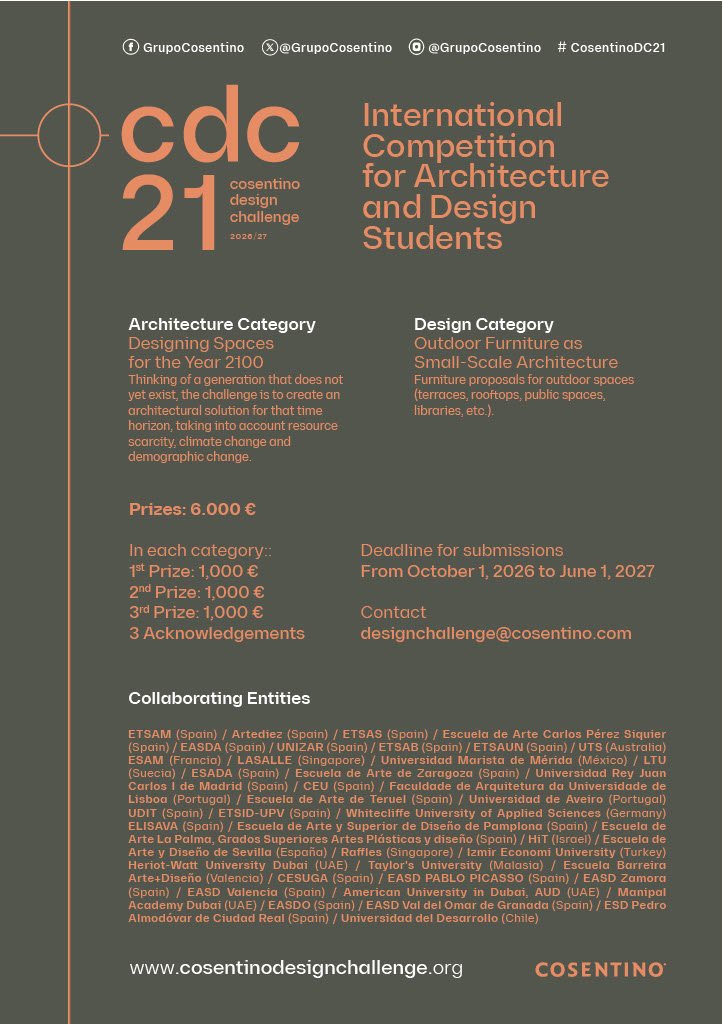
The 21th Cosentino Design Challenge is an international student competition with two parallel categories: architecture and design. The architecture brief asks entrants to imagine spaces for the year 2100 under pressures including resource scarcity, climate change, ageing populations and smaller households. The design category treats outdoor furniture as small-scale architecture.
Important rights notice: awarded entrants grant Cosentino S.A. exclusive exploitation, reproduction, distribution, communication, modification, patentability and other industrial-property rights over their work. The rules also state that winning works and special mentions become Cosentino S.A. property. Entrants should assess this clause before submitting.
Competition overview
| Organizer | Cosentino S.A. / Cosentino Design Challenge |
|---|---|
| Eligibility | Students enrolled in 2026–2027 in architecture, design, interior architecture or a related programme |
| Entry fee | No competition fee is stated; proof of 2026–2027 academic-fee payment may be requested |
| Prizes | Six stated first prizes of EUR 1,000 each (about USD 1,123 each at the ECB reference rate of 21 October 2026); second-prize cash is not specified |
| Registration | No separate pre-registration |
| Submission | 1 June 2027, 23:59; official time zone not stated |
| Language | English required; Spanish may be added |
| Opportunity type | Student ideas competition; no implementation commission is promised |
Brief and design scope
The architecture category, “Designing Spaces for the Year 2100,” is deliberately open in programme and site. Entrants must nevertheless turn the speculative horizon into a buildable spatial proposition. The rules require sections, detailed drawings and assembly instructions, and they ask the proposal to integrate sustainability, landscape and material choices rather than use the year 2100 as imagery alone.
Cosentino products must form a meaningful part of the proposal. Other materials such as timber or glass may be used to a limited extent, while feasible production from flat panels and pieces cut directly from slabs must be considered. Any invented or project-specific material should be identified explicitly.
The parallel design category asks for outdoor furniture for settings such as terraces, rooftops, public spaces and libraries. It is assessed through the same concerns for spatial experience, manufacturability, material research and environmental responsibility.
Eligibility and participation
| Eligible fields | Architecture, design, interior architecture and similar programmes |
|---|---|
| Academic status | Enrolled during the 2026–2027 academic year |
| Geographic scope | International |
| Evidence | The organiser may request proof of payment of academic fees for 2026–2027 |
| Teams | The reviewed rules are written for an individual student and do not clearly state a team-entry mechanism; confirm before preparing a group submission |
Submission requirements
| Deliverable | One DIN A1 presentation panel |
|---|---|
| File | JPG at 300 dpi, submitted electronically through the official online form |
| Orientation | Portrait or landscape |
| Required content | Proposal title; plans, drawings, renderings or photographs needed to explain it; detailed definition of the principal feature; construction plans, assembly details or processes; technical specifications; and identification of the Cosentino products used |
| Anonymity | No personal information or school identification on the panel |
| Language | The proposal title must be in English; English is official and Spanish may be included additionally |
| File limit | No maximum upload size is stated in the reviewed public rules; verify it in the live submission form |
Schedule and awards
| Submissions opened | 1 October 2026, 09:00 |
|---|---|
| Questions period | 1 October 2026 to 1 June 2027 |
| Submission deadline | 1 June 2027, 23:59; time zone not stated |
| Jury deliberation | June 2027 |
| Awards event | Date and location to be communicated to finalists and participating schools |
The rules describe three first prizes and three second prizes in each category, creating six first-prize and six second-prize positions across the programme. They then specify EUR 1,000 for each of the six first prizes but do not publish a cash amount for second prizes. Certificates are stated for winners and special mentions. Entrants should therefore treat only the six EUR 1,000 payments as confirmed cash awards.
Jury and assessment
Named jurors are not published in the reviewed rules. The first online phase uses one teacher representative from each partner school and selects 20 finalists per category. The second phase comprises one recognised architecture, design or industry professional, one Cosentino representative and five professors from partner schools. The composition mixes educational and industry perspectives, although the absence of names limits advance assessment of individual expertise or conflicts.
- Conceptual and technical quality
- Research and analysis of the theme and spatial experience
- Creativity, innovation and environmental responsibility
- Feasibility and adaptation to Cosentino materials
- Graphic and presentational quality
Rights, publication and implementation
Entrants remain identified as authors and retain moral rights. For awarded work, however, the grant to Cosentino is broad and exclusive, extending to modification and industrial-property rights; the rules additionally say winning projects become company property. No construction commission, prototype budget or continuing design appointment is promised. Publication, certificates and an awards event should not be read as additional payment.
The organiser also reserves the right to terminate the competition. The rules do not set out a withdrawal or dispute process for submitted work, and no separate competition fee is announced. Participants should retain copies of their files, confirm upload limits and timing in the live form, and save the completion receipt.
✦ ArchUp Competition Review
The strongest part of this call is the friction between a very distant horizon and a practical material constraint. Requiring details, assembly logic and slab-based production can prevent the architecture category from becoming only futuristic imagery. It also creates a useful studio exercise in connecting resource scenarios to construction decisions.
The main reservation is contractual rather than conceptual. The exclusive rights requested from awarded entrants are extensive relative to the EUR 1,000 first-prize amount, and the rules do not clarify a paid route from an awarded concept to development or fabrication. The unnamed second-stage jurors and unspecified second-prize cash also reduce transparency. Students should enter only after understanding those limits and discussing them with their school where appropriate.
Related competitions — Editors’ selection
For further student and ideas-based design calls, see Persian Garden Suite and Design Circle’s Art Gallery Competition.
Time remaining for submission
Indicative countdown: the official rules state 1 June 2027 at 23:59 but do not name a time zone. This timer assumes the organiser’s Spanish local time (CEST, UTC+2), giving 21:59 UTC. Confirm in the live form and submit early.
Official submission form
Read the official rules, confirm the upload limits and time zone, then submit through the competition’s direct form.