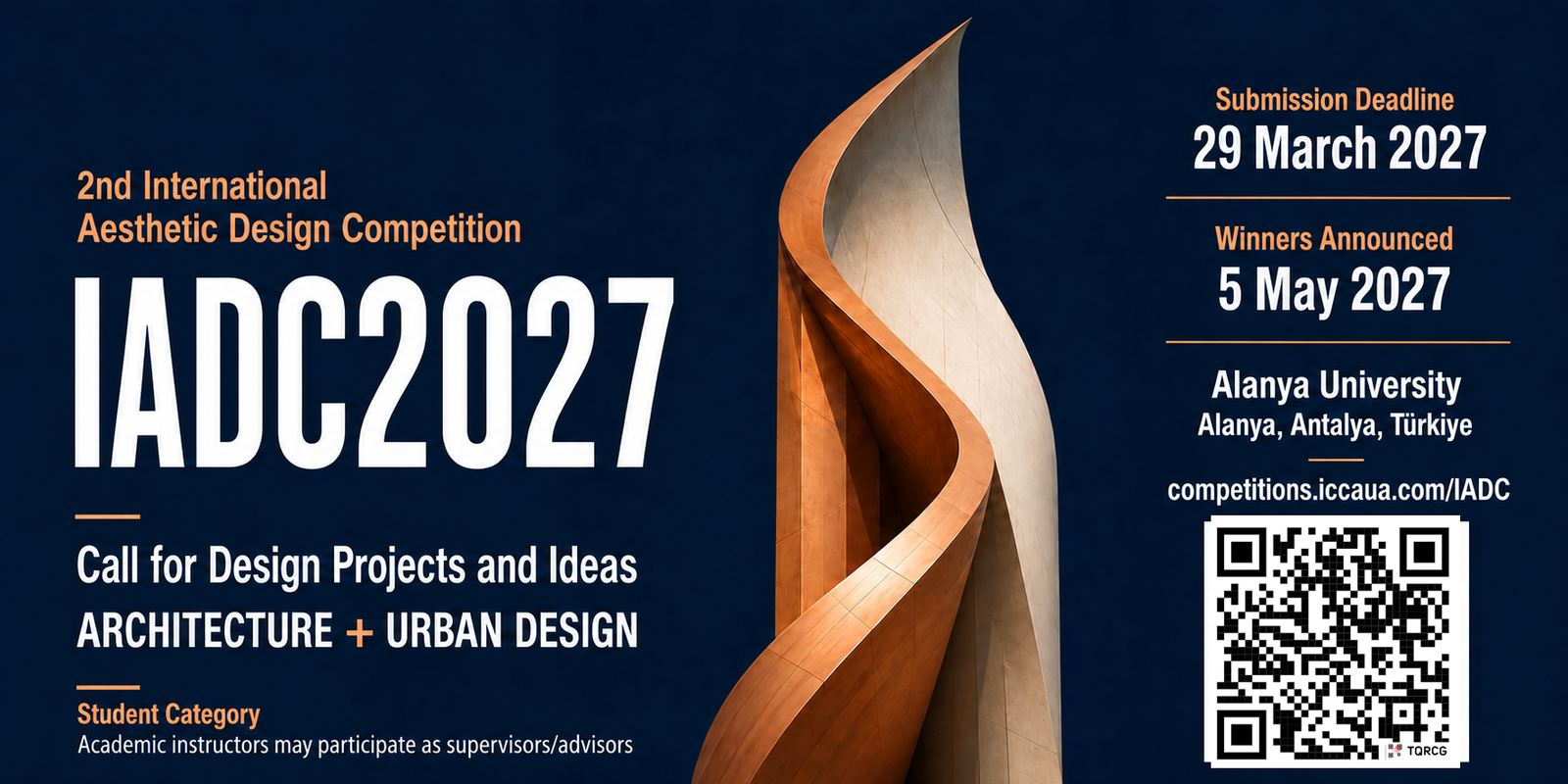
2nd International Aesthetic Design Competition

Brief
The 2nd International Aesthetic Design Competition (IADC2027) invites architecture and urban-design projects from around the world for a single-stage anonymous review. It accepts conceptual, unbuilt and built work and is hosted by the Department of Architecture at Alanya University in Türkiye. Entrants submit an existing or independently developed project rather than design for a prescribed site.
Competition data
| Field | Value |
|---|---|
| Organizer | Department of Architecture, Alanya University, Alanya, Antalya, Türkiye. |
| Registration deadline | 29 March 2027, together with final project submission. The official site does not publish a closing hour or time zone. |
| Submission deadline | 29 March 2027. Registration, payment and submission must all be complete. |
| Entry fee | EUR 25 per project until 28 February 2027 (approximately USD 28); EUR 70 from 1 March 2027 (approximately USD 78). Conversions use the ECB reference rate of 1 EUR = 1.1181 USD published 12 October 2026. |
| Total prize fund | EUR 800 (approximately USD 894 at the same 12 October 2026 ECB rate): EUR 400 first, EUR 300 second and EUR 100 third. |
| Eligibility | Students may enter individually or in teams of up to four, with academic instructors as supervisors or advisers. A separate eligibility clause also permits teams where at least one member is studying or holds a degree in a relevant built-environment discipline. |
| Competition type | International, single-stage, anonymous awards for architecture and urban design; no project commission or implementation is announced. |
The official material contains an eligibility tension: the overview calls IADC2027 exclusively a Student Category, while the detailed rule allows a team member who either studies or already holds a relevant degree. Entrants who are not current students should obtain written confirmation from the organiser before paying. The public deadline also omits its hour and time zone.
Purpose, classifications and project scope
The theme, “Aesthetic Design Ideas for a Better World,” treats aesthetics as part of spatial quality, cultural identity, environmental performance, contextual integration and human experience. Entrants choose either ARCHITECTURE, covering building and interior projects, adaptive reuse, renovation and envelope work, or URBAN DESIGN, covering public space, neighbourhoods, waterfronts, regeneration and other urban-scale interventions. There is no set site, scale, floor area or building height.
Submission requirements
| Component | Published requirement |
|---|---|
| Project description | Maximum 200 words in English, submitted as Microsoft Word .doc or .docx. |
| Project poster | One A2 horizontal poster, 42 × 59.4 cm, PDF, maximum 20 MB, in English. |
| Poster content | Project title at the top; drawings, plans, sections, elevations, images, diagrams and short explanatory text may be used. |
| Template area | The registration-number area at the bottom right of the official template must remain unchanged and blank for administration. |
| Anonymity | No participant, team, university, company, logo, photograph, email, social account or other identifying information may appear on the jury poster. |
| Payment evidence | The payment receipt is a third compulsory upload. One registration and fee are required for each project. |
| Method | Online through the official IADC submission system; email and file-transfer submissions are not accepted. |
| AI disclosure | Substantial use of generative AI should identify the tool, purpose, stage of use and affected material; unedited AI output cannot replace human design authorship. |
Organizer and programme record
Alanya University’s Department of Architecture hosts the competition through the IADC platform. The official name identifies this as the second edition. The current rules provide for an ISBN competition book, online exhibition and permanent archive; ArchUp did not infer institutional age from the website domain and did not expand this review into a separate search of past editions.
Jury and evaluation
| Jury member | Published affiliation |
|---|---|
| Prof. Dr. José Manuel Pagés Madrigal | Department of Architecture, BAU Cyprus University, Lefkosa, TRNC. |
| Prof. Dr. Luis Moreira Pinto | CITAD Research Center, Lusiada University of Lisbon, Portugal. |
| Prof. Islam Hamdi El Ghonaimy | University of Bahrain, Bahrain. |
| Dr. Aykut Karaman | MSGSU / Altınbaş University, Istanbul, Türkiye. |
| Prof. Ana Paula Parreira Correia Rainha | University of Beira Interior, Department of Civil Engineering and Architecture, Portugal. |
| Dr. Husam R. Husain | Architecture and Urban Design Program, German University in Cairo, Egypt. |
The published jury is predominantly academic and directly connected to architecture, civil engineering and urban design. The recommended scoring weights are: aesthetic excellence and visual quality 30%; creativity and design innovation 15%; conceptual strength and coherence 15%; cultural and contextual relevance 10%; spatial quality and functionality 10%; environmental responsibility and sustainability 10%; feasibility and resolution 5%; communication and presentation 5%.
Awards, fees, rights and conditions
The three cash awards total EUR 800. Up to 30 additional projects may receive special-mention or shortlisted recognition across the two classifications, with certificates, publication in the ISBN book and permanent web presentation. All eligible participants completing the process receive a participation certificate. Fees are non-refundable after formal submission, except if the organisers cancel the competition. Participants retain copyright and authorship, while granting IADC a worldwide, royalty-free, non-exclusive licence for competition results, publication, exhibitions, archives and future IADC promotion. Taxes on prizes are not specified.
✦ ArchUp Competition Review
IADC2027 is unusually flexible about site, scale and project status, making it suitable for adapting a strong academic studio, thesis, built project or speculative proposal. The low early fee and explicit scoring matrix reduce some uncertainty, while the one-poster limit requires a disciplined selection of evidence.
The main reservation is the inconsistent eligibility wording between the Student Category statement and the degree-holder clause. This matters before payment, especially for graduates entering without a currently enrolled student. The prize fund is modest relative to the publication and certificate structure, so the opportunity is best assessed for academic portfolio value rather than as a route to implementation.
Reviewed on 13 October 2026 against the organiser’s official overview, rules, jury, awards, dates and fee pages.
Related competitions — Editorial team selection
For other routes to present completed or unbuilt work, see the AIANY Design Awards and the Unbuilt Award 2027.
Indicative time remaining
Official date: 29 March 2027. The organiser does not publish a closing hour or time zone; the timer assumes 23:59 UTC solely as an end-of-day reference.
Official competition and submission
Review the rules, download the template and register the project through the official platform.