
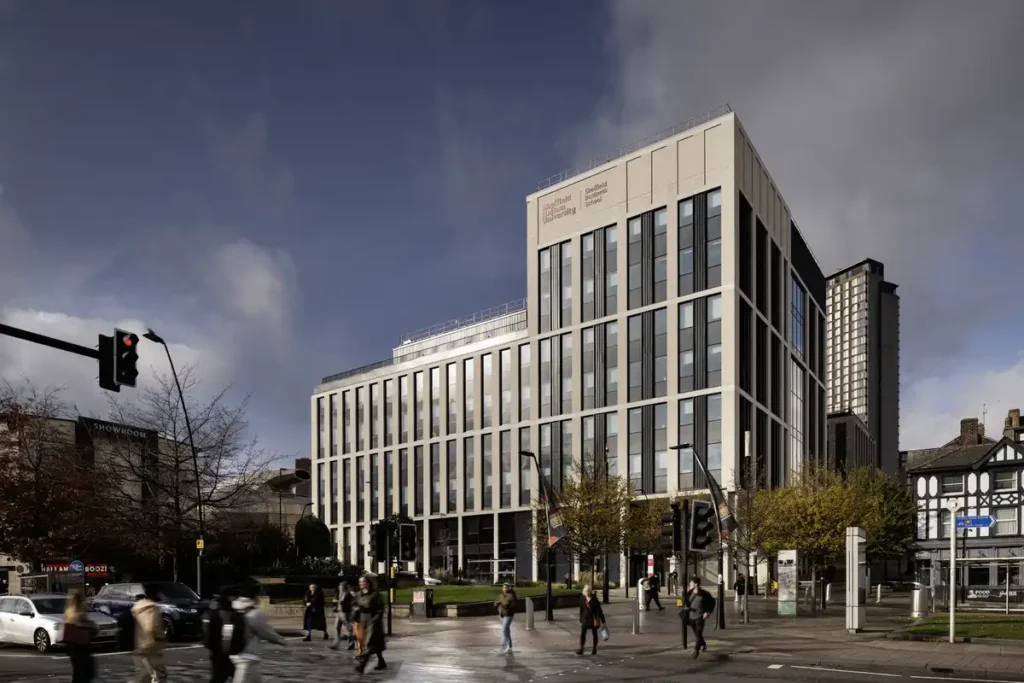
Completion of three buildings exemplifying the concept of academic architecture at Sheffield Hallam campus in the UK

Academic architecture in the Langsett, Redmires and Strines complex at Sheffield Hallam University represents a new approach in architectural design that integrates education, research, and public life in Sheffield. The project embodies a contemporary campus model that bridges the academic institution with the city, reflecting a shift in expectations for academic architecture within urban and planning contexts.

Design Concept
Langsett, Redmires and Strines function as both academic facilities and civic spaces. Langsett hosts the Sheffield Business School, featuring a trading floor and business engagement zone. Redmires serves social sciences, architecture, and law, with a moot court and legal clinic. Strines supports the South Yorkshire Institute of Technology through VR/AR and robotics studios. Flexible layouts promote interdisciplinary collaboration, aligning with modern interior design principles.

Materials & Construction
Delivered via the Hallam Alliance, the project united BDP, ARUP, BAM, and CBRE under one framework. This model streamlined construction and long term operations. Structures use reinforced concrete and steel for durability. Glazed and precast facades balance daylight and thermal efficiency. Hallam Green integrates landscape and public art, blurring boundaries between institutional and civic buildings.
Sustainability & Urban Impact
All buildings are net zero ready, supporting the university’s environmental goals and global sustainability standards. Hallam Green boosts biodiversity with native planting and communal seating. A new pedestrian route links Sheffield Station to the city center. This enhances accessibility and strengthens the campus’s role in urban life across cities.
Conclusion
The project redefines the university’s civic presence. Can such models inspire other institutions to merge academic and public realms more effectively?
Architectural Snapshot: Three net zero ready academic buildings in Sheffield, UK, designed by BDP Architects, unify education, public space, and urban connectivity.

✦ ArchUp Editorial Insight
The Langsett, Redmires and Strines coverage presents Sheffield Hallam’s trio of net zero ready buildings as a civic-educational fusion, framed through the Hallam Alliance narrative. The text dutifully catalogs programmatic allocations trading floors, moot courts, VR studios yet reads more like a press release than critical architecture journalism. It avoids probing questions about equity, maintenance burdens, or the real world performance of net zero claims. Still, credit goes to the precise functional breakdown per building, rare in institutional reporting. This piece may survive only as a time capsule of 2025’s architectural optimism, not as enduring analysis.