ACRP University Design Competition

Brief
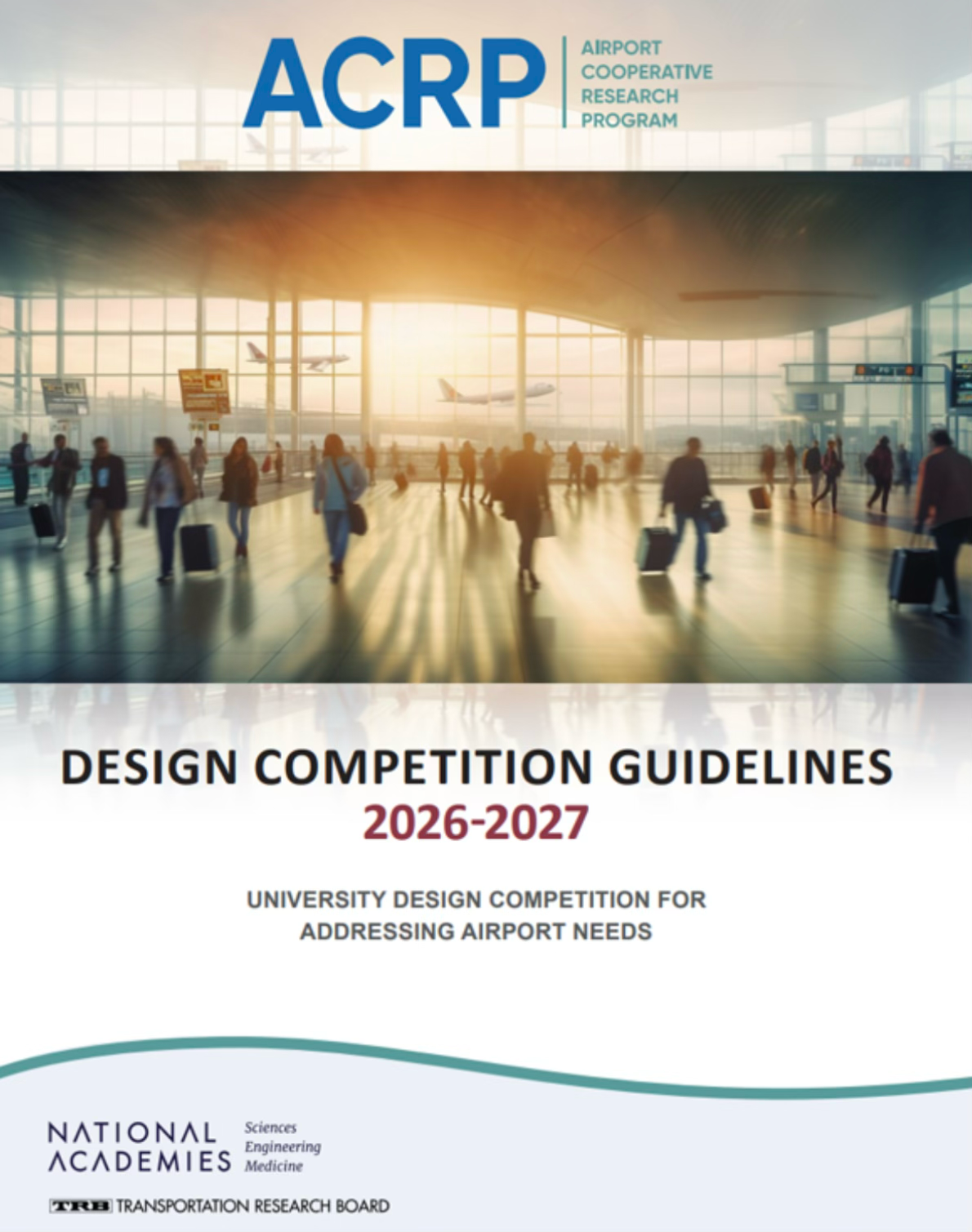
ACRP University Design Competition is a U.S. national university challenge for practical, research-led responses to airport and National Airspace System needs. It is sponsored by the Airport Cooperative Research Program, funded by the Federal Aviation Administration and managed by the Transportation Research Board of the National Academies of Sciences, Engineering, and Medicine.
Purpose and design scope
| Item | Published terms |
|---|---|
| Competition type | National student design competition for accredited U.S. colleges and universities. |
| Airport Safety, Operations and Maintenance | Solutions addressing airfield safety, maintenance, runway and taxiway risks, closures, routing and operational efficiency. |
| Passenger Experience and Terminal Design | Cost-conscious improvements to layouts, operations, technology and passenger experience, including solutions that optimise existing infrastructure. |
| Airport Environmental Interactions | Approaches that increase community benefits or reduce traffic, noise, emissions, waste, public-health and wildlife impacts. |
| Airport Management and Planning | Planning and management responses to demand, new aircraft, new technologies, congestion, capacity and future service needs. |
| Topic flexibility | Teams may answer a listed technical challenge or define another topic that fits one of the four broad areas. |
Eligibility and participation
The competition is open to undergraduate and graduate students enrolled for at least one term during the 2026–2027 academic year at an accredited U.S. college or university. Entries may be individual or team-based, but every entry must work with a faculty advisor. An optional Expression of Interest can be submitted before the final deadline so ACRP can help connect teams with airport operators or expert advisors.
This is not an international open call: students outside accredited U.S. colleges and universities are not independently eligible. Projects receiving direct FAA funding may not enter as part of that funded activity.
Submission requirements
| Component | Required specification |
|---|---|
| Main report | No more than 40 pages, excluding required Appendices A–F. |
| Report structure | Cover page; one-page executive summary; contents; problem statement and background; literature review; problem-solving approach; safety risk assessment; practicality and feasibility. |
| Design evidence | Drawings, mock-ups, computer code and other appropriate evidence. Links or QR codes to original videos, websites or apps may be included. |
| Industry engagement | Documented interaction with airport operators and industry experts is required, including feedback received. |
| Financial analysis | A realistic cost-benefit discussion, commercial potential, practicality and the steps needed to reach implementation. |
| Appendices | Contacts; institution profile; contacted operators and experts; faculty and department sign-off; educational evaluation; full references. |
| File format | One PDF, double-spaced and single-sided, with minimum 12-point Times New Roman or Helvetica; captions and charts may use 10-point type. Pages and sections must be numbered and bookmarked. |
| Submission method | Upload through the official ACRP Academic portal, with the corresponding student author and primary faculty advisor details. |
Schedule
| Stage | Official time | UTC |
|---|---|---|
| Expression of Interest | Open and encouraged; it may be submitted until the final deadline. | No separate closing time. |
| Final submission | 15 May 2027, 5:00 p.m. EDT | 15 May 2027, 21:00 UTC |
| Award presentation | Date to be determined. | Not yet announced. |
Fees and awards
| Item | Published terms |
|---|---|
| Entry fee | No entry fee is stated in the official 2026–2027 guidelines. |
| First place | USD 3,000 in each of the four technical challenge areas. |
| Second place | USD 2,000 in each area. |
| Third place | USD 1,000 in each area. |
| First-place presentation | Representatives are invited to present at a national award ceremony and an appropriate partner workshop or conference. Travel support is provided for at least three people, including one faculty advisor and two to three students. |
| Team awards | The cash award is shared equally among student team members. |
Assessment and reviewers
The published rubric totals 130 points: 46 for the problem-solving approach, 20 for practicality and feasibility, 16 for overall package quality, 14 for innovation, 11 for the literature review, 10 for the problem statement and background, 8 for safety risk assessment and 5 for the opening sections. The organiser does not publish a named jury in advance. ACRP states that partner organisations supply expert advisors and participate in design reviews, including AAAE, ACC, ACI-NA, NASAO and the University Aviation Association.
Organiser and published limits
ACRP is an applied-research programme addressing shared airport problems not adequately covered by other federal programmes. The current guidelines explain eligibility, submission, evaluation and awards, but do not set out a detailed public copyright or licensing clause for submitted designs. Entrants with commercially sensitive inventions should therefore seek written clarification before disclosing protectable material.
✦ ArchUp Competition Review
This competition asks for more than an architectural image. Its heaviest scoring weight falls on the problem-solving process, while feasibility, safety, evidence and cost-benefit analysis are integral to the proposal. For architecture and planning students, the terminal-design and airport-management tracks are the clearest points of entry; engineering, environmental and operational disciplines can work across all four areas.
The institutional framework, long preparation period and access to airport practitioners are meaningful strengths. The trade-off is workload: a 40-page report plus six appendices, literature review, safety assessment and documented industry engagement resembles a substantial academic research project. Eligibility is also narrow, and a named review panel is not available in advance. Teams should treat the prize as recognition for a rigorous semester-scale investigation rather than compensation for the full effort.
Reviewed on 10 October 2026 against the official ACRP competition page, academic portal and 2026–2027 design guidelines.
Related competitions — Editorial team selection
Students comparing research-led design briefs may also review the 2027 Steel Competition and the 2027 COTE Competition, both of which place academic supervision and evidence-based design at the centre of participation.
Time remaining for submission
15 May 2027 · 21:00 UTC.
Competition page
Read the current guidelines and submit through the official academic portal.