The Drain Ends Above the Pavement. Why Is the Walkway Always Wet?

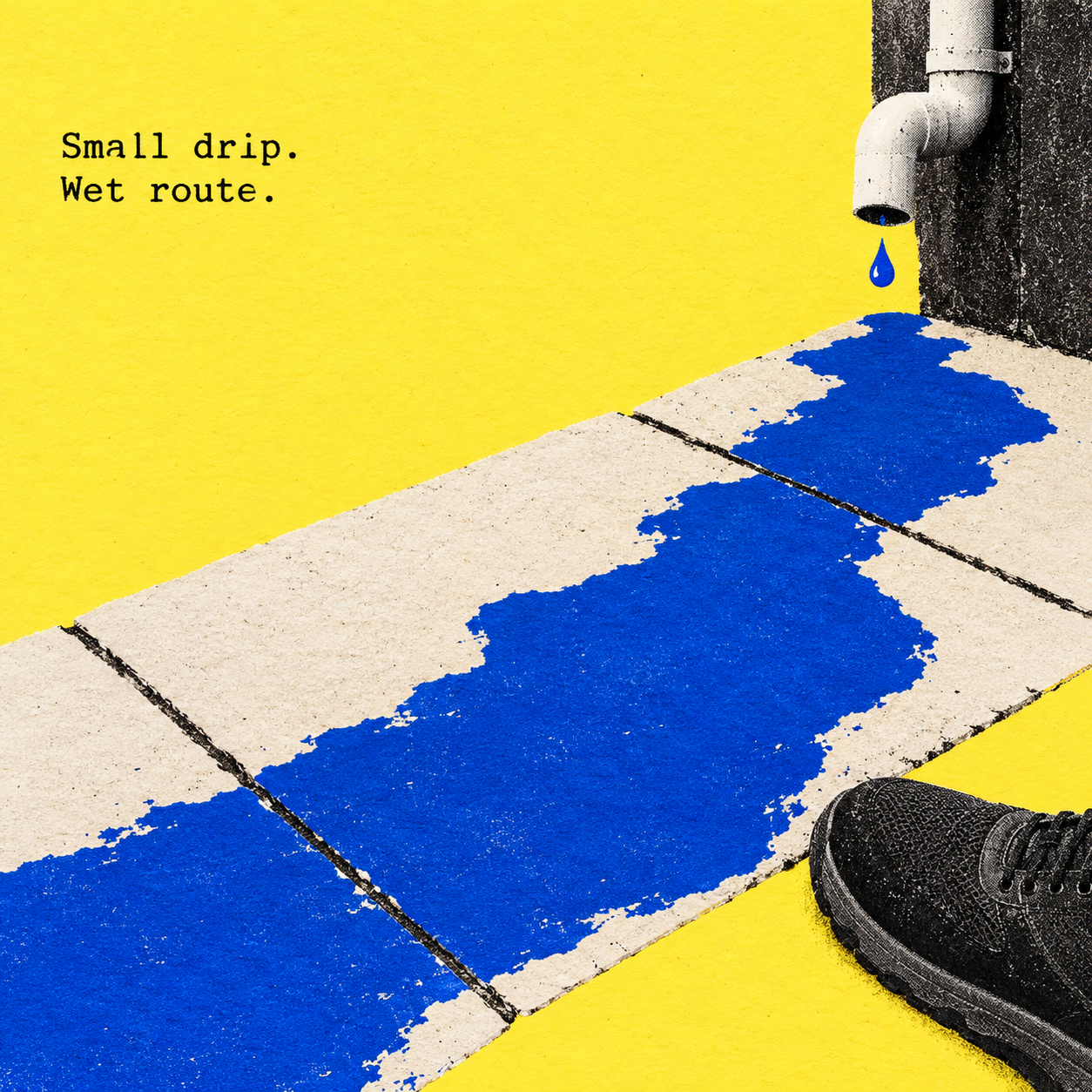
Air-conditioning condensate, surface wetting and the difference between a dry specification and a wet walking route.
A small condensate pipe can end a few centimetres above a pavement and still alter the performance of an entire pedestrian strip. On the drawing, the mechanical system drains and the paving material remains unchanged. In use, however, a recurring patch of water turns a surface specified under one condition into a surface operating under another.
This research connects an experimental study of ceramic-tile slip resistance with a biomechanics study of human walking. Neither study examined air-conditioning condensate. The architectural application developed here is therefore an explicit inference: if a drain repeatedly wets a circulation surface, its endpoint should be treated as part of walkway design, not as an isolated mechanical detail.
What the material experiment tested
Ewa Sudoł, Marcin Małek, Mateusz Jackowski, Marcin Czarnecki and Cezary Strąk tested six ceramic tile products with different surface finishes. Their 2021 study used three methods: a pendulum test, a barefoot ramp test and a sliding-friction test. Samples were assessed in dry and wet conditions, with repeated measurements rather than a single visual judgement.
The result was not simply that rough tiles were safe and smooth tiles unsafe. All six products performed as low slip risk in the dry pendulum test, but only two retained that classification when wet. Across the samples, dry pendulum values were about 1.5 to 5.4 times their wet values. One polished, unglazed product changed from a sliding-friction coefficient of 0.95 to 0.15 with a rubber slider. Yet the researchers found no clear general correlation between average surface roughness and slip resistance. Finish geometry, wetting and the test method interacted.
This matters architecturally because a product label or a tactile impression cannot substitute for performance under the condition that the detail will actually create.
What gait research adds
James P. Hanson, Mark S. Redfern and Mainak Mazumdar approached slipping from the body rather than the tile. Five harnessed participants walked on tile and carpet ramps at different inclinations under dry, wet and soapy conditions. Force measurements and high-speed video distinguished normal steps, recoverable slips and falls.
Their model compared the friction required by a step with the friction available at the shoe-floor interface. Slip and fall events increased as required friction exceeded available friction. The useful idea for design is a margin, not a universal magic number: safety depends on the interaction among surface, contaminant, footwear, gait and slope.
The experiment was small and controlled. It does not predict the probability that a particular condensate stain will cause a fall, and it does not represent every age, disability, shoe or walking speed. It does explain why the same wet patch can be tolerated by one pedestrian and hazardous to another.
Condensate is a recurring operating condition
Rain is intermittent and usually affects a broad area. Condensate can be narrow, persistent and located exactly where a pipe terminates. Its significance is not the volume alone. A small flow may repeatedly occupy the same route, keep joints damp, collect dust, encourage staining or biological growth, and remain present when the rest of the pavement is dry.
ArchUp is not claiming that every visible condensate outlet is unlawful or unsafe. Codes, climate, system type and approved disposal points vary. The design question is narrower: does the outlet create a predictable wet condition on a path that people are expected to use?
Design the endpoint, not only the pipe
A coordinated drawing should identify the final receiving condition. Depending on local rules and project constraints, the response may be connection to an approved drain, routing to a planted or collection area, a trapped receptor, a properly detailed channel, or another maintained disposal point. The choice must be checked by the mechanical, plumbing, civil, landscape and architectural teams rather than assumed by one discipline.
- Map the outlet against the actual pedestrian desire line, door swing, ramp, kerb cut and service route.
- Specify and test paving for the expected wet condition, not only its dry appearance.
- Check falls and crossfalls so water does not migrate across the accessible route.
- Keep the outlet and receiving point visible and reachable for cleaning without placing maintenance work in the walking line.
- Inspect the installed endpoint during commissioning while the unit is producing condensate.
How the proposal can be verified
Verification should happen at three scales. First, review the coordinated drawings to confirm where the water is permitted to go. Second, run the equipment and observe the real wet footprint, including overflow, wind and surface slope. Third, assess slip resistance using a method appropriate to the installed material and expected contamination. The 2021 study itself recommends more than one method because different tests did not produce interchangeable classifications.
The evidence supports treating wetness as a material state and friction as an interaction. It does not establish a universal separation distance between a condensate outlet and a pavement, nor does it prove that every recurring wet patch will cause a fall. Those values require local standards, field conditions and project-specific testing.
✦ ArchUp Editorial Insight
The non-architectural pressure begins with coordination economy: a condensate line must be routed, its endpoint appears minor, and responsibility is easily divided among mechanical, plumbing, civil, landscape and architectural packages. Under schedule pressure, each package can be technically complete while the receiving surface remains ownerless. Procurement reinforces the split when equipment performance is accepted independently from the pavement condition it creates. The resulting risk is transferred forward: the installer leaves after commissioning, while cleaners, facility managers and pedestrians encounter the recurring wet patch. The research does not prove that this contractual pattern causes falls; it supports a narrower governance hypothesis—that acceptance should test the interface between discharge and circulation, not each component alone. A close parallel appears in the gap between fitting charging equipment and preserving usable access: the object passes its own dimensional test while the human route absorbs the unresolved consequence. For condensate, a commissioning photograph of the pipe is therefore weak evidence. Running the unit, tracing the water and testing the wet walking surface would move approval from component presence to operational performance. The architecture at stake is the small damp strip produced after every drawing package has declared itself finished.
Prepared by ArchUp Research Lab.
Correction — 11 October 2026: Removed an outdated note stating that the editorial image was awaiting preparation; the image is already attached. — ArchUp Editorial Committee
References
- Sudoł, E., Małek, M., Jackowski, M., Czarnecki, M. and Strąk, C. “What Makes a Floor Slippery? A Brief Experimental Study of Ceramic Tiles Slip Resistance Depending on Their Properties and Surface Conditions.” Materials, 2021.
- Hanson, J. P., Redfern, M. S. and Mazumdar, M. “Predicting Slips and Falls Considering Required and Available Friction.” Ergonomics, 1999.