Anjung Project: Massing, Space, and Climate Adaptation


Deconstructing Massing and Its Relationship to Spatial Structure
The architectural composition of the Anjung project emerges through an experimental approach that re-examines the relationship between architectural massing and site. The project is expressed as two clearly defined functional volumes: a retreat house and a working studio, positioned in direct response to the site’s topographical characteristics and the surrounding natural movement patterns.
The positioning strategy is strongly influenced by the site’s low elevation, high groundwater level, and seasonal flood risk. This led to locating the building masses along the higher eastern edge of the site, close to the main access route. This orientation not only addresses environmental constraints but also redefines the entry experience, transforming the transition from exterior to interior into a gradual sequence that reveals the rear garden through a carefully calibrated visual and sensory progression.
Human Experience and Biophilic Interaction with the Environment
The spatial experience is grounded in a direct interaction between the user and the site’s existing natural elements. The project preserves the original vegetation, including oil palm trees, native species, and bamboo groves, treating them as an integral structural component of the architectural experience rather than a mere backdrop.
This vegetative system generates dynamically shifting shadows that intersect with architectural surfaces throughout the day, continuously reshaping the perception of materiality and space. Air movement through the bamboo groves and the openness of interior spaces toward the garden enhance a sensory condition tied to humidity, shade, and motion, integrating the building into a living ecosystem and transforming it into a mediator between human presence and the surrounding climate.
| Field | Value |
|---|---|
| Architects | Eleena Jamil Architect |
| Area | 565 m² |
| Year | 2026 |
| Photographs | Zakee Man |
| Category | Houses, Offices |
| City | Selangor |
| Country | Malaysia |

Transitional Spaces and the Reinterpretation of Vernacular Architecture
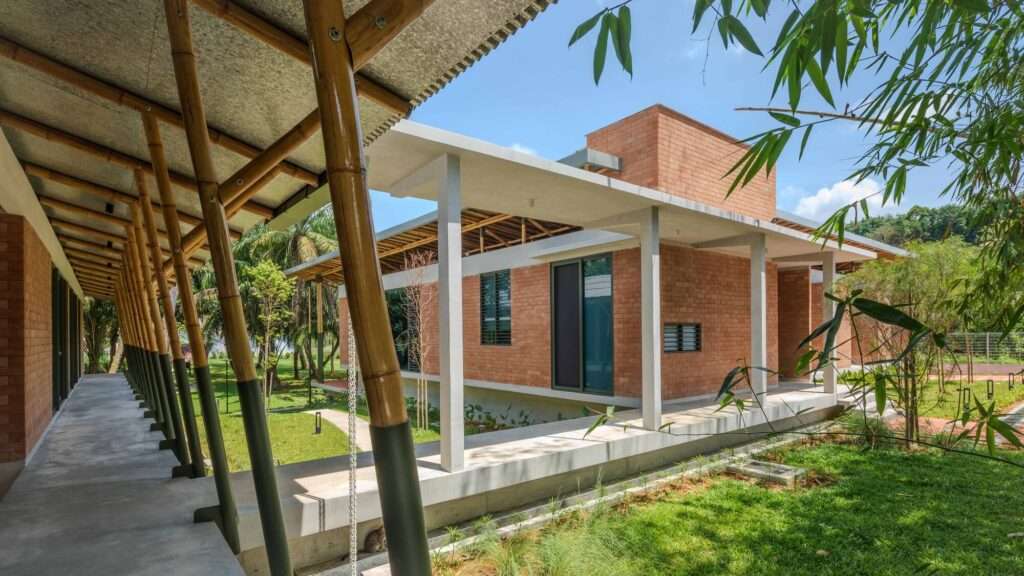
The project reinterprets the concept of transitional space in vernacular architecture known as “Anjung” as a mediating structure that goes beyond being a mere auxiliary space. This element becomes an organizing spatial axis that connects interior and exterior conditions in both the house and the studio.
The design extends semi-outdoor spaces through shaded surfaces and structural roof overhangs, dissolving rigid boundaries between inside and outside. This produces a mode of inhabitation based on spatial gradation rather than binary separation, where daily movement merges with the natural environment in a continuous spatial experience that enables airflow and uninterrupted visual connection with the surroundings.
Material Sustainability and the Spatial Impact of Massing
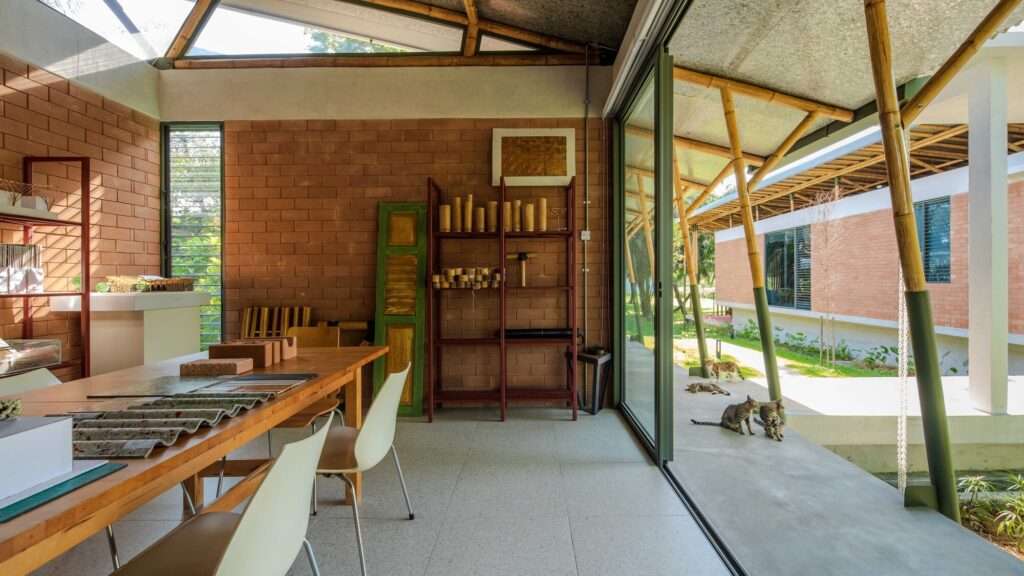
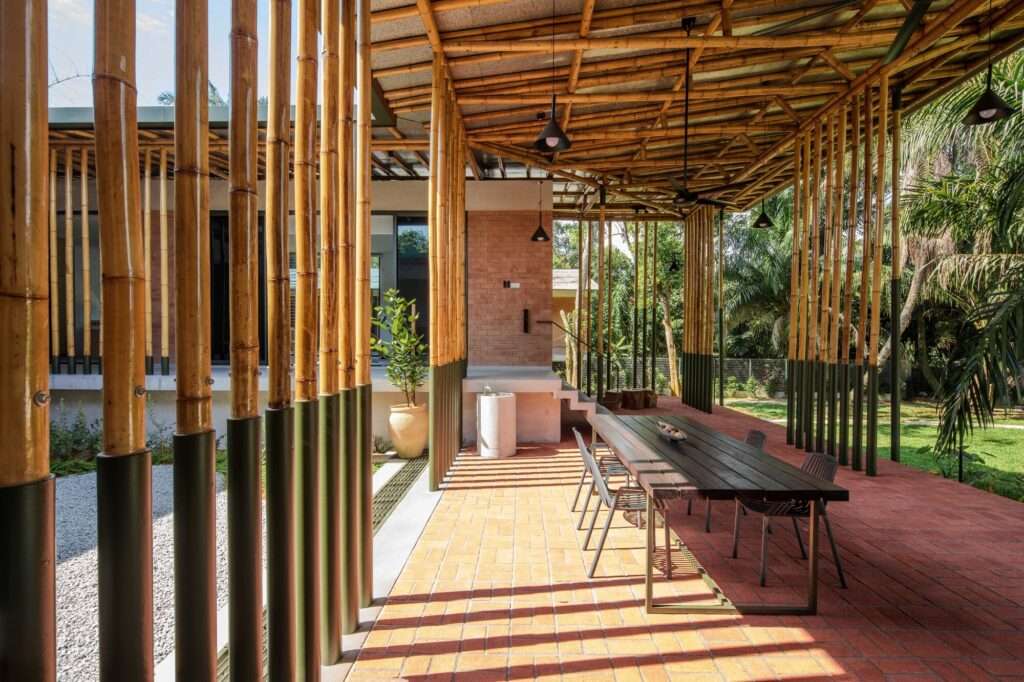
The project explores climatic design strategies based on the use of low-carbon local materials while maintaining spatial quality. Bamboo culms are used in their natural state to form the roof structure, giving the space an organic character that responds to light and shadow movement.
This system is complemented by Building Materials such as compressed earth block (CEB) walls that provide a clear thermal and visual mass, while recycled food packaging materials are used in roofing components to enhance the project’s environmental dimension. This layering of materials creates a balanced structural system that merges lightness and mass, climatic performance and material expression.
Spatial Analysis and Massing Geometry
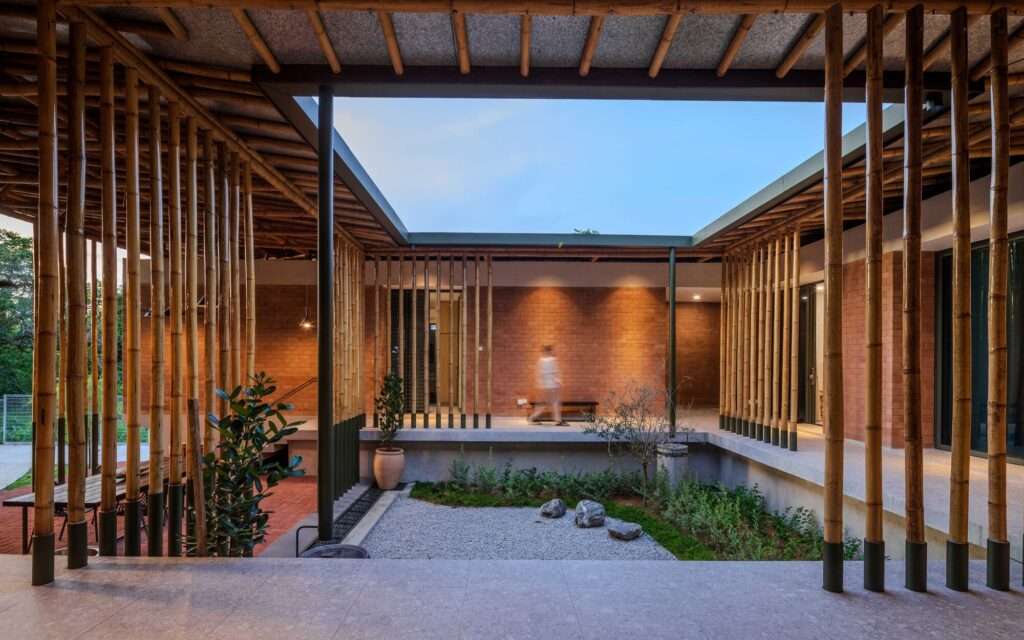
The house design follows a square-based geometric organization, with functions arranged around a central courtyard that acts as the climatic and visual core of the building. Access is mediated through a transitional veranda that enhances the gradation of privacy between exterior and interior.
On the western side, a lowered veranda extends 1.5 meters in response to the site’s topography, becoming an open social space directly connected to the garden and reinforcing the relationship with the ground. Interior spaces follow a linear organization with wide openings toward the courtyard and garden, enhancing natural lighting and cross ventilation.
The roof is composed of single-slope bamboo trusses oriented toward the courtyard, channeling rainwater into designated collection tanks. The building terraces are supported by bamboo columns arranged in a rhythm that evokes the density of the surrounding vegetation and achieves integration between structural system and landscape.
Scenographic Interaction and Light Dynamics in the Studio
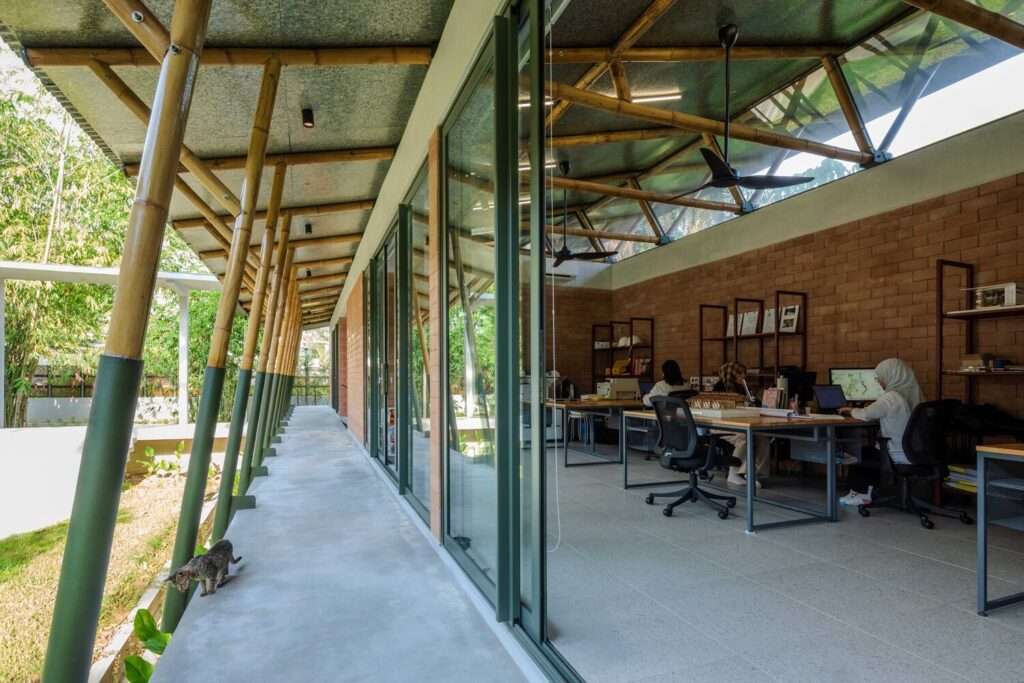
The studio adopts a linear configuration divided into a working volume and a second volume for meetings and workshop activities, connected by a shaded northern circulation corridor formed by low roof overhangs.
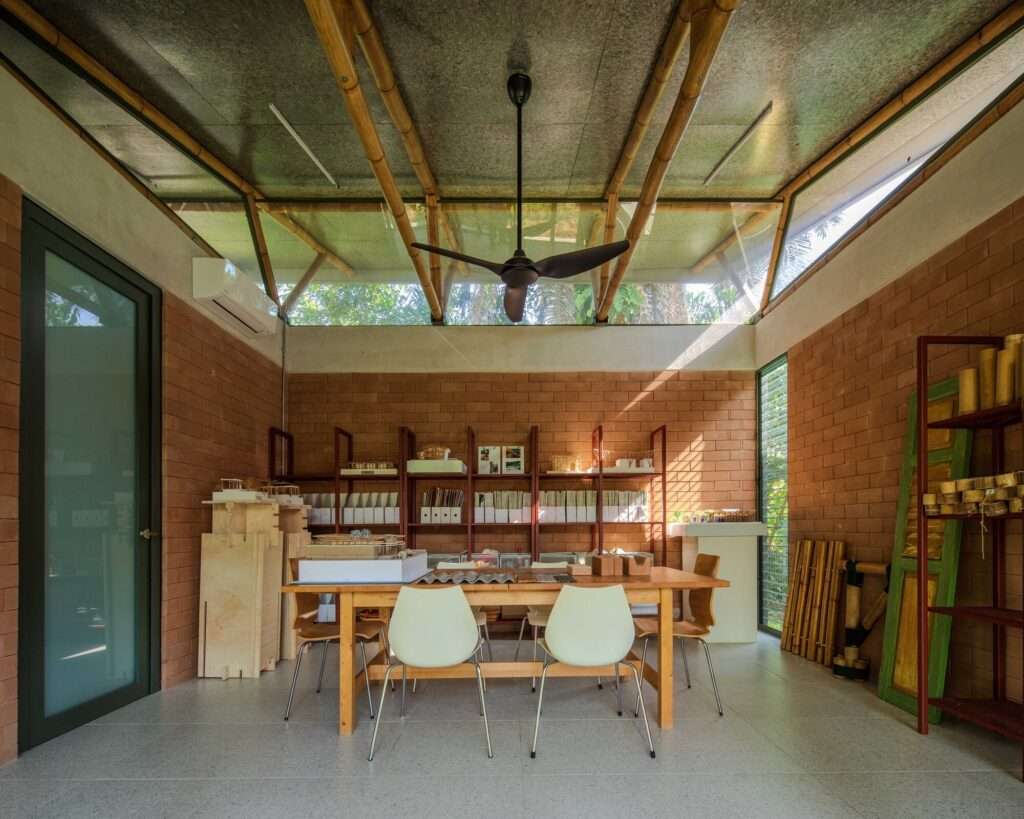
The bamboo structure is left fully exposed, emphasizing the logic of the structural system and transforming constructional details into a visual experience. Lighting is mediated through northern clerestory openings and southern sliding glass façades, creating a balance between diffuse and direct light within the space.
The environmental system is further enhanced through high-level ventilation openings that allow hot air to escape and promote cross ventilation. This maintains natural thermal stability and makes the space highly responsive to daily climatic variations.

Architectural Intertextuality and the Reorientation of Construction Practices
The design of the studio is grounded in an epistemological extension of an earlier experiment developed by the office in the Bamboo Classroom project in the Philippines, where elements such as deep roof overhangs and naturally ventilated clerestory openings are re-employed as devices that merge climatic performance with spatial expression. These elements are not treated merely as technical solutions, but as part of a formal language that responds directly to the specificity of climatic and spatial context.
Within a local context heavily dependent on high-carbon construction practices such as reinforced concrete, fired brick, and concrete tiles, the project proposes an alternative approach that redirects construction effort toward low-energy building systems. This approach is based on rethinking construction itself as an environmentally conscious practice aimed at reducing emissions embedded in conventional production chains.
Earth Block Materiality and Structural Integration with Bamboo
Compressed Earth Blocks (CEBs), made from local laterite soil, are used as a sustainable structural solution. They are produced through compaction and natural drying with limited cement content, significantly reducing carbon footprint compared to fired Building Materials.
These walls function as load-bearing elements, reducing reliance on conventional concrete frameworks, while their unfinished surface allows a direct reading of the soil’s material, visual, and thermal qualities. This system is integrated with perimeter concrete beams that form a stable base for bamboo trusses, where timber elements are connected to concrete through engineered metal joints designed to withstand structural stresses and wind loads, achieving a balance between bamboo’s flexibility and the rigidity of the construction systems.
Tectonic Detailing and the Material Language of Surfaces and Furniture
The precision of structural solutions is reflected in the treatment of material junctions, where the ends of bamboo columns are fixed into steel sleeves at terraces and verandas. These act as protective shoes that prevent moisture penetration while ensuring continuity with the ground slab.
Bamboo is used in its natural state without intensive industrial treatment, preserving its material identity and minimizing environmental impact. On interior surfaces, panels made from recycled food packaging are thermally compressed to produce a material with a layered visual texture, adding a sensory dimension related to the perception of light and color within the space.
This material logic extends to the furniture, where timber salvaged from the site is reused to produce tables and seating elements supported by local bamboo components, alongside worktables made from rubber wood. This reinforces material continuity within a closed-loop system of reuse.
Spatial Function and Future Operational Scenarios
Activities within the project are organized according to a dual model combining private and productive use. The house currently operates as a residential space with limited hosting for family and friends, with the potential to evolve into a platform for short-term residencies, workshops, and architectural events, reinforcing its nature as an educational and experimental environment.
In contrast, the studio functions as an active productive space combining work, exhibition, and visitor interaction, transforming the project from a conventional residential structure into a flexible architectural system that reflects how architecture adapts to local context and responds directly to physical and climatic conditions.
✦ ArchUp Editorial Insight
The Anjung project is presented as a recalibration of the relationship between residential and productive massing within a flood-sensitive terrain, where site response is used to organize a dual distribution of functions on elevated ground. The concept of the threshold is transformed into a climatic and organizational device, employing bamboo, compressed earth blocks, and recycled materials within a porous spatial system aligned with contemporary debates in environmental architecture and the redefinition of spatial performance.
However, a critical reading reveals that this material discourse tends to overestimate its own replicability. Bamboo and compressed earth systems rely on craftsmanship and climatic maintenance conditions that are not easily transferable, while carbon performance is not fixed but dependent on cement ratios and transportation networks. In practical terms, the project becomes more of a limited experimental prototype than a scalable architectural model within a broader framework of evaluating the real-world applicability of sustainable construction systems.