Valaya House: Balancing Climatic Protection and Spatial Openness


Dialectic of Openness and Protection: Massing Articulation and Climate Management
The architectural composition of the Valaya Projects emerges as a direct structural response to the climatic challenges of Ahmedabad, where the design concept transcends superficial visual expression to adopt the notion of “protection” as the fundamental basis for spatial formation. This approach is manifested through a conscious massing strategy that relies on deconstructing building elements and reorienting them according to solar angles and wind movement. Solid mass buffers are formed on the southern and eastern sides to absorb intense heat and prevent harsh climatic penetration into the residential core. In contrast, the structural configuration opens toward the north and east to capture indirect natural light, creating a precise balance that allows interior spaces to engage with the surrounding environment without sacrificing privacy or thermal comfort.
Spatial Experience: Synaesthetic Analysis and Human Dynamics
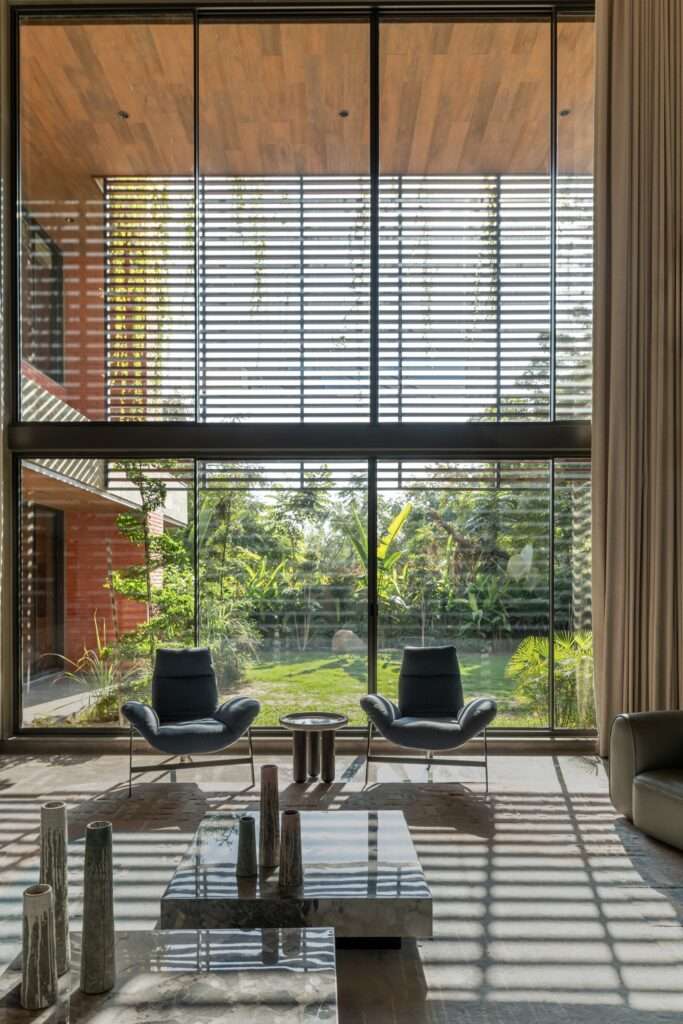
The human experience within the architectural space unfolds through carefully orchestrated transitional sequences that enhance the sense of enclosure and protection in a gradual scenographic manner. Upon moving from exterior to interior, the user perceives a tangible shift in light intensity and air temperature, where shadows cast by projecting masses intersect with architectural openings to create a continuously evolving dialogue with the sun’s movement throughout the day. This material dynamism, combined with the guidance of natural airflow through corridors, transforms the dwelling from a mere physical shell into a living environment that interacts psychologically and physically with its inhabitants, granting the act of living a sensory dimension that deepens the relationship between humans and the built environment and strengthens the role of interior spaces.


Environmental Intelligence and the Protective Wall: Mass Deconstruction and Air Dynamics
The architectural thesis of this composition centers on a curved brick wall positioned along the southwestern façade, serving a structural role that extends beyond visual presence. This dynamic barrier acts as an insulating layer designed to deflect harsh climatic forces and filter incoming light. Its relatively solid massing allows the release of the remaining surfaces, particularly on the northeastern and southeastern sides, where the structure opens up to accommodate indirect daylight. The climatic system is further enhanced through the integration of internal courtyards and double-height spaces, which function as a continuous physical mechanism for drawing in cool air and exhausting hot air upward, translating spatial planning into a direct response to natural forces within a broader Architecture discourse.
Kinetic Experience and Sensory Scenography: Pathways of Transition
The user experience within the space is defined by a scenographic gradient that begins at the northeastern arrival point, where movement transitions from the open exterior into interior spaces through a carefully sequenced spatial progression. A lotus pond forms the first sensory threshold, followed by a central double-height living area that acts as the core of both vertical and horizontal circulation and a visual connector between levels. Within this context, the stone waterfall and shallow basin extending toward the garden present water not merely as a thermal cooling element, but as an auditory and visual component that intersects with the material language and shadow play, deepening the psychological and physical impact of the lived experience within the residence.

Horizontal Extension and Courtyard Relationship: Fluid Boundaries Between Interior and Exterior
The spatial distribution at this level is characterized by a clear visual and kinetic extension toward the east, where the dining and kitchen areas connect with external platforms, expanding the living space and integrating it with open air conditions. This organic relationship with the surrounding environment is further expressed in the orientation of the “Puja” room toward an internal courtyard that receives filtered natural light, while the bedrooms are positioned in the northeastern corner to ensure necessary privacy without disconnecting from the overall spatial circulation axis of the house. On the opposite side, the southwestern façade is pierced by extended openings and recessed balconies overlooking the garden, yet these remain anchored behind the climatic defensive line established by the solid Valaya wall, achieving a condition of protected openness shaped by broader Cities contexts.
Architectural Section and Vertical Organization: Dynamic Flow of Light and Mass
The sectional analysis of the building reveals a strict vertical logic centered on the double-height void as a structural and spatial nucleus to which all shared spaces and upper-level corridors are connected. Upper clerestory openings work in tandem with internal courtyards to introduce balanced and evenly distributed natural light toward the periphery, preventing direct glare while ensuring a stable thermal environment through passive architectural strategies. As the Valaya wall extends to the upper floor, its role is reinforced as a continuous thermal envelope that maintains both visual and physical connectivity between different levels, while simultaneously shaping a human experience that transitions seamlessly between shadow, light, and continuous ventilation. This logic aligns with evolving Construction methodologies and passive performance thinking in contemporary spatial systems.


Morphology of Mass and Material Authenticity: Volumetric Gradation and Structural Expression
The external mass of the building is formed through stepped and shifted architectural volumes that align structurally with the placement of internal courtyards and the sectional variation of heights. This gives the overall composition a balanced massing that avoids monotony. The material philosophy is based on a limited and honest palette that relies on concrete, brick, timber, and natural stone for their inherent qualities and their ability to age naturally over time. The brick “Valaya” wall emerges as a dominant material element, where its structural thickness and warm earthy tone give the façade a tangible human scale, while also functioning as a scenographic device for generating shadow and expressing notions of permanence and climatic resilience.
Interior Spatial Scenography: Composition of Proportion and Perception of Light
The interior designs translate the same architectural logic through spaces that rely on precise geometric proportions and the flow of natural light rather than excessive spatial volumes, creating a sense of calm and understated spaciousness. Light is treated as a dynamic compositional element that filters through courtyards and shading devices, continuously transforming the visual and material qualities of the spaces throughout the day, alongside a simple and functional distribution of furniture that supports flexible use. On the upper floor, bedrooms are organized around shared spaces and wide corridors overlooking the central double-height void, with each room carefully oriented to ensure maximum emotional enclosure and visual privacy through precisely directed views toward gardens and enclosed courtyards within broader Interior Design thinking.

✦ ArchUp Editorial Insight
The critical tension between programmatic openness and extreme thermal exposure in the semi-arid climate represents a clinical symptom of a broader structural shift away from image-centric architecture toward climatic performance efficiency. When analyzed through layers of geoclimatic data, particularly the vectors of intense solar radiation from the southwest and alternating monsoon wind patterns, the building ceases to be merely an aesthetic choice and becomes a defensive envelope. These data layers reveal a systemic pressure imposed by accelerating climatic volatility, enforcing an institutional decision-making framework that redefines operational priorities from formal display to passive thermal security. Within this framework, building orientation, envelope opacity, and natural convective pathways are elevated into primary design determinants that govern the formation of the entire residential typology in relation to broader Cities conditions.
The spatial outcome emerges as a logical binary result of this climatic framework, manifested in the strategic deployment of the curved brick wall tectonics. The built mass functions as a thermal buffer, employing a deep structural barrier along the southwestern perimeter to absorb external environmental loads, thereby freeing the internal horizontal plan. In the context of contemporary climate-stressed cities, spatial organization can no longer rely on energy-intensive mechanical cooling; instead, it operates through a finely tuned infrastructure of double-height voids and internal courtyards that function as low-velocity air lungs, drawing air across stone water surfaces to activate evaporative cooling within evolving architecture paradigms.
Ultimately, this shift repositions the designer from arbitrary formal experimentation toward a strict fiduciary responsibility for long-term resource efficiency and habitability, marking a definitive transition from spatial form-making to critical environmental engineering aligned with ongoing architectural research and performance-driven design methodologies in the field of construction.