Abadim House: Ruins and Contemporary Dialogue

Spatial Experience and Mass Deconstruction
The project’s spatial structure revolves around a U-shaped central courtyard, where circulation is redefined through two contrasting temporal volumes that organize the transition between private and public realms. Upon crossing the entrance threshold, users encounter a completely transparent central hall that functions as both a visual and kinetic bridge between two historical periods. This transparency disrupts the solidity of the stone mass and allows uninterrupted views toward the surrounding landscape and the Sierra de Cabrera mountain range. Through this intelligent orientation strategy, movement becomes more than a simple transition through space; it transforms into a lived experience that places the occupant at the heart of the natural setting, benefiting from the flow of air and natural light through the intermediary glazed volume.
Scenographic Impact and Material Contrast
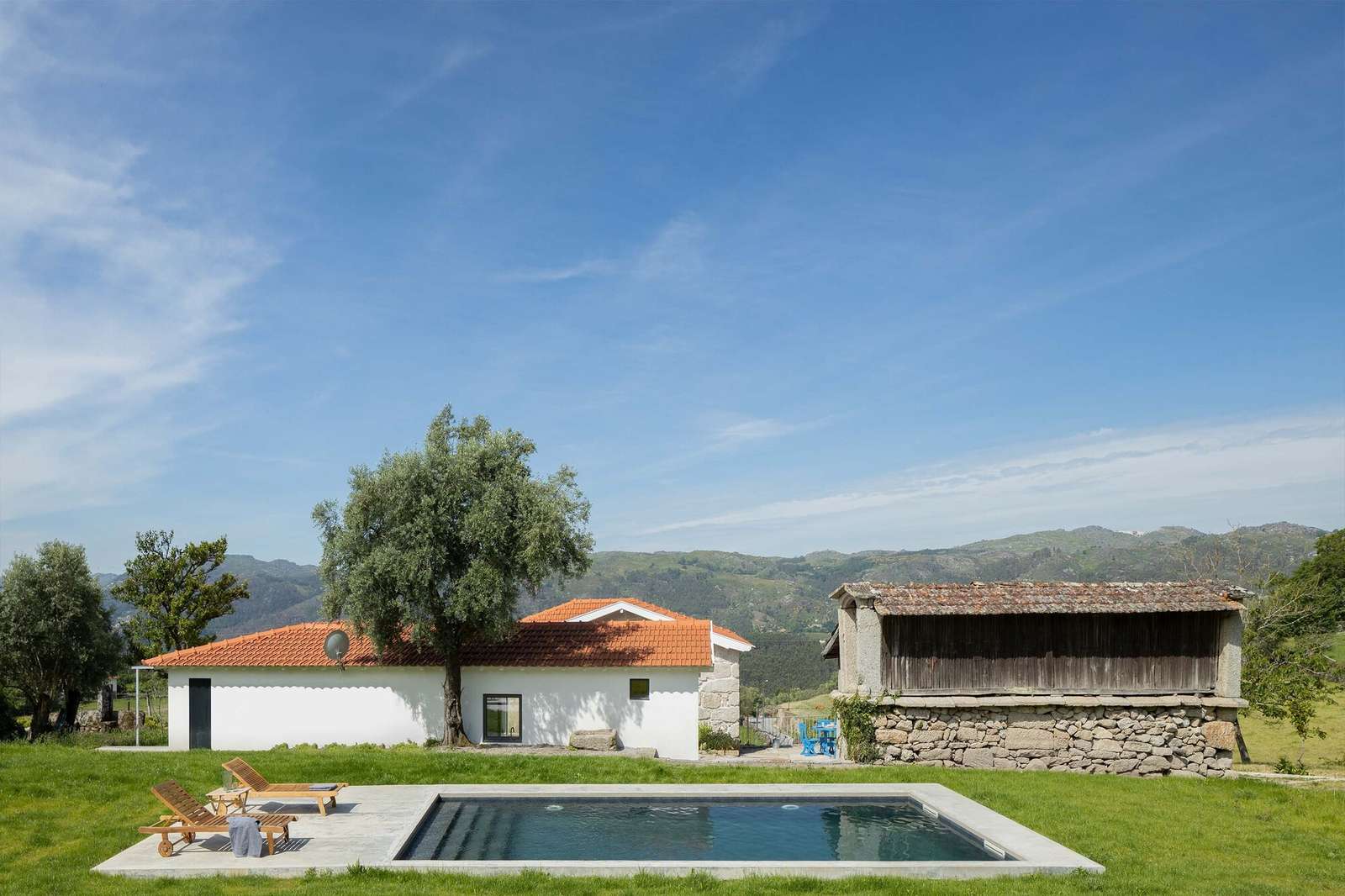
The design language emerges through the tangible material contrast between two volumes. The older structure relies on exposed, heavy stone walls that convey a sense of authenticity and belonging, while receiving the shadows of surrounding trees in a way that accentuates their rough texture and creates a calm psychological depth suited to its function as sleeping quarters. In contrast, the newer volume is characterized by plastered walls that accommodate the social spaces, where smooth surfaces interact with the sun’s path to reflect light and provide a sense of vitality and openness within the communal areas. This carefully orchestrated contrast in texture and mass reinterprets the site’s heritage identity without affectation, creating an architectural environment that engages both visual and tactile senses through the continuous interplay of shadow and light, grounded in contemporary architecture.
Orientation and Spatial Dynamics
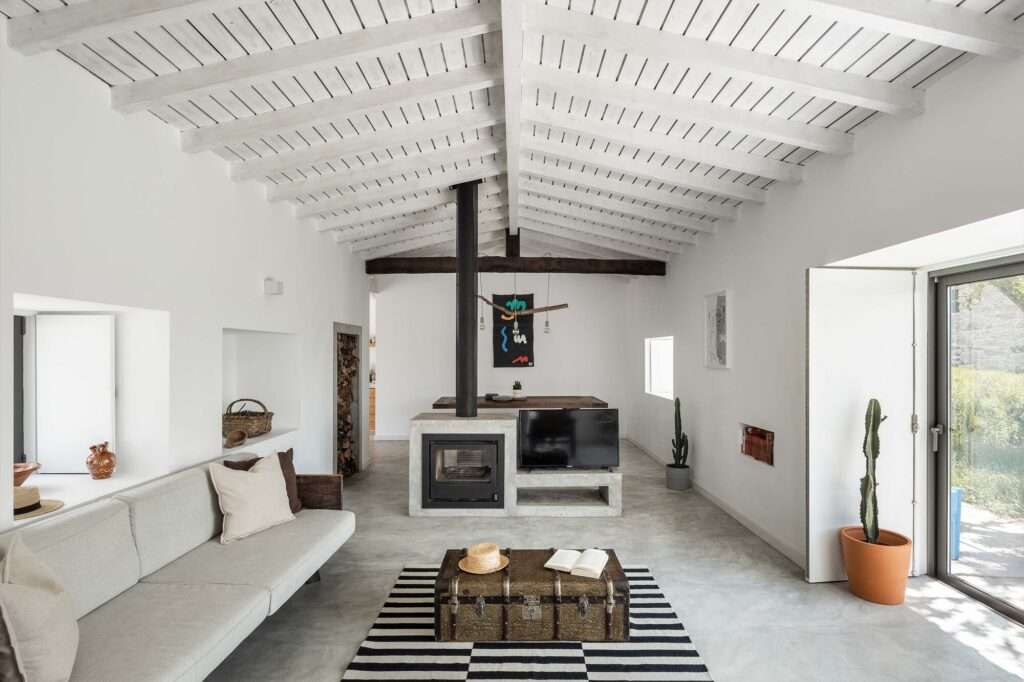
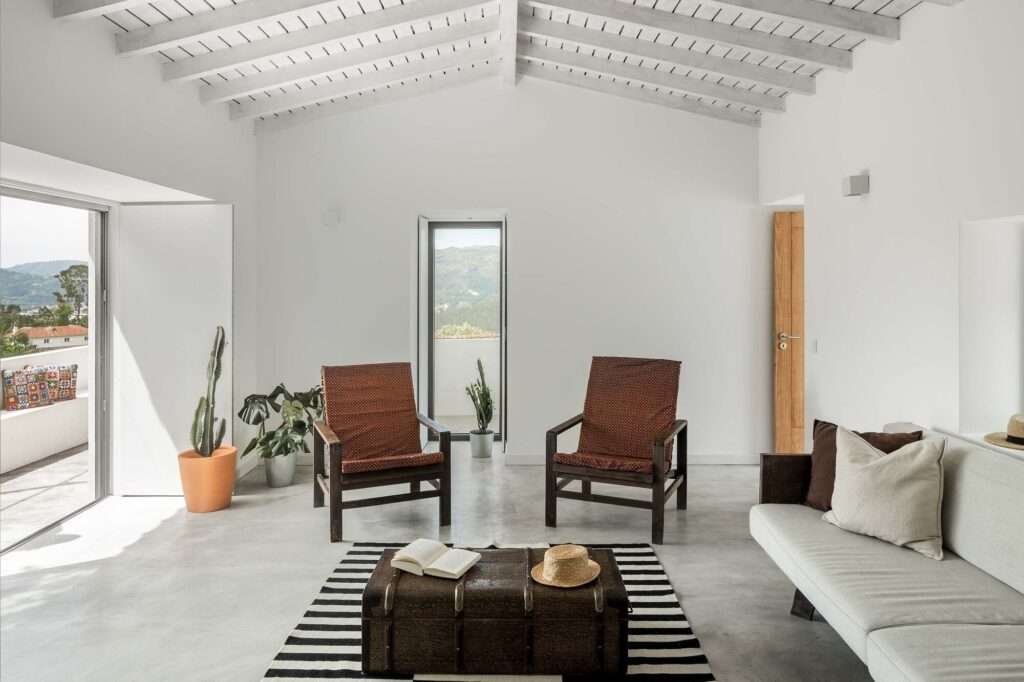
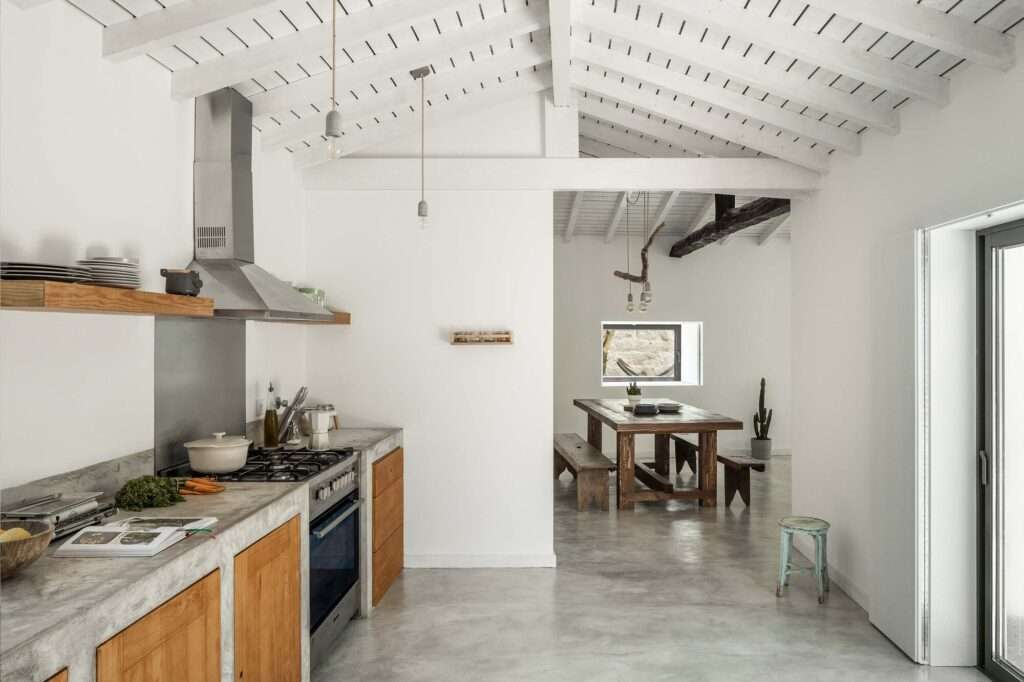
The social areas are internally organized through a continuous L-shaped space, allowing occupants to move along a fluid circulation path that flexibly connects key functions. The scenographic orientation is expressed through the fireplace, which acts as a visual anchor positioned at the center of the space, functioning simultaneously as a spatial guide and an invisible divider between the living and dining areas. This arrangement maintains a strong relationship between the dining table and kitchen without relying on solid partitions. The horizontal extension opens directly onto a south-facing terrace and garden, enabling sunlight to penetrate deeply into the volume while fostering a continuous dialogue between interior and exterior spaces that enhances both the vitality and visual permeability of the human experience.
Material Dialogue and Psychological Impact
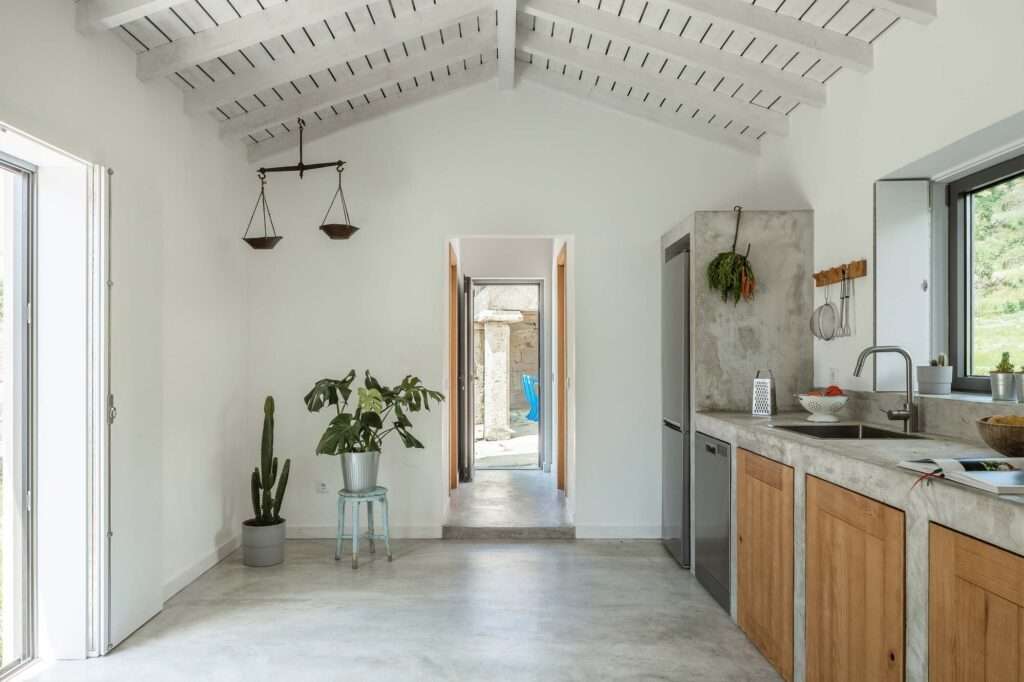
The selected materials create a delicate sensory balance that shapes the occupants’ psychological perception and interaction with the surrounding environment. Within the living areas, the white-painted timber ceiling and the smooth flooring surfaces reinforce a contemporary atmosphere and a sense of visual spaciousness, while preserved niches and remnants of the original timber structure stand as physical traces of the building’s history and legacy. Moving into the bedroom zone, the spatial identity shifts through the use of wooden floors and soft ceilings, creating a warm and independent environment that supports privacy. Meanwhile, fixed elements crafted from concrete and natural timber, including kitchen counters, the fireplace, and built-in cabinetry, flow throughout the various wings, unifying the project through a distinctive rustic material language that reinforces the dwelling’s coherence despite the differing periods of its construction.
Mass Deconstruction and the Relationship Between Construction and Ruins
The design critique becomes evident in this portion of the project through a “building within a building” strategy, whereby the former stable was transformed into an independent accommodation unit through the insertion of a fully contemporary concrete volume within the existing stone ruins without altering them. This structural and material separation establishes a critical dialogue between two distinct eras. The embedded concrete volume fulfills contemporary functional requirements by housing the kitchen, bathroom, and mezzanine bedroom, while intentionally detaching itself from the original stone walls at one corner to create a recessed triangular balcony. This balcony operates as a transitional and scenographic space that opens visually toward the sky and surrounding landscape, transforming the gap between old and new into a spatial experience that heightens the occupant’s awareness of time and place within contemporary architecture.
Environmental Scenography and Deliberate Fragmentation
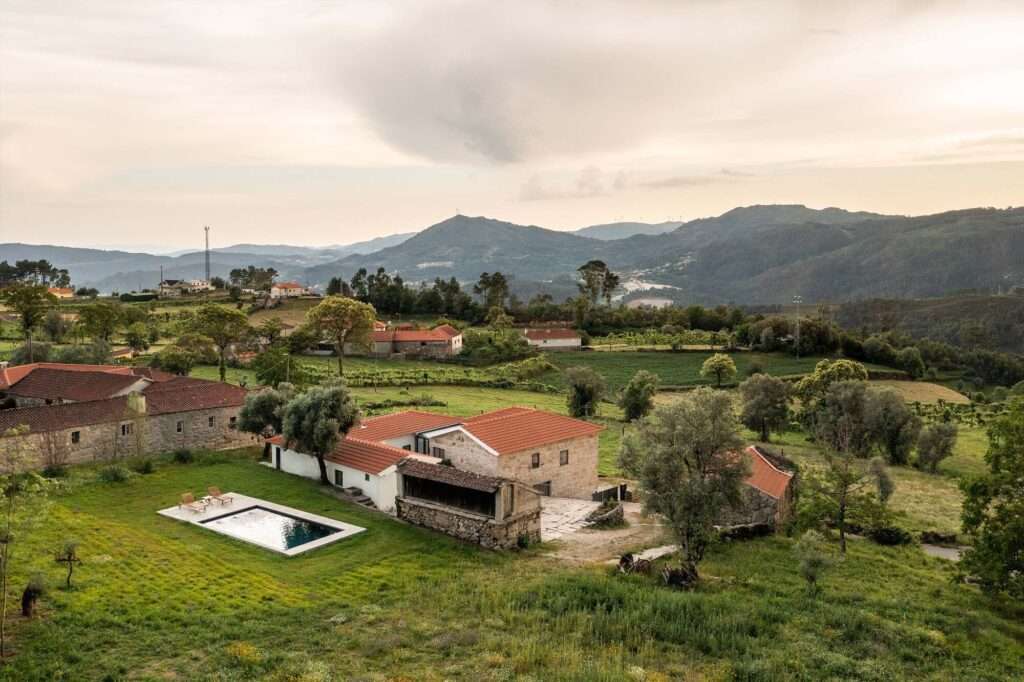
The human experience across the site is enriched through a network of dispersed architectural elements, including the swimming pool, barn, threshing floors, water reservoir, and grain storage structures, which have been treated as independent volumes rather than consolidated into a unified and overly interventionist massing solution. This dispersed arrangement grants the project a strong natural character that responds harmoniously to the site’s rugged topography, allowing occupants to move between contemporary and historic functions while experiencing the passage of time through spatial succession. Such contrast and volumetric fragmentation enable shadows to form freely between buildings and leave circulation routes open to airflow, making the architecture appear as though it has grown organically from the land itself and become an inseparable component of the surrounding architecture.
✦ ArchUp Editorial Insight
The project positions adaptive reuse as a process of spatial negotiation between the permanence of history and the insertion of contemporary programmatic requirements. By embedding residential cells within eighteenth-century stone walls and suspending a monolithic concrete volume inside agricultural ruins, the design reinforces the principle of tectonic adjacency. This strategy transforms abandoned rural clusters into a fragmented residential typology, demonstrating the adaptive capacity of local building masses in resisting contemporary obsolescence through processes of construction.
However, this extensive celebration of material memory overlooks the economic friction inherent in fine-grained restoration practices. Treating dispersed agricultural infrastructure as isolated luxury ruins disconnects the site from broader regional architectural networks. This approach imposes an arguably unjustified degree of constructional redundancy, as reduced volumetric efficiency and varying thermal conditions demand costly maintenance, ultimately transforming authentic rural heritage into an intensively curated and resource-consuming residential landscape.