Architecture Without Gravity

How “The Sims” Shaped an Entire Generation’s Imagination of Ideal Space, and Why Its Invented Language Failed to Build a Genuine Architectural Identity
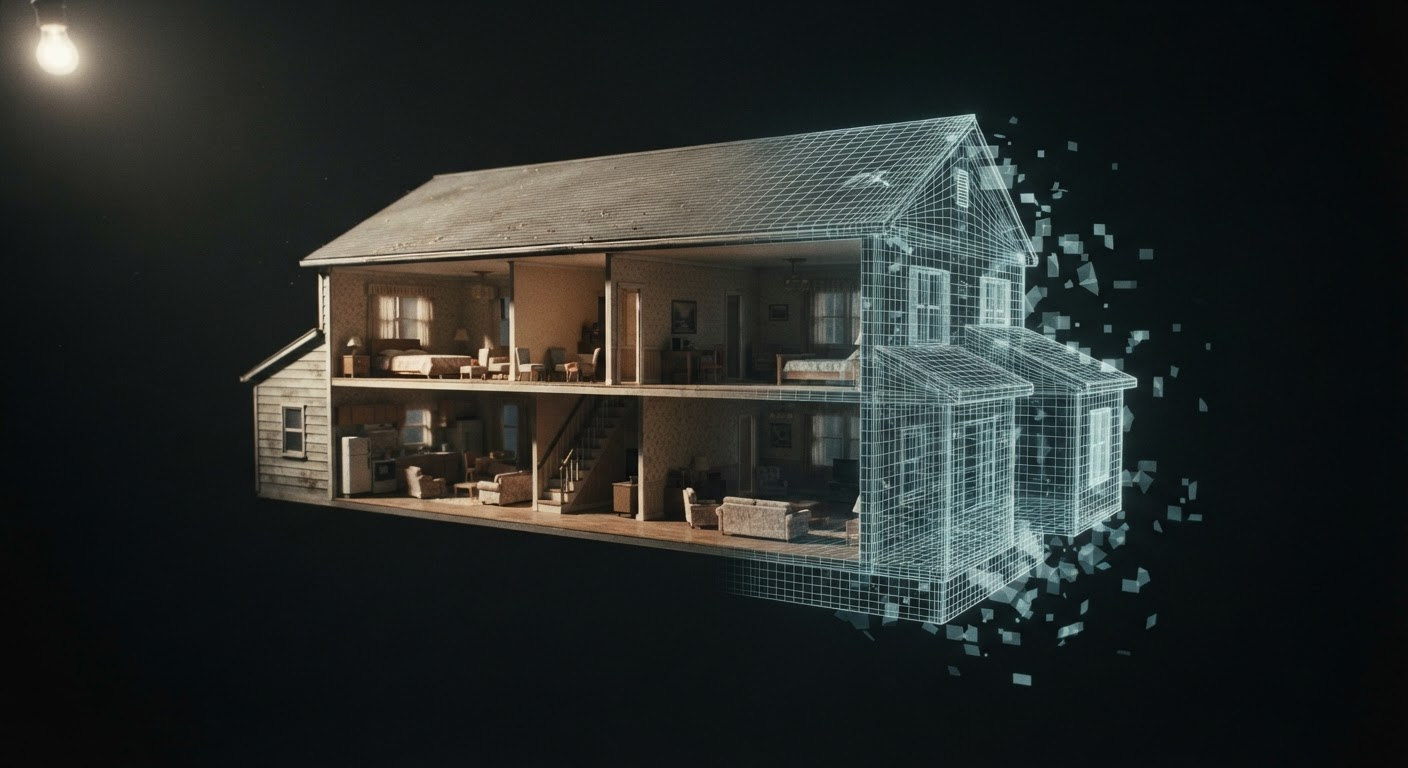
Before many of us ever opened a book on interior planning or heard the term “spatial relationships between rooms,” we had already spent hours arranging furniture in a virtual house, knocking down a wall here to widen the living room, adding a pool there, without a moment’s concern for building codes, excavation costs, or even gravity itself. This is the paradox worth pausing on: an entire generation absorbed its first intuitions about inhabited space from a computer game called The Sims, not from an architecture school or a practicing architect. The question this raises is not technical but distinctly architectural: when millions of “houses” are built inside a world governed by neither construction law nor market economics, what happens to people’s expectations when they later try to build their actual homes?
This question gains further depth once we recognize that the game itself was designed to be “universal” without an authentic linguistic identity, through a wholly invented language called Simlish. As recent studies in game localization reveal, this design choice was not a passing technical decision but a complete structural shift that redistributed the burden of meaning and cultural identity onto other elements of the virtual space: names, furniture descriptions, and catalog details. This is precisely where the story of “architecture without gravity” begins.
From “User” to “Architect”: How the Game Turned the Ordinary Player Into a Space Planner
The first feature to understand about The Sims is that it never cast the player as a spectator. Instead, it placed the player directly in the position of an architectural decision-maker: which room adjoins which, how windows are distributed, where the bed sits in relation to the kitchen. Researcher Jim Ranalli, in her study on using the game as a language-learning tool, observes that the game’s visual and textual content, from instructions to catalog descriptions, carries the greatest communicative weight, since the characters themselves speak no real language but instead communicate through gestures and the invented Simlish. This means the player was not learning “grammar rules” so much as unconsciously learning the rules of reading space: how a home is read through its furnishings, its labels, and its object descriptions, rather than through dialogue between its occupants.
The result is that millions of players practiced, for the first time in their lives, something close to interior planning before they ever knew the term: distributing functions across rooms, calculating pathways between spaces, and even experiencing what architects call “spatial flow,” all without real cost and without any building code to restrain them.
Simlish: The Language That Tried to Erase Local Identity
Here lies the deeper trick in the game’s design. Rather than give its characters a real language tied to a specific culture, which would have made localizing the game for each market an arduous task requiring the complete rewriting of dialogue, The Sims invented a spoken language with no translatable meaning, a language with no grammar and no lexicon, as the specialized literature on game localization makes clear. This choice freed the game from the burden of translating spoken dialogue, but in exchange, it transferred the entire burden onto the written layer: character names, neighborhood names, interface instructions, and object descriptions in the virtual store.
In other words, the inhabited space of the game was designed to sound “universal” while its texts remained captive to a single culture: American suburban consumer life. Researchers note that this frame, suburban homes, carpooling, brand names, and stereotypical consumption patterns, forms the entire cultural backdrop against which the game’s jokes and references are built. When the game is “localized” for a new market, changing the language is not enough; the implicit agreement between content creator and local audience must be rebuilt from scratch, or the joke and the cultural reference lose their function entirely, much as an imported architectural design loses its meaning when transplanted into an urban context that does not understand its references.
The Ironic Catalog: When Marketing Copy Becomes a Hidden Teacher of Taste
One of the most influential and least noticed textual layers in the game is the object and furniture descriptions in the virtual catalog from which the player shops. These descriptions are never neutral; they are saturated with gentle irony and semi-earnest wit that turns an ordinary piece of furniture into a subject of cultural humor, in an overall tone closer to a satirical parody of American suburban consumer life. The player, reading these descriptions hundreds of times while searching for a piece that suits “their house,” unconsciously absorbs an entire system of aesthetic judgment: what counts as “elegant furniture,” what counts as “excessive,” and what deserves mockery in domestic taste.
This kind of indirect aesthetic education through satirical marketing text has not been sufficiently studied within Arab architectural contexts, even though it may partly explain the aesthetic expectations many young clients carry today when they ask an interior designer for a “look” they first encountered in a virtual version of a home that does not exist in reality.
When the Player Rebels Against the Official Version and Relocalizes Their Own Home
One of the more striking findings in research on the game is that official localization was never the final word. Researcher Hanna Wirman’s study of Finnish players of The Sims 2 reveals that players, even after receiving an officially translated and adapted version, continued to perform their own additional “localization”: adding design elements specific to their own culture, such as sauna rooms and Scandinavian design objects, that the official version did not provide, since, according to the study, that version differed between countries primarily in language rather than in the substance of the space on offer.
This observation carries a direct architectural lesson: when a single spatial model, the American suburban home, is exported to different cultures through the mere “translation” of names without redesigning the underlying spatial relationships, it falls to the end user to carry out the real work of relocalization. This mirrors how many homeowners try to “localize” an imported villa design by adding local elements after handover, precisely because the original design was never built from within their own culture to begin with.
Physics Without Limits: How the Game Manufactured Unrealistic Expectations About Space and Cost
Research on game localization points to a fundamental constraint governing every act of textual or spatial construction within the game: limited text space, and the fragmentation of content into short, separate units that translators sometimes work on without seeing the full context in which they appear, a practice the field’s literature calls “blind translation.” This technical constraint, originally applied to text, symbolically mirrors what actually happens in the spatial design of the game itself: space that is built and demolished with no real construction cost, and expanded with no accounting for land price, material cost, or neighboring constraints.
When a player becomes accustomed, from an early age, to the logic of “I can always add another room” or “I can knock down this wall with the click of a button,” they build an intuitive stock of knowledge about space that never faces the test of reality: construction costs, load physics, permitting complications. And when that player grows up and confronts their first real housing project, they collide with a gap between “the space they imagined” and “the space that can actually be built,” a psychological and architectural gap that deserves far more serious study than it has received so far.
Have Games Become a “Popular School of Architecture” Rivaling Engineering Faculties in Shaping Public Taste?
Specialized research on game localization describes the process of reshaping cultural and linguistic content not as ordinary translation but as full “transcreation,” in which the team behind the project is granted broad license to change names, cultural references, and even the structure of the narrative itself, so that a user in any country feels as though the product was designed for them from the outset. When we apply this logic to the architectural space within The Sims, we arrive at an unavoidable question: if a single game has shaped millions of people’s perceptions of room layout, furniture styles, and the very concept of the “dream home” more than any textbook or interior design magazine has managed to do, can we still consider architecture schools the sole authority responsible for shaping public architectural taste?
The honest answer, based on what this research reveals, is that this influence is real and far-reaching, yet it has not been studied with sufficient depth from an architectural perspective specifically. Most of the available research has approached the phenomenon from the standpoint of linguistics and translation studies, leaving the question of “space” and taste formation largely neglected, a research gap that architecture and urban planning scholars should be the first to address.
✦ ArchUp Editorial Insight
The Sims did not choose a suburban American spatial template because it was aesthetically appealing; it chose it because localization economics demanded a single deployable architecture across dozens of markets under sim-ship deadlines. Voice dialogue was replaced by Simlish specifically to avoid re-recording costs, which shifted the entire burden of cultural adaptation onto cheap, fragmented text strings edited without context, a workflow known internally as blind localization. Under these production constraints, redesigning spatial logic per market was commercially irrational; renaming objects was not. The resulting global house typology is therefore not a design outcome but a cost-avoidance outcome, later repaired informally by players who add their own cultural furniture, effectively performing, for free, the localization work the production pipeline was structured to avoid.
References
Hevia, C. M. “Video Games Localisation: Posing New Challenges to the Translator.” Perspectives, 2007.
Mangiron, Carmen. “Research in Game Localisation.” Journal of Internationalization and Localization, 2017.
Robertson, W. “Unspeakable Puns: Kanji-Dependent Wordplay as a Localization Strategy in Japanese.” Perspectives, 2018.
O’Hagan, Minako. “Game Localisation as Software-Mediated Cultural Experience: Shedding Light on the Changing Role of Translation in Intercultural Communication in the Digital Age.” Multilingua, 2015.
Low, Peter. “Translating Jokes and Puns.” Perspectives, 2011.
Popa, Diana-E. “Jokes and Translation.” Perspectives, 2005.
Song, Hyeonjeong. “Translation and Localisation in Video Games: Making Entertainment Software Global.” Australian Journal of Linguistics, 2017.
Wirman, Hanna. “Playing by Doing and Players’ Localization of The Sims 2.” Television & New Media, 2013.
Ranalli, Jim. “Learning English with The Sims: Exploiting Authentic Computer Simulation Games for L2 Learning.” Computer Assisted Language Learning, 2008.
Fernández-Costales, Alberto. “On the Sociolinguistics of Video Games Localisation.” Journal of Internationalization and Localization, 2017.
Losavio, A., Polyakova, S., Hayden, T., and Losavio, M. “Linguistic Implementations in Computer Game and Virtual World Design.” IEEE Conference on Computer Games, 2014.